Table of Contents[Hide]
- 1. Understanding custom tailoring: The foundation
- 2. What is made-to-measure tailoring?
- 3. What is bespoke tailoring?
- 4. Made-to-measure vs bespoke: The definitive comparison
- 5. How to choose: Decision framework for Australian grooms
- 6. The Dunnio Tailor difference: Best of both worlds
- 7. Beyond the suit: Styling and coordination
- 8. Care and maintenance: Protecting your investment
- 9. Frequently asked questions
- 10. Conclusion: Your path to sartorial excellence
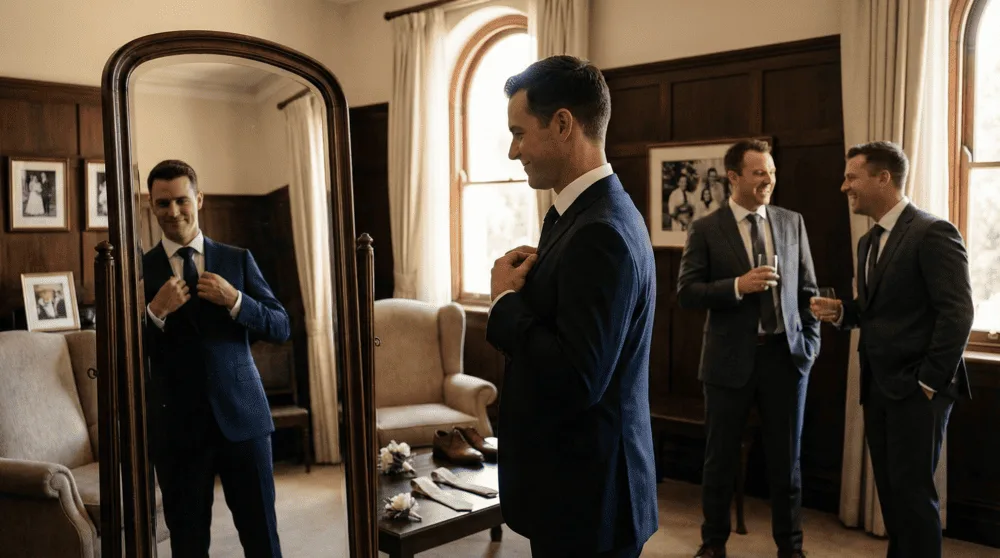
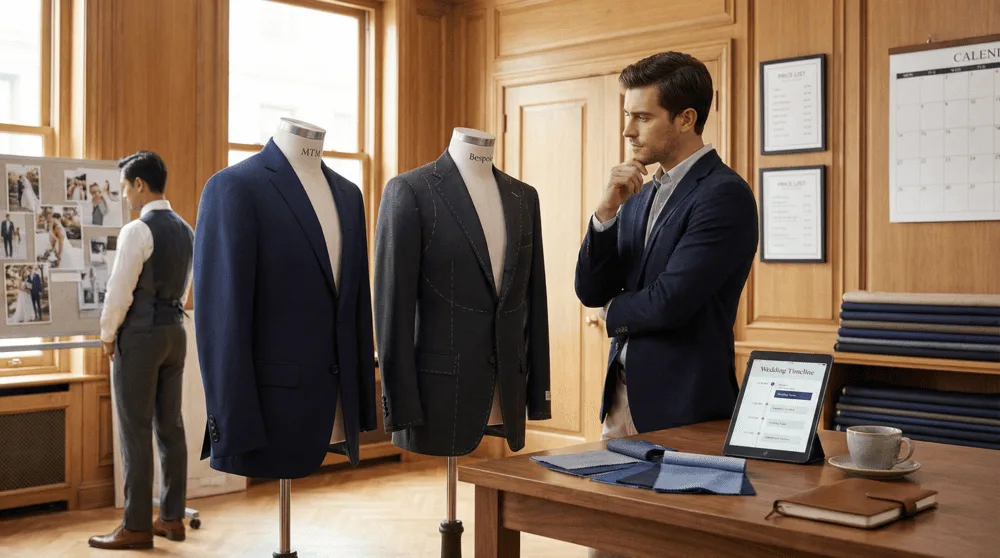
You are standing in front of a mirror in an off-the-rack suit. The shoulders are slightly too wide, the waist bags awkwardly, and the sleeves bunch at your wrists. You know your wedding day deserves better than almost fits. Welcome to the world of custom tailoring, where made-to-measure and bespoke represent two distinct paths to sartorial excellence. This comprehensive guide will demystify both options, helping you understand the technical differences, investment considerations, and which approach suits your wedding timeline and personal style. At Dunnio Tailor, we have guided hundreds of Australian grooms through this decision, understanding the unique demands of our climate, wedding culture, and the modern man who values both tradition and efficiency. Whether you have four months or sixteen weeks before your big day, this guide will equip you with the knowledge to make a confident choice.
1. Understanding custom tailoring: The foundation
Before diving into the made-to-measure versus bespoke debate, it is essential to understand where custom tailoring fits in the broader menswear landscape.
What is custom tailoring?
Custom tailoring represents a fundamental departure from ready-to-wear clothing. While off-the-rack suits are manufactured in standard sizes and altered to approximate your body, custom tailoring begins with your unique measurements and builds the garment specifically for you.
For Australian grooms, this distinction matters profoundly. Our climate varies dramatically from the humid tropics of Queensland to the temperate shifts of Victoria, requiring thoughtful fabric selection and construction methods that ready-to-wear simply cannot accommodate.

The spectrum of personalization
Think of suit personalization as a continuum:
- Ready-to-wear: Mass-produced standard sizes with minor alterations
- Made-to-measure: Modified existing patterns based on your measurements
- Bespoke: Hand-drafted unique patterns created from scratch for you
A common misconception is that alterations transform a ready-to-wear suit into custom tailoring. While a skilled tailor can improve fit through alterations, they are working within the constraints of an existing garment. True custom tailoring starts with a blank canvas.
The Australian context
Australian men increasingly recognize that significant life events, particularly weddings, warrant investment in garments that reflect personal style while performing in our unique climate. The modern groom seeks clothing that looks exceptional in photographs, feels comfortable during outdoor ceremonies, and remains a wardrobe staple for years beyond the wedding day.
2. What is made-to-measure tailoring?
Made-to-measure, often abbreviated as MTM, represents the contemporary evolution of custom tailoring, balancing personalization with efficiency.
2.1. Definition and process
Made-to-measure tailoring begins with a pre-existing base pattern, sometimes called a block, which is then digitally or manually modified according to your specific measurements. During your initial consultation, a stylist will take 10 to 15 key measurements including chest, waist, hips, sleeve length, and inseam.
The process typically unfolds as follows:
- Initial consultation and measurement session (60 to 90 minutes)
- Fabric and style selection from curated options
- Pattern modification based on your measurements
- Garment construction (predominantly machine-assisted)
- Final fitting and minor adjustments
- Delivery in approximately 20 days (3 weeks)
Modern MTM services, particularly those focused on the Australian market, have refined this process to accommodate the busy professional or groom managing multiple wedding responsibilities.

2.2. Customization options in MTM
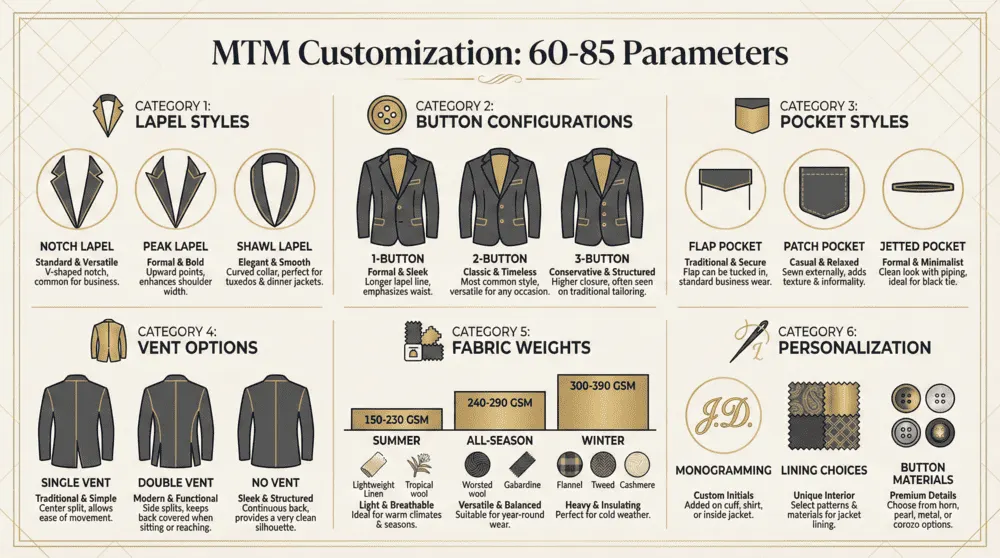
While made-to-measure works from a base pattern, the customization options remain extensive. A quality MTM service will offer choices across 60 to 85 distinct parameters:
Fabric selection:
- Wool weights from lightweight tropical (150 to 230 GSM) to heavier flannels (300+ GSM)
- Seasonal blends including wool-linen-silk combinations
- Color palette spanning classic navy and charcoal to contemporary sage and stone tones
Style choices:
- Lapel styles: notch, peak, or shawl
- Button configurations: single-button, two-button, or three-button
- Pocket styles: flap pockets, patch pockets, or jetted pockets
- Vent options: single vent, double vent, or no vent
- Trouser details: pleated or flat front, cuffed or plain hem
Personalization details:
- Interior lining fabrics and colors
- Monogramming on interior pockets or cuffs
- Button material and color
- Contrast stitching options
At Dunnio Tailor, we curate fabric collections specifically for Australian conditions, ensuring your suit performs beautifully whether your ceremony is beachside in Byron Bay or in a Melbourne ballroom.
2.3. Construction methods in MTM
The internal construction of a made-to-measure suit significantly impacts its longevity, comfort, and drape. Understanding canvas construction is crucial:
Half-canvas construction: The gold standard for quality MTM involves a canvas layer of horsehair and cotton in the chest and lapel area, while the lower panels may be fused. This provides:
- Natural lapel roll and shape retention
- Breathability in the upper chest
- Resistance to the bubbling that plagues fully fused jackets
- Balance between quality and cost-efficiency
Machine finishing with hand details: Quality MTM combines machine efficiency with hand-finished details such as:
- Hand-sewn buttonholes on premium options
- Pick stitching along lapels for visual refinement
- Reinforced stress points for durability
For the Australian groom, half-canvas construction offers exceptional value, providing the breathability necessary for our climate while maintaining structural integrity through multiple wears and dry cleaning cycles.
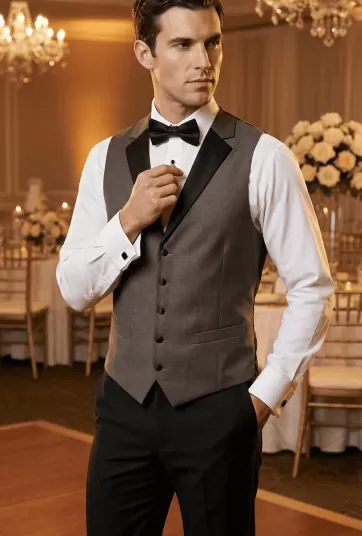


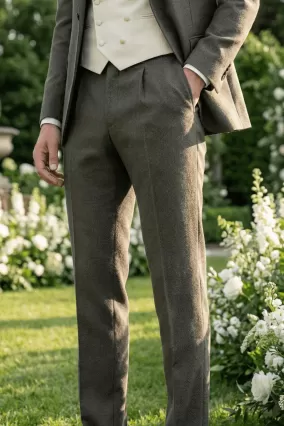
Charcoal Taupe Wool-Blend Six-Button Tuxedo Vest - M4HL84
Products in the outfit
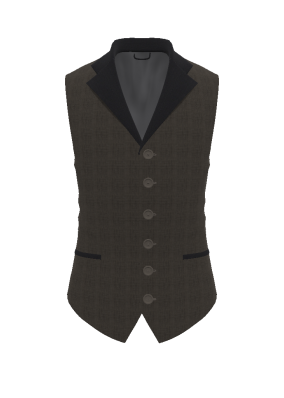
Notch Lapel | 6 Buttons | Single Opening Pocket | Angle Cut | Back Plain
2.4. MTM for Australian weddings
Made-to-measure has become the dominant choice for Australian grooms for several compelling reasons:
Timeline efficiency:
With most engagements lasting 12 to 18 months and wedding planning intensifying in the final six months, Dunnio's 20-day MTM timeline fits seamlessly into pre-wedding schedules, offering faster delivery than traditional MTM services.
Climate considerations:
Australian wedding seasons demand fabric versatility. MTM services offer:
- Summer weddings (September to March): Lightweight tropical wools (150 to 230 GSM), linen blends, and high-twist fabrics
- Winter weddings (June to August): Medium-weight wools (240 to 290 GSM) with optional flannel textures
- Destination weddings: Breathable wool-silk-linen blends that pack well and resist wrinkles
Groomsmen coordination:
MTM excels at outfitting wedding parties. The efficiency of the process allows multiple groomsmen to be measured and fitted within a condensed timeframe, with many Australian tailors offering group discounts for parties of four or more.
Investment range:
Quality made-to-measure suits in Australia typically range from AUD 800 to AUD 2,500, positioning them as accessible luxury for the modern groom who wants exceptional fit without the maximum investment of bespoke.
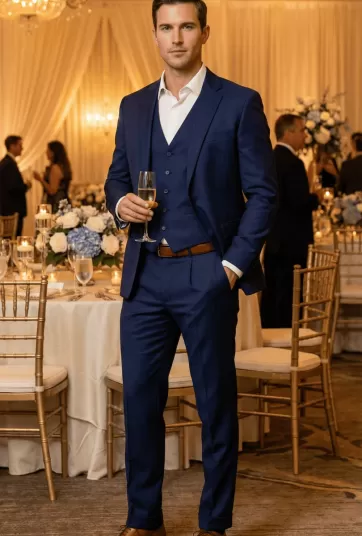


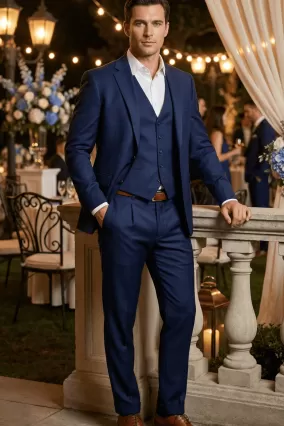
Navy Blue Wool Blend Slim-Fit Pleated Dress Pants - M3HL46
Products in the outfit
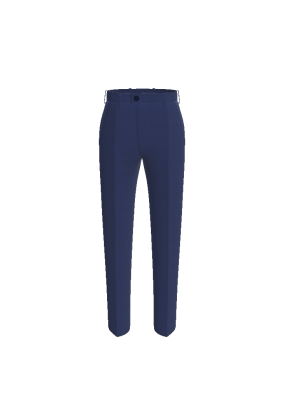
Narrow/Slim | Single Pleat | Slanted Pocket | Back Pocket - Double Opening | Single | Regular Cuff
3. What is bespoke tailoring?
Bespoke represents the pinnacle of tailoring craftsmanship, a tradition stretching back to the Renaissance when custom clothing signified power and wealth.
3.1. The meaning of bespoke
The term bespoke originates from the verb to bespeak, meaning to speak for something in advance. Historically, a gentleman would bespeak a length of cloth from a merchant, which would then be held for him while a tailor created a unique pattern and garment.
What does bespoke mean in fashion today? True bespoke tailoring is defined by several non-negotiable elements:
- A unique paper pattern hand-drafted from scratch for each client
- The same master tailor who measures you also cuts your cloth
- Multiple fittings with radical structural adjustments possible at each stage
- Extensive handwork throughout construction
- Full canvas architecture using horsehair and cotton
The term bespoke is frequently misused in modern marketing. Many brands label modified made-to-measure as bespoke, but without a unique hand-drafted pattern and multiple basted fittings, the garment does not meet the traditional definition.

3.2. The bespoke process unveiled
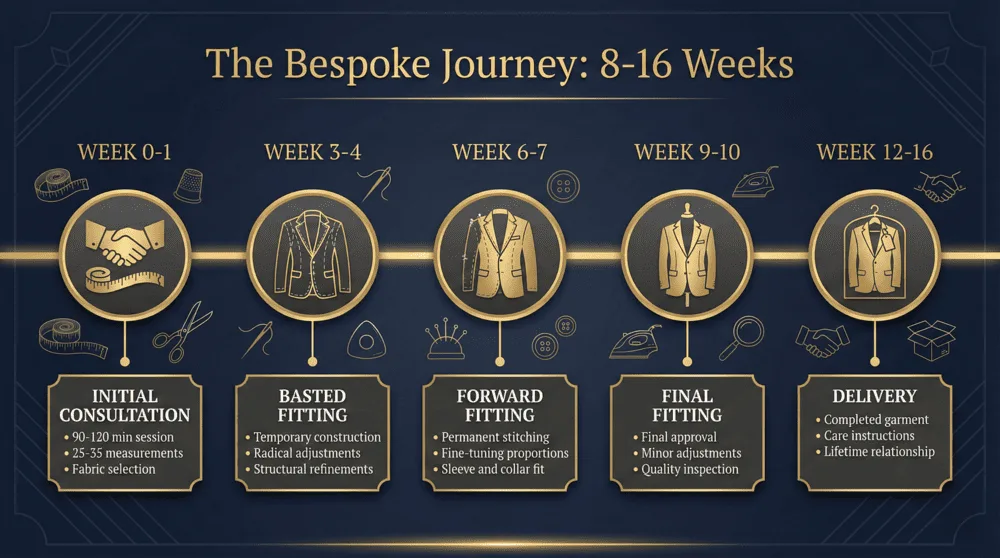
The bespoke journey is as much about relationship-building as garment construction. It typically unfolds over 8 to 16 weeks:
Initial consultation (90 to 120 minutes):
Your first meeting with a bespoke tailor involves extensive discussion about:
- The occasion and how you will wear the suit
- Your lifestyle and wardrobe needs
- Fabric preferences and climate considerations
- Personal style and any fit challenges from previous garments
Comprehensive measurement:
A bespoke tailor will take 25 to 35 measurements, accounting for:
- Shoulder slope and any asymmetry
- Spinal curvature and posture
- Arm length differences between left and right
- Hip and seat proportions
- Chest expansion for breathing room
Pattern drafting:
Using your measurements, the tailor hand-drafts a unique paper pattern. This is not a modification of an existing template but a completely original architectural blueprint for your garment.
First basted fitting (3 to 4 weeks after initial consultation):
The jacket is temporarily stitched together with white basting thread, allowing the tailor to see how the fabric drapes on your body. Radical adjustments can be made at this stage, including:
- Repositioning shoulder seams
- Adjusting armhole depth and shape
- Refining waist suppression
- Correcting balance and pitch
Forward fitting (2 to 3 weeks after basted fitting):
The garment is now more refined, with permanent stitching in place. Fine-tuning occurs for sleeve length, collar fit, and overall proportions.
Final fitting (2 to 3 weeks after forward fitting):
The completed suit is tried on for final approval. Minor adjustments may still be made before delivery.
This iterative process ensures a flawless silhouette that is unmatched by any other tailoring discipline.
3.3. Bespoke construction excellence
The internal architecture of a bespoke suit represents centuries of refined technique:
Full canvas construction:
A floating canvas layer runs from shoulder to hem, stitched to the outer wool rather than glued. This provides:
- Maximum breathability, crucial for Australian climates
- Natural molding to your body over time
- Superior shape retention and drape
- Resistance to dry cleaning damage
Hand-stitched details:
Bespoke garments feature extensive handwork:
- Hand-sewn buttonholes with thread that matches or contrasts based on your preference
- Pick stitching along lapel edges, creating subtle visual texture
- Hand-attached sleeves, allowing for perfect pitch and movement
- Reinforced stress points using traditional techniques
For the Australian groom, full canvas construction offers unparalleled comfort during long wedding days, particularly for outdoor ceremonies where breathability prevents overheating.
3.4. Bespoke for the discerning groom
Bespoke tailoring represents a significant investment, typically ranging from AUD 3,500 to AUD 10,000 or more in the Australian market. This investment makes sense for:
Grooms with unique fit challenges:
If you have significant posture variations, asymmetry, or have struggled to find ready-to-wear that fits properly, bespoke offers solutions that made-to-measure cannot match.
Those seeking heirloom quality:
A well-maintained bespoke suit can last decades, potentially becoming a garment passed down to future generations. The cost-per-wear over a lifetime makes the initial investment more palatable.
Collectors and enthusiasts:
For men building a considered wardrobe of exceptional pieces, bespoke represents the ultimate expression of personal style and appreciation for artisanal craft.
Timeline considerations:
Bespoke requires 8 to 16 weeks minimum, with some traditional houses requiring even longer. Grooms should begin the process at least 4 to 6 months before their wedding date to allow for potential delays and additional fittings.
Australian bespoke houses, particularly in Sydney and Melbourne, maintain the highest standards of this craft, offering local expertise combined with access to the finest fabrics from Italian and British mills.
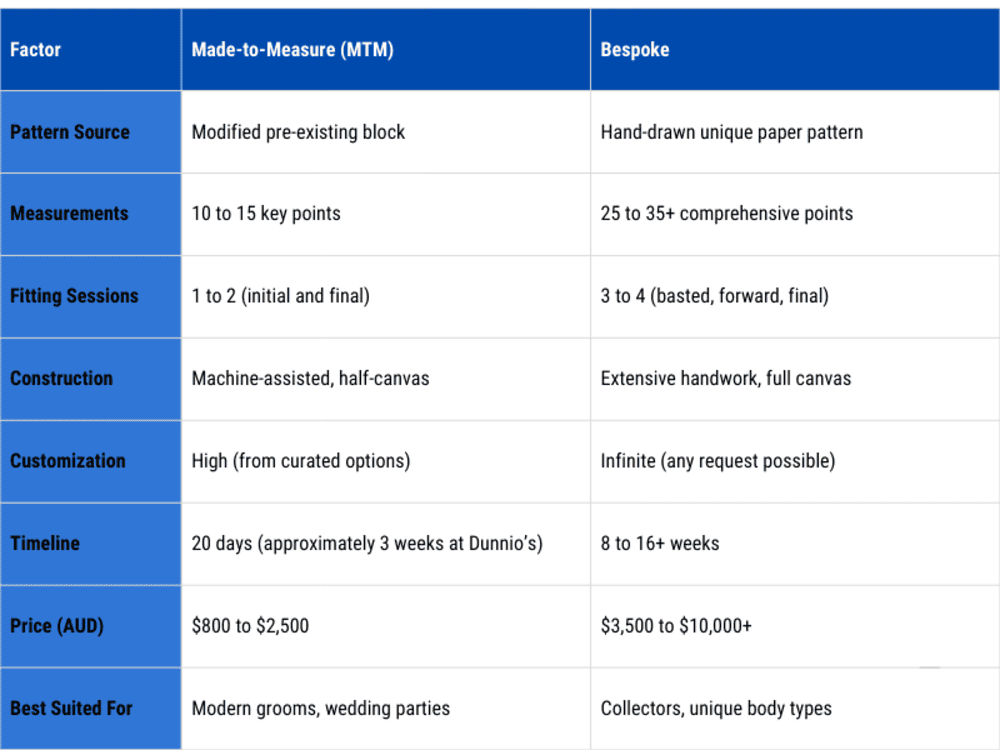
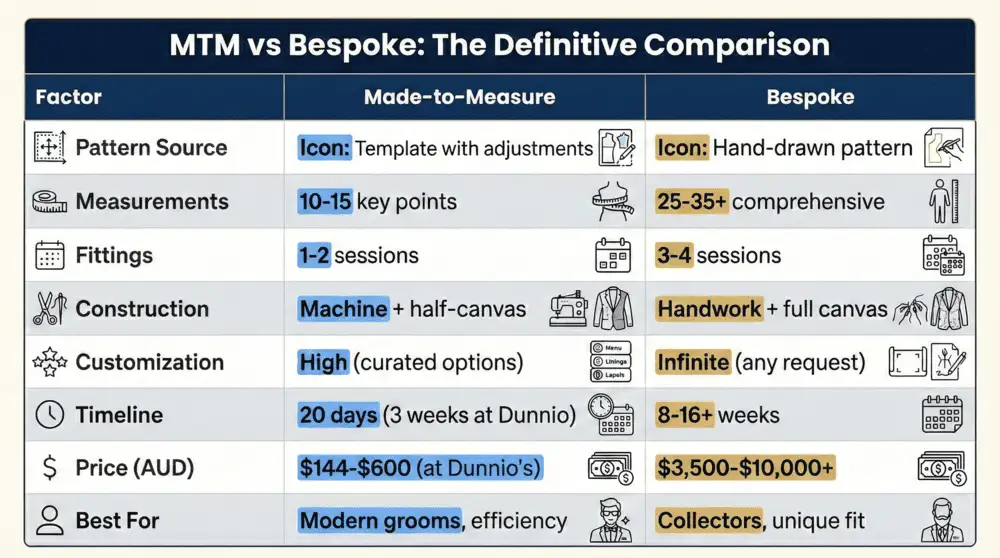
4. Made-to-measure vs bespoke: The definitive comparison
Understanding the technical differences between made-to-measure and bespoke empowers you to make an informed decision aligned with your priorities.
4.1. Side-by-side comparison
4.2. Fit and comfort differences
How fit is achieved:
Made-to-measure achieves excellent fit by modifying a proven base pattern according to your measurements. The result is a suit that fits significantly better than ready-to-wear, accommodating your proportions within the parameters of the base pattern.
Bespoke achieves exceptional fit by creating a pattern specifically for your body, accounting for every nuance including asymmetry, posture, and movement preferences. The multiple fittings allow for adjustments that would be impossible in a single-fitting MTM process.
Body accommodation:
For men with standard to athletic builds and minimal asymmetry, made-to-measure delivers outstanding results. For those with significant postural variations, uneven shoulders, or other fit challenges, bespoke offers solutions that MTM cannot replicate.
Long-term comfort:
Both MTM and bespoke, when constructed with proper canvas, offer superior comfort to fused ready-to-wear. However, the full canvas of bespoke molds to your body over time, creating a truly personalized drape that improves with wear.

4.3. Fabric and material options
Made-to-measure services curate fabric collections, typically offering:
- 60 to 150+ fabric options
- Seasonal selections appropriate for Australian climate
- Fabrics from reputable mills (Italian, British, Australian merino)
- Clear guidance on weight and weave for your wedding date and venue
Bespoke tailors provide access to:
- Unlimited fabric options from merchant books
- Rare and exclusive cloths not available in MTM collections
- The ability to source specific fabrics upon request
- Expert guidance on unconventional choices
For most Australian grooms, the curated MTM fabric selection provides more than sufficient choice. Bespoke fabric access becomes valuable for those seeking highly specific or rare materials.
4.4. Longevity and value
Durability comparison:
A quality made-to-measure suit with half-canvas construction, when properly maintained, will last 5 to 10 years of regular wear. The machine construction is robust, and modern techniques ensure consistent quality.
A bespoke suit with full canvas and extensive handwork can last a lifetime with proper care. The floating canvas and hand-stitched details are more resilient to dry cleaning and general wear, and the garment can be altered more extensively as your body changes over time.
Cost-per-wear analysis:
- Made-to-measure at AUD 1,500 worn 50 times over 5 years: AUD 30 per wear
- Bespoke at AUD 6,000 worn 200 times over 20 years: AUD 30 per wear
While the upfront investment differs dramatically, the long-term value proposition can be comparable for the groom who will wear his suit regularly beyond the wedding day.
Resale and heirloom potential:
Made-to-measure suits have limited resale value, as they are fitted to your specific measurements. However, they can be altered for changing body proportions within reasonable limits.
Bespoke suits, particularly from renowned houses, can retain value and may even appreciate if maintained in excellent condition. More importantly, they carry the potential to become heirloom pieces passed to sons or grandsons.
5. How to choose: Decision framework for Australian grooms
Selecting between made-to-measure and bespoke depends on your specific circumstances, priorities, and resources.
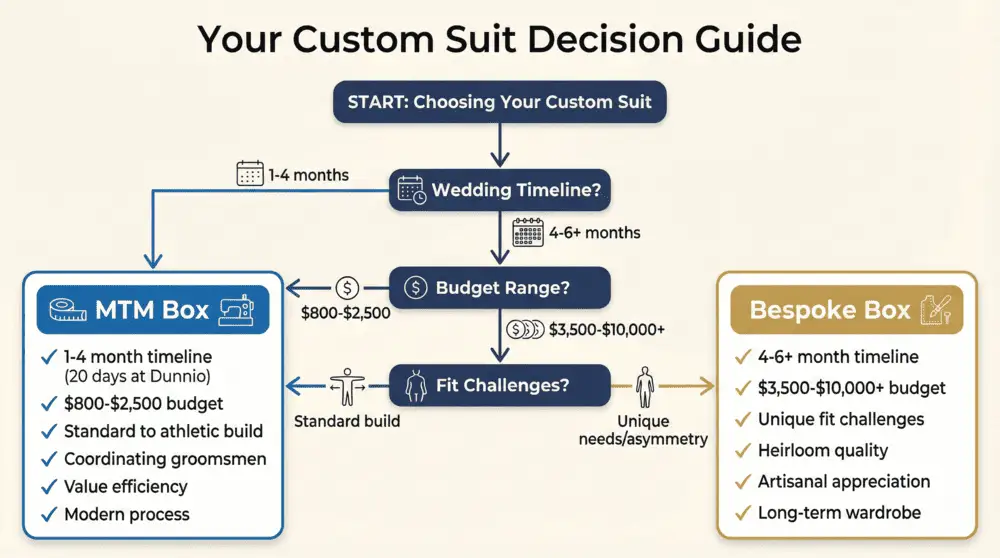
5.1. Choose made-to-measure if:
- Your wedding timeline is 1 to 4 months away: Dunnio's 20-day MTM production timeline fits comfortably within this window, allowing ample time for final adjustments even with shorter notice.
- You want exceptional fit without maximum investment: MTM delivers 90% of the fit quality of bespoke at 30 to 40% of the cost, representing outstanding value.
- You are coordinating multiple groomsmen: The efficiency of MTM makes outfitting a wedding party of 4 to 8 men logistically manageable and financially accessible.
- You have a standard to athletic build: If your body proportions are relatively symmetrical without significant postural variations, MTM will achieve excellent results.
- Your budget is AUD 800 to AUD 2,500 per suit: This range provides access to quality MTM with half-canvas construction and premium fabrics.
- You value efficiency and modern process: MTM services often incorporate digital measurement tools, online fabric browsing, and streamlined communication that appeals to the contemporary groom.
5.2. Choose bespoke if:
- You have 4 to 6+ months before your wedding: The extended timeline allows for the multiple fittings and potential adjustments that bespoke requires.
- You have unique fit challenges: Significant asymmetry, posture variations, or previous difficulty finding suits that fit properly make bespoke the superior choice.
- You want an heirloom-quality garment: If you envision your wedding suit as a lifetime investment or potential family heirloom, bespoke construction justifies the investment.
- You appreciate artisanal craftsmanship: For grooms who value the human skill and tradition behind their clothing, the bespoke process offers a deeply satisfying experience.
- Your budget allows AUD 3,500 to AUD 10,000+: This investment range provides access to true bespoke from reputable Australian tailors.
- You are building a long-term wardrobe: If this suit is the foundation of a considered wardrobe of exceptional pieces, bespoke sets the standard for future acquisitions.
5.3. Timeline planning guide
Wedding countdown checklist:
6+ months before wedding:
- Begin bespoke process or start MTM research
- Attend initial consultations with tailors
- Review fabric options and seasonal considerations
4 to 5 months before:
- Latest recommended start for bespoke
- Ideal time to begin MTM process
- Coordinate groomsmen measurements
3 months before:
- Final opportunity for MTM with comfortable buffer
- Bespoke should be in forward fitting stage
- Confirm all groomsmen orders placed
3 to 4 weeks before:
- MTM final fittings should occur
- Bespoke final fitting and delivery
- Final alterations if needed
2 to 4 weeks before:
- Final pickup and try-on
- Break in your suit with a wear or two
- Confirm all accessories coordinated
Buffer time considerations:
Always build in 1 to 2 weeks of buffer time beyond the tailor's quoted delivery. With Dunnio's 20-day timeline, planning for 4 weeks total provides comfortable buffer.
Seasonal fabric planning:
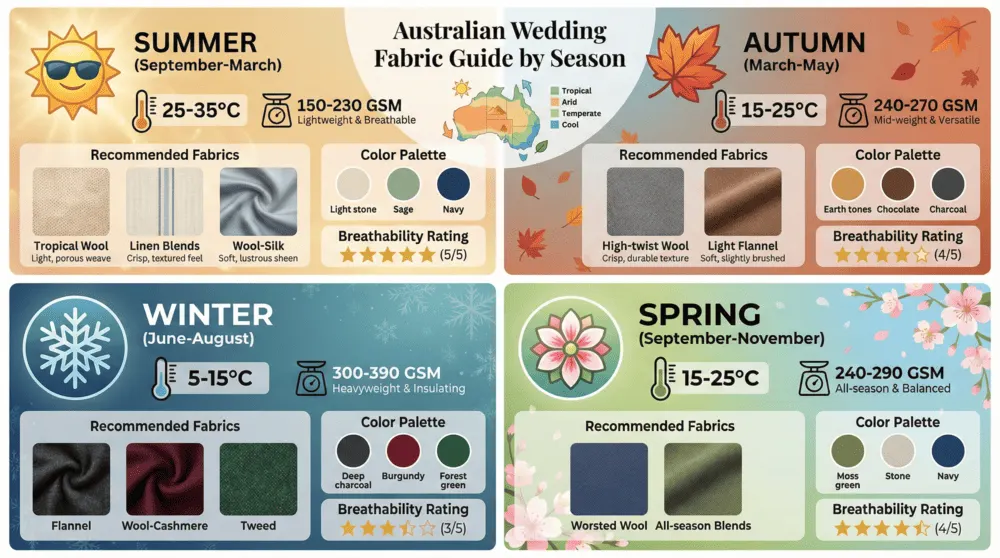
- For summer weddings (September to March), prioritize lightweight fabrics (150 to 230 GSM) in breathable weaves like tropical wool or linen blends.
- For winter weddings (June to August), medium-weight wools (240 to 290 GSM) or flannel textures provide warmth without bulk.
- For destination weddings, wool-silk-linen blends offer versatility, packing resilience, and comfort across varying climates.
5.4. Budget allocation strategy
Groom versus groomsmen investment: A common approach is to invest more significantly in the groom's suit while providing quality but more accessible options for groomsmen:
- Groom: Bespoke or premium MTM (AUD 2,000 to 6,000)
- Groomsmen: Quality MTM or elevated ready-to-wear (AUD 800 to 1,500 each)
This creates visual distinction while ensuring the entire wedding party looks polished and coordinated.
5.4.1. Where to splurge versus save:
Splurge on:
- Fabric quality (invest in higher thread counts and natural fibers)
- Construction method (half-canvas minimum for MTM)
- Fit (never compromise on proper measurements and fittings)
Save on:
- Excessive customization details that won't be visible in photos
- Trendy style elements that may date the suit
- Accessories that can be acquired separately
5.4.2. Package deals and group discounts:
Many Australian MTM services offer groomsmen packages:
- 10 to 20% discount for parties of 4+ men
- Complimentary groom suit with 5+ groomsmen orders
- Bundled accessory packages (ties, pocket squares, cufflinks)
At Dunnio Tailor, we structure our wedding packages to provide exceptional value for the entire party while ensuring each man receives personalized attention and perfect fit.
6. The Dunnio Tailor difference: Best of both worlds
At Dunnio Tailor, we have developed a hybrid approach that brings bespoke-level attention and quality to the efficiency of made-to-measure.
6.1. Dunnio's hybrid approach
We believe the modern Australian groom should not have to choose between exceptional quality and realistic timelines. Our process combines:
Bespoke-level consultation: Every client receives a comprehensive 90-minute initial consultation, regardless of whether they choose MTM or bespoke. We take the time to understand your wedding vision, lifestyle needs, and style preferences.
Enhanced measurement protocol: While traditional MTM takes 10 to 15 measurements, we capture 20+ data points, accounting for posture, asymmetry, and movement preferences that standard MTM often overlooks.
Curated Australian fabric collections: We source fabrics specifically for Australian conditions, with particular attention to:
- Lightweight tropical wools for summer weddings
- Breathable blends for outdoor ceremonies
- Fabrics that photograph beautifully in Australian light
Personal stylist relationships: You work with the same stylist throughout your journey, ensuring continuity and a deep understanding of your preferences.
6.2. The Dunnio wedding experience
We have refined our wedding services based on hundreds of Australian grooms and their unique needs:
Groom consultation process:
Your journey begins with a relaxed, pressure-free consultation where we discuss:
- Your wedding date, venue, and theme
- Climate considerations for your specific location and season
- Your personal style and comfort preferences
- Budget parameters and investment priorities
Groomsmen coordination services:
Coordinating a wedding party can be logistically challenging. We streamline this through:
- Group measurement sessions at our showroom or your location
- Digital coordination tools for remote groomsmen
- Cohesive styling that creates unity without uniformity
- Flexible payment options for individual groomsmen
Climate-specific recommendations:
Australian weddings span diverse climates. We provide expert guidance:
- Tropical Queensland weddings: Ultra-lightweight linens and tropical wools
- Temperate Sydney and Melbourne: Versatile mid-weight wools
- Destination and beach weddings: Wrinkle-resistant blends that travel well
Timeline flexibility: We understand wedding planning is unpredictable. Our standard MTM process delivers in just 20 days (approximately 3 weeks), and rush services can accommodate even tighter timelines when circumstances demand, making Dunnio one of the fastest quality MTM services in Australia.

6.3. Construction quality commitment
Every Dunnio suit, whether MTM or bespoke, meets rigorous construction standards:
Canvas construction: Our MTM suits feature half-canvas construction as standard, not an upcharge. This ensures:
- Natural drape and breathability
- Shape retention through multiple wears
- Resistance to dry cleaning damage
Hand-finishing details: Even our MTM garments include hand-finished elements:
- Hand-sewn buttonholes on premium fabric selections
- Reinforced stress points for longevity
- Pick stitching on lapels for refined visual detail
Quality control process: Every garment undergoes multi-point inspection before delivery:
- Measurement verification against original specifications
- Stitching integrity and finish quality
- Fabric inspection for flaws or inconsistencies
- Final pressing and presentation
Alteration guarantees: We stand behind our work with comprehensive alteration policies:
- Complimentary adjustments within 30 days of delivery
- Lifetime minor alterations for weight fluctuations
- Transparent communication if significant alterations are needed
6.4. Real groom confidence
The suits we create are more than fabric and thread. They represent confidence stitched into every seam, tailored to your unique story and the Australian climate you will celebrate in.
Our grooms consistently report that their Dunnio suit was one of the best investments of their wedding planning, providing not just a perfect fit for the big day but a versatile wardrobe staple for years of formal occasions, professional milestones, and special celebrations.
7. Beyond the suit: Styling and coordination
A perfectly fitted suit is the foundation, but comprehensive styling elevates your entire wedding presence.
7.1. Coordinating your wedding party
The modern wedding aesthetic has moved away from matching uniforms toward curated cohesion.
Groom distinction strategies: Create visual hierarchy through subtle differences:
- The groom wears a three-piece suit while groomsmen wear two-piece versions
- The groom chooses a double-breasted jacket while groomsmen wear single-breasted
- Fabric texture variation: groom in fine worsted, groomsmen in textured weave
These distinctions ensure the groom stands out in photographs without creating jarring contrast.
Groomsmen cohesion without uniformity:
Achieve unity through shared elements:
- Same fabric and color across all suits
- Coordinated accessories (matching ties or pocket squares)
- Consistent lapel style and button configuration
Allow individuality through:
- Fit preference (slim versus classic cut)
- Waistcoat optional for groomsmen
- Personal touches in cufflinks or tie bars
Accessory coordination: Accessories create the visual thread connecting your wedding party:
- Ties or bow ties in complementary colors to bridesmaid dresses
- Pocket squares that echo wedding florals
- Boutonnieres that coordinate with bridal bouquet
- Matching cufflinks as groomsmen gifts
Rental versus purchase for groomsmen: Consider these factors when deciding:
Rental advantages:
- Lower upfront cost (AUD 150 to 300 per person)
- No long-term storage concerns
- Ideal for traditional black-tie that groomsmen may rarely wear again
Purchase advantages:
- Groomsmen gain a versatile wardrobe piece
- Perfect fit through MTM rather than approximate sizing
- Group discounts often make purchase competitive with rental
- Sentimental value of wearing the suit to future occasions

7.2. Seasonal and venue considerations
Australian weddings demand climate-responsive styling.
Summer weddings (September to March):
Fabric priorities:
- Lightweight tropical wools (150 to 230 GSM)
- Linen or linen-blend suits for casual beach weddings
- Wool-silk blends for elegant breathability
Color recommendations:
- Light stone and sand tones for beach venues
- Sage and moss green for garden ceremonies
- Classic navy and light gray for versatility
Styling adaptations:
- Unlined or half-lined jackets for maximum airflow
- Linen shirts for casual destination weddings
- Loafers or suede shoes instead of heavy leather
Winter weddings (June to August):
Fabric priorities:
- Medium-weight wools (240 to 290 GSM)
- Flannel textures for visual warmth
- Wool-cashmere blends for luxury and insulation
Color recommendations:
- Deep charcoal and navy for formal elegance
- Rich earth tones: chocolate, tobacco, forest green
- Jewel tones for evening celebrations: burgundy, emerald
Styling additions:
- Three-piece suits for layered warmth
- Wool ties and pocket squares
- Overcoats for outdoor photography
Venue-specific styling:
Beach and destination weddings:
- Lighter colors that reflect rather than absorb heat
- Wrinkle-resistant fabrics that travel well
- Optional: jacket-free ceremony with waistcoat
Ballroom and formal venues:
- Traditional dark suits or tuxedos
- Peak lapels for commanding presence
- Patent leather shoes for black-tie events
Rustic barn and garden weddings:
- Textured fabrics: tweeds, herringbone
- Earth tones and nature-inspired colors
- Brown leather shoes and casual accessories
7.3. Color trends for 2025 and 2026
Australian grooms are embracing bolder, more personal color choices.
The new neutrals:
Sage and moss green:
These nature-inspired tones have emerged as sophisticated alternatives to navy, particularly for outdoor and garden weddings. They photograph beautifully in natural light and complement botanical wedding themes.
Stone and sandstone:
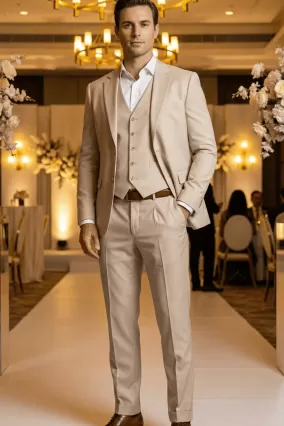
Light beige and stone tones create a fresh, modern aesthetic perfect for beach and destination weddings. These colors feel elevated and photogenic without the formality of traditional dark suits.
Rich earth tones:
Chocolate brown:
A resurgence of brown suits brings warmth and vintage sophistication. Particularly striking for autumn weddings and rustic venues.
Tobacco and terracotta:
These warm, reddish-brown tones create distinctive visual impact while remaining versatile for future wear.
Jewel tones for evening:
Deep emerald:
Rich green suits or dinner jackets make bold statements for evening celebrations, particularly winter weddings.
Burgundy and merlot:
Wine-inspired tones bring depth and luxury, coordinating beautifully with popular bridesmaid color palettes.
Timeless classics:
Navy and charcoal:
These remain the most versatile and photographically reliable choices, suitable for any venue, season, or time of day.
Midnight blue:
Slightly softer than black for evening wear, midnight blue photographs as black but offers subtle sophistication in person.
7.4. Accessories and finishing touches
The details complete your sartorial story.
Footwear:
Formal weddings:
- Black oxford shoes in patent or highly polished leather
- Dark brown oxfords for navy or earth-tone suits
Semi-formal and daytime:
- Brown or tan leather brogues
- Suede loafers for summer and casual venues
Beach and destination:
- Leather loafers without socks for relaxed elegance
- High-quality leather sandals for ultra-casual beach ceremonies
Neckwear:
Long ties:
- Silk ties in solid colors or subtle patterns
- Knit ties for textured, casual sophistication
- Seasonal fabrics: linen for summer, wool for winter
Bow ties:
- Classic for black-tie and tuxedos
- Self-tie for authentic elegance
- Coordinated with cummerbund or waistcoat
Pocket squares:
Styling approaches:
- White linen for timeless formality
- Coordinated with tie for cohesive look
- Contrasting color for visual interest
Fold styles:
- Presidential fold (flat) for formal elegance
- Puff fold for relaxed sophistication
- Three-point fold for visual interest
Cufflinks and watches:
Cufflinks:
- Classic silver or gold for formal occasions
- Personalized or sentimental designs
- Coordinated sets as groomsmen gifts
Watches:
- Leather strap dress watches for formal weddings
- Metal bracelet watches for modern elegance
- Avoid overly casual sports watches
8. Care and maintenance: Protecting your investment
A custom suit requires thoughtful care to deliver years of exceptional wear.
8.1. Immediate post-purchase care
First wear preparation:
Before your wedding day, wear your suit for 2 to 3 hours at home. This allows:
- The fabric to settle and conform to your body
- You to identify any minor discomfort that can be addressed
- Confidence that everything fits and moves correctly
Breaking in your suit:
Natural fibers, particularly wool, benefit from gradual breaking in:
- Wear the jacket around your home while doing light activities
- Sit, stand, and move to allow the canvas to mold to your body
- Avoid vigorous activity that might stress seams before the wedding
Initial adjustments:
After your first full wear, assess whether any minor adjustments are needed:
- Sleeve length when wearing dress shirts
- Trouser break when wearing wedding shoes
- Waistcoat fit when sitting and standing
Contact your tailor within the alteration guarantee period if any refinements are needed.
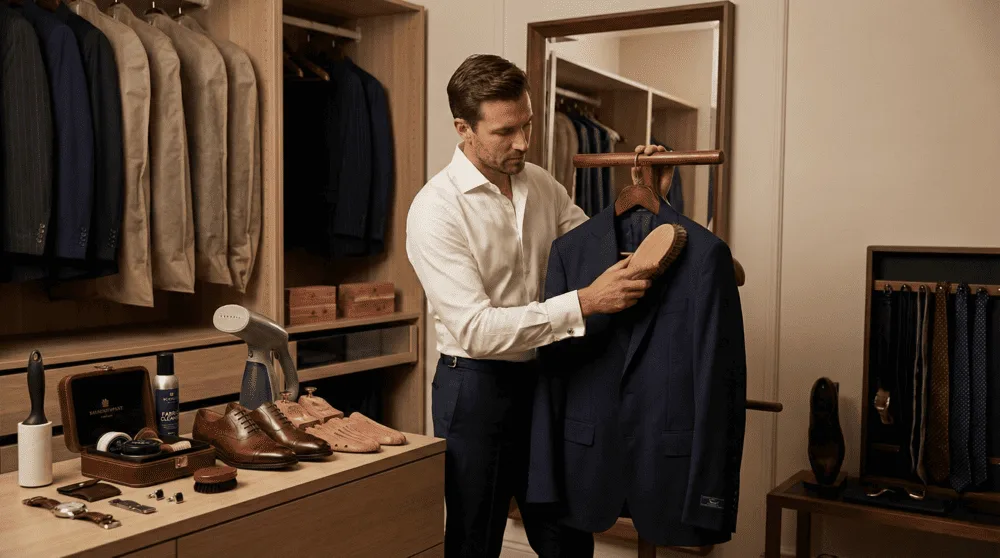
8.2. Ongoing maintenance
The Australian climate presents unique care challenges, particularly humidity and temperature fluctuations.
Brushing and spot cleaning:
After each wear:
- Use a horsehair brush to remove surface dust and lint
- Brush in downward strokes following the fabric grain
- Pay particular attention to shoulders and lapels where skin oils accumulate
For small marks:
- Dab (never rub) with a damp cloth
- Use specialized fabric cleaners for stubborn spots
- Address stains immediately to prevent setting
Steaming versus dry cleaning:
Steaming is your primary maintenance tool:
- Hang your suit in the bathroom while running a hot shower
- Use a handheld steamer for targeted wrinkle removal
- Steam refreshes fabric and removes odors without chemical damage
Dry cleaning should be minimized:
- Only dry clean once or twice per year maximum
- Chemicals damage natural wool fibers over time
- Fused jackets are particularly prone to bubbling from dry cleaning
- Always use reputable dry cleaners experienced with quality tailoring
Storage solutions for Australian climate:
Proper storage prevents damage from humidity, moths, and wrinkles:
Hangers:
- Use thick wooden hangers that support shoulder shape
- Avoid wire hangers that create pressure points
- Cedar hangers provide natural moth deterrence
Garment bags:
- Cotton garment bags allow fabric to breathe
- Avoid plastic bags that trap moisture and promote mildew
- Store in climate-controlled areas when possible
Moth prevention:
- Cedar blocks or lavender sachets in storage areas
- Regular airing prevents moth attraction
- Inspect stored suits every 2 to 3 months
Resting between wears:
Wool fibers need recovery time:
- Allow 24 to 48 hours between wears
- Hang immediately after wearing to allow moisture evaporation
- Rotate between multiple suits if you wear tailoring frequently

8.3. Long-term preservation
Your wedding suit can serve you for decades with proper long-term care.
When to dry clean:
Dry clean only when:
- Visible stains cannot be removed through spot cleaning
- The suit has been worn 8 to 10 times since last cleaning
- Odors persist after steaming and airing
- Before long-term storage (6+ months)
Professional pressing:
Periodic professional pressing maintains crisp appearance:
- Every 12 to 18 months for regularly worn suits
- Before significant events where you want optimal presentation
- Ensure the presser understands canvas construction to avoid damage
Seasonal storage:
For suits worn only occasionally:
- Clean before storage to remove oils and potential stains
- Store in breathable cotton garment bags
- Add cedar or lavender for moth protection
- Store in cool, dry, dark locations
- Avoid attics (too hot) and basements (too humid) in Australian homes
Travel care for destination events:
When traveling with your suit:
- Use a dedicated suit carrier with rigid structure
- Hang immediately upon arrival
- Steam in hotel bathroom to release travel wrinkles
- Pack a small clothes brush for quick refreshing
Alterations as your body changes: Quality suits can be altered as you age:
- Waist can typically be let out or taken in 1 to 2 inches
- Trouser hems can be adjusted
- Sleeve length modifications are straightforward
- Significant alterations may affect the original drape
Consult your original tailor for alterations when possible, as they understand the suit's construction and can maintain its integrity.
9. Frequently asked questions
What does bespoke mean in fashion?
Bespoke refers to garments created from a unique hand-drafted pattern specifically for an individual client, involving multiple fittings and extensive handwork throughout construction. The term originates from to bespeak, meaning to speak for something in advance. True bespoke requires that the same master tailor who measures you also cuts your cloth, ensuring complete understanding of your body and fit requirements.
Is made-to-measure worth it?
For most Australian grooms, made-to-measure represents exceptional value. It delivers 90% of the fit quality of bespoke at 30 to 40% of the cost, with a timeline that fits comfortably within typical wedding planning schedules. If you want a suit that fits significantly better than ready-to-wear, accommodates your personal style, and will serve you for years beyond your wedding, MTM is absolutely worth the investment.
How long does bespoke tailoring take?
True bespoke tailoring requires 8 to 16 weeks minimum, with some traditional houses requiring even longer for first-time clients. This timeline accounts for pattern drafting, multiple fittings (basted, forward, and final), and the extensive handwork involved in construction. Australian grooms should begin the bespoke process at least 4 to 6 months before their wedding date to allow comfortable buffer time.
Can I get bespoke ladies clothing?
Yes, many tailors who offer men's bespoke services also provide bespoke tailoring for women, including suits, trousers, shirts, and occasion wear. The same principles apply: unique hand-drafted patterns, multiple fittings, and construction tailored to individual body shape and style preferences. At Dunnio Tailor, we offer comprehensive tailoring services for women seeking the same level of fit and quality as our men's offerings.
What is the difference between bespoke and couture?
Bespoke refers specifically to custom tailoring, typically menswear, created through hand-drafted patterns and multiple fittings. Couture, short for haute couture, refers to high-end custom fashion, typically women's garments, created by prestigious fashion houses. Both involve extensive handwork and customization, but couture often emphasizes artistic design and runway fashion, while bespoke focuses on perfect fit and timeless style within traditional tailoring parameters.
How much does a bespoke suit cost in Australia?
Bespoke suits in Australia typically range from AUD 3,500 to AUD 10,000 or more, depending on the tailor's reputation, fabric selection, and complexity of construction. Entry-level bespoke from emerging tailors may start around AUD 3,000, while established houses in Sydney and Melbourne with decades of heritage may charge AUD 8,000 to AUD 15,000 for suits using rare fabrics and extensive hand detailing.
What is the difference between made-to-measure and custom?
The terms are often used interchangeably, but technically custom is a broader category that includes both made-to-measure and bespoke. Made-to-measure specifically refers to garments created by modifying existing patterns based on your measurements. Some brands use custom to describe any personalization, even simple alterations to ready-to-wear, so it is important to clarify exactly what process a tailor uses.
How do I choose between MTM and bespoke for my wedding?
Consider three primary factors: timeline, budget, and fit requirements. If your wedding is 2 to 4 months away and your budget is AUD 800 to AUD 2,500, made-to-measure is the clear choice. If you have 4 to 6+ months, budget of AUD 3,500+, and unique fit challenges or desire for heirloom quality, bespoke is worth the investment. Most Australian grooms find MTM delivers exceptional results for their needs.
Can groomsmen get made-to-measure suits?
Absolutely, and this is one of the primary advantages of MTM for wedding parties. The efficiency of the process allows multiple groomsmen to be measured and fitted within a condensed timeframe, and many Australian tailors offer group discounts for parties of four or more. This ensures every groomsman has a properly fitted suit rather than approximating with rental sizing.
What fabric weight should I choose for an Australian summer wedding?
For Australian summer weddings (September to March), choose lightweight fabrics between 150 and 230 GSM (grams per square meter). Tropical wools, linen blends, and high-twist fabrics in this weight range provide breathability and comfort for outdoor ceremonies while maintaining a polished appearance. For beach and destination weddings, wool-silk-linen blends offer excellent wrinkle resistance and pack-ability.
10. Conclusion: Your path to sartorial excellence
The choice between made-to-measure and bespoke is not about which is objectively better, but which aligns with your specific circumstances, priorities, and vision for your wedding day.
Made-to-measure offers the modern Australian groom exceptional fit, extensive customization, and climate-appropriate fabric selection within timelines and budgets that accommodate contemporary life. Bespoke provides the ultimate expression of tailoring craftsmanship, creating heirloom-quality garments through centuries-old techniques and infinite personalization.
You now possess the knowledge to make this decision with confidence, understanding the technical differences, investment considerations, and practical implications of each approach.
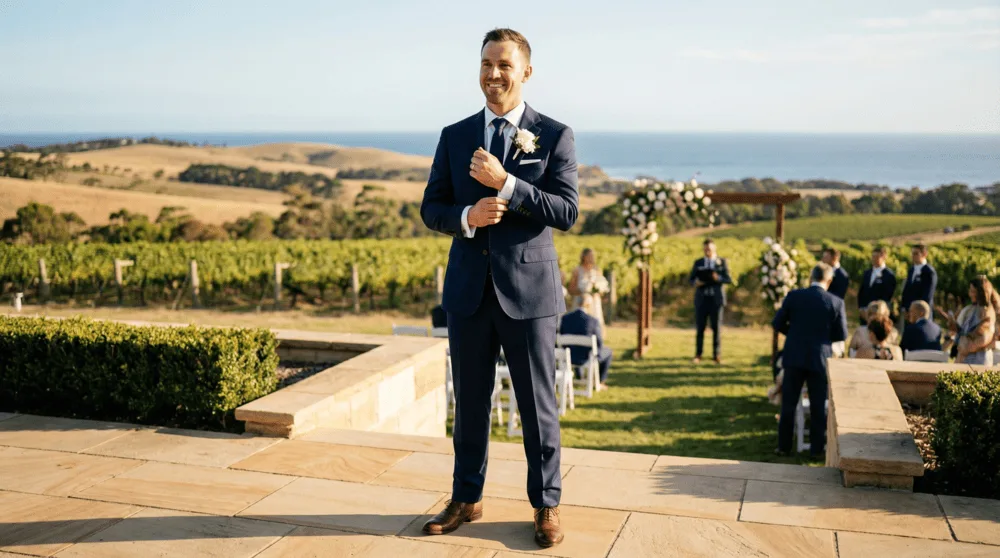
At Dunnio Tailor, we are committed to guiding Australian grooms through this journey with expertise, transparency, and genuine care for your wedding day vision. Whether you choose our elevated made-to-measure service or embark on a bespoke journey, you will receive the same level of personal attention, quality construction, and climate-conscious fabric curation that has made us a trusted partner for hundreds of Australian weddings.
Your wedding suit is more than fabric and thread. It is confidence stitched into every seam, tailored to your unique story and the Australian landscape you will celebrate in. We invite you to begin this journey with us, creating a garment that will serve you not just on your wedding day, but for years of milestones, celebrations, and moments that matter.
Book your consultation with Dunnio Tailor today and discover the difference that true custom tailoring makes.

When choosing groom's suits at Dunnio Tailor, you will receive:
- Tailoring is based on personal measurements.
- Customize according to preferences.
- Instructions from a professional technical team.
- Tailored by skilled craftsmen.
- Fitting and adjusting as required.
- Fabric pattern options with a collection of more than 500 different fabric patterns.
- Free 720-day warranty.
- Free hangers and specialized storage bags.
- Support and shipping policies for international customers.
Hotline - WhatsApp: +84 968996668
Email: support@dunniotailor.com