Table of Contents[Hide]
- 1. Why accurate suit measurements matter more than ever
- 2. The essential tools you need before you start
- 3. The critical importance of having a helper
- 4. How to prepare your body and mind for measurement
- 5. Understanding the difference between body measurements and garment measurements
- 6. The complete upper body measurement guide
- 7. The complete lower body measurement guide
- 8. Measuring for different body types and wedding roles
- 9. Common measurement mistakes and how to avoid them
- 10. The Australian climate and fabric considerations for measured suits
- 11. The final steps, alterations, and fit verification
- 12. Taking ownership of your suit fit
Taking accurate body measurements as well as understanding male body types are the foundation of a perfectly fitting suit. Whether you are ordering a custom wedding suit for your big day, outfitting groomsmen across different cities, or simply want to ensure your tailored suit fits like it was made for you, understanding how to measure for a suit correctly will save you time, money, and disappointment.
In Australia's diverse wedding landscape, from summer beach ceremonies on the Gold Coast to elegant vineyard receptions in the Yarra Valley, the right fit is not negotiable. A suit that pulls at the shoulders, gaps at the waist, or pools at the ankles diminishes even the finest fabric and most thoughtful design. This comprehensive guide will walk you through every measurement you need, the tools required, common mistakes to avoid, and how different body types should approach the measurement process for wedding attire.
1. Why accurate suit measurements matter more than ever
The Australian wedding suit market has transformed dramatically in recent years. Gone are the days when grooms simply rented a generic tuxedo from a hire shop, accepting whatever fit the size chart suggested. Today's Australian groom demands personalization, quality, and above all, fit. The rise of accessible made-to-measure and bespoke tailoring services means that a perfectly fitted custom suit is now within reach for most budgets.
However, this democratization of custom tailoring places a new responsibility on you: providing accurate data. Unlike traditional bespoke tailoring where a master tailor takes dozens of measurements in person, many modern Australian tailoring services rely on you to submit your own measurements or those taken by a friend. Brands like InStitchu offer hybrid models with showroom visits, while international services provide detailed video guides for self-measurement. Local manufacturers can offer quick turnarounds, but only if your initial measurements are correct.
The reality is stark:
- A suit jacket with shoulders that are too wide cannot be fixed.
- A trouser rise that is too short will be permanently uncomfortable.
- These are structural elements built into the pattern itself.
Getting your measurements right the first time is not just about vanity; it is about avoiding costly remakes, rushed alterations, and the stress of ill-fitting wedding attire arriving two weeks before your ceremony.

2. The essential tools you need before you start
Before taking a single measurement, you need the right equipment and setup. This is not a process to rush through with whatever you have lying around the house.
The tape measure - your most critical tool:
- Use a flexible vinyl-coated or fiberglass tailor's tape measure.
- Should measure up to 150 centimeters or 60 inches.
- Must have clear numbering on both sides.
- Do not use metal construction tape measures (too rigid, cannot contour around curves).
- Avoid old cloth fabric tapes (they stretch over time and absorb moisture).
A full-length mirror for verification:
- Essential for your assistant to verify the tape is level from a distance.
- Allows checking that tape has not twisted or sloped at the back.
- Helper should check tape position from multiple angles.
Proper fitting clothing:
- Wear a well-fitted dress shirt and dress trousers or lightweight chinos.
- Never measure over jeans (thick denim adds bulk and distorts dimensions).
- Avoid hoodies, bulky sweaters, or athletic wear.
- For most precise measurements, some tailors recommend measuring in just underwear, then add dress shirt only to identify shoulder seam landmarks.
Recording tools:
- Notepad or smartphone to record each measurement immediately.
- Do not rely on memory.
- Consider taking photos of the tape measure at key measurements as backup verification.

3. The critical importance of having a helper
One of the most consistent pieces of advice from professional tailors and successful made-to-measure customers is this: do not measure yourself alone. Accurate suit measurement is inherently a two-person operation.
Why self-measurement fails ?
The biomechanics of the human body make it physically impossible to measure certain dimensions without introducing error:
- Measuring your own back width or shoulder span requires extending arms forward or to the side, which expands shoulder blades and distorts natural posture.
- Reaching down to measure inseam or outseam forces you to bend at the waist, shortening the actual measurement.
- Measuring your own chest means you cannot keep arms relaxed at sides while simultaneously holding and reading the tape behind your back.
Your assistant's role:
Your assistant does not need to be a professional tailor. A partner, groomsman, family member, or friend can do this job perfectly well with clear instructions. Their responsibilities include:
- Position the tape measure accurately.
- Ensure it remains level and untwisted.
- Read the measurement without parallax error (reading from an angle leads to inaccuracies of half a centimeter or more).
For remote groomsmen:
For groomsmen located in different cities or countries, the best practice is to have them visit a local alteration tailor or dry cleaner that offers measurement services. A small fee of twenty to thirty dollars ensures professional accuracy, which is a worthwhile investment compared to the cost and hassle of fixing an incorrectly fitted suit.

4. How to prepare your body and mind for measurement
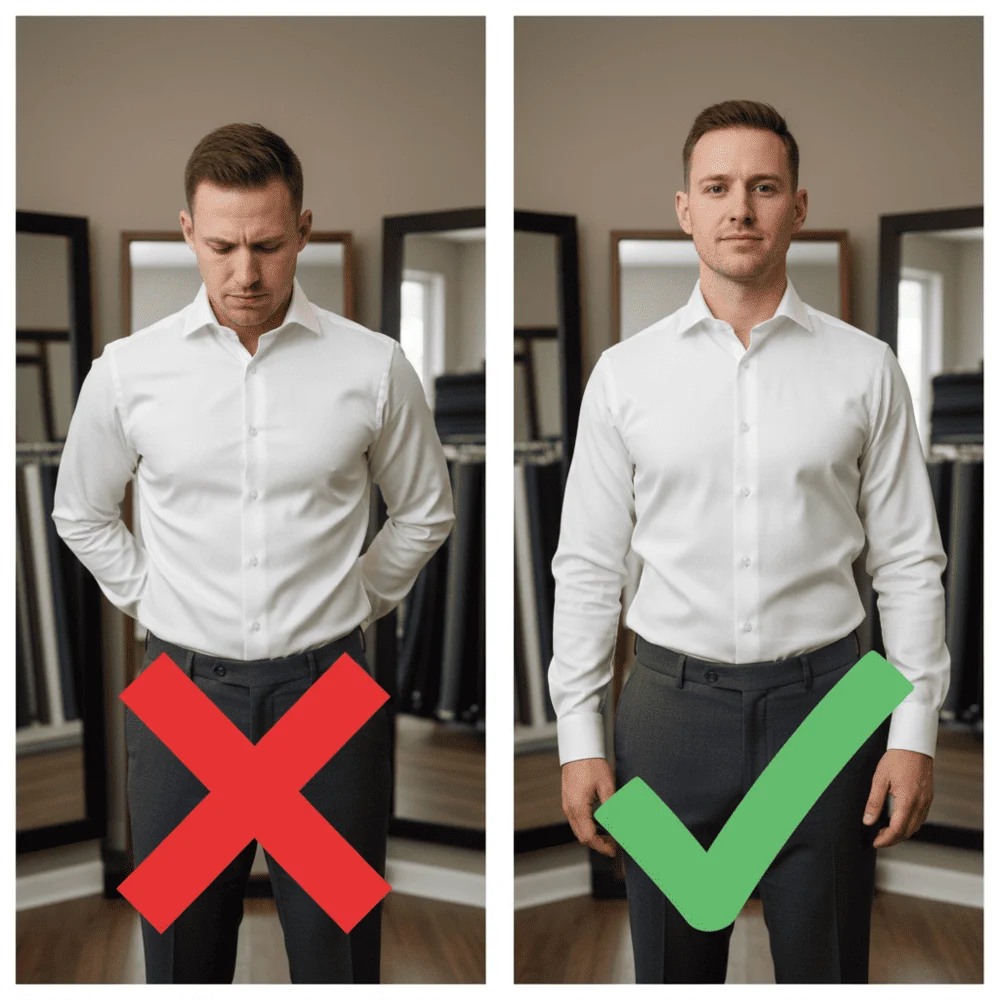
The way you stand and breathe during measurement has a surprising impact on the final fit of your suit. Many men instinctively try to present their "best" body when being measured, sucking in their stomach, puffing out their chest, and standing with military stiffness. This is a mistake that leads to suits built for an idealized, temporary posture rather than your actual body.
Correct standing posture:
- Stand naturally, as if waiting in line for coffee.
- Look straight ahead at the horizon, not down at the tape measure (looking down compresses the neck and shortens back measurement).
- Keep shoulders relaxed in their natural position.
- Do not pull shoulders back as if standing at attention.
Breathing technique:
- For chest, waist, and stomach measurements, breathe normally.
- Assistant should take measurement at neutral point of breathing cycle (neither fully inhaled nor fully exhaled).
- Measurement taken at full inhalation will result in jacket that feels tight during normal breathing.
Final preparation steps:
- Empty all pockets completely (phones, wallets, keys, coins add bulk).
- Remove your belt for trouser measurements.
- Ensure suit trousers will be measured at the actual waistline where they will be worn, not hip level like jeans.
5. Understanding the difference between body measurements and garment measurements
There are two fundamentally different approaches to measuring for a suit: measuring your body or measuring a garment you already own. It is critical to understand which approach your tailor or online service requires, as submitting the wrong type of data will result in an incorrectly fitted suit.
Body measurements (recommended for most people):
- Direct measurements of your physical dimensions: actual chest circumference, actual waist, actual arm length from shoulder to wrist bone.
- This is the approach recommended for most Australian made-to-measure services and is the focus of this guide.
- When you provide body measurements, the tailor applies their own "ease" allowances to the pattern.
- Ease is the extra fabric added beyond your body measurements to allow for movement, comfort, and the desired silhouette.
- Different tailors have different house styles for ease, which is why two suits built from the same body measurements by different companies may fit slightly differently.
Garment measurements (requires expertise):
- Measurements taken from an existing suit jacket or trousers that fit you well.
- You measure the physical dimensions of the garment itself: pit-to-pit chest width when laid flat, length of sleeve seam, waist width of trousers.
- Requires understanding garment construction (for example, measuring chest of a jacket laid flat requires measuring from armpit seam to armpit seam across front, then doubling that number).
- Must account for any desired changes - if current suit is slightly too tight, you cannot simply replicate its exact measurements.
Bottom line: For inexperienced measurers, body measurements are significantly more reliable. It is easier to identify a bone on a person's body than to determine exactly where a sleeve head should sit on a flat-laid jacket. All major Australian services including InStitchu, Dunnio Tailor, and international providers are calibrated to accept body measurements.

6. The complete upper body measurement guide
The upper body measurements determine the structural integrity of your suit jacket. Unlike trousers, which can be altered relatively easily at the waist and hem, a jacket with incorrect shoulder or chest measurements is often structurally irreparable and must be remade.

6.1. How to measure neck circumference
Your neck measurement determines the collar size and the overall comfort of your shirt and jacket collar area.
Measurement technique:
- Place tape measure around neck at the level where dress shirt collar naturally sits.
- This is typically just below Adam's apple and at base of neck where it meets shoulders.
- Tape should be level all the way around, not sloping up at back or front.
- Assistant should place one finger between tape and skin while taking measurement (essential for swallowing comfort and preventing collar from choking you).
Important considerations:
- If measurement falls between standard sizes, always round up to nearest half centimeter.
- A collar that is too tight is not just uncomfortable; in hot weather it can cause overheating and restrict blood flow, leading to lightheadedness.
- Australian summer weddings, particularly outdoor ceremonies, demand this extra consideration.

6.2. How to measure shoulder width
Shoulder width is the single most critical measurement for your suit jacket. This measurement cannot be altered significantly after construction without dismantling and rebuilding the entire jacket. Get this wrong, and your suit is essentially unwearable.
Finding the anatomical landmarks:
- The shoulder measurement is taken from the bony tip of one shoulder to the bony tip of the other.
- You are looking for the acromion process, the hard bony point at the edge of your shoulder where your arm begins.
- Place fingers on top of shoulder and move them outward until you reach the edge where bone ends and arm starts.
Critical technique details:
- The tape measure should NOT travel in a straight line across your back.
- It must follow the natural curve of upper back and shoulders.
- Tape should travel up and over the trapezius muscles and touch the prominent vertebra at base of neck.
- This curved measurement is longer than a straight line and accurately represents the space the jacket shoulder must span.
Common errors to avoid:
- Do not extend measurement onto deltoid muscle of upper arm; if measurement goes past the bone, your jacket shoulders will be too wide, causing shoulder pads to droop and creating an unflattering "sad" silhouette.
- If measurement is too narrow, sleeve head will pinch into shoulder, creating visible divots and restricting arm movement.
Modern context: Modern Australian tailoring in 2026 favors softer, more natural shoulder construction with minimal padding, especially for wedding suits. This Neapolitan or "unconstructed" style requires absolute precision in shoulder measurement because there is no heavy padding to hide asymmetries or errors.

6.3. How to measure chest circumference
The chest measurement determines how the jacket fits across your torso at its widest point and influences the overall silhouette and comfort of the suit.
Measurement technique:
- Stand with arms relaxed at sides.
- Measurement is taken around fullest part of chest (for most men, across nipples and high into armpits).
- Extends across shoulder blades in the back.
- Tape must remain parallel to floor for entire circumference.
Critical error to avoid:
- Do not raise arms while tape is being positioned for reading.
- You may lift arms briefly to allow assistant to pass tape around body, but must then lower arms completely to sides before measurement is read.
- Keeping arms raised expands latissimus dorsi muscles and rib cage, resulting in measurement that is too large.
- When you lower arms in the finished suit, it will feel baggy.
Verification steps:
- Assistant should stand behind you and ensure tape has not twisted and runs straight across shoulder blades.
- In front, check in mirror that tape crosses chest at appropriate height.
- Tape should be snug enough that it does not sag or droop but not so tight that it compresses chest.
- You should be able to breathe normally.

6.4. How to measure jacket waist and stomach
This measurement is different from your trouser waist and determines the hourglass shape of your jacket. A properly fitted jacket should gently taper from the chest to the waist and then flare slightly over the hips.
Where to measure:
- Athletic or trim build: Measure around narrowest part of torso, typically at natural waistline around floating ribs and solar plexus.
- Larger midsection: Measure around widest part of belly, usually at or just below navel.
- Be honest with yourself about your body shape and measure where stomach is actually widest.
Proper tension:
- Tape should be snug but not compressive.
- If you have a prominent stomach, this measurement is absolutely critical for determining where jacket button will sit and whether jacket will button comfortably without pulling.
- A jacket that is too tight at stomach will create the dreaded X-shaped creases radiating from the button when fastened.
The golden rule: Do not suck in your stomach during this measurement. Your suit needs to fit the body you have, not the body you wish you had or plan to have after three months at the gym. If you lose significant weight before your wedding, you can have the jacket taken in. If you gain weight or measured while holding your breath, the jacket cannot be let out enough to compensate.

6.5. How to measure sleeve length
Sleeve length determines where your jacket sleeve ends on your arm, which in turn dictates how much shirt cuff is visible - a key detail in proper suit styling.
Measurement technique:
- Stand with arm relaxed at side with natural, slight bend at elbow (do not straighten arm rigidly).
- Measurement is taken from point where shoulder ends (same acromion bone used for shoulder width) down outside of arm to wrist bone.
- The anatomical landmark at wrist is the ulnar styloid process, the bony protrusion on outside of wrist.
- Assistant should let tape measure follow the natural bend of your arm.
Why natural arm bend matters: Measuring a completely straight, rigid arm will result in sleeves that ride up when you bend your elbow to shake hands, hold a drink, or embrace someone.
Important note: Do not add extra length to account for shirt cuff visibility. The tailor's pattern will automatically account for the standard one to one and a half centimeters of cuff that should show beyond your jacket sleeve. If you add this yourself, your sleeves will be too long.

6.6. How to measure jacket length
Jacket length determines where the hem of your jacket ends on your body and dramatically affects the overall proportions of your suit. Too long, and you will look short and stumpy. Too short, and the jacket appears juvenile.
Measurement technique:
- Measurement is taken from high point of shoulder (where neck meets shoulder) straight down front of body.
- Traditional rule of thumb: Jacket should end at thumb knuckle when arms hang naturally at sides.
- However, modern Australian tailoring trends in 2026 favor a slightly shorter jacket that ends at seat line, where buttocks curve back into thigh.
- This contemporary cut lengthens the leg line and creates a more youthful, fashion-forward silhouette popular in Sydney and Melbourne wedding circles.
Practical verification test - the cup-your-hand test:
- When standing naturally with arms at sides, you should be able to curl fingers up and under hem of jacket comfortably.
- If you cannot reach the hem, jacket is too long.
- If hem is above your palm, it is too short.
Height-specific guidance:
- Taller men over 190 centimeters: Ensure jacket length is sufficient to cover full curvature of buttocks; a jacket that is too short on a tall man makes him look like he has outgrown his clothes.
- Shorter men under 170 centimeters: Avoid excessive length; measurement should be precise to thumb knuckle or slightly higher to create illusion of height.

7. The complete lower body measurement guide
Trouser measurements control comfort, movement, and the overall proportion of your suit. While trousers are more forgiving than jackets in terms of alteration potential, starting with accurate measurements ensures you need only minor adjustments for the perfect fit.

7.1. How to measure trouser waist
Your trouser waist measurement must be taken at the exact height where you intend to wear your suit trousers. This is critical because suit trousers are traditionally worn higher than casual trousers or jeans.
Key understanding:
- Suit trousers typically sit at or just below navel, at your natural waistline.
- This is several centimeters higher than where you wear jeans, which sit on hip bones.
- Ask yourself: Where will you actually wear these trousers? Place tape measure at that exact height and measure around circumference.
Measurement technique:
- Ensure no belt is worn during measurement.
- Tape should be snug enough that it will not slide down but not so tight that it digs into skin.
- You should be able to breathe and sit comfortably.
Beware of vanity sizing: Your jeans might say size 34 on the label, but they often measure 36 or even 37 inches in reality. Never use the tagged size of your casual trousers as your measurement. Measure your actual body at the height where the suit trousers will sit.

7.2. How to measure hips and seat
The hip or seat measurement is taken around the fullest part of your buttocks and hips. This measurement determines whether your trouser pockets lie flat or flare open, which is a telltale sign of a poorly fitted suit.
Measurement technique:
- Stand with feet together.
- Empty pockets completely (remove phone, wallet, keys, and any other items).
- Assistant should place tape measure around body at widest point of glutes.
- Ensure tape is perfectly horizontal all the way around.
Why this matters?
This measurement is particularly important for men with athletic builds or well-developed leg muscles, as the hip circumference on suit trousers needs sufficient ease to prevent pocket flare. If trousers are too tight at the seat, side pockets will pop open and destroy the clean lines of the suit. It is safer to add one to two centimeters of ease to this measurement when in doubt.

7.3. How to measure thigh circumference
Thigh measurement is frequently overlooked but is critical for Australian men with athletic builds. Rugby players, AFL athletes, cyclists, and men who engage in heavy leg training at the gym often have significantly developed quadriceps that cannot fit into standard suit trouser patterns.
Measurement technique:
- Measurement is taken around circumference of thigh immediately below crotch seam at gluteal fold.
- Assistant should place one finger between tape and skin to ensure minimal comfort ease.
Special consideration for muscular builds: If you have particularly muscular thighs or large legs, you may need to measure at the widest part of your thigh, even if it is slightly lower down the leg. Communicate this to your tailor. Trousers that fit your waist perfectly but strangle your thighs will be uncomfortable and prone to ripping when you sit, squat, or dance.

7.4. How to measure rise and crotch
The rise, sometimes called the crotch measurement, determines where your trousers lock onto your body and how much fabric exists between your waistband and the crotch seam. This affects both comfort and the visual proportions of your suit.
Measurement technique:
- The full rise measurement runs from center front of waistband, down between legs, and up to center back of waistband.
- This can be difficult to measure on a body, so a common alternative is to measure a pair of well-fitting dress trousers you already own.
- Lay them flat and measure the curved seam from front waistband through crotch to back waistband.
Understanding rise impact:
- Longer rise is more traditional and comfortable for taller men or older men who prefer to wear trousers higher on waist.
- Shorter rise creates a more modern, streamlined look but can be uncomfortable if too short, as it may cause trousers to pull down when you sit and shirt to untuck.
Height-specific guidance:
- Taller men over 185 centimeters: Communicate to your tailor that you may need a longer rise to maintain proper proportions.
- Shorter men: May prefer a slightly shorter rise to avoid excess fabric bunching.

7.5. How to measure trouser length, inseam, and outseam
Trouser length is where your personal style preference comes into play, as the break of your trousers on your shoes is a matter of current fashion and individual taste.
Measurement definitions:
- Outseam: Measured from top of waistband down outside of leg to point where you want trouser hem to end
- Inseam: Measured from crotch seam down inside of leg to same endpoint
- Both measurements should be taken without shoes, and you should stand naturally
Understanding trouser break - the four main options:
No break:
- Trouser hem just barely touches top of shoe with no fold at all.
- Most modern and fashion-forward option in 2026 Australian wedding styling.
- Especially popular with loafers and when showing off premium dress shoes.
- Creates a clean, elongated leg line.
Quarter break:
- Allows slightest hint of a fold at front of trouser.
- Current sweet spot for contemporary wedding suits.
- Offers polished look without appearing overly trendy.
Half break:
- Creates a noticeable but single fold where trouser meets shoe.
- Safe, conservative choice appropriate for corporate environments and traditional wedding styles.
Full break:
- Creates a significant fold and excess fabric pooling on shoe.
- Was standard in 1990s and early 2000s but is now considered dated in Australian market.
- Only choose if you specifically prefer a very traditional aesthetic.
Critical measurement tip: Your assistant should measure your outseam to the desired break point while you are wearing or holding the shoes you plan to wear with the suit. Different shoe styles have different heights, and measuring in bare feet then trying to estimate will lead to errors.

8. Measuring for different body types and wedding roles
Not all bodies are the same, and not all measurements require the same approach. The Australian male population includes significant variation in build, and your measurement strategy should account for your specific body type and the role you will play in the wedding.
8.1. The athletic or inverted triangle build
Men who engage in bodybuilding, rugby, swimming, or heavy labor often develop an inverted triangle shape characterized by a broad chest and shoulders paired with a narrow waist. The drop, which is the difference between your chest and waist measurements, can exceed 25 centimeters.
8.1.1. Why custom measurement is essential?
For this body type, off-the-rack suits will either fit your chest and billow at the waist or fit your waist and strangle your chest and arms.
8.1.2. Special measurement considerations
Bicep measurement:
- Measure your bicep both flexed and relaxed.
- Provide the flexed measurement to your tailor with a note.
- A suit sleeve that catches on your bicep when you bend your arm is a common complaint for athletic builds.
Shoulder measurement:
- Consider requesting a slightly extended shoulder measurement.
- While the standard rule is to measure to the acromion bone, men with developed deltoids may need an additional half centimeter past the bone to accommodate the muscle cap and prevent sleeve head from pinching.
Jacket waist suppression:
- Request a significant waist suppression on your jacket.
- Communicate your exact chest-to-waist drop to your tailor so they can create the appropriate hourglass shape rather than defaulting to their standard pattern.
Trouser considerations:
- Thigh and seat measurements are critical.
- Do not be shy about requesting a more generous cut in the leg while maintaining a trim waist.

8.2. The stockier or portly build
Older men, fathers of the groom, and men carrying extra weight around the midsection require a different measurement approach that prioritizes comfort and a clean button line.
Critical measurements:
Stomach measurement:
- The most critical number for this body type.
- Jacket must be cut to button comfortably over belly without pulling.
- Measure at absolute widest point of stomach, typically at or below navel.
- Do not hold in your breath.
Trouser waist placement:
- This is a matter of preference
- Some men with larger midsections prefer to wear suit trousers on top of belly at natural waistline.
- Others prefer below belly on hips.
- This choice dramatically affects your inseam and rise measurements.
- Clarify exactly where trousers will sit before measuring length.
Jacket length:
- Should be sufficient to provide coverage.
- A jacket that is too short emphasizes a large stomach.
- The traditional thumb-knuckle rule or slightly longer is appropriate.
Fabric recommendations:
- Heavier weight fabrics around 300 to 360 GSM in darker colors or subtle patterns.
- Help create structure and minimize appearance of midsection.
- Better than lightweight fabrics in light colors that show every shadow and pull.

8.3. The tall build for men over 190 centimeters
Tall men face unique challenges in suit measurement, as standard proportions do not scale linearly with height. A man who is 195 centimeters tall does not simply need every measurement increased by a fixed percentage.
Key measurement concerns:
Jacket length:
- The most common problem area.
- Ensure your jacket is long enough to cover the full curve of your buttocks.
- A jacket that is too short on a tall man is immediately obvious and unflattering.
- Measure carefully and err on the side of slightly longer rather than shorter.
Sleeve length:
- Must be measured with care.
- Tall men often have long arms.
- Sleeves that are too short expose too much shirt cuff or even the wrist, creating a juvenile appearance.
Trouser rise and inseam:
- Need sufficient length.
- Communicate your height to your tailor explicitly.
- Online measurement forms often have fields for total height, which helps tailor anticipate proportional adjustments.

8.4. The short build for men under 170 centimeters
Shorter men must pay meticulous attention to proportions, as excess fabric in any dimension creates visual weight that makes you appear even shorter.
Key measurement principles:
Jacket length precision:
- Should end exactly at or slightly above thumb knuckle.
- Do not allow excess length.
- Every centimeter of extra jacket length shortens your leg line and makes you appear more compact.
Trouser break minimization:
- A no-break or quarter-break hem is ideal.
- Excess fabric pooling on shoes visually shortens the legs.
- Ensure your outseam measurement is precise with the shoes you will wear.
Shoulder width exactness:
- Must be exact.
- Shoulders that are too wide will droop and make you look like you are wearing your father's suit.
- Shoulders that are precise to your bone structure create sharp, clean lines that enhance your frame.

8.5. The groom versus the groomsmen measurement considerations
The groom's suit - absolute precision required:
This is the suit that will appear in hundreds of photos, will be scrutinized by family and friends, and will be worn for potentially twelve to fifteen hours through a ceremony, photos, reception, and dancing. Spare no effort or expense on accurate measurement and professional fitting.
Groom best practices:
- Consider booking a professional in-person fitting at a showroom if possible, even if you plan to order online.
- The data from a professional fitting is worth the consultation fee.
- Schedule your groom suit measurement and order at least six months before your wedding.
- Allow for production time, shipping, and at least two rounds of fittings and alterations.
Groomsmen suits - coordination and consistency:
Groomsmen suits require coordination and consistency but can tolerate slightly more flexibility in the measurement process. The key is ensuring all groomsmen use the same measurement methodology. If one groomsman is measured professionally in a showroom and another measures himself at home, the inconsistency in technique can result in visible fit differences across the wedding party.
The professional proxy protocol for remote groomsmen:
- Each groomsman should visit a local alterations tailor, dry cleaner, or department store that offers measurement services.
- They pay a small fee for professional measurement.
- Receive a printout or email of their dimensions.
- Submit those standardized measurements to the suit order form.
- This ensures consistency across the entire wedding party.
Wedding guests - most flexibility:
A well-fitted suit is always preferable, but the scrutiny level is lower. Guests can rely on self-measurement with a helper or use their closest off-the-rack size with planned alterations.
9. Common measurement mistakes and how to avoid them
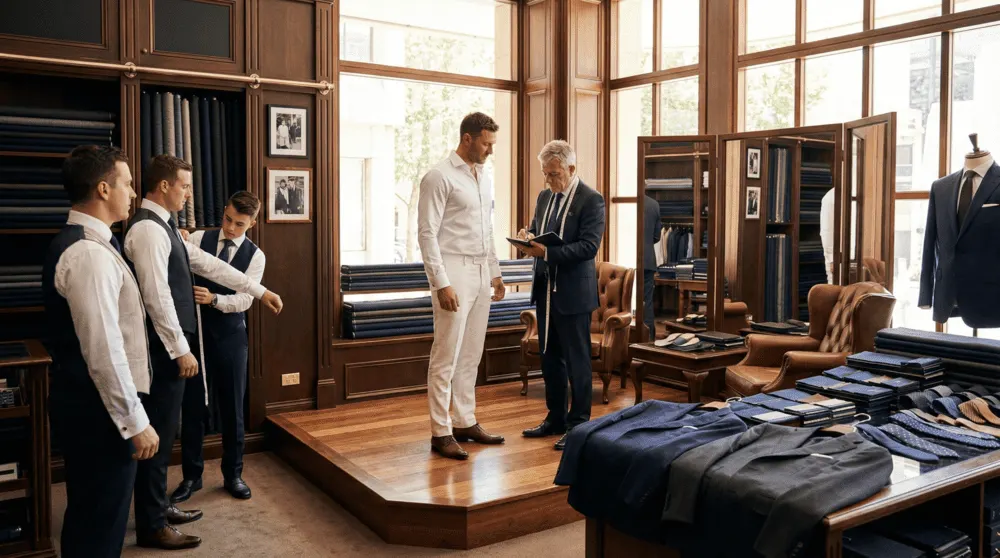
Even with the best intentions and careful attention, certain errors appear repeatedly in suit measurement data. Being aware of these common pitfalls helps you avoid them.
The seven most common measurement mistakes:
1. Measuring over bulky clothing:
- The most frequent error.
- Jeans, hoodies, and thick sweaters add centimeters to every measurement.
- Always measure over appropriate dress clothing or minimal clothing.
2. Posturing during measurement:
- Creates a suit for a body that does not exist.
- Stand naturally, breathe normally, and resist the urge to present your ideal physique.
3. Skipping the helper and measuring yourself:
- Introduces errors in nearly every dimension.
- Accept that you need assistance and schedule a time when a friend or partner can help you properly.
4. Using a worn-out cloth tape or incorrect measuring tool:
- Compromises every measurement.
- Invest in a quality vinyl measuring tape from a sewing shop or online retailer.
- They cost less than ten dollars and ensure accuracy.
5. Forgetting to record measurements immediately:
- Leads to confusion and second-guessing.
- Write down each measurement as you take it.
- Consider photographing the tape measure as backup documentation.
6. Rounding down instead of up when between sizes:
- Often creates suits that are too tight.
- When in doubt, round up by half a centimeter for comfort.
7. Measuring only once and assuming it is correct:
- Risky approach.
- Professional tailors measure each dimension at least twice to verify accuracy.
- You should do the same.

10. The Australian climate and fabric considerations for measured suits
Accurate measurement creates the fit, but the fabric you choose determines whether your perfectly fitted suit is actually wearable in Australian conditions. The continent's dramatic climate variation means a suit that is perfect for a winter wedding in Melbourne may be unbearable for a summer ceremony on the Gold Coast.
10.1. Fabric weight guide by Australian climate zones:
Lightweight tropical fabrics (200 to 240 GSM):
- Essential for summer and tropical weddings in Queensland, Northern Territory, and northern Western Australia.
- These fabrics breathe and prevent overheating.
- Can show wrinkles and body contours more readily.
Medium weight fabrics (250 to 280 GSM):
- The versatile four-season standard for Sydney, Perth, and transitional seasons.
- Balance breathability with structure and durability.
Heavyweight fabrics (300 to 360 GSM):
- Appropriate for winter weddings in Melbourne, Tasmania, Canberra, and the Southern Highlands.
- Provide warmth and create strong structure.
- Can help conceal body imperfections.

10.2. Specialty fabric considerations:
Linen and cotton-linen blends:
- Popular for beach and outdoor summer weddings.
- These natural fibers breathe exceptionally well but wrinkle easily.
- Wrinkles are culturally accepted in Australian summer wedding aesthetics as relaxed elegance.
10.3. Jacket lining impact:
Jacket lining affects temperature regulation as much as the outer fabric:
- Full lining with heavy Bemberg or silk back panel traps heat between your body and the fabric.
- For hot weather, request a half-lined or butterfly-lined jacket where lining is removed from back panels.
- This allows outer fabric to breathe directly against your shirt.
Summer measurement consideration: When providing measurements for a summer wedding, consider that you may need a slightly looser fit to accommodate airflow and prevent the suit from sticking to your body in humid conditions. Communicate the wedding location, season, and expected temperature to your tailor so they can adjust the ease allowances appropriately.
11. The final steps, alterations, and fit verification
Receiving your custom or made-to-measure suit is not the end of the measurement journey. Even with perfect initial data, nearly all custom suits require minor alterations to dial in the absolute perfect fit.
11.1. Budgeting for alterations
Budget for alterations as part of your overall suit cost:
- Expect to spend an additional fifty to one hundred fifty dollars per suit for local tailoring adjustments.
- This is normal and expected, even for high-end made-to-measure services.
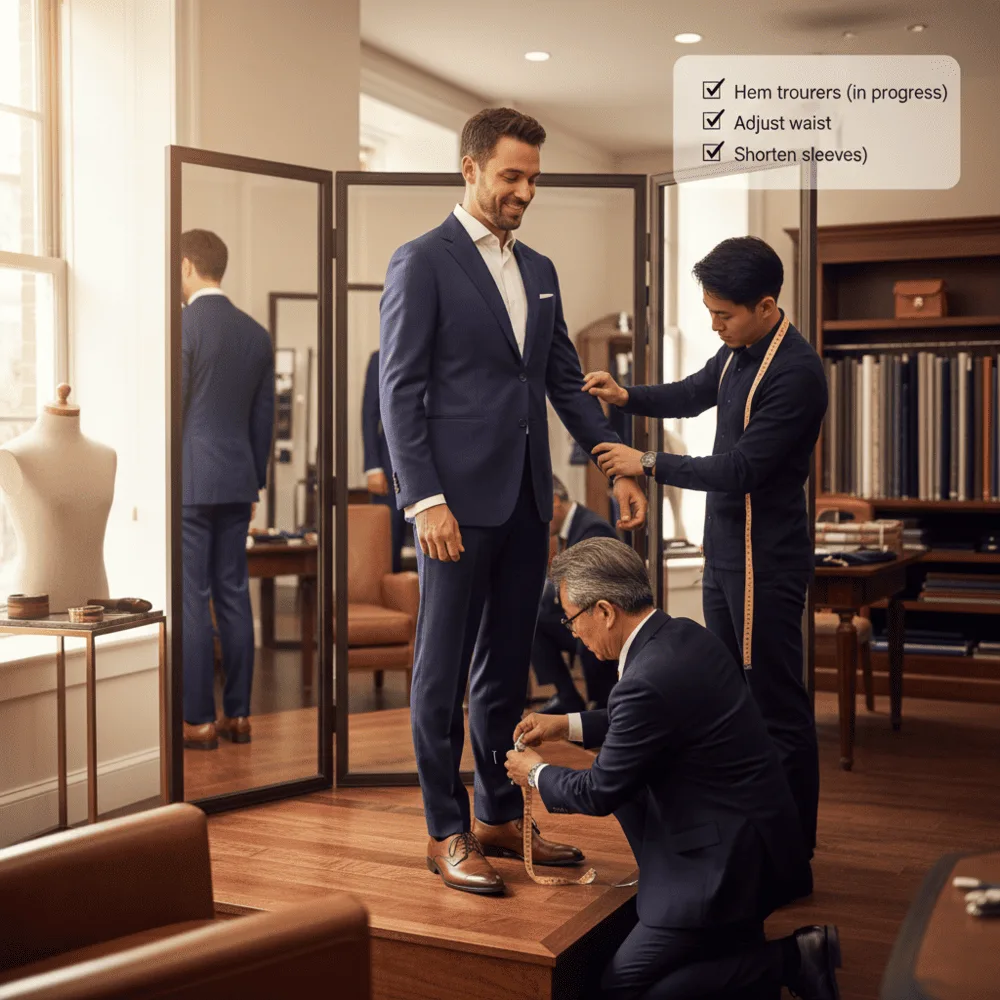
The most common alterations:
- Hemming trousers to achieve your desired break with your specific shoes.
- Adjusting waist in or out by one to three centimeters.
- Shortening jacket sleeves by half a centimeter to one centimeter to perfect shirt cuff visibility.
11.2. Fitting timeline and logistics
Scheduling your fitting:
- Schedule first fitting at least four to six weeks before your wedding.
- This provides time for alterations to be completed.
- Allows for a second fitting to verify changes if necessary.
- Groomsmen should coordinate their fitting schedules to ensure everyone is ready simultaneously.
What to bring to your fitting:
- Bring the complete outfit including dress shirt, shoes, belt, and any accessories you plan to wear.
- The fit of a suit changes with different shoe heel heights and shirt collar styles.
11.3. Understanding alteration categories
Cosmetic alterations (routine and inexpensive):
- Hemming.
- Sleeve shortening.
- Minor waist adjustments.
Structural alterations (expensive or impossible):
- Changing shoulder width.
- Changing jacket length.
- Changing trouser rise.
- These indicate that original measurements were significantly incorrect.
12. Taking ownership of your suit fit
In the modern landscape of Australian wedding tailoring, the perfect fit is not handed to you; it is created through a collaborative process between you, your assistant, and your tailor. The measurements you provide are the architectural blueprint from which your suit is constructed. Providing accurate, carefully taken measurements is your responsibility and your opportunity.

Whether you are a groom preparing for the most photographed day of your life, a groomsman supporting your friend, or a father of the bride looking to look your absolute best, understanding how to measure for a suit empowers you to take control of your appearance. The process is not difficult, but it does require patience, attention to detail, and a commitment to accuracy.
Your action plan:
- Arm yourself with the right tools.
- Enlist a capable helper.
- Prepare your body and environment properly.
- Take each measurement with care and verification.
- Communicate openly with your tailor about your body type, your fit preferences, and any concerns you have.
- The result will be a suit that does not just fit but enhances your natural physique, provides comfort throughout a long event day, and gives you the confidence that comes from knowing you look exactly as you should.
The Australian wedding suit market offers unprecedented access to quality, customization, and value. Seize that opportunity by providing the foundation it requires: precise, honest, carefully measured data about your unique body. When you do, you will experience the difference between wearing a suit and wearing your suit.
Struggling to balance the cost of a full bespoke look for an upcoming wedding? Whether you’re a guest, a groomsman, or the groom yourself, Dunnio Tailor’s online made-to-measure service is the answer. With prices from $199 to under $600, you can finally get a customized suit that fits your frame as perfectly as it fits your pocket.
When choosing groom's suits at Dunnio Tailor, you will receive:
- Tailoring is based on personal measurements.
- Customize according to preferences.
- Instructions from a professional technical team.
- Tailored by skilled craftsmen.
- Fitting and adjusting as required.
- Fabric pattern options with a collection of more than 500 different fabric patterns.
- Free 720-day warranty.
- Free hangers and specialized storage bags.
- Support and shipping policies for international customers.
Hotline - WhatsApp: +84 968996668
Email: support@dunniotailor.com