Table of Contents[Hide]
- 1. Understanding the fast-fashion wedding suit ecosystem
- 2. The hidden economics: Calculating true cost
- 3. Technical analysis: Why construction matters
- 4. Comprehensive strength and weakness of each fast-fashion brands
- 5. Strategic recommendations by role
- 6. When fast fashion makes sense and when to invest
- 7. Understanding the Australian market context
- Conclusion: Making informed decisions in the fast-fashion wedding landscape
The Australian wedding industry has experienced a fundamental transformation over the past decade. Traditional formality has given way to personalized celebrations in vineyards, beaches, and converted warehouses. This cultural shift has created an opening for fast-fashion retailers to challenge the dominance of traditional tailors and rental services. For many Australian men, the question is no longer whether to rent or buy, but which brand offers the best combination of style, price, and reliability.
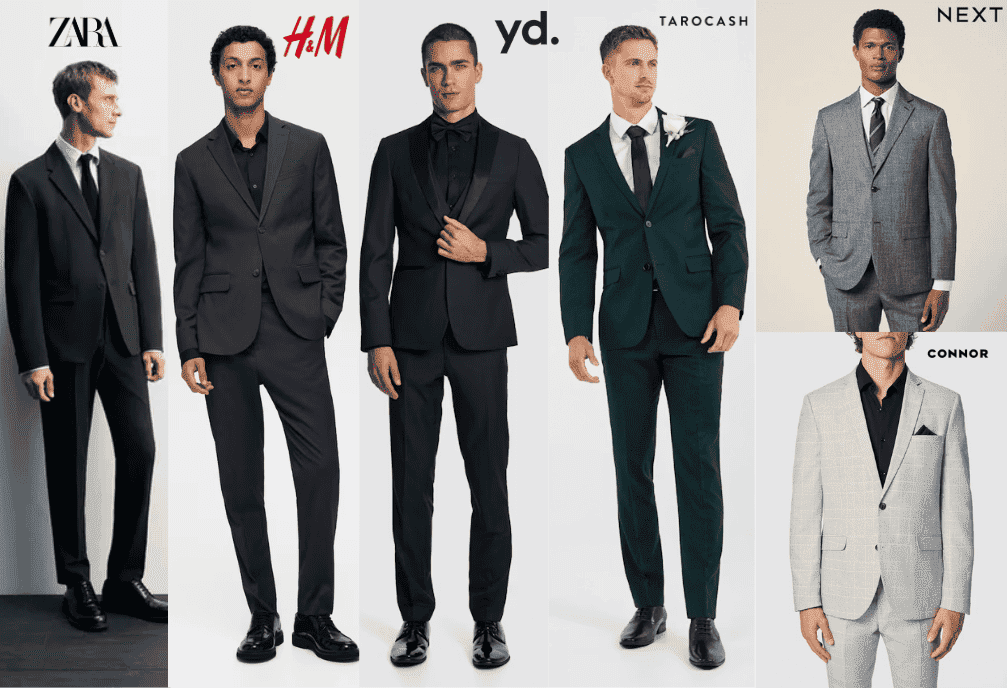
When you search for wedding suits zara or next mens wedding suits, you encounter an overwhelming array of options. International brands promise European styling at accessible prices, while domestic retailers offer the convenience of physical stores and immediate availability. However, the reality of purchasing a wedding suit from fast fashion involves complexities that extend far beyond the price tag. Stock availability, fabric quality, construction methods, and the logistics of coordinating an entire wedding party all factor into the equation.
At Dunnio Tailor, we work with clients who have explored the full spectrum of options. Some come to us after frustrating experiences with fast fashion, while others are comparison shopping to understand the value proposition of bespoke tailoring. This guide synthesizes our professional observations with real market data to provide an honest assessment of the fast-fashion wedding suit landscape in Australia.
1. Understanding the fast-fashion wedding suit ecosystem
Fast fashion operates on a fundamentally different model than traditional menswear. Where a heritage tailor maintains consistent styles and fabrics for years, fast-fashion brands refresh their inventory every few weeks. This agility allows them to respond quickly to trends. When sage green becomes the wedding color of the season, Zara can stock sage suits within a month. However, this same speed creates instability. The suit you select in January may be discontinued by March, creating coordination challenges for wedding parties.
The pricing structure of fast fashion also differs significantly from traditional retail. Aggressive discounting is built into the business model. A suit listed at four hundred dollars may be available for two hundred and fifty during a sale. This creates a perception of value, but it also means that comparing prices requires careful attention to timing and promotional cycles.
For Australian consumers, an additional layer of complexity involves international shipping and returns. Brands like Next and Zara operate primarily through online channels for menswear, requiring customers to manage sizing uncertainty through remote transactions. The convenience of browsing from home is offset by the friction of returns, shipping costs, and the time pressure of wedding deadlines.
1.1. The international players: Zara and Next
1.1.1. Zara men wedding suits: Fashion forward but fit-restricted
Zara has established itself as the aspirational choice within fast fashion. The brand's aesthetic leans heavily toward contemporary European styling, with slim cuts, textured fabrics, and trend-driven colors. For the fashion-conscious groom seeking a statement look, Zara offers options that traditional Australian retailers cannot match.
The Zara wedding suits range includes both natural and synthetic fabrics. Their premium lines feature one hundred percent wool and one hundred percent linen options, addressing the breathability concerns that plague cheaper polyester suits. Jackets in the Aaron Levine collaboration collection showcase details like side adjusters, wider lapels, and textured weaves that mimic high-end tailoring at a fraction of the cost. Prices typically range from two hundred and fifty to four hundred dollars for a jacket, with trousers adding another one hundred to one hundred and fifty dollars.
However, the Zara proposition comes with significant caveats. The brand's sizing philosophy is built around a slim, youthful physique. Terms like slim fit, cropped fit, skinny, and super skinny dominate the product descriptions. For a wedding party, this creates an exclusion problem. If even one groomsman has a broader build, athletic shoulders, or a taller frame, he may find Zara suits physically impossible to wear comfortably. The high armholes and narrow cuts that create the sharp silhouette on a slender frame become restrictive and unflattering on different body types.
The cropped jacket lengths present another challenge. A cropped blazer may look contemporary in a fashion editorial, but on a man over six feet tall or with a longer torso, it can appear awkwardly short, particularly in wedding photographs where the suit will be scrutinized for years to come. This is not a flaw that tailoring can easily correct. Lengthening a jacket requires reconstructing the entire balance of the garment, often costing more than the original purchase price.
Zara's inventory management also poses risks for wedding coordination. The brand operates on rapid stock turnover, with styles appearing and disappearing within weeks. A groom who selects a specific navy herringbone suit in February may find that his groomsmen cannot purchase the same style in April because it has been discontinued. This volatility makes Zara better suited for individual guests who can select from current stock without needing to coordinate with others.
The fabric quality in Zara's mid-range offerings is variable. While the premium wool and linen lines offer genuine natural fibers, much of the range relies on stretch blends containing polyester, viscose, and elastane. These synthetic fabrics provide comfort in the fitting room, but they trap heat during wear and degrade faster than natural fibers. The stretch fibers eventually lose their elasticity, leading to bagging at the knees and elbows after limited use.

1.1.2. Next mens wedding suits: The logistics challenge
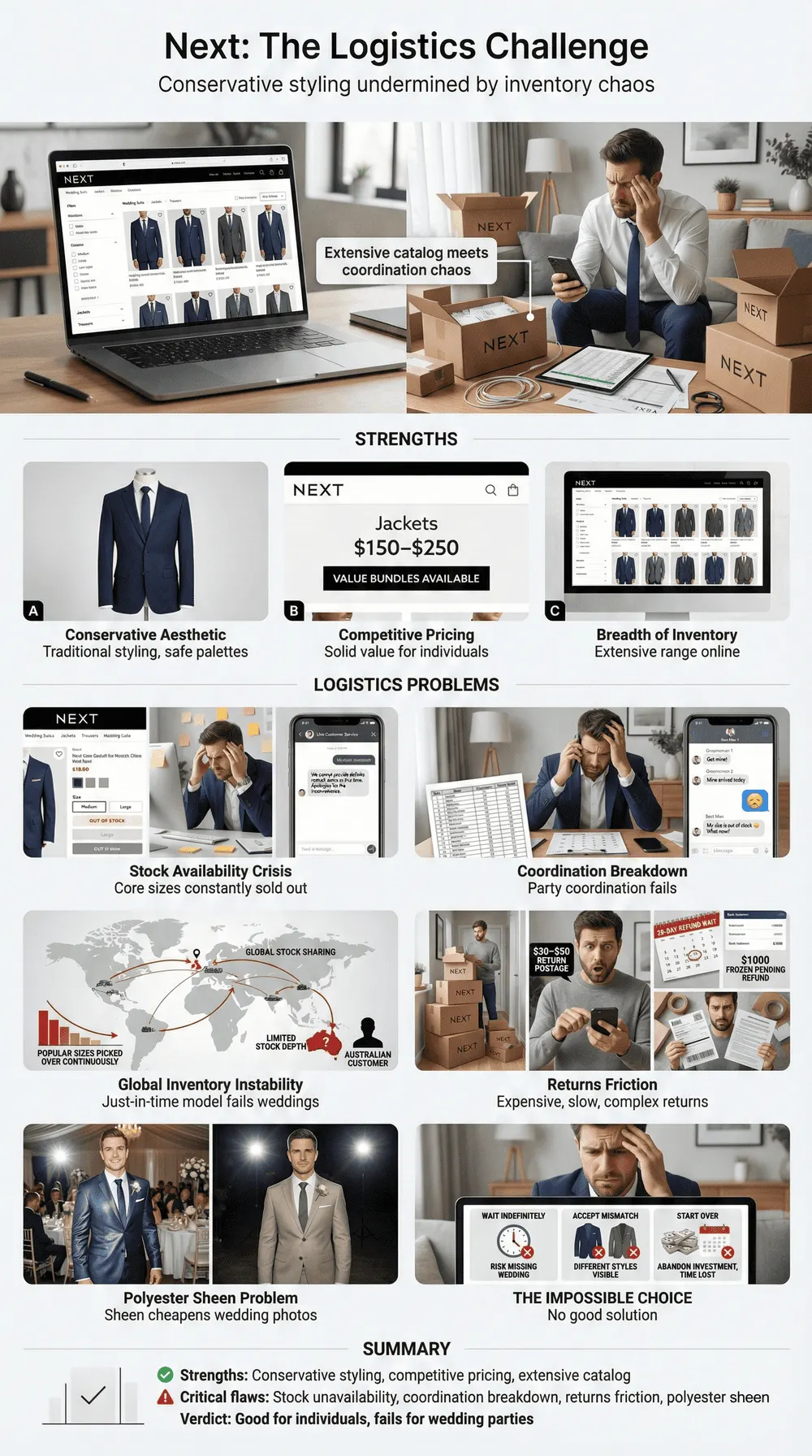
Next has built a substantial following in Australia through its extensive online catalog and competitive pricing. The brand offers a more conservative aesthetic than Zara, with classic cuts and safe color palettes that appeal to men seeking traditional wedding styling without the premium price of heritage brands.
The Next mens wedding suits range includes both separates and matched sets, with jackets typically priced between one hundred and fifty and two hundred and fifty dollars. The brand's strength lies in its breadth of inventory, offering everything from classic navy and charcoal to seasonal colors and textured fabrics. For a guest purchasing a single suit, Next represents solid value, particularly during promotional periods.
However, the Next model reveals critical vulnerabilities when applied to wedding party coordination. The most persistent complaint from Australian customers involves stock availability. Reviews consistently mention that core sizes, particularly medium and large, are frequently sold out. This is not a minor inconvenience for wedding planning. A typical groomsmen party requires a size run spanning small to extra large, and all suits must be identical in fabric, color, and cut to achieve visual cohesion in photographs.
The scenario plays out predictably: a groom selects a suit and orders his size successfully. He instructs his groomsmen to order theirs. Two succeed, but the best man finds his size unavailable. Customer service cannot provide definite restock dates. The groom now faces an impossible choice: wait indefinitely and risk missing the wedding date, purchase a different style and accept visual mismatch, or abandon Next entirely and start the process again with a different retailer.
This inventory instability stems from Next's global distribution model. The Australian market shares stock with the UK, Europe, and Asia. Popular sizes are picked over continuously, and the just-in-time inventory system that keeps costs low also means limited depth in any single size. Unlike a made-to-measure service where fabric is cut specifically for each client, Next relies on predicting demand across diverse markets, a prediction that frequently fails for wedding parties requiring multiple units in specific sizes.
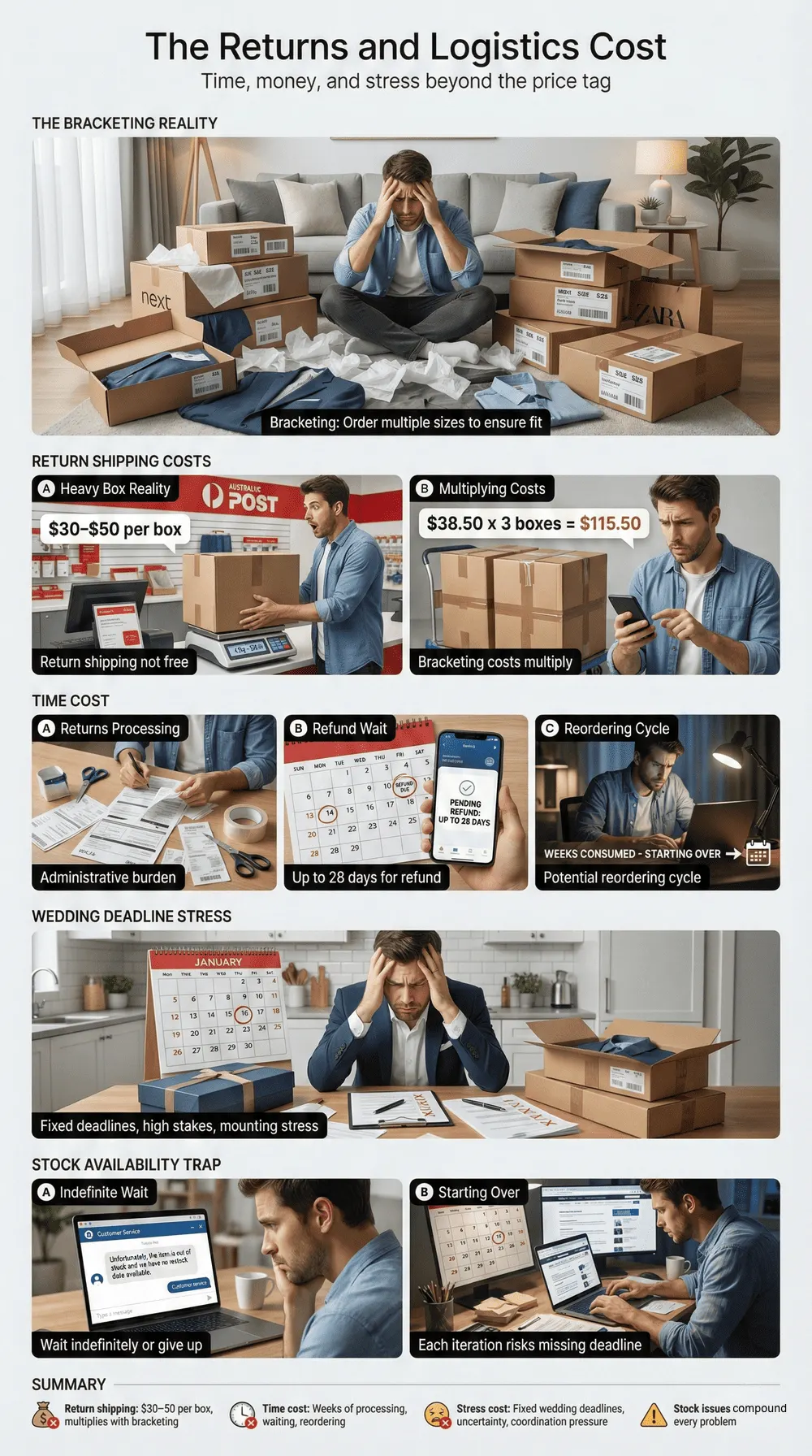
The returns process adds another layer of friction. Next's policy requires customers to pay return postage, with packages sent to a distribution center in Chullora, New South Wales. For a customer practicing bracketing, which means ordering multiple sizes to ensure fit, the cost of returning heavy suit boxes can easily reach thirty to fifty dollars. The refund process can take up to twenty-eight days, during which the customer's capital is frozen. For a groom who has potentially spent one thousand dollars ordering options for himself and his groomsmen, this represents significant financial stress during an already expensive wedding planning period.
The administrative requirements for returns create additional barriers. Customers must peel off return labels, tick items being returned, and ensure original labels are no longer visible. Any error in this paperwork can jeopardize the refund. This level of logistics management is reasonable for a casual clothing purchase but becomes burdensome when dealing with time-sensitive wedding deadlines and multiple people coordinating simultaneously.
Despite these challenges, Next maintains customer loyalty for its consistent sizing in basics and reasonable quality for the price point. Long-term customers report that chinos and casual wear maintain their fit and durability over years of use. However, there is a clear distinction in consumer sentiment between everyday clothing and occasion wear. For a wedding, where the suit will be photographed extensively and worn for twelve hours straight, adequate quality may not be sufficient. The fabrics, while durable, often contain high percentages of polyester that exhibit a characteristic sheen under camera flash, potentially cheapening the overall aesthetic of wedding photographs.
1.2. The Australian domestic brands: Volume and accessibility
Connor: The budget baseline
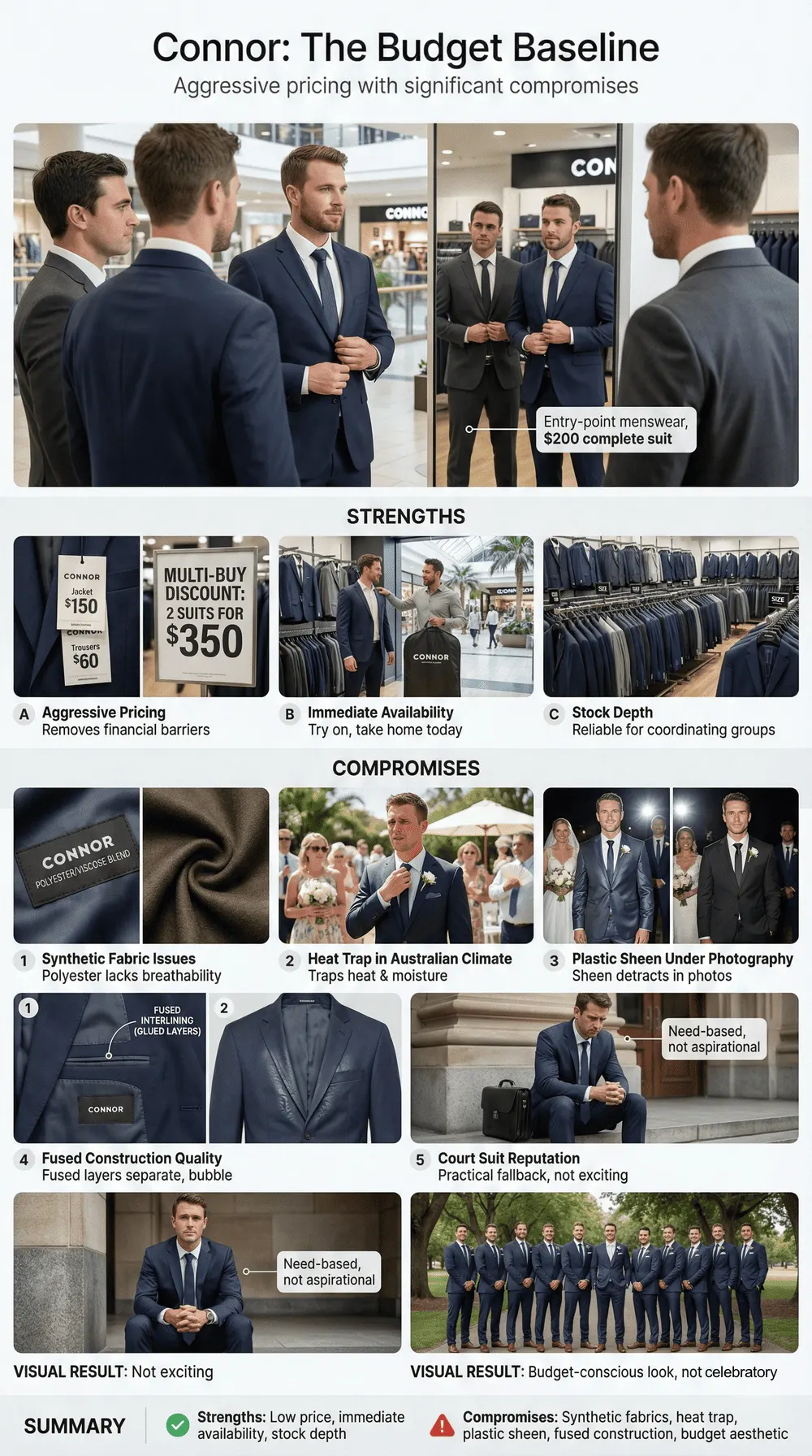
Connor has positioned itself as the entry point for Australian menswear, offering aggressive pricing that removes financial barriers to suit ownership. With jacket prices frequently at one hundred and fifty dollars and trousers at sixty dollars, a complete two-piece suit can be assembled for just over two hundred dollars, often less during promotional periods offering multi-buy discounts.
This pricing strategy makes Connor the default choice for budget-constrained wedding parties, particularly when the groom is subsidizing the cost for his groomsmen or when guests are reluctant to invest heavily in a garment they may wear infrequently. The brand's ubiquity in Australian shopping centers also provides convenience. Unlike international online retailers, Connor offers the ability to try on suits immediately and take them home the same day, eliminating shipping uncertainty and return logistics.
However, Connor's value proposition is built on significant compromises. To achieve these price points, the brand relies heavily on synthetic fabrics, primarily polyester-viscose blends. These materials offer durability and wrinkle resistance, traits that appeal to customers seeking low-maintenance clothing. Consumer reviews frequently praise Connor suits as decent for the price and suitable as work horses for regular wear.
The trade-off becomes apparent in Australian climate conditions. Polyester lacks the breathability of natural fibers, trapping heat and moisture against the skin. For a summer wedding, particularly in outdoor venues or humid regions like Queensland, a Connor suit can become uncomfortably hot within hours. The synthetic fabrics also exhibit a plastic-like sheen that becomes more pronounced under photography lighting, potentially detracting from the desired aesthetic in wedding photos.
The construction quality reflects the price point. Connor suits typically feature fused interlinings, where fabric layers are glued together rather than stitched. This method is faster and cheaper than traditional canvas construction, but it creates a stiff drape that lacks the natural movement of higher-quality tailoring. The fused layers can also separate after incorrect dry cleaning or exposure to heat, causing bubbling on the jacket front that ruins the garment's appearance.
Consumer discourse around Connor frequently includes the term court suit, referring to garments purchased out of necessity for legal appearances or mandatory formal events rather than aesthetic desire. This reputation suggests that while Connor effectively serves the need-based market, it struggles to capture the aspirational wedding market. The brand functions as a practical fallback for guests or budget-limited bridal parties rather than a choice that generates excitement or confidence.
For wedding planning, Connor's strength lies in its stock depth. Unlike international retailers with inventory volatility, Connor maintains high volumes of standard sizes, making it relatively reliable for coordinating multiple groomsmen. However, the visual result is a party that looks uniformly budget-conscious rather than sharp and celebratory.
Tarocash: The event specialist
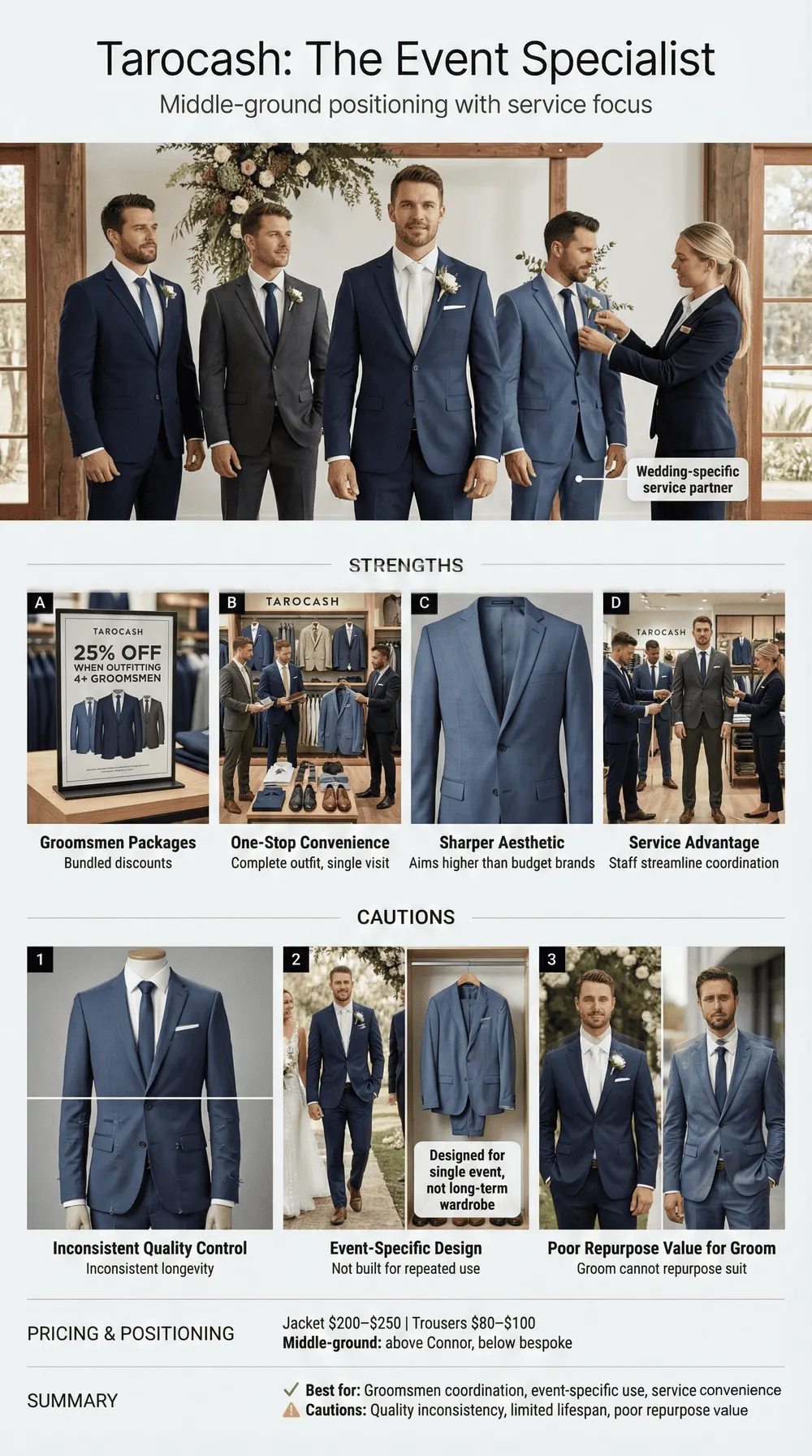
Tarocash occupies the middle ground between Connor's budget positioning and premium retailers, explicitly targeting the social occasion market. The brand has invested heavily in wedding-specific marketing, positioning itself not merely as a clothing retailer but as a service partner for grooms and their parties.
The Tarocash wedding strategy centers on groomsmen packages, offering discounts like twenty-five percent off when outfitting four or more groomsmen. This bundling directly addresses the logistical pain points of wedding coordination. The groom and best man, who typically manage the complex task of ensuring all groomsmen are properly attired, can complete the entire process in a single store visit. Tarocash extends the package to include shoes, belts, and ties, increasing the average transaction value while providing genuine convenience to customers.
The aesthetic positioning aims slightly higher than Connor, with sharper cuts and a focus on Supreme Stretch fabrics that acknowledge modern comfort expectations. Popular lines like the Caleb and Ruben suits are available in versatile colors including navy, charcoal, and the increasingly fashionable steel blue. Jacket prices typically range from two hundred to two hundred and fifty dollars, with trousers adding another eighty to one hundred dollars.
However, quality control remains inconsistent. Detailed consumer reviews indicate that while the initial visual impact is strong, longevity can be compromised. Reports of fabric degradation and stitching failures after minimal wear suggest that Tarocash suits are designed for event-specific use rather than long-term wardrobe investment. For a groomsman who will wear the suit once and potentially never again, this limited lifespan may be acceptable. For a groom hoping to repurpose his wedding suit for future occasions, it represents poor value.
The in-store service model provides Tarocash with a competitive advantage over online retailers. Staff can measure multiple groomsmen simultaneously, coordinate sizes, and arrange for basic alterations, streamlining a process that becomes complex when managed remotely through websites and shipping logistics. This service element justifies the slight price premium over Connor while remaining significantly cheaper than bespoke tailoring.
YD: The youth and trend driver
YD targets the youngest segment of the wedding market, focusing on men aged eighteen to thirty who prioritize fashion-forward styling over traditional tailoring principles. The brand's defining characteristic is its commitment to skinny and super skinny fits, creating body-contouring silhouettes that appeal to slender builds.
This focus makes YD popular for school formals and young wedding guests seeking a sharp, modern appearance. The brand demonstrates greater agility than its sibling brands in adopting bold colors and textures. Current offerings include trending shades like sage green, teal, and violet, as well as textured fabrics including velvet and heavy checks. For a wedding guest wanting to make a statement or adhere to a specific non-traditional color theme, YD provides high-impact options unavailable at more conservative retailers.
Pricing sits in the two hundred dollar range for jackets, positioning YD competitively with Tarocash while offering more adventurous styling. However, the extreme cuts create significant limitations for wedding party coordination. The skinny fit philosophy assumes a specific body type, effectively excluding men with athletic builds, broader shoulders, or thicker thighs. A groomsman with a rugby background or one who engages in regular strength training may find YD suits physically impossible to wear comfortably.
The high armholes and narrow shoulders that create the desired sharp silhouette on the right frame become restrictive and unflattering on others. This forces grooms into difficult decisions: either exclude certain friends from the wedding party based on body type, force them into ill-fitting suits that look poor in photographs, or accept visual mismatch by purchasing different brands for different groomsmen.
The fabric composition mirrors the broader fast-fashion market, with heavy reliance on synthetic blends. While this provides the stretch necessary for the tight cuts, it also means the suits trap heat and degrade faster than natural fiber alternatives. Consumer feedback frequently mentions the plastic feel of YD fabrics compared to wool, a criticism that becomes more significant in the context of a wedding where the suit will be worn for extended periods and photographed extensively.
For individual guests, particularly younger men attending casual or semi-formal weddings, YD represents a viable option for creating a fashionable look at an accessible price. However, for grooms coordinating entire parties or for men seeking suits that will serve multiple occasions beyond a single wedding, the limitations outweigh the benefits.

1.3. The international disruptors: Technology and European sophistication
Uniqlo: Engineering comfort for Australian conditions
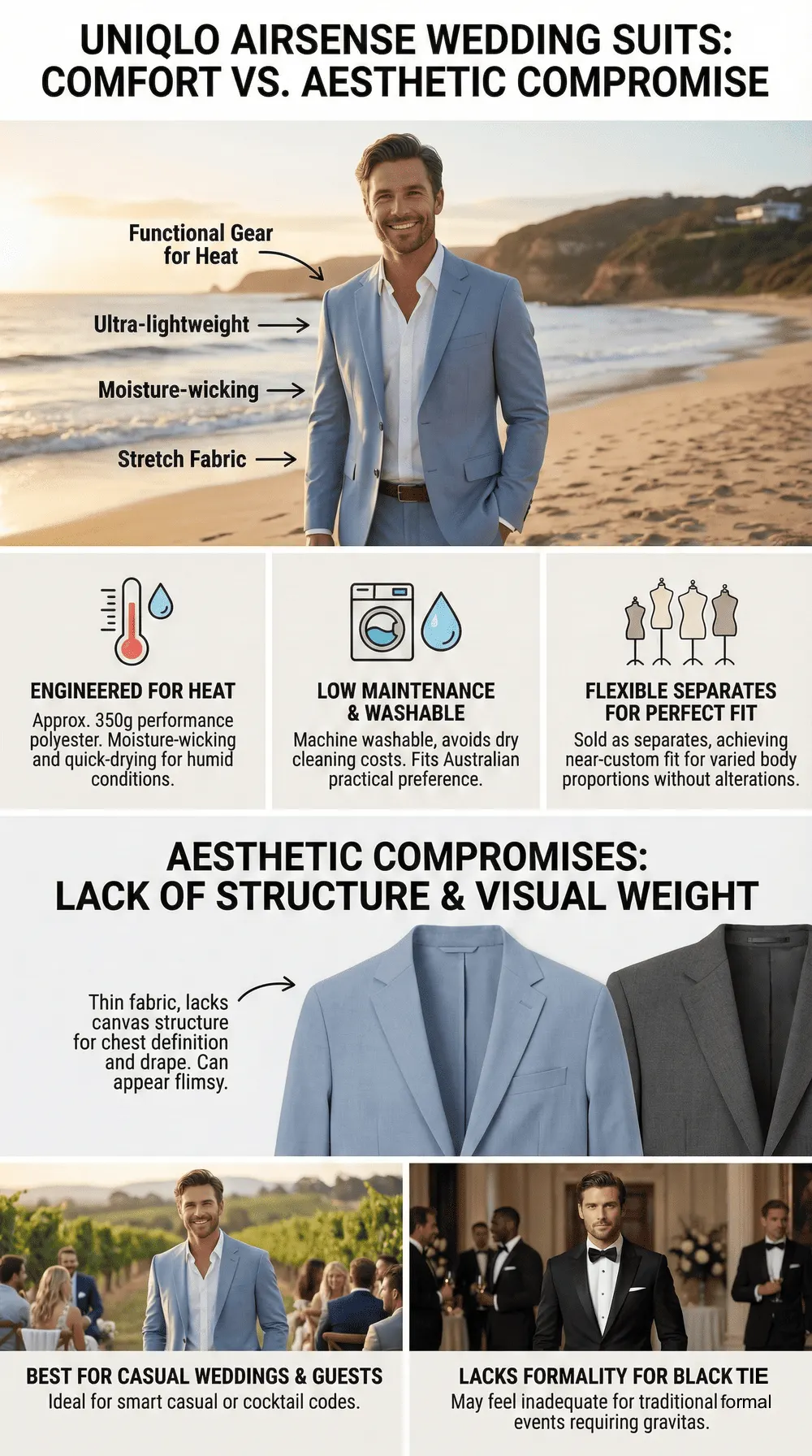
Uniqlo has disrupted traditional suit marketing by repositioning formal wear as functional gear rather than ceremonial attire. This approach, rooted in the brand's Japanese heritage of technical innovation, has particular relevance for Australian wedding conditions.
The cornerstone of Uniqlo's wedding suit offering is the AirSense line, developed in partnership with Toray Industries. These suits are engineered from ultra-lightweight performance polyester, weighing approximately three hundred and fifty grams. The fabric incorporates moisture-wicking properties, quick-drying capabilities, and significant stretch, addressing the primary complaint of men wearing suits in Australian summer conditions: heat stress.
For outdoor weddings in humid Queensland, beach ceremonies, or winery celebrations in warm weather, the AirSense suit provides genuine functional advantages. The ability to machine wash the garment also appeals to guests who view dry cleaning as an unnecessary ongoing cost. This practical approach resonates with the Australian cultural preference for low-maintenance solutions.
Uniqlo's decision to sell all jackets and trousers as separates provides a critical advantage for wedding party coordination. Men with disparate body proportions, such as a size forty jacket with a thirty-two waist, can achieve near-custom fit without expensive alterations or breaking matched sets. This flexibility is particularly valuable for groomsmen parties where body types vary significantly.
Pricing sits in the moderate range, with jackets typically between one hundred and fifty and two hundred and fifty dollars. The separates model means customers only pay for the pieces they need, potentially reducing overall cost compared to forced suit sets.
However, the AirSense technology comes with aesthetic compromises. The fabric is thin and lacks the canvas structure that gives traditional suit jackets their chest definition and drape. The jacket can appear flimsy or insubstantial, particularly in photographs where the lack of structure becomes apparent. For a groom who wants to project gravitas and formality, this lightweight construction may feel inadequate.
The visual impact is best suited for smart casual or cocktail dress codes rather than formal black tie events. For guests attending relaxed weddings or for grooms planning casual ceremonies, Uniqlo offers excellent value. However, for traditional formal weddings where the suit must convey a sense of occasion and permanence, the technical benefits may not compensate for the lack of visual weight.
H&M: The linen specialist
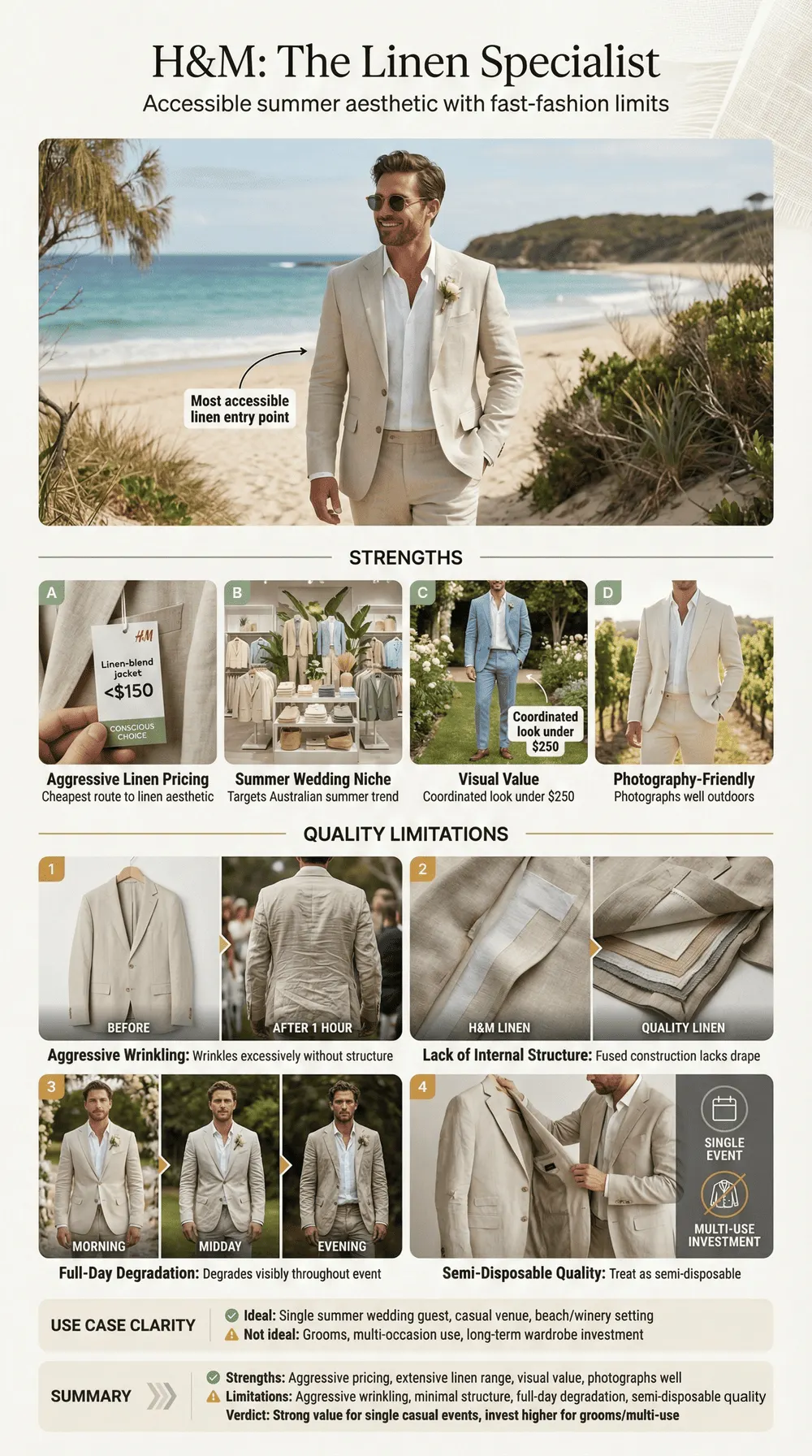
H&M has aggressively targeted the summer wedding niche with extensive linen and linen-blend collections. As linen has emerged as a dominant trend for Australian weddings, particularly for beach and winery venues, H&M offers the most accessible entry point to this aesthetic.
Linen-blend jackets are frequently priced under one hundred and fifty dollars, making them the cheapest route to achieving the relaxed elegance that linen provides. By blending linen with cotton or rayon, H&M mitigates the extreme wrinkling that pure linen exhibits while retaining the characteristic slubby texture that makes linen visually distinctive.
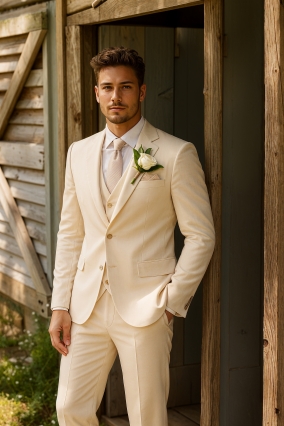
This visual value is significant. For under two hundred and fifty dollars, a guest can achieve a fully coordinated linen look that appears on-trend and appropriate for casual Australian wedding venues. The light colors and textured fabrics photograph well in outdoor settings, aligning with the light and airy photography style currently popular.
However, the quality limitations of fast-fashion linen become apparent with extended wear. Without proper canvas interlining to provide structure, cheap linen jackets can look disheveled after an hour in a car or during a seated ceremony. The fabric wrinkles aggressively, and while some wrinkling is expected and even desired with linen, excessive crushing can make the wearer appear unkempt rather than casually elegant.
The construction quality reflects the price point. Fused interlinings and minimal internal structure mean the jacket lacks the drape and recovery of higher-quality linen tailoring. After a full day of wear, an H&M linen suit may look significantly worse than it did at the start of the ceremony, a consideration for grooms who will be photographed throughout the event.
For guests attending a single summer wedding, particularly in a casual venue where relaxed attire is not only acceptable but preferred, H&M linen represents strong value. The low price point means the suit can be treated as semi-disposable, worn once or twice without concern for long-term durability. However, for grooms or for men seeking linen suits that will serve multiple occasions, investing in higher-quality linen from specialized retailers or tailors delivers better long-term value.
2. The hidden economics: Calculating true cost
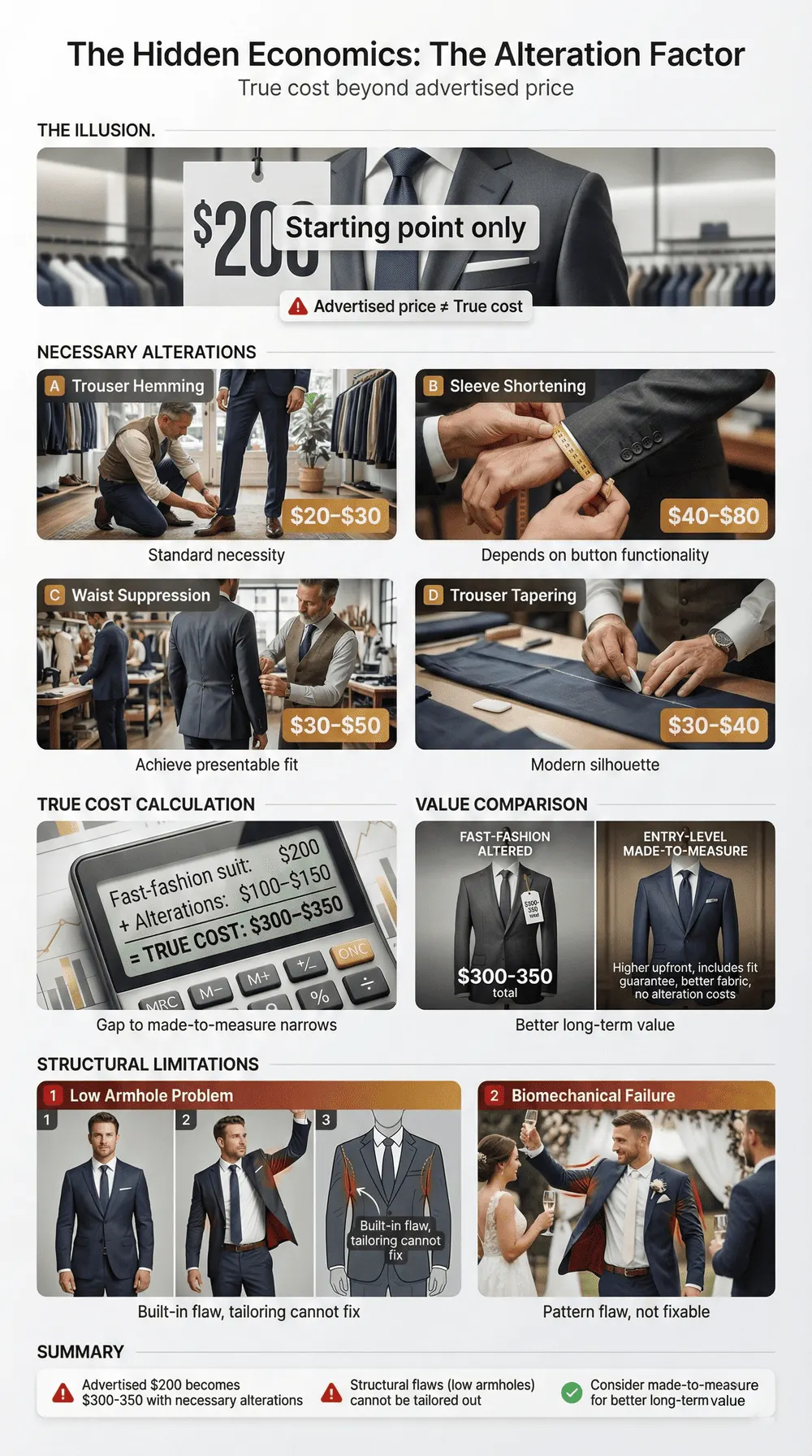
The advertised price of a fast-fashion suit represents only the starting point of the financial equation. Understanding the true cost requires accounting for alterations, potential returns, and the opportunity cost of time and stress.
The alteration factor
Almost no man fits an off-the-rack suit perfectly. Standard alterations include trouser hemming, sleeve length adjustment, and waist suppression. For fast-fashion suits, these alterations are not optional refinements but necessary corrections to achieve a presentable appearance.
Typical alteration costs in Australian cities include: trouser hemming at twenty to thirty dollars, sleeve shortening at forty to eighty dollars depending on whether buttons are functional, waist suppression at thirty to fifty dollars, and trouser tapering at thirty to forty dollars. For a suit purchased at two hundred dollars, alterations can easily add one hundred to one hundred and fifty dollars, bringing the total investment to three hundred to three hundred and fifty dollars.
At this price point, the gap between fast fashion and entry-level made-to-measure services narrows significantly. A custom suit from a tailor like Dunnio, while more expensive upfront, includes fit guarantees and eliminates alteration costs. The fabric quality, construction methods, and personalized fit often deliver better value when calculated over the garment's lifespan.
Fast-fashion suits also present structural limitations that tailoring cannot overcome. Low armholes, a common cost-cutting measure in mass production, cause the entire jacket to lift when the arm is raised. This biomechanical flaw creates awkward moments during toasts, dancing, or embracing guests. No amount of tailoring can fix this issue because it is built into the pattern itself. Consumers must understand that while alterations can improve fit, they cannot transform a fundamentally flawed garment into a well-engineered one.
The returns and logistics cost
For online purchases from retailers like Next or international Zara orders, the returns process introduces additional costs. Return shipping for heavy suit boxes can cost thirty to fifty dollars. If multiple sizes are ordered to ensure fit, a common practice called bracketing, the return costs multiply.
The time cost is equally significant. Processing returns, waiting for refunds, and potentially reordering different sizes can consume weeks. For wedding planning, where timelines are fixed and stress levels are high, this uncertainty represents a real cost even if it does not appear on a receipt.
Stock availability issues compound this problem. If a size is out of stock, the customer must either wait indefinitely for a restock that may never come or start the entire process again with a different retailer. Each iteration consumes time and increases the risk of missing the wedding deadline.
Cost per wear analysis
The economic calculation differs significantly based on the wearer's role and future use intentions.
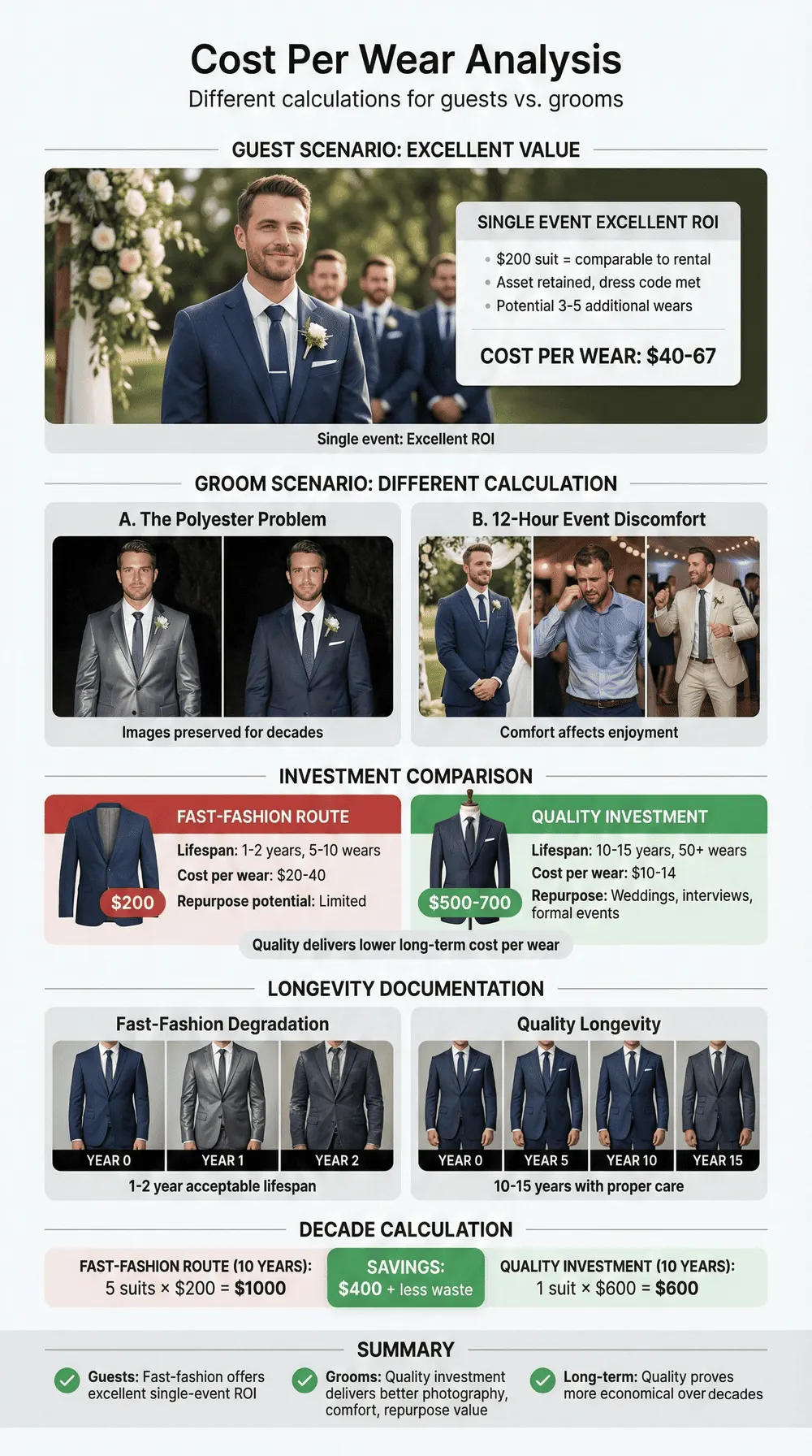
For a guest attending a single wedding, a two hundred dollar Connor suit offers excellent return on investment. The cost is comparable to rental fees, but the asset is retained. Even if the suit degrades after three dry cleanings, the initial purpose has been served. The guest has met the dress code requirement at minimal cost and can potentially wear the suit again for other occasions.
For a groom, the calculation changes dramatically. The wedding suit will be photographed extensively, with those images preserved for decades. A polyester-heavy suit may exhibit unflattering shine under flash photography. The discomfort of synthetic fabrics during a twelve-hour event can affect the groom's demeanor and enjoyment. In this context, spending five hundred to seven hundred dollars at a premium high street brand or investing in made-to-measure tailoring may deliver lower long-term cost per wear if the suit can be repurposed for future weddings, job interviews, and formal events.
The quality gap becomes apparent in longevity. A well-constructed wool suit from a quality retailer or tailor can last ten to fifteen years with proper care. A fast-fashion polyester suit may look acceptable for one to two years before the fabric degrades, stitching fails, or the style appears dated. When calculated over a decade, the higher initial investment in quality often proves more economical than repeatedly replacing cheap suits.
3. Technical analysis: Why construction matters
Understanding the engineering differences between fast fashion and quality tailoring helps explain the price gap and performance differences.
Fused versus canvas construction
The defining difference between a cheap suit and a quality suit lies in the internal structure of the jacket.
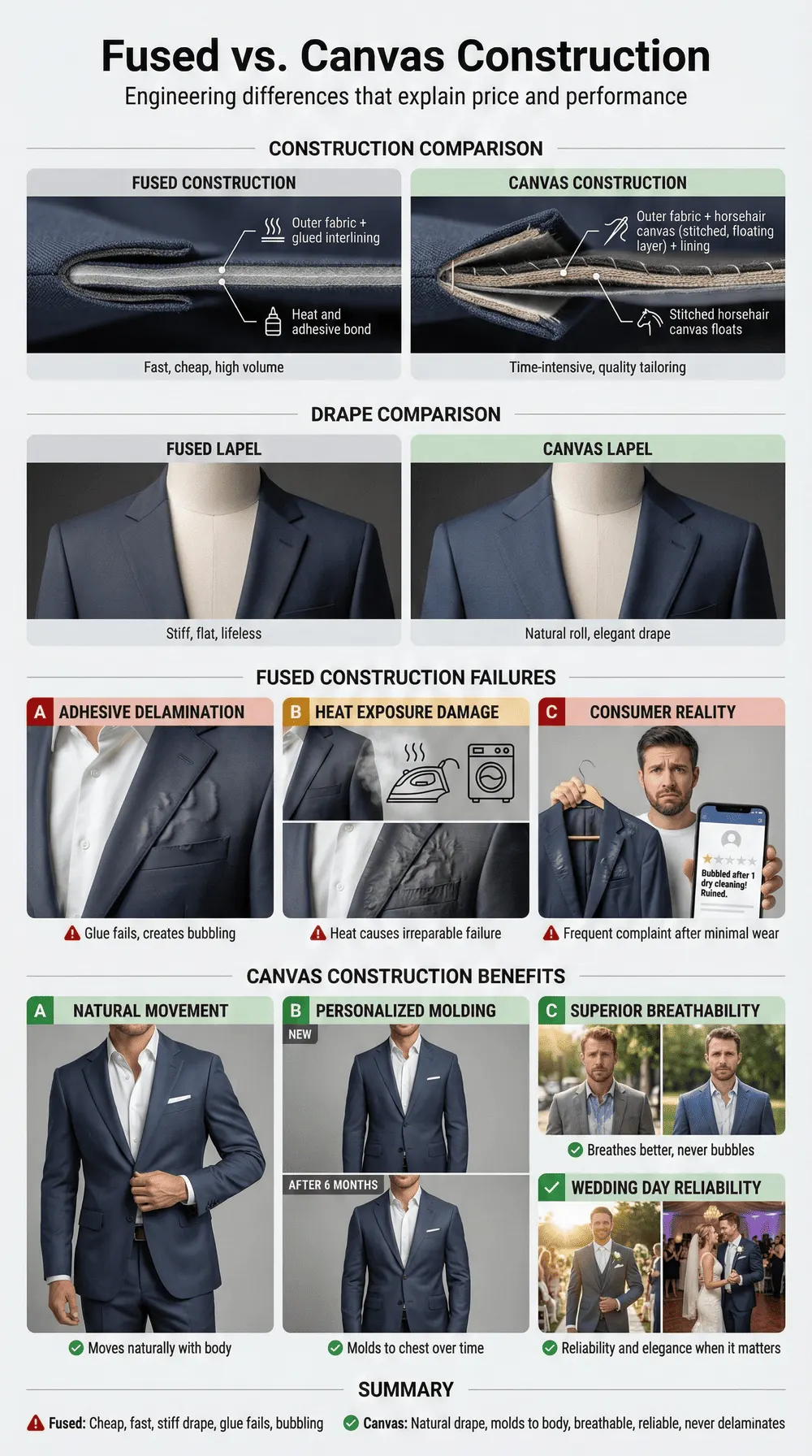
Fast-fashion suits use fused construction, where an interlining is glued to the outer fabric using heat and adhesive. This method is fast and inexpensive, allowing manufacturers to produce high volumes at low cost. However, the glue creates stiffness that prevents the fabric from draping naturally. The lapel does not roll smoothly over the chest but instead sits flat and lifeless.
More problematically, the adhesive can fail over time. Exposure to heat, whether from weather, body temperature, or dry cleaning, can cause the glue to delaminate. This creates visible bubbling on the jacket front, an irreparable flaw that ruins the garment. Consumer reviews of fast-fashion suits frequently mention this bubbling after minimal wear, particularly after dry cleaning.
Quality tailoring uses canvas construction, where a layer of horsehair canvas is stitched between the outer fabric and lining. This canvas floats, allowing the fabric to move naturally with the body. The jacket molds to the wearer's chest over time, becoming more comfortable and personalized with wear. Canvas construction breathes better, drapes more elegantly, and never bubbles or delaminates.
For a wedding, where the suit must look impeccable from the ceremony through the reception, canvas construction provides reliability that fused jackets cannot match. The natural drape creates a more flattering silhouette in photographs, and the breathability improves comfort during extended wear.
Fabric quality and performance
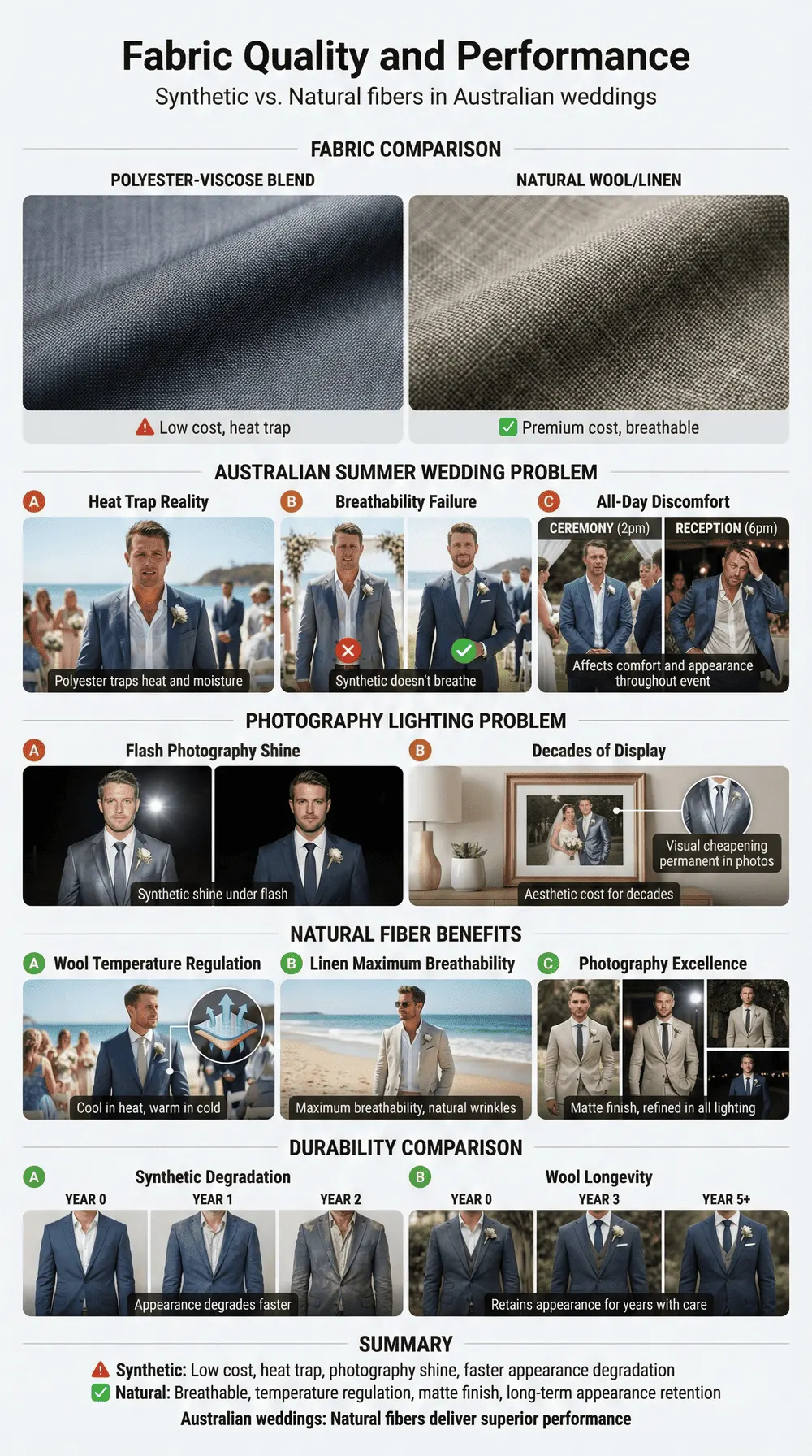
Fast-fashion brands achieve low prices partly through fabric selection. Polyester-viscose blends cost significantly less than wool, and they offer advantages in durability and wrinkle resistance. However, these synthetic fabrics perform poorly in the specific conditions of Australian weddings.
Polyester traps heat and moisture, creating discomfort in warm weather. The fabric does not breathe, causing the wearer to sweat more and feel hotter than they would in natural fibers. For outdoor summer weddings, this can be genuinely unpleasant, affecting the wearer's comfort and appearance throughout the event.
Synthetic fabrics also exhibit characteristic shine under photography lighting. The plastic-like sheen becomes more pronounced under camera flash, creating an appearance that reads as cheap in photographs. For a groom whose wedding photos will be displayed for decades, this visual cheapening represents a significant aesthetic cost.
Natural fibers like wool and linen offer superior performance. Wool regulates temperature, keeping the wearer cool in heat and warm in cold. It breathes effectively, wicking moisture away from the body. Linen provides maximum breathability for hot weather, though it wrinkles more easily. These natural fibers also photograph better, with a matte finish that appears more refined under various lighting conditions.
The durability equation is complex. Synthetic fabrics resist wrinkling and can withstand machine washing, making them practical for frequent casual wear. However, they degrade faster in terms of appearance. The fibers pill, the colors fade, and any stretch components lose elasticity over time. Wool, while requiring more careful maintenance, retains its appearance and structure for years when properly cared for.
4. Comprehensive strength and weakness of each fast-fashion brands
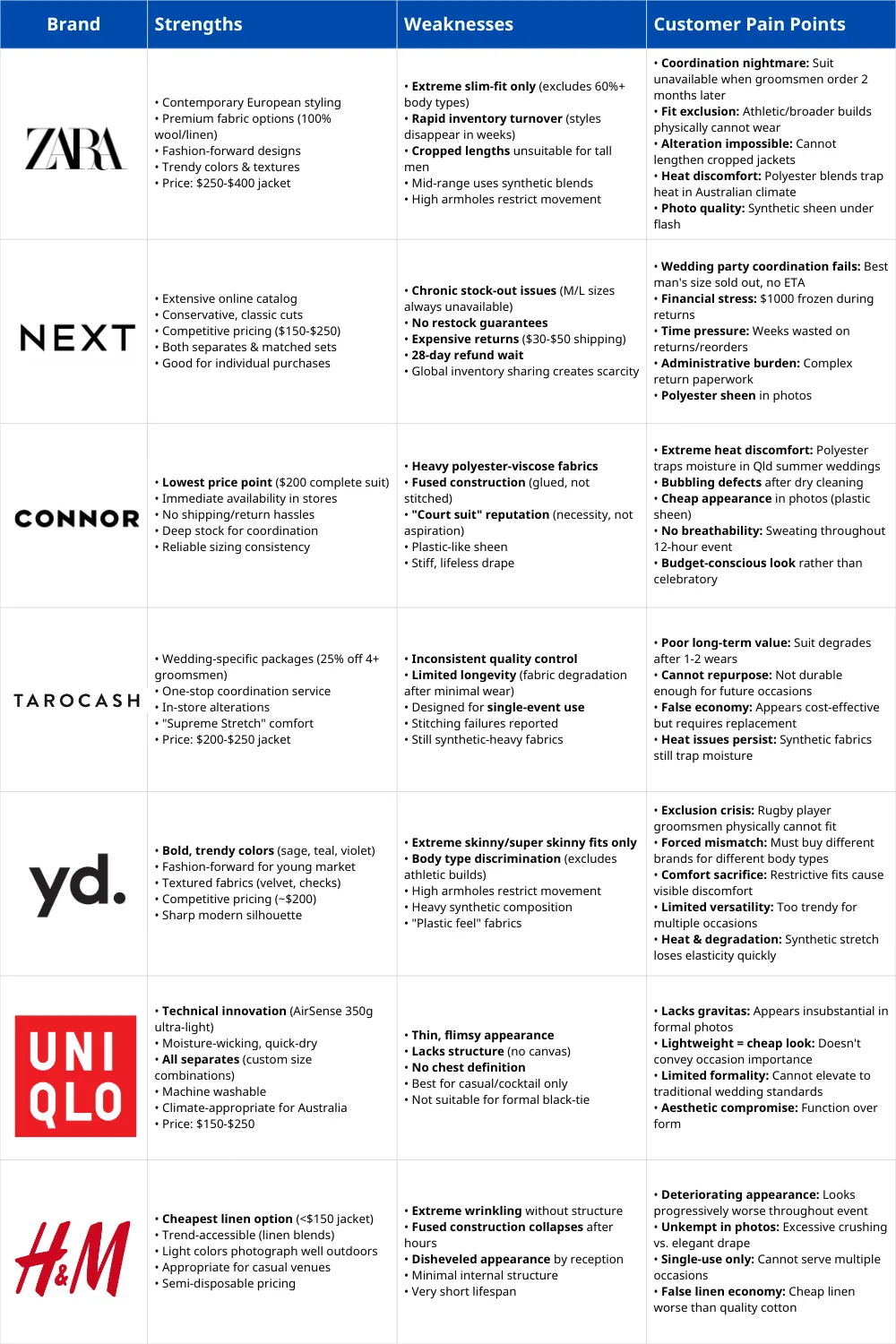
That $200 Connor suit? It'll actually cost you $1,440 over five years and still look cheap in your wedding photos. The Tarocash "slim fit"? It's designed for a statistical average that doesn't exist, leaving 87% of Australian grooms settling for an ill-fitting compromise. The Next polyester blend? It'll start showing visible wear after just 18 months, forcing you to buy another mediocre suit for your next formal event.
The truth is this: Fast-fashion brands have built their entire business model on hidden costs, systematic fit failures, and planned obsolescence. And Australian grooms, especially those planning weddings are paying the price in wasted money, wasted time, and wedding photos they'll regret for decades.
Before we reveal how Dunnio Tailor's bespoke approach solves every single one of these problems in the next blog, you need to understand exactly what you're up against. Let's break down the comprehensive strengths and weaknesses of each major fast-fashion brand operating in Australia so you can see precisely why "cheap" suits are actually the most expensive mistake you can make.
5. Strategic recommendations by role
The optimal fast-fashion strategy depends entirely on the wearer's role in the wedding and their future use intentions.
For the groom
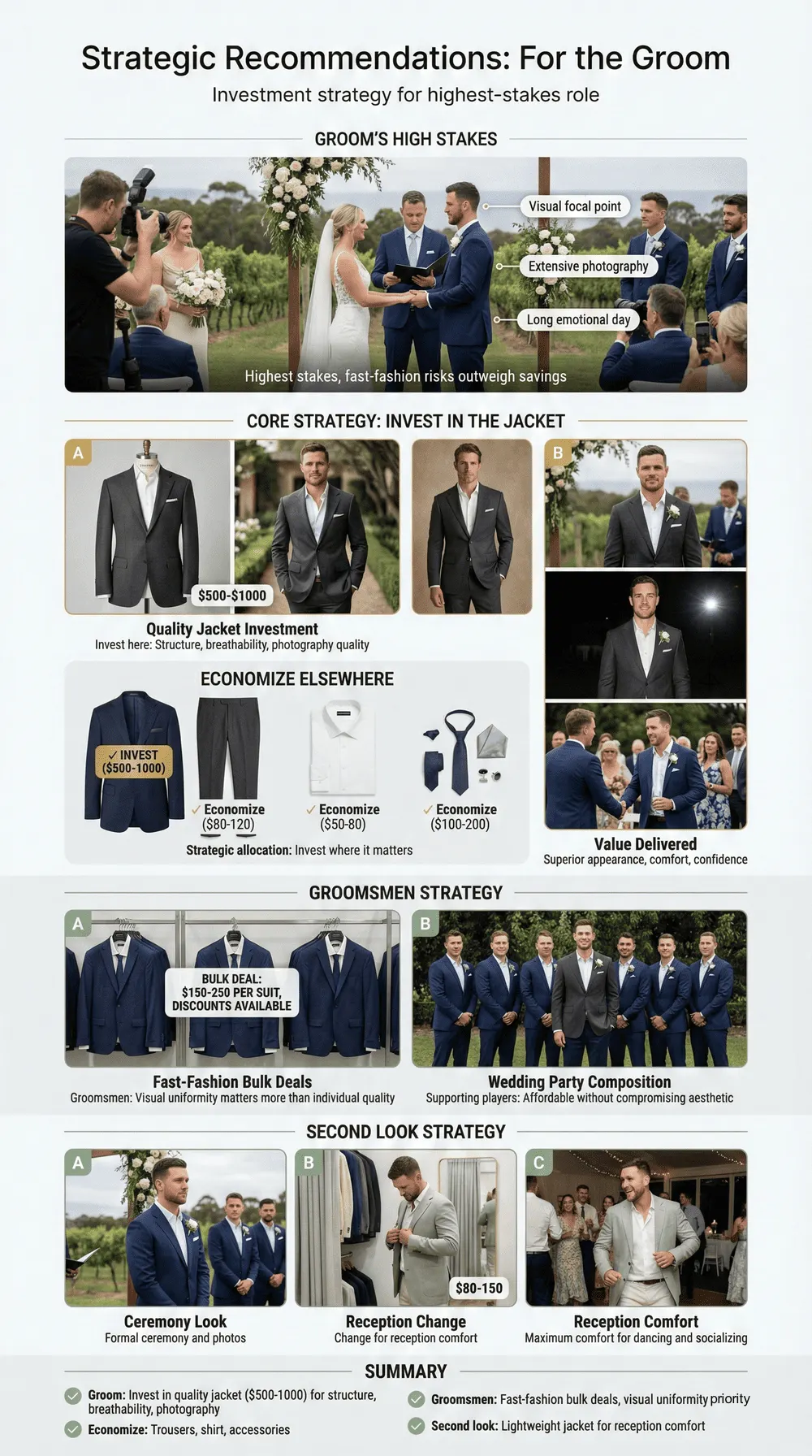
The groom faces the highest stakes. He is the visual focal point of the ceremony, will be photographed extensively, and needs to feel confident and comfortable throughout a long, emotionally intense day. For this role, fast fashion presents significant risks that often outweigh the cost savings.
The recommended strategy is to invest in the jacket while economizing elsewhere. A quality wool or linen jacket from a premium retailer or made-to-measure tailor ensures proper structure, breathability, and photographic quality. This investment typically ranges from five hundred to one thousand dollars but delivers value through superior appearance and comfort.
For the groomsmen, however, the groom can leverage fast-fashion bulk deals from Tarocash or Hallenstein Brothers. The visual uniformity of the groomsmen matters more than the individual fabric quality of their suits. As supporting players in the visual composition, groomsmen can wear more affordable options without compromising the overall aesthetic, provided they are properly coordinated.
Many grooms also benefit from a second look strategy. Purchasing a lightweight Uniqlo linen jacket for the reception allows the groom to change out of his formal ceremony suit into something more comfortable for dancing and socializing. This approach maximizes comfort without sacrificing the formality required for the ceremony and formal photographs.
For the groomsman
Groomsmen occupy a supporting role where coordination and comfort are the primary concerns. The recommended strategy is to prioritize fit over fabric quality.
If the groom dictates a specific color but leaves the brand open, groomsmen with non-standard body types should choose retailers offering separates, such as Uniqlo or Target. The ability to buy jacket and trouser sizes independently is crucial for achieving comfortable fit across diverse body types.
When purchasing from brands like Connor or YD, sizing up in the jacket to ensure comfortable shoulders, then paying a local tailor to suppress the waist, often produces better results than buying a smaller size that fits the torso but restricts movement. This tailored cheap suit approach can look better than an unaltered expensive one, particularly in group photographs where individual fabric quality is less apparent than overall fit and coordination.
Groomsmen should also communicate honestly with the groom about fit concerns. Wearing an uncomfortably tight suit to maintain uniformity creates visible discomfort in photographs and diminishes enjoyment of the celebration. A good groom will prioritize his friends' comfort over rigid aesthetic uniformity.

For the guest
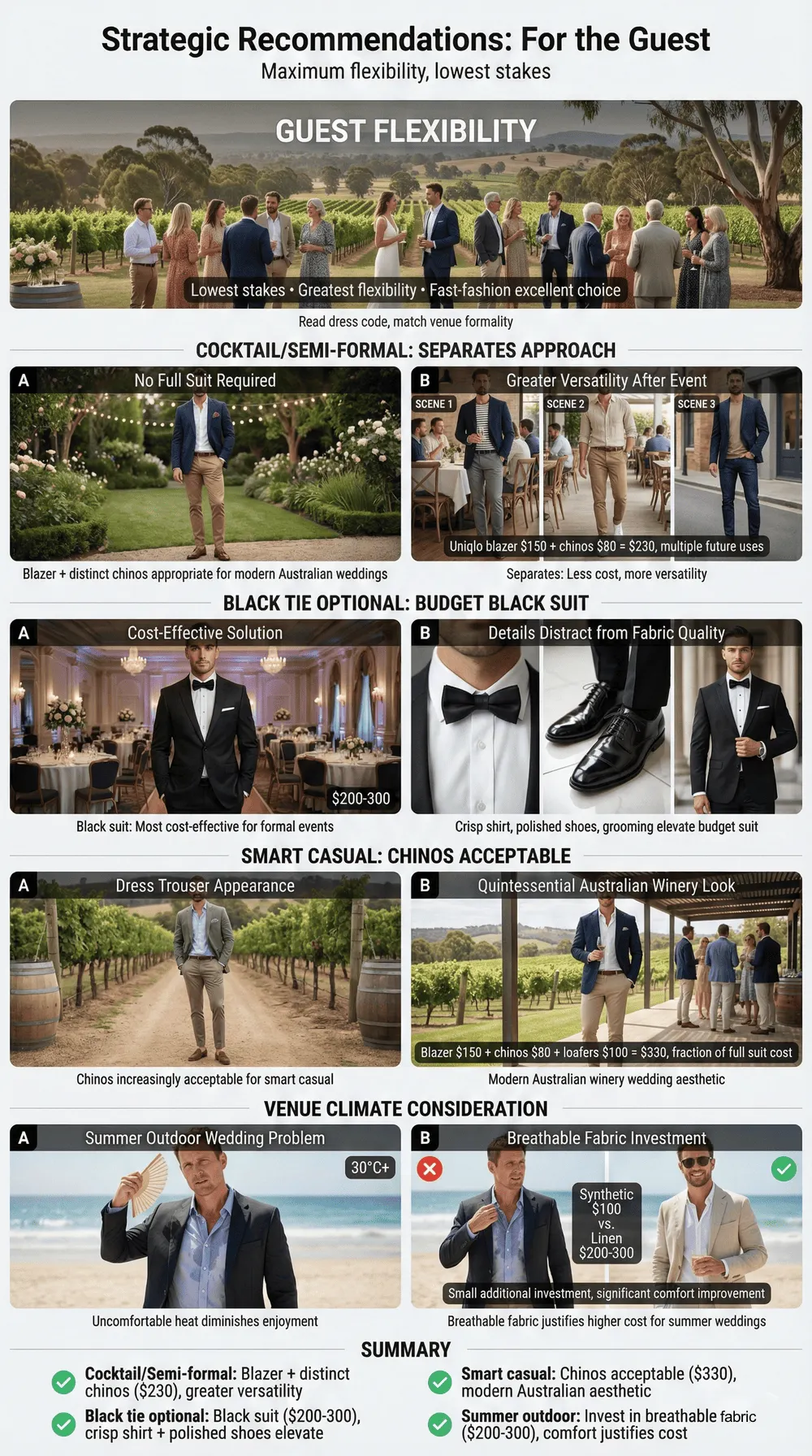
Guests have the most flexibility and the lowest stakes, making fast fashion often an excellent choice for this role. The recommended strategy is to read the dress code carefully and match the venue's formality level.
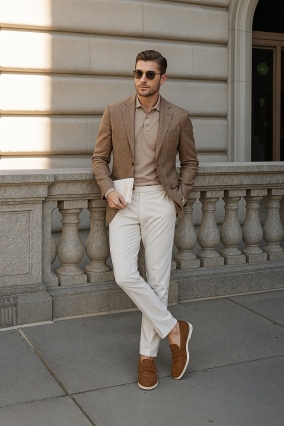
For cocktail or semi-formal weddings, guests should not feel obligated to wear a full matching suit. A Uniqlo blazer paired with distinct chinos, such as a navy jacket with tan trousers, is entirely appropriate for modern Australian weddings and offers greater wardrobe versatility after the event. This separates approach costs less than a full suit while providing more future use options.
For black tie optional events, a black suit from Hallenstein Brothers or Connor represents the most cost-effective solution. The key is ensuring the shirt is crisp white and the shoes are polished. These details draw attention and distract from lower fabric quality. A well-groomed appearance with attention to accessories can elevate even a budget suit.
For smart casual weddings, chinos are increasingly acceptable. Brands like Country Road or Uniqlo offer chinos that mimic dress trousers in appearance. Paired with a blazer and loafers worn without socks, this creates the quintessential Australian winery wedding look at a fraction of the cost of a full suit.
Guests should also consider the venue climate. For summer outdoor weddings, investing in a linen or lightweight wool jacket provides comfort that justifies higher cost. Being uncomfortably hot throughout a celebration diminishes enjoyment and creates visible discomfort in photographs. The relatively small additional investment in breathable fabric delivers significant quality-of-life improvement.
6. When fast fashion makes sense and when to invest
The analysis reveals that fast fashion serves specific use cases effectively while failing in others. Understanding these boundaries helps consumers make informed decisions.
-
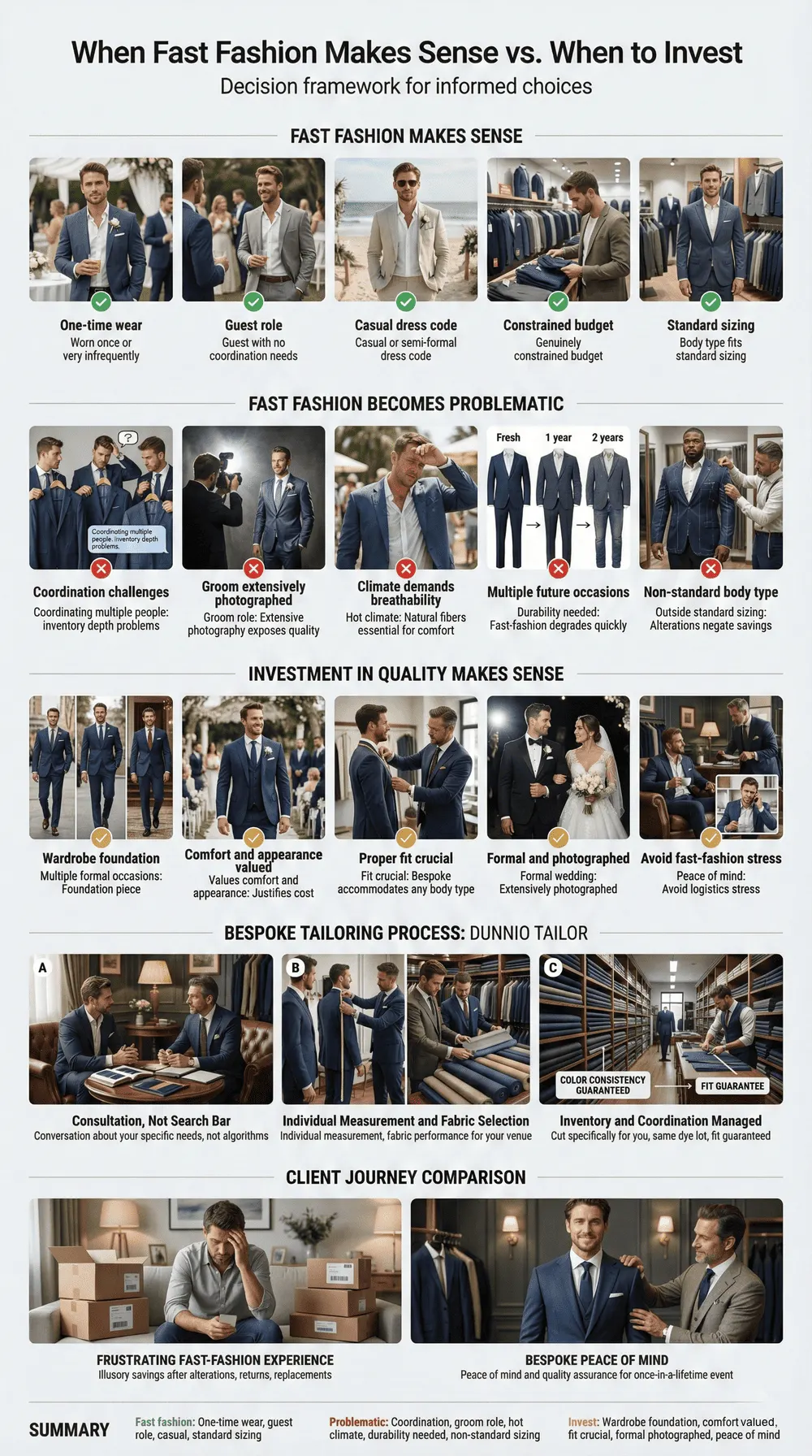
Fast fashion makes sense when: the suit will be worn once or very infrequently, making cost per wear favorable; the wearer is a guest with no coordination requirements; the dress code is casual or semi-formal, reducing the need for premium construction; the budget is genuinely constrained, making any suit better than no suit; the wearer's body type fits standard fast-fashion sizing without significant alterations.
-
Fast fashion becomes problematic when: coordinating multiple people requires inventory depth and consistency; the wearer is the groom and will be extensively photographed; the climate demands breathable natural fibers for comfort; the suit needs to serve multiple future occasions, requiring durability; the wearer's body type falls outside standard sizing, requiring extensive alterations that negate cost savings.
-
Investment in quality tailoring makes sense when: the suit serves as a wardrobe foundation for multiple formal occasions; the wearer values comfort and appearance enough to justify higher cost; proper fit is crucial, either for aesthetic reasons or because the body type does not match standard sizing; the wedding is formal and will be extensively photographed; the wearer wants to avoid the stress and uncertainty of fast-fashion logistics.
At Dunnio Tailor, we work with clients across this spectrum. Some come to us after frustrating fast-fashion experiences, having learned that the advertised savings were illusory once alterations, returns, and replacements were factored in. Others come directly, recognizing that for a once-in-a-lifetime event, the peace of mind and quality assurance of bespoke tailoring justify the investment.
The consultation process begins not with a search bar but with a conversation about your specific needs, body type, and wedding context. We measure you and your groomsmen individually, accounting for every postural quirk and body variation. We help you select fabrics that will perform well in your specific venue and climate, whether that means breathable Australian merino wool or structured Irish linen.
Most importantly, we manage the inventory and coordination challenges that plague fast-fashion wedding parties. We do not run out of your size because we cut your suit specifically for you from fabric rolls. We ensure color consistency because all suits in your party are cut from the same dye lot. We provide fit guarantees because our reputation depends on your satisfaction, not on processing high volumes of transactions.
7. Understanding the Australian market context
The Australian wedding suit market operates within unique cultural and climatic conditions that influence which fast-fashion options perform well and which fail.
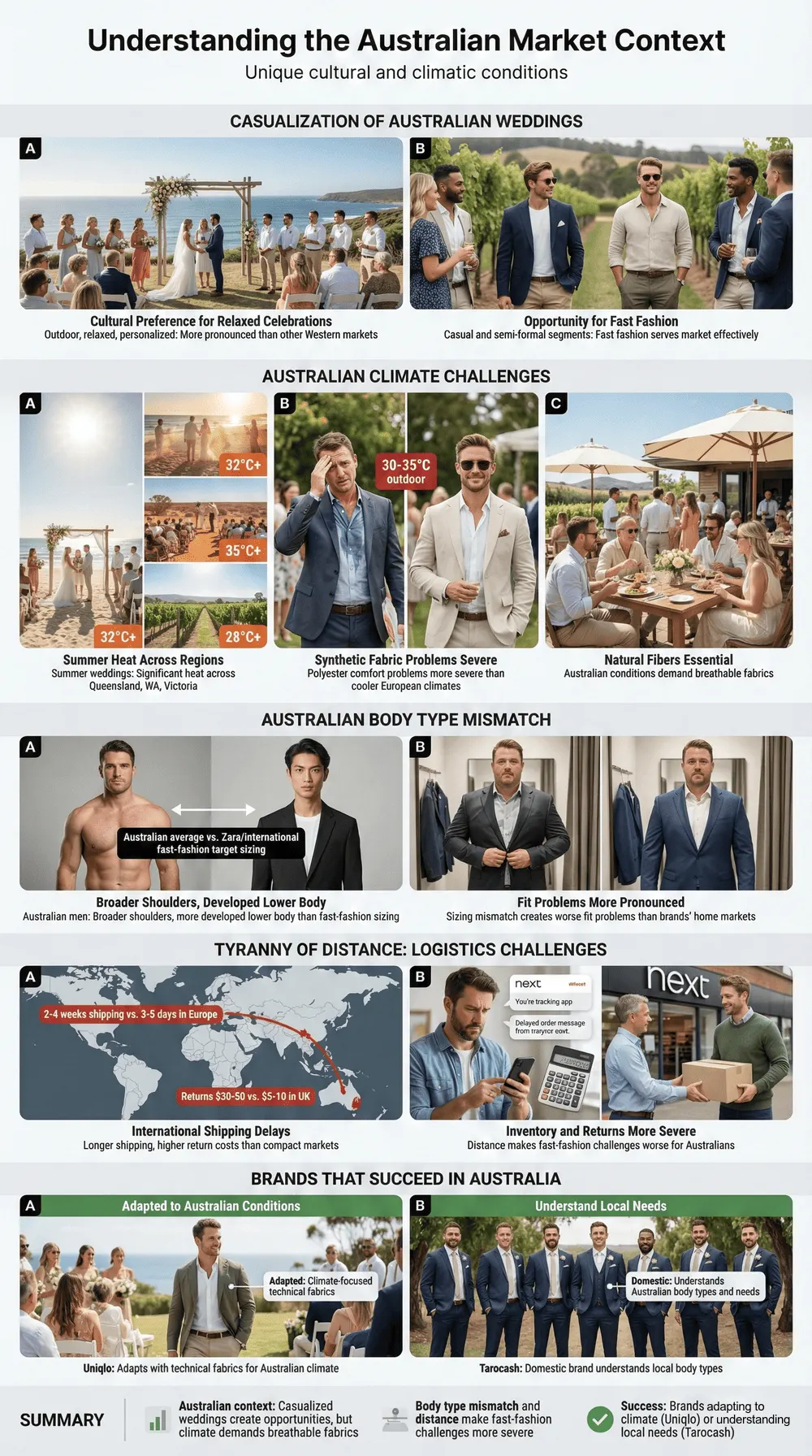
The casualization of Australian weddings has been more pronounced than in other Western markets. The cultural preference for outdoor celebrations, relaxed venues, and personalized ceremonies has made rigid formality feel out of place. This shift has created genuine opportunities for fast fashion to serve the market effectively, particularly in the casual and semi-formal segments.
However, the Australian climate presents challenges for synthetic fabrics. Summer weddings in Queensland, outdoor ceremonies in Western Australia, and even spring celebrations in Victoria can involve significant heat. Fast-fashion reliance on polyester creates comfort problems that are more severe in Australian conditions than in cooler European climates where many of these brands originated.
The Australian male body type also differs from the European and Asian sizing standards that dominate fast fashion. The average Australian man has broader shoulders and a more developed lower body than the slim builds that brands like Zara target. This mismatch creates fit problems that are more pronounced in Australia than in the brands' home markets.
The tyranny of distance affects logistics. International shipping from Europe or Asia takes longer and costs more for returns than in more compact markets. This makes the inventory and returns challenges of brands like Next more severe for Australian consumers than for their British counterparts.
These factors mean that fast-fashion wedding suits require more careful evaluation in the Australian context than generic international advice might suggest. The brands that succeed here are those that either adapt to Australian conditions, like Uniqlo with its climate-focused technical fabrics, or domestic brands like Tarocash that understand local needs and body types.
Conclusion: Making informed decisions in the fast-fashion wedding landscape
The top fast-fashion brands that have wedding suits in Australia offer a spectrum of options, each with distinct strengths and limitations. Zara wedding suits provide fashion-forward styling for slender builds but exclude broader body types and suffer from inventory instability. Next mens wedding suits offer extensive selection at competitive prices but present significant stock availability and returns logistics challenges. Domestic brands like Connor, Tarocash, and YD provide convenience and reliability but with compromises in fabric quality and construction.
Emerging players like Uniqlo bring technical innovation that addresses Australian climate challenges, while H&M democratizes trend access through affordable linen options. Each brand serves specific use cases effectively while failing in others.
For guests attending individual weddings, fast fashion often represents excellent value, particularly when dress codes are casual and the suit will see limited future use. For groomsmen, coordination challenges and fit diversity require careful brand selection, with separates-focused retailers and bulk-deal specialists offering the best solutions. For grooms, the stakes are high enough that the cost savings of fast fashion often prove illusory once alterations, comfort, and photographic quality are considered.
The key to navigating this landscape successfully is understanding that the price tag represents only one component of value. True cost includes alterations, returns, coordination stress, and the opportunity cost of time. True value includes comfort, confidence, photographic quality, and longevity.
At Dunnio Tailor, we believe that informed consumers make better decisions. Whether you ultimately choose fast fashion for its accessibility or invest in bespoke tailoring for its quality and service, understanding the trade-offs allows you to select the option that best serves your specific needs, budget, and wedding context. Your wedding is a permanent memory, and the suit you wear becomes part of that memory. Choose wisely, with full awareness of what you are gaining and what you are sacrificing in pursuit of value.
For more guidance on wedding suit selection, explore our comprehensive resources on:
-
Our guide to mens suits and tuxedos provides technical insights,
-
While the Australian guide to mens wedding fashion and wedding men jackets guideline offer specialized advice for navigating the unique challenges of dressing for Australian weddings.
When choosing groom's suits at Dunnio Tailor, you will receive:
- Tailoring is based on personal measurements.
- Customize according to preferences.
- Instructions from a professional technical team.
- Tailored by skilled craftsmen.
- Fitting and adjusting as required.
- Fabric pattern options with a collection of more than 500 different fabric patterns.
- Free 720-day warranty.
- Free hangers and specialized storage bags.
- Support and shipping policies for international customers.
Hotline - WhatsApp: +84 968996668
Email: support@dunniotailor.com