Table of Contents[Hide]
- 1. Understanding the Formal Dress Code Hierarchy
- 2. White Tie: The Pinnacle of Formal Elegance
- 3. Black Tie: The Modern Formal Standard
- 4. Choosing the Right Formal Attire for Your Body Type
- 5. Regional Considerations: US vs. AUS/NZ Markets
- 6. The Economics of Formal Wear: Rental vs. Custom-Made
- 7. Wedding Dress Code Etiquette: Roles and Responsibilities
- 8. Materials Matter: Fabrics, Weaves, and Quality Indicators
- 9. Accessories and Final Touches
- 10. Frequently Asked Questions About White Tie vs Black Tie Attire
- Conclusion
You've just received an elegant invitation embossed with "Black Tie" or the even more intimidating "White Tie" at the bottom. Your first thought? What exactly does that mean, and how do you show up looking impeccable rather than inappropriately dressed? You're not alone. Formal dress codes remain one of the most misunderstood aspects of modern men's style, yet mastering them is essential for weddings, galas, and prestigious events.
White tie represents the pinnacle of formal elegance full evening dress reserved for the most exclusive occasions. Black tie, meanwhile, has become the versatile standard for modern formal events, balancing classical rigor with measured personal expression. This guide breaks down every element of both dress codes, from the anatomy of a tailcoat to choosing the right tuxedo for your body type. Whether you're a groom planning your wedding look with a set of wedding suits, a guest navigating etiquette, or simply investing in quality formal wear, you'll learn exactly what to wear, when, and how to achieve a perfect fit that flatters your unique physique.
1. Understanding the Formal Dress Code Hierarchy
The world of formal evening wear is built on a historical progression that began with the dominance of the tailcoat in the 19th century and eventually gave way to the dinner jacket as a more accessible alternative. Understanding this hierarchy is crucial because the choice between white tie and black tie is almost always dictated by the host via your invitation, not by personal preference.
White tie, often called "full evening dress" or simply "tails," stands at the absolute peak of formality. It is a structured system of black and white garments designed to create a uniform, regal appearance. Black tie referred to as a "tuxedo" in the United States and a "dinner jacket" in Australia and the United Kingdom occupies the tier just below, serving as the standard for high-end evening events while allowing slightly more flexibility in fabric and color choices.
Then there's black tie optional, a modern compromise that acknowledges not everyone owns formal wear while still encouraging guests to dress up. This code permits well-tailored dark suits as an alternative to tuxedos, though the tuxedo remains the preferred choice.

Formal dress code comparison
| Aspect | White Tie | Black Tie | Black Tie Optional |
| Formality Level | Ultra-formal (highest level of elegance) | Formal (standard for high-end social events) | Formal yet relaxed (personal preference allowed) |
| Primary Garment | Evening tailcoat (clawhammer/swallowtail) | Tuxedo/Dinner jacket | Tuxedo or dark conservative suit |
| Waistcoat | White cotton piqué (marcella) | Black silk waistcoat or cummerbund | Optional waistcoat or simple dark vest |
| Neckwear | White piqué bow tie (self-tied) | Black silk bow tie (satin or grosgrain) | Black bow tie or black silk necktie |
| Trouser Detail | Double line of silk braid | Single line of silk braid | Standard formal trouser or single braid |
| Typical Occasions | State dinners, royal affairs, Nobel Prize ceremonies, prestigious opera galas | Evening weddings, charity galas, red carpet events, award ceremonies | Semi-formal weddings, upscale business events, holiday parties |
The rigid nature of white tie is intentional. By suppressing individual flair in favor of collective uniformity, it creates a symphony of elegance that photographers and historians recognize as timeless. Black tie, by contrast, has loosened slightly in recent decades to accommodate midnight blue jackets, velvet textures, and creative lapel choices, making it more accessible for the modern gentleman.
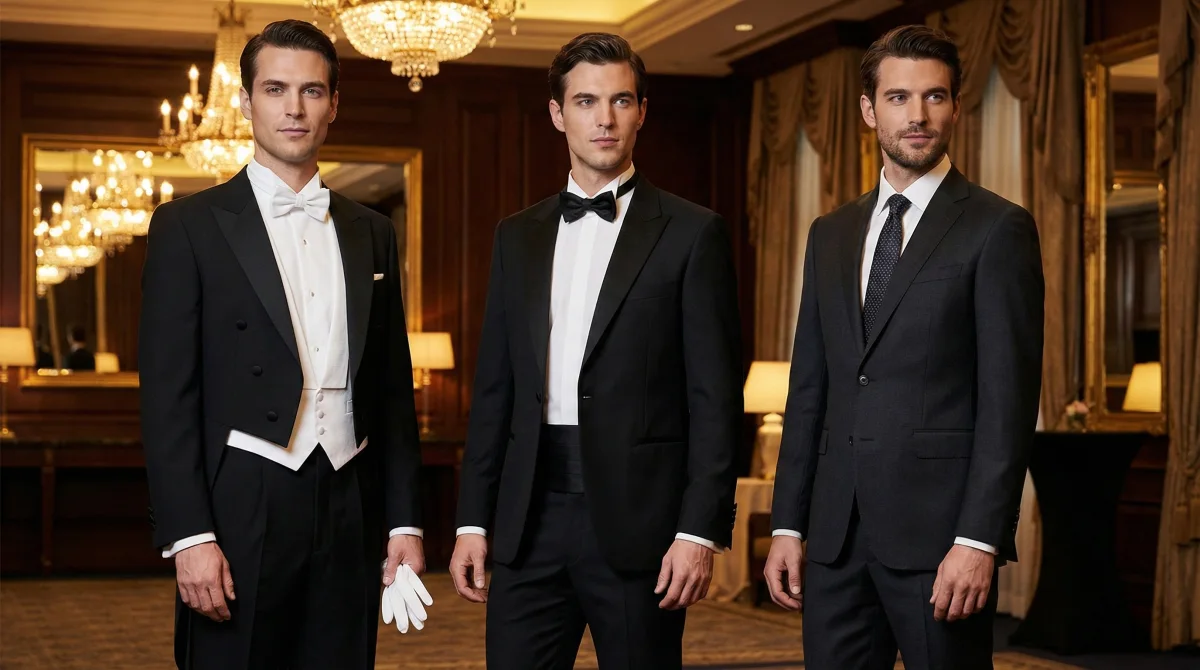
Understanding where each code sits in this hierarchy helps you respect the formality of any occasion while ensuring you're neither overdressed nor underdressed.
Design your perfect-fit tuxedo with Dunnio Tailor's
2. White Tie: The Pinnacle of Formal Elegance
White tie is not just formal it is a complete exercise in sartorial precision. Every element, from the cut of the tailcoat to the texture of the piqué fabric, is engineered to create a silhouette that visually elevates the wearer. This is full evening dress at its finest, a direct descendant of the coats worn throughout the day during the Regency period, now refined into a strictly evening garment.
2.1. The evening tailcoat: anatomy and fit
The defining feature of white tie attire is the black or midnight blue evening tailcoat. Unlike a standard suit jacket, the tailcoat cannot be buttoned in the front. The two rows of buttons you see are purely decorative, a vestige of its 1820s origins. The jacket is cut short at the front, terminating exactly at or slightly below the natural waistline, while the back extends into two tails that must fall precisely to the bend of your knee. This "swallowtail" or "clawhammer" shape creates an unbroken vertical line that makes even average-height men appear taller and more commanding.
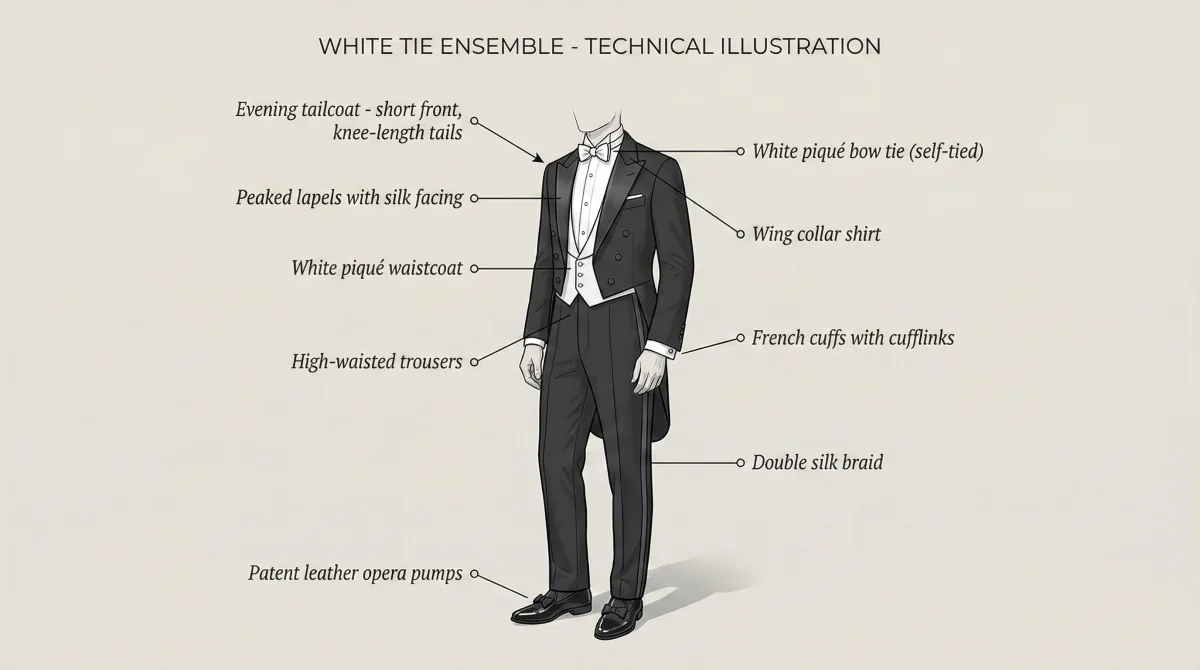
The lapels must be peaked never shawl or notch and faced with silk in either a satin (lustrous) or grosgrain (ribbed, matte) finish. High-quality tailcoats feature exceptionally high armholes, a technique famously employed by Fred Astaire. This prevents the sleeves from pulling at the body during dancing, toasts, or any arm movement, allowing the jacket to remain perfectly seated on the shoulders throughout a long evening.
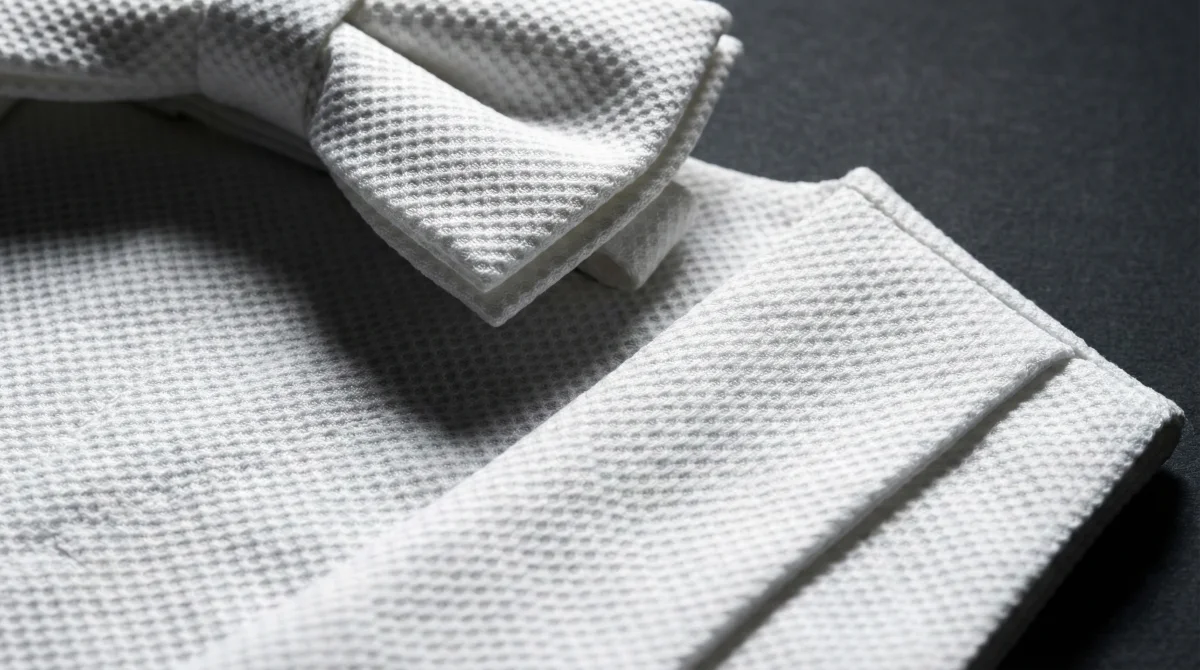
Each sleeve should be tapered and reveal exactly half an inch to one inch of your white shirt cuff. The sleeves terminate in four closely set, silk-covered buttons a hallmark of quality construction.
Body type considerations: For tall and slim men, the tailcoat is extraordinarily flattering. It elongates your natural proportions and creates a regal, distinguished silhouette that photographs beautifully. For men with fuller midsections, the high-waisted trousers combined with a properly fitted white waistcoat create a defined waistline, optically slimming the torso while the black fabric provides vertical contrast that further enhances this effect.
2.2. The piqué essentials: shirt, waistcoat, and bow tie
The "architecture" of white tie hinges on a fabric called marcella or cotton piqué. This material has a distinctive geometric weave that adds texture and structural integrity, giving the ensemble its characteristic crispness.
The formal shirt must be white piqué, featuring a stiff, starched front (bib) that remains flat and unwrinkled even as you move. It requires a high-standing detachable wing collar, secured to the shirt body with small metal studs rather than buttons. French cuffs are mandatory for cufflinks, which should be understated and elegant.
The white waistcoat is made of the same white piqué fabric. It is typically cut in a low V-shape, though antique U-shaped versions exist. The most critical fitting requirement and the most commonly botched element in rental white tie is that the waistcoat must cover the trouser waistband entirely but must not extend below the front points of the tailcoat. When this fit is correct, you create a seamless transition from jacket to waist to trousers. When it's wrong, you get the dreaded "poking out" effect that ruins the clean line.
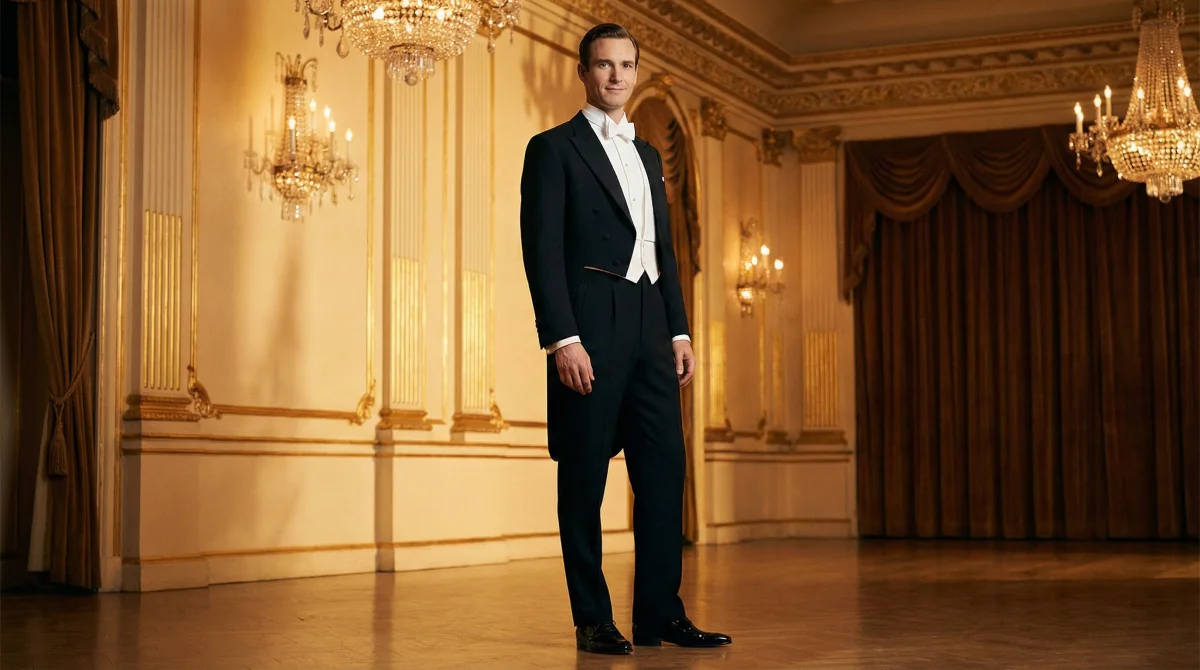
The white bow tie, also crafted from marcella piqué, must be self-tied. Pre-tied clip-ons are unacceptable in true white tie contexts. The bow should be proportionate to your face and the width of your lapels.
Tailoring insight: The waistcoat is the most commonly misfitted element in white tie rentals. At Dunnio Tailor, our measurement system ensures your waistcoat sits precisely at the natural waist, avoiding the "poking out" effect that ruins the clean line. Our artisans hand-finish waistcoat edges for a seamless drape that rental services simply cannot match.
2.3. Trousers and footwear
White tie trousers are constructed from the same fine wool barathea as the tailcoat. They feature an exceptionally high rise to meet the short front of the tailcoat and are distinguished by two parallel lines of silk braid running down the outside of each leg. These trousers are never worn with a belt always with braces (suspenders) to maintain the clean, uninterrupted line at the waist.
For footwear, the most traditional choice is black patent leather opera pumps, characterized by a low-cut vamp and a grosgrain bow across the top. In contemporary settings, highly polished black wholecut oxfords are an acceptable, slightly less formal alternative that many modern gentlemen prefer for their versatility beyond white tie occasions.
2.4. When to wear white tie
White tie is exceedingly rare in modern society, reserved only for the most prestigious and ceremonial occasions:
- State dinners and diplomatic receptions
- Royal events such as coronations or investitures (more common in Commonwealth nations like Australia)
- Prestigious cultural events like opening nights at major opera houses (the Metropolitan Opera in New York, Sydney Opera House)
- Ultra-formal weddings, particularly those involving aristocratic families or high-profile individuals
- Nobel Prize ceremonies and similar international honors
In the United States, white tie has become nearly extinct outside of a few elite social circles and diplomatic functions. In Australia and New Zealand, it occasionally appears at Government House events and royal engagements. If you receive a white tie invitation, it is a significant honor and an absolute mandate there is no "optional" interpretation.
Preparing for a white-tie occasion? Dunnio Tailor's artisan craftsmanship delivers bespoke-quality tailcoats at a fraction of local tailor prices. Explore custom white tie options.


Beige Twill Slim-Fit Pleated Dress Pants - NHDM11
Products in the outfit
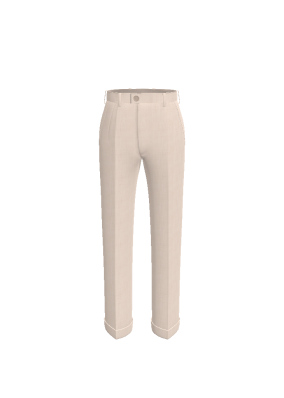
Normal/Straight | Double Pleats | Slanted Pocket | Back Pocket - Single Opening | Single | Cuff Cuff


Cream Beige Linen Cotton Three-Button - CHLN41
Products in the outfit

3 buttons, Single breasted | RegularNotch LapelNo Buttonhole | Curved | 2 Slanted pockets | 3 Working buttons | Side vent
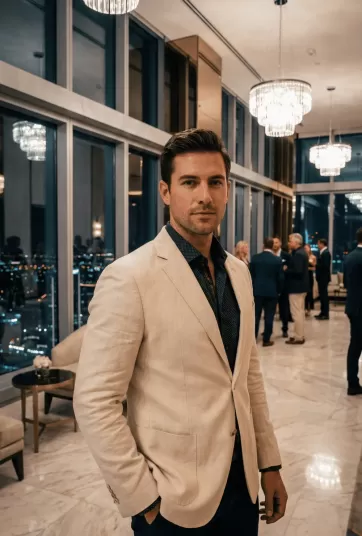
Elegant cream linen-cotton blend jacket
Products in the outfit
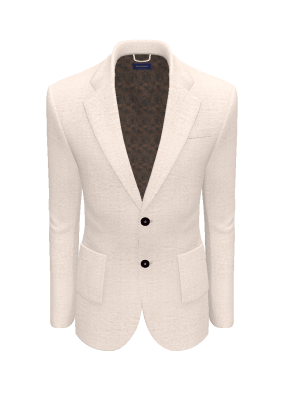
2 Buttons, Single Breasted | RegularNotch LapelNo Buttonhole | Curved | 2 Patched pockets | 4 Standard buttons | Side vent
3. Black Tie: The Modern Formal Standard
Black tie represents the evolution of formal dress toward versatility and accessibility. Originally popularized by the Prince of Wales in the late 19th century as a more comfortable alternative to tails for private dinners, the tuxedo (or dinner jacket) has become the undisputed standard for formal evening occasions worldwide.
3.1. The tuxedo/dinner jacket: essential elements
The dinner jacket is the cornerstone of black tie attire. In North America, it's universally called a "tuxedo" after the Tuxedo Club in New York where it was first introduced to American society. In Australia, the United Kingdom, and New Zealand, "dinner jacket" remains the preferred term.
Lapel geometries offer your first major style decision. Peak lapels are the more formal and authoritative choice. They point upward and outward, emphasizing your shoulders and creating a strong, confident V-shape that photographers love. Shawl collars, by contrast, feature a rounded, continuous curve from collar to lapel that exudes luxurious refinement. This style is particularly popular for double-breasted jackets or velvet dinner jackets worn in winter. Notch lapels common on business suits are generally considered inappropriate for high-end black tie, as they lack the visual drama and formality of the other two styles.
Silk facings distinguish a dinner jacket from a regular suit. The lapels are "faced" with silk, typically in one of two finishes. Satin offers a lustrous, high-shine appearance that catches light beautifully under chandeliers. Grosgrain provides a more understated, matte, ribbed texture that many connoisseurs prefer for its subtlety and longevity.
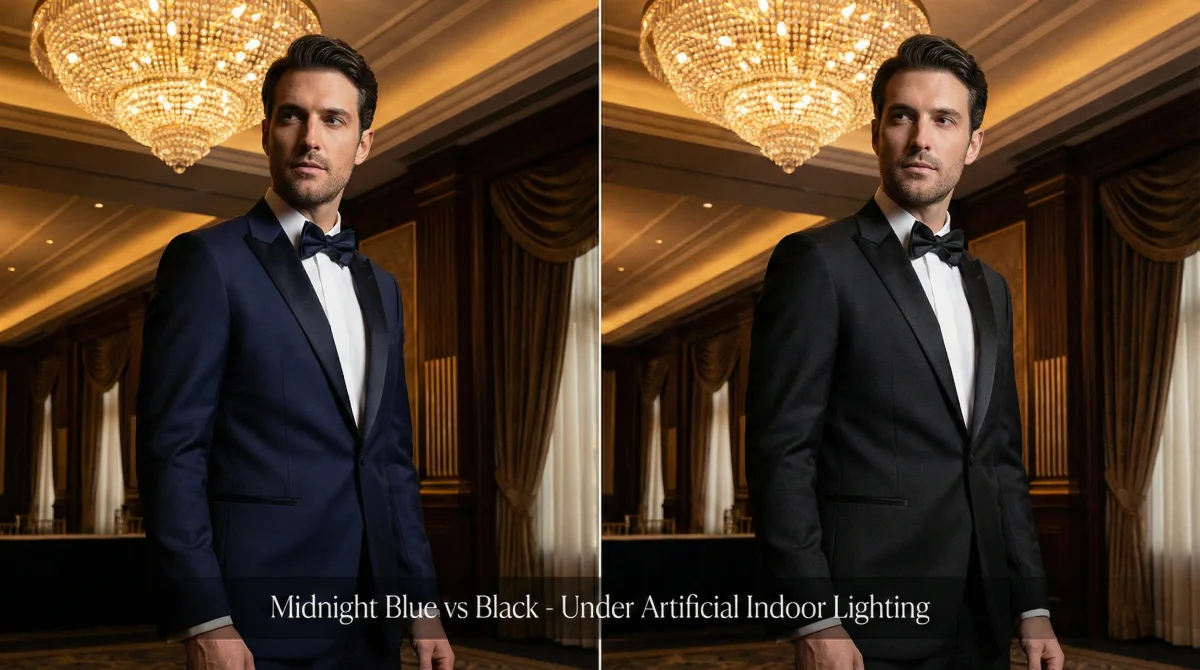
- Color palette: While classic black is the traditional standard, midnight blue has emerged as a superior choice for many formal wear experts. Under artificial indoor lighting the environment where you'll spend most black tie evenings midnight blue appears richer and darker than black fabric, which can sometimes look slightly dusty or gray. This optical phenomenon makes midnight blue the secret weapon of well-dressed men.
- Body type considerations: Men with athletic builds or broad shoulders look commanding in peak lapels, which emphasize width and create a powerful V-shape silhouette. Slender or narrow-shouldered men often prefer shawl collars, which add visual softness and gently round out the upper body. For men carrying extra weight in the midsection, midnight blue's visual depth creates a slimming optical effect superior to black, particularly under the warm, artificial lighting common at wedding receptions and galas.

3.2. The dress shirt and waist covering
A white dress shirt is the non-negotiable foundation of black tie. The best versions feature either a pleated front or a marcella (piqué) bib for added formality and texture. While turndown collars have become the modern standard, wing collars are occasionally worn for a more traditional aesthetic, though some etiquette guides reserve wing collars exclusively for white tie.
The shirt must feature French cuffs to accommodate cufflinks, which should be elegant but understated think simple silver, gold, or mother-of-pearl rather than oversized novelty designs.
Waist coverings serve a practical purpose: hiding the "messy" meeting point where your shirt tucks into your trousers. You have two primary options. A black cummerbund is a pleated silk sash that wraps around your waist, with the pleats always facing upward (historically, they held opera tickets). Cummerbunds are particularly popular in warmer climates and summer weddings because they're cooler than a waistcoat. Alternatively, a low-cut black waistcoat made of silk or fine wool offers a more structured, traditional look favored in cooler months.
Practical tip for fuller figures: For clients with fuller midsections or those who find cummerbunds constricting, Dunnio Tailor recommends adding 1 to 1.5 inches to your natural waist measurement when ordering. This ensures the cummerbund or waistcoat sits comfortably without bunching or rolling, maintaining a smooth line throughout a long evening of sitting, standing, and dancing.
3.3. The black bow tie and accessories
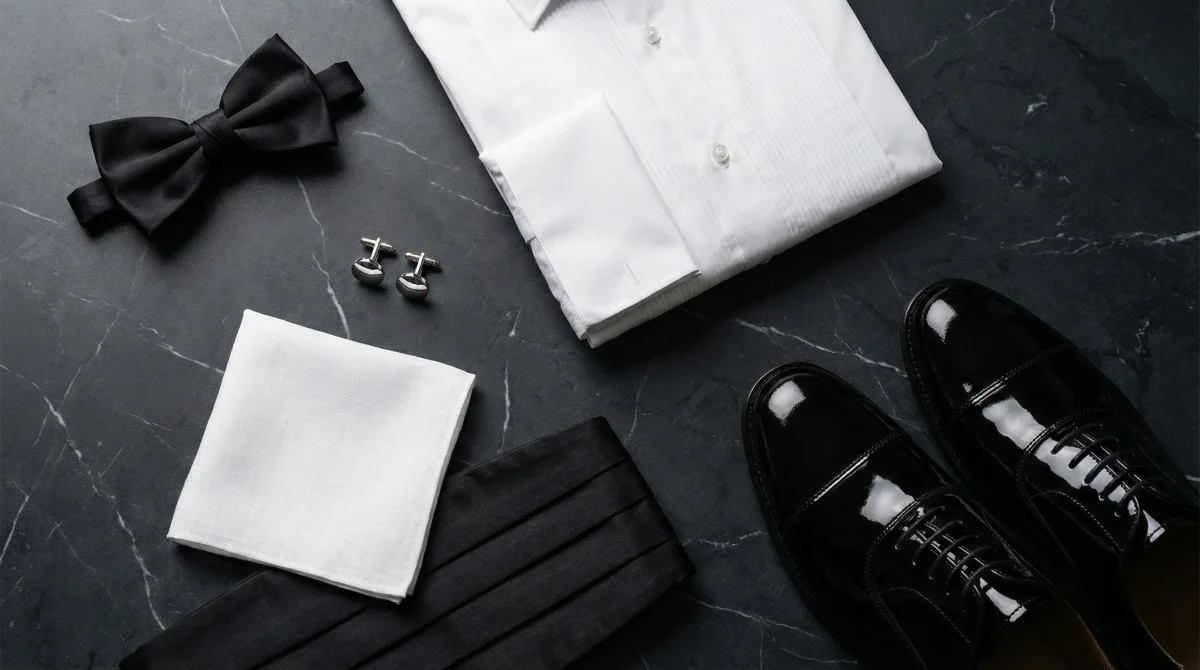
The bow tie is the signature element of black tie attire, and it must be self-tied never a pre-tied clip-on. The fabric should match your lapel facings: satin bow tie with satin lapels, grosgrain with grosgrain. Mixing these creates a subtle but noticeable mismatch that signals carelessness.
The "butterfly" or "thistle" shape is the canonical choice, offering a balanced, classic proportion. "Diamond point" and "batwing" shapes provide vintage or idiosyncratic alternatives for those seeking a more distinctive look, though these should be reserved for men confident in their formal wear knowledge.
The pocket square should be white linen in a simple fold either the classic presidential fold (flat) or a subtle one-point fold. Avoid matching your pocket square exactly to your bow tie, and resist the temptation toward elaborate, overly ornate folds that distract from the overall ensemble.
Cufflinks should be understated: simple silver, gold, or onyx designs that complement without competing. If your shirt requires studs (for a stiff-front or piqué bib), these should match your cufflinks in metal and style.
3.4. Trousers and footwear
Black tie trousers are cut from the same fabric as your dinner jacket and feature a single silk braid (also called a "stripe") running down the outer seam of each leg. Unlike suit trousers, they have no belt loops and no cuffs at the hem. They should be held up with braces for the cleanest waistline.
Footwear offers more flexibility than white tie. Black patent leather oxfords remain the most formal choice, delivering a mirror-like shine perfect for galas and upscale weddings. Well-polished black calfskin oxfords are a versatile alternative, appropriate for black tie while also serving you well in business contexts. For winter "creative black tie" events, velvet loafers particularly those embroidered with a personal crest or monogram add a festive, luxurious touch.
Regional variations: In the United States, patent leather remains the gold standard for formal evening events. In Australia and New Zealand, the more relaxed climate and cultural approach to formality have made polished calfskin the norm, with patent leather reserved for the most elite occasions.
3.5. When to wear black tie
Black tie is far more common than white tie and applies to a broad range of formal evening events:
- Evening weddings, particularly those beginning after 6 PM
- Charity galas and fundraising dinners
- Award ceremonies and red carpet events
- High-end corporate dinners and industry celebrations
- Opening nights at theaters, symphonies, and cultural institutions
- Casino nights, formal holiday parties, and milestone celebrations
The key distinction is that black tie is an evening dress code. Wearing a tuxedo to a daytime event even a formal one is generally considered inappropriate. For daytime weddings and formal events, a well-tailored dark suit is the correct choice.



Dark charcoal grey barathea wedding vintage pants - SP1M29
Products in the outfit
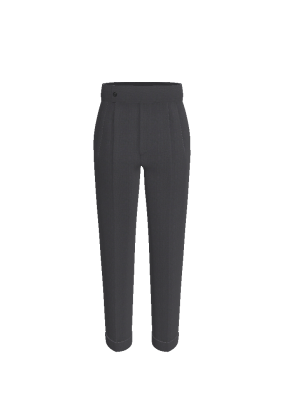
Normal/Straight | Double Pleats | None Pocket | Back Pocket - Single Opening
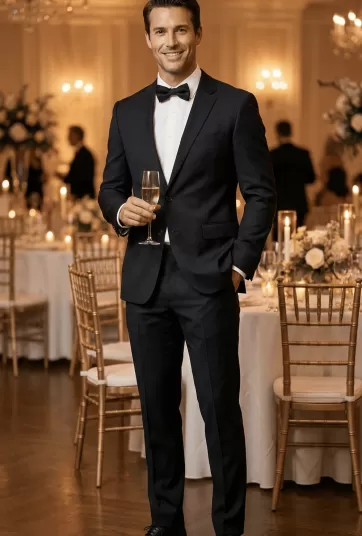
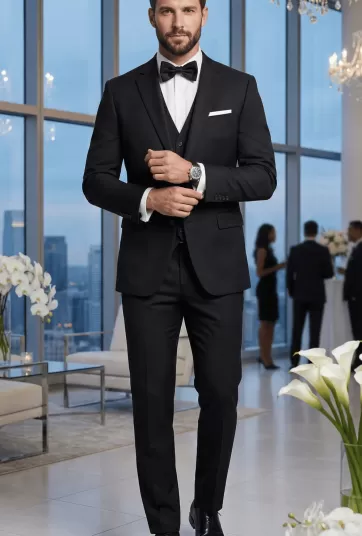
Black Hopsack Cotton Blend Single-Breasted Suit - NHDM13
Products in the outfit
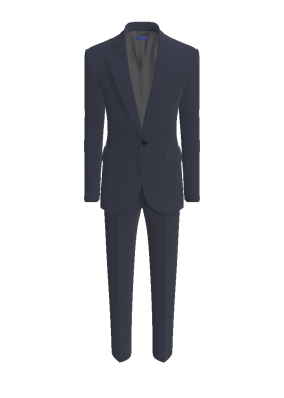
Jacket: 1 Buttons, Single Breasted | RegularNotch LapelNo Buttonhole | Curved | 2 Straight Pockets | 4 Standard Buttons | Side vent - Pant: Narrow/Slim | Single Pleat | Slanted Pocket


Black Pinstripe Double-Breasted Blazer
Products in the outfit

6 Buttons, Double Breasted (2 to Close) | RegularPeak LapelNo Buttonhole | Straight | 2 Straight & 1 ticket pockets | 4 Standard buttons | Side vent


Black Cotton-Linen DB Jacket - Sapphire Plaid Vest - Slate Grey Wool Trousers
Products in the outfit
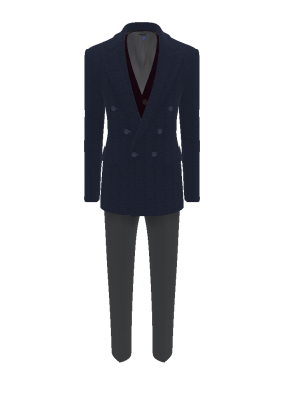
Jacket: 6 Buttons, Double Breasted (1 to Close) | LargerPeak LapelNo Buttonhole | Straight | 2 Straight Pockets | 4 Standard buttons | Side vent - Pant: Narrow/Slim | Single Pleat | Slanted Pocket | Back Pocket - Single Opening | Single | Regular Cuff - Vest: V Neck | 6 Buttons | Single Opening Pocket | Angle Cut | Back Plain -

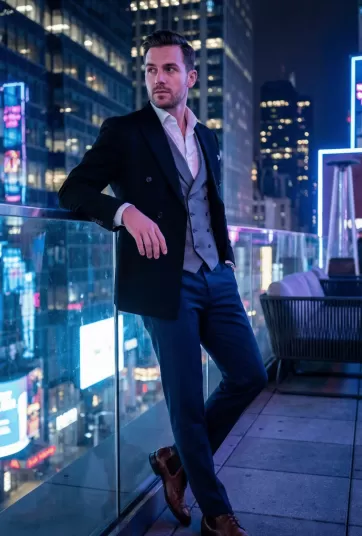

Black Double Breast, Grey Vest, & Navy Pleated Trousers - M3HL44 | M3HL45 | NHDM2 |
Products in the outfit
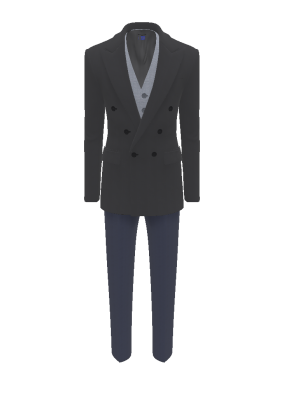
Jacket: 6 Buttons, Double Breasted (1 to Close) | LargerPeak LapelNo Buttonhole | Straight | 2 Straight Pockets | 4 Standard buttons | Side vent - Pant: Narrow/Slim | Single Pleat | Slanted Pocket | Back Pocket - Single Opening | Single | Regular Cuff - Vest: V Neck | 6 Buttons | Single Opening Pocket | Angle Cut | Back Plain -
Create your signature black tie look with Dunnio Tailor. Choose peak or shawl lapels, select midnight blue or classic black, and enjoy a perfect fit all from $199.
4. Choosing the Right Formal Attire for Your Body Type
Formal wear is uniquely flattering because of its structured construction and strategic use of color contrast. Understanding how white tie and black tie garments interact with your specific physique allows you to maximize their built-in advantages while making targeted adjustments for perfect fit and proportion.
Body type and formal wear optimization
| Body Type | White Tie Strategy | Black Tie Strategy | Key Tailoring Adjustments |
| Tall and Slim | Tailcoat elongates frame naturally; white piqué adds visual dimension to chest | Peak lapels create horizontal width; shawl collar adds softness and rounds silhouette | Ensure jacket length hits mid-hand; avoid over-slimming in chest and waist |
| Fuller Midsection | High-waisted trousers + proper waistcoat coverage creates defined waist; black fabric slims | Midnight blue creates superior slimming effect vs. black; single-breasted preferred | Add 1-1.5 inches to waist for comfort; ensure complete waistcoat/cummerbund coverage |
| Athletic/Broad Shoulders | Tailcoat emphasizes natural V-shape; ensure high armholes for mobility during movement | Peak lapels enhance shoulder width; check sleeve pitch for muscular arms | Increase chest/shoulder ease by 0.5-1 inch; specify high armholes to prevent pulling |
| Shorter Stature | Tailcoat can overwhelm; prioritize proportion over tradition if under 5'7" | Higher button stance and shorter jacket length create leg length illusion | Ensure trousers break cleanly at shoe; avoid excessively long tails in white tie |
| Muscular Thighs/Calves | High-rise trousers naturally accommodate; ensure brace buttons positioned correctly | Tapered leg maintains formality while providing comfort in thigh and seat | Add 0.5-1 inch to thigh measurement; ensure full mobility for sitting and dancing |
4.1. The optical power of formal black and white
Formal wear's effectiveness lies in its use of visual contrast and architectural structure. Black formal wear creates strong vertical lines that naturally slim the silhouette. This is particularly beneficial for men carrying extra weight in the midsection, as the unbroken black line from shoulder to shoe combined with the waist-covering function of a cummerbund or waistcoat effectively masks perceived flaws while creating the illusion of a neater, more refined shape.
The white elements in formal wear piqué shirt fronts, white waistcoats, white bow ties add dimension and visual interest. For slender men who may appear overwhelmed by the structure of formal wear, these white accents create contrast that balances the figure and adds presence to the chest area.
The structured construction of formal jackets, including shoulder pads, chest canvassing, and high armholes, creates an architectural shape that flatters all body types by imposing geometric order on the natural human form.
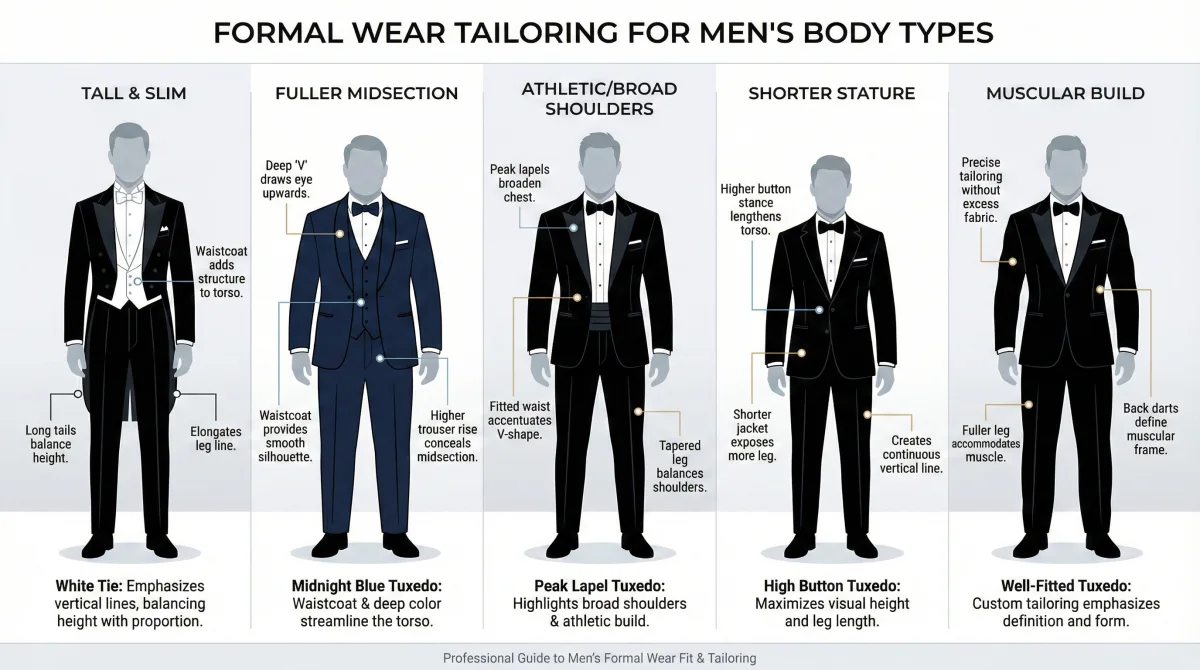
4.2. Practical tailoring tips from Dunnio Tailor
Achieving a perfect fit in formal wear requires precision measurements and an understanding of how you move in these garments.
- For fuller arms, biceps, or thighs: Add 0.5 to 1 inch to your actual measurement when providing dimensions to your tailor. This additional ease ensures the fabric drapes naturally rather than pulling tight when you bend your arm for a toast or sit down at a banquet table.
- For broad shoulders or athletic builds: Request higher armholes in your jacket construction. This prevents the jacket from riding up your back when you raise your arms, a common issue in off-the-rack formalwear that causes constant tugging and adjustment.
- For shorter stature (under 5'8"): Opt for a higher button stance on your dinner jacket, which creates the illusion of longer legs by raising the visual break point. Ensure your jacket length ends precisely at mid-hand when your arms hang naturally at your sides. In white tie, verify that tailcoat tails do not extend past the back of your knee, as excessive length will overwhelm your proportions.
- For tall, slender frames: Ensure your white tie tailcoat tails reach exactly to the bend of your knee no shorter. Verify that your dress shirt cuffs show the standard 0.5 to 1 inch beyond your jacket sleeves. Consider adding a white piqué pocket square to add dimension to your chest.
- Measurement precision: Dunnio Tailor's artisans possess a natural advantage in executing intricate tailoring adjustments. Our small-hand craftsmanship allows for precise shoulder pitch corrections, hand-stitched sleeve heads that create natural drape, and detailed alterations often missed in mass production. For best results, follow our comprehensive measurement guide at this blog post about how to measure each men's body parts for tailoring suits. If you encounter difficulty measuring unique areas of your body, our expert consultation team can provide personalized guidance to ensure your garment achieves nothing short of perfection.
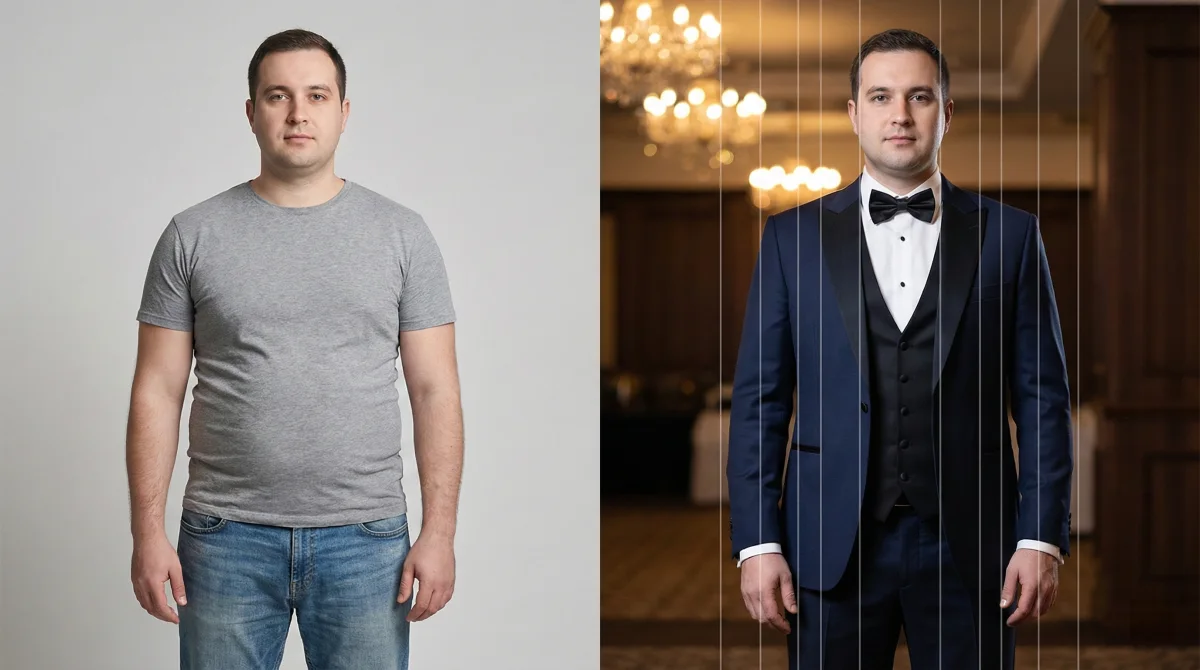
Unsure about your measurements? Contact Dunnio Tailor's expert consultation team for personalized guidance on achieving your ideal formal wear fit.
Hotline - WhatsApp: +84 968996668
Email: support@dunniotailor.com
5. Regional Considerations: US vs. AUS/NZ Markets
While the fundamental rules of formal wear are universal, climate, cultural heritage, and commercial traditions have created distinct regional characteristics in how white tie and black tie are interpreted and worn across the United States, Australia, and New Zealand.
5.1. United States: the tuxedo tradition
The American market is the global leader in tuxedo culture, driven by large-scale weddings, high school proms, and a robust formal event industry.
- Terminology is distinctly American: "tuxedo" and "black tie" are the standard terms, with "dinner jacket" rarely used outside of high-end tailoring circles. The word "tux" has become so embedded in American culture that it's used casually in everyday conversation. Wedding culture in the US often features large wedding parties five to ten groomsmen is common which has fueled a massive rental market. Unlike European tradition, American weddings frequently specify "evening wear" regardless of the actual ceremony time. A 2 PM wedding may still request black tie, a practice that would be considered incorrect in the UK but is widely accepted in the US. Footwear standards lean heavily toward patent leather, particularly for galas and upscale weddings. The high-shine finish is seen as the epitome of formal elegance.
- Fabric weight: Because most formal events take place in climate-controlled indoor venues, heavy wool barathea remains acceptable year-round, even for summer weddings in warm states like Texas or Florida.

5.2. Australia and New Zealand: adaptive formality
The Australasian market demonstrates a more relaxed, pragmatic approach to formal wear, largely driven by climate and cultural attitudes toward European formality. Climate adaptation is essential. Sydney, Melbourne, and Auckland experience warm to hot summers, and many formal events particularly weddings take place outdoors or in venues with limited air conditioning. This has necessitated the adoption of lightweight wool, linen blends, and breathable linings that maintain formal elegance while accommodating heat.
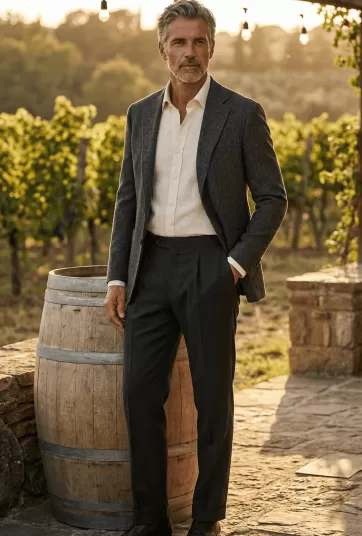
- Terminology is hybrid: both "dinner jacket" (the British term) and "tuxedo" (the American term) are used interchangeably, reflecting Australia's cultural position between British heritage and American influence. Footwear preferences skew toward highly polished calfskin over patent leather. This choice reflects both the warmer climate (patent leather can be uncomfortable in heat) and a slightly more relaxed interpretation of formality. Outdoor venues are common for Australian and New Zealand weddings, from beachfront ceremonies to vineyard receptions. Breathable fabrics and lighter construction are not just preferences but necessities.
- Climate-smart tailoring: For AUS/NZ clients, Dunnio Tailor offers lightweight wool-linen blends and breathable cupro or Bemberg linings that maintain formal elegance while accommodating warmer climates without the premium upcharge typical of local tailors who may charge $2,000 or more for climate-adapted formal wear.

Attending a formal event in Sydney, Melbourne, Auckland, or across the US? Dunnio Tailor ships internationally with fabrics optimized for your climate. Explore options.
6. The Economics of Formal Wear: Rental vs. Custom-Made
For many men, the decision between renting and owning formal wear comes down to simple mathematics: how often will you wear it, and what is the cost per wear? Understanding this calculation helps you make a smart financial decision while securing the superior fit that only custom tailoring provides.
Cost comparison 2025-2026
| Option | Cost Per Event | Total Investment | Fit Quality | When It Makes Sense |
| Standard Rental | $99-$150 | $99-$150 per event | Generic sizing with limited alterations | One-time event with no anticipated future formal occasions |
| Premium Rental | $150-$200 | $150-$200 per event | Better fabric quality, basic fit adjustments | 1-2 events total, or testing style preferences before purchase |
| Dunnio Tailor Custom | $48-$200 per event* | $144-$600 total | Perfect fit with personalized details | 3 or more events over 2-3 years |
| Local Bespoke Tailor | $500-$3,333 per event* | $1,500-$10,000+ total | Perfect fit with in-person fittings | Unlimited budget or very frequent formal wear |
6.1. The smart investment calculation
The cost-per-wear formula is simple: divide your total investment (purchase price plus any maintenance costs) by the number of times you wear the garment. This reveals the true cost of your formal wear strategy.
- Rental scenario: A man attending three formal events over two years who rents a premium tuxedo each time at $175 per rental spends $525 total with no asset to show for it afterward.
- Dunnio Tailor scenario: That same man invests $400 in a custom midnight blue tuxedo with peak lapels from Dunnio Tailor. After three wears, his cost per wear is $133 comparable to a single premium rental. After five wears over three years, his cost per wear drops to just $80, and he owns a perfectly fitted garment available whenever needed.
- Local tailor scenario: If he had commissioned the same tuxedo from a local bespoke tailor at $2,200, his cost per wear after three events would be $733 more than four times the rental cost and more than five times the Dunnio Tailor investment.
The advantages of ownership extend beyond pure economics. A custom tuxedo fits your exact measurements, accommodates your body's unique proportions, and can be modified or updated as your physique changes. You control the fabric, the lapel style, the button configuration, and every detail. You never face the disappointment of arriving at a rental shop to find your size unavailable or the fit subpar.

6.2. Why Dunnio Tailor delivers exceptional value
- The question most men ask is logical: how can Dunnio Tailor offer custom-made formal wear at $144 to $600 when local tailors charge $1,500 to $3,000 or more for comparable quality? The answer lies in our artisan advantage and operational model.
- Our tailors possess a natural edge in precision work: smaller hands that execute intricate tasks detailed stitching, precise embroidery, hand-finished buttonholes with an ease that is difficult to replicate. This allows us to deliver bespoke-quality details at a fraction of traditional costs. Our intelligent measurement system uses comprehensive male demographic data to provide accurate fit recommendations, reducing the need for costly in-person fittings while maintaining precision. When you combine this technology with direct-to-consumer delivery, we eliminate the markup layers that make local bespoke tailoring prohibitively expensive. The material quality matches domestic tailors. We source the same premium barathea wool, mohair blends, and silk facings used by high-end tailors in Sydney, Melbourne, New York, and Los Angeles. The difference is price, not quality. For clients seeking truly one-of-a-kind pieces with elevated levels of bespoke personalization hand-painted linings, exotic fabric selections, museum-quality embroidery our premium tier delivers at prices still well below traditional bespoke.
- Real value example: A peak lapel midnight blue tuxedo from Dunnio Tailor costs approximately $400. Worn to five events over three years, your cost per wear is $80. An identical garment from a local tailor at $2,200 would cost $440 per wear over the same usage. You receive authentic custom craftsmanship, perfect fit, and save $1,800 in the process money that can be invested in quality dress shoes, a dress watch, or simply kept in your pocket.
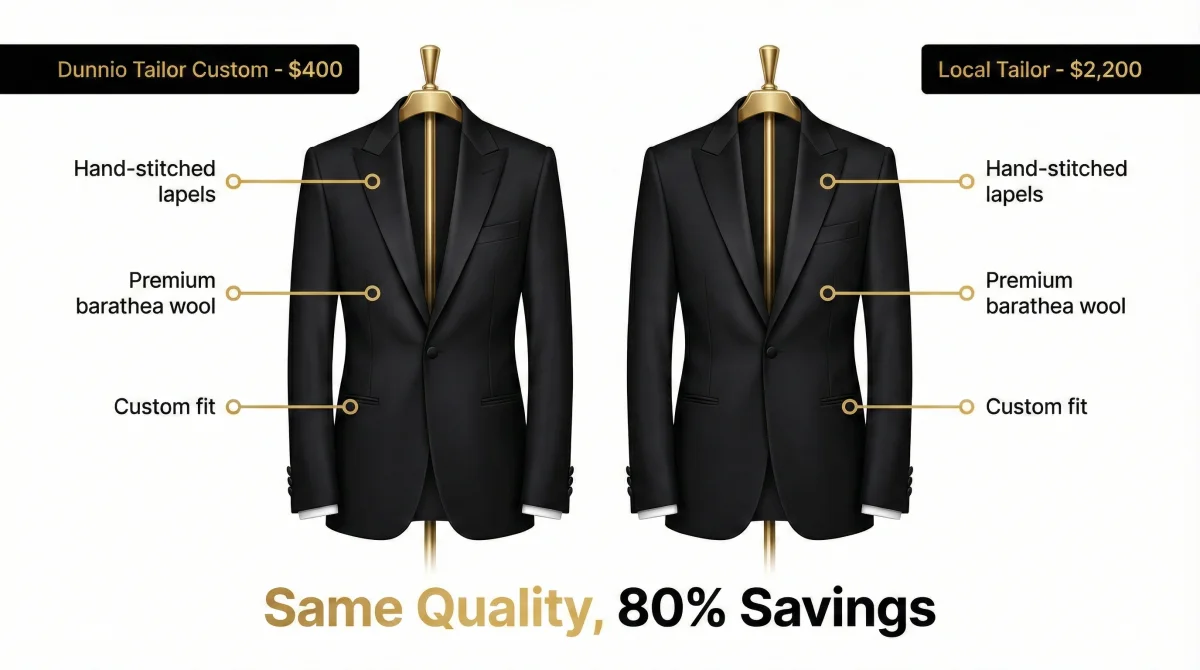
Invest in formal wear that pays for itself. Design your custom tuxedo with Dunnio Tailor's affordable pricing and superior craftsmanship.
7. Wedding Dress Code Etiquette: Roles and Responsibilities
Weddings are the most common context in which modern men encounter formal dress codes. Whether you're the groom, a member of the wedding party, or a guest, understanding your role and dressing appropriately is a sign of respect for the couple and the significance of the occasion.
7.1. For grooms: differentiation strategies
As the groom, your objective is to be the most polished man in attendance without appearing ostentatious or overly distinct from your wedding party. Many grooms choose to match their groomsmen exactly, creating a cohesive, uniform look for photographs. However, there is a growing trend toward subtle differentiation that highlights the groom while maintaining visual harmony.

Differentiation methods:
- Color contrast: The groom wears a midnight blue or navy tuxedo while groomsmen wear classic black. This creates just enough distinction to identify the groom in photos without breaking the formal aesthetic.
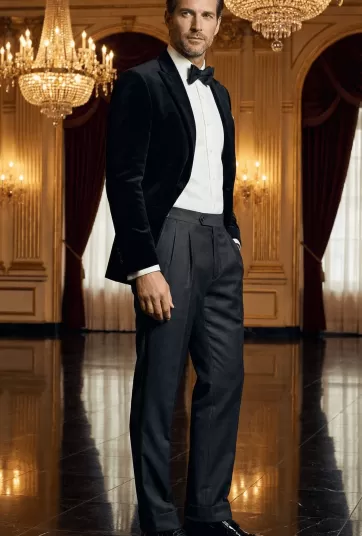
- Fabric texture: The groom chooses a velvet dinner jacket for evening receptions while groomsmen wear standard wool barathea. This adds a tactile, luxurious dimension visible in close-up photos and under venue lighting.
- Accessory shift: In black tie optional settings, the groom wears a full tuxedo with bow tie while groomsmen wear high-quality dark suits with silk neckties. This elevates the groom's formality level while keeping the overall party coordinated.
- Unique boutonniere: The groom's floral arrangement is distinct in color, size, or flower type compared to the groomsmen's matching boutonnieres.
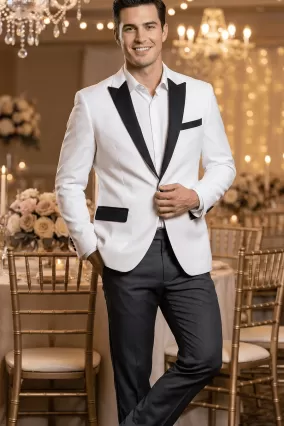
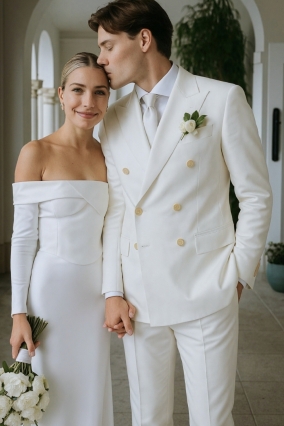
- Caution: White or ivory dinner jackets are a bold choice for grooms, particularly for warm-weather or destination weddings, providing a fresh, suave James Bond aesthetic. However, tradition holds that wedding guests should never wear white or ivory jackets, as this risks upstaging the groom or visually competing with the bride's white gown.
7.2. For groomsmen: supporting the aesthetic
Groomsmen serve as the visual "supporting cast" in wedding photography. Your primary responsibility is to adhere to the agreed-upon style, ensuring uniformity that provides a clean backdrop for the couple.
- This means wearing exactly what the groom specifies: matching lapel styles, identical bow tie shapes, coordinated cufflinks, and the same shoe style. Even small deviations one groomsman in a wing collar while others wear turndown, or one in velvet loafers while others wear oxfords can create visual discord in formal photos.
- Fit matters: Ill-fitting rental tuxedos detract from the overall elegance of the wedding party. If you're renting, schedule your fitting well in advance and request alterations if the jacket pulls across the shoulders or the trousers pool at your shoes.

7.3. For guests: respect the code
When you receive a wedding invitation specifying a dress code, that code is not a suggestion it's a clear instruction from the hosts about how they want their celebration to look and feel.
Black tie invitation means a tuxedo is required. Wearing a dark business suit to a black tie wedding, even an expensive one, is considered underdressing and shows a lack of respect for the couple's vision.
Black tie optional means the couple encourages tuxedos but understands not everyone owns one. A well-tailored dark suit in navy, charcoal, or black is acceptable, paired with a white dress shirt and conservative silk tie.
Never as a guest: Do not wear a white dinner jacket, ivory jacket, or any light-colored formal jacket unless you are the groom or have been explicitly invited to do so. This risks visual competition with the couple.
Wedding guest dress code quick reference
| Invitation Says | What to Wear | What to Avoid |
| White Tie | Full evening dress: tailcoat, white piqué waistcoat, white bow tie, black formal trousers | Dinner jacket, colored waistcoats, business suits |
| Black Tie | Tuxedo/dinner jacket, black bow tie, formal black trousers, patent leather or polished oxfords | Business suits, colored bow ties, brown shoes, casual footwear |
| Black Tie Optional | Tuxedo preferred; dark suit (navy, charcoal, black) acceptable with white shirt and conservative tie | Light-colored suits, casual shirts, no tie, brown shoes |
8. Materials Matter: Fabrics, Weaves, and Quality Indicators
The quality of formal wear is not merely a function of brand reputation it's a question of material science and construction technique. Understanding the fabrics and details that define superior formal wear helps you make informed decisions and recognize value.
8.1. Premium formal fabrics
Barathea wool is the gold standard for dinner jackets and tailcoats. It's a soft, somewhat heavy wool with a granular, almost pebbly texture that creates a deep, matte finish. This fabric contrasts beautifully with the reflective silk lapel facings, creating the visual distinction that defines formal wear. Barathea drapes elegantly and photographs exceptionally well under both natural and artificial light.
Mohair comes from the Angana goat and is prized for its resilience and subtle sheen. A mohair-blend tuxedo maintains crisp lines throughout a long evening and is naturally wrinkle-resistant ideal for weddings where you must remain camera-ready from a noon ceremony through a midnight reception. High-quality mohair blends often include 10-20% mohair with wool, balancing structure with softness.
Velvet is the texture hero for winter and holiday formal wear. Quality velvet provides natural insulation, feels luxurious to the touch, and photographs beautifully under the warm, artificial lighting of December galas and New Year's Eve parties. Velvet dinner jackets, typically in midnight blue or deep burgundy, add a festive elegance appropriate for creative black tie events.
Wool-linen blends address the climate challenges of Australian and New Zealand formal events. These blends maintain the structure and drape of formal wool while adding the breathability of linen, making them ideal for outdoor summer weddings or warm-weather galas.

8.2. Construction quality indicators
Beyond fabric, the construction techniques used in your formal wear reveal its quality level.
- Lapel facings: The most nuanced detail is the choice between standard grosgrain and Petersham ribbon. Both are ribbed fabrics, but Petersham features a distinctive scalloped or picot edge. More importantly, Petersham can be steamed and shaped with an iron to follow curves such as the rounded edge of a shawl lapel without puckering. This "old-world detail" is a hallmark of bespoke or high-quality construction, whereas standard grosgrain is used in mass production.
- Canvassing: Quality formal jackets use floating canvas construction, where a layer of canvas (traditionally horsehair and wool) is loosely stitched inside the jacket front. This canvas molds to your body over time, creating a personalized fit. Fused construction, common in budget formalwear, glues the canvas to the outer fabric cheaper and faster, but it never achieves the same natural drape and can separate or bubble with wear.
- Hand-stitched details: Look for hand-stitched pick-stitching along lapel edges, hand-sewn buttonholes (with visible thread irregularities that signal handwork), and hand-attached sleeves. These details don't just look better they create garments that move with you rather than against you.
- Lining quality: Premium formal wear uses Bemberg (cupro) or silk linings, both of which are breathable and allow moisture to escape. Budget garments use polyester linings, which trap heat and feel clammy during long events.
- Artisan precision: Dunnio Tailor's small-hand craftsmanship enables hand-stitched lapel edges, precise sleeve pitch adjustments, and intricate embroidery details that elevate your garment beyond machine-made alternatives all at accessible pricing. Our tailors execute these details with a precision that rivals Savile Row at a fraction of the cost.

Choose from premium fabrics and construction techniques with Dunnio Tailor's custom options. Explore materials.
9. Accessories and Final Touches
Formal wear accessories operate on a principle of understatement: each element should enhance the overall ensemble without competing for attention. Getting these details right transforms good formal wear into exceptional presentation.
9.1. The formal watch
A dress watch is an essential accessory for formal occasions, but it must be chosen carefully. The ideal formal watch features a minimalist design: a clean dial with simple hour markers, no chronograph complications or sporty bezels, and a slim profile under 12mm thick that slides easily beneath your shirt cuff. The strap should be leather black or dark brown matching your shoe color.
Sports watches, dive watches, and chronographs, no matter how expensive, are considered "as dressy as sneakers" in true formal contexts. If you wear a watch to a white tie or black tie event, it should whisper elegance, not shout functionality.
An alternative, particularly for white tie, is a traditional pocket watch with a fob chain, worn in the waistcoat pocket. This is a historically accurate and elegant choice that adds vintage sophistication.

9.2. Footwear excellence
Your shoes carry the entire ensemble. Even the most perfectly fitted tuxedo looks unfinished with scuffed, inappropriate footwear.
Patent leather delivers a mirror-like shine that screams formality. Black patent leather oxfords are the classic choice for galas, award ceremonies, and prestigious weddings. They require minimal maintenance a quick wipe restores their shine.
Polished calfskin oxfords offer versatility. When buffed to a high shine, they're appropriate for black tie, yet they also serve you well in business contexts and upscale casual settings. For men who cannot justify owning dedicated "tuxedo shoes," polished calfskin is the smart choice.
Velvet loafers embroidered with a crest or monogram are a festive choice for winter creative black tie events, particularly around the holidays. They add personality while maintaining formality appropriate for confident dressers who understand the rules well enough to bend them slightly.
Critical: Ensure your shoes are polished to a high shine, your soles are clean (visible when seated), and if wearing black tie optional with a belt, that your belt matches your shoes exactly.

9.3. The pocket square
The pocket square is your one opportunity for subtle personal expression in an otherwise highly regimented dress code.
A white linen pocket square in a simple fold the flat presidential fold or a subtle one-point fold is the safest, most elegant choice. It's correct for both white tie and black tie, never looks wrong, and photographs beautifully.
Avoid the temptation to match your pocket square exactly to your bow tie or to create elaborate, overly ornate folds (the puff, the rose, the crown). These draw attention to themselves rather than enhancing the overall composition.
Pre-event formal wear checklist
- Jacket fits smoothly across shoulders with no pulling or bunching
- Trousers break cleanly at the top of shoes with no fabric pooling
- Shirt cuffs show 0.5 to 1 inch beyond jacket sleeves
- Bow tie is self-tied, not a clip-on
- Shoes polished to high shine with clean soles
- Pocket square folded simply and positioned correctly
- Watch is slim, minimal, and formal (or no watch at all)
- All buttons secure, no loose threads or lint visible
This checklist, completed 15 minutes before you leave for your event, ensures you present the polished, confident image that formal occasions demand.
10. Frequently Asked Questions About White Tie vs Black Tie Attire
What is the main difference between white tie and black tie?
White tie is the most formal dress code in existence, requiring a full evening dress ensemble: black evening tailcoat with tails, white piqué waistcoat, white piqué bow tie, and formal trousers with double silk braiding. It is reserved for ultra-formal events like state dinners, royal occasions, and prestigious opera galas. Black tie is formal but more accessible and common, featuring a tuxedo (dinner jacket), black bow tie, and either a black cummerbund or waistcoat. Black tie is the standard for evening weddings, charity galas, and award ceremonies.
Can I wear a black tie tuxedo to a white tie event?
No. White tie events explicitly require full evening dress, which means a tailcoat. Wearing a tuxedo to a white tie event is a significant breach of etiquette and demonstrates disrespect to the host and the occasion's significance. If you receive a white tie invitation and cannot acquire or rent proper attire, the appropriate response is to respectfully decline the invitation rather than attend underdressed.
What is black tie optional and what should I wear?
Black tie optional means the host encourages guests to wear tuxedos but acknowledges not everyone owns formal wear. Guests may wear either a full tuxedo or a well-tailored dark suit in navy, charcoal, or black, paired with a white dress shirt and conservative silk necktie. However, the tuxedo remains the preferred choice and best honors the formality the host intends for the event.
Is midnight blue better than black for a tuxedo?
Yes, particularly for evening events under artificial lighting. Midnight blue appears richer, deeper, and darker than black fabric when viewed under the warm, indoor lighting typical of wedding receptions, galas, and banquet halls. Black fabric can sometimes appear slightly dusty or gray under these conditions. This optical phenomenon is why many formal wear connoisseurs and style experts prefer midnight blue for black tie occasions.
What formal attire works best for big-bellied or fuller-figured men?
Black tie attire is exceptionally flattering for men with fuller midsections. The unbroken vertical line created by black fabric produces a slimming optical effect, while a properly fitted cummerbund or waistcoat conceals the trouser waistband and visually defines the waist. Midnight blue enhances this slimming effect even further. The key is proper tailoring: ensure your tuxedo jacket includes adequate ease (add 1 to 1.5 inches to your natural waist measurement) for comfortable drape and natural movement throughout a long evening.
Can tall slim men wear formal attire without looking too elongated?
Absolutely. White tie tailcoats are specifically designed to create an elongated, regal silhouette that naturally complements tall, slim builds. For black tie, peak lapels add horizontal visual interest and emphasize shoulder width, while shawl lapels provide a softer, rounded effect that balances a slender frame. The key is ensuring proper proportions: jacket length should hit precisely at mid-hand, trousers should break cleanly at the shoe without excess fabric, and a white piqué pocket square can add dimension to the chest area.
How much does a custom tuxedo cost compared to renting?
Standard tuxedo rentals cost between $99 and $200 per event depending on quality and location. Dunnio Tailor's custom-made tuxedos range from $144 to $600, offering perfect fit, personalized details, and permanent ownership. If you attend three or more formal events over two to three years, custom ownership becomes more economical than renting. A $400 custom tuxedo worn five times equals $80 per wear less than half the cost of a single premium rental, with superior fit quality and the convenience of always having formal wear available.
What shoes should I wear with a tuxedo?
Black patent leather oxfords are the traditional and most formal choice, offering a high-gloss finish perfect for galas and upscale weddings. Well-polished black calfskin oxfords are a versatile alternative that works for black tie while also serving in business and upscale casual contexts. In Australia and New Zealand, polished calfskin has become the standard. Avoid brown shoes of any kind, casual loafers (except velvet for creative black tie), sneakers, or any footwear that isn't formal leather dress shoes.
Do I have to wear a bow tie with a tuxedo?
For traditional black tie, yes a self-tied black silk bow tie is required. The bow tie is the defining element of black tie attire and should match the fabric of your lapel facings (satin with satin, grosgrain with grosgrain). For black tie optional events where you choose to wear a dark suit instead of a tuxedo, a black silk necktie is acceptable. Never wear a colored, patterned, or novelty tie with formal evening wear.
How do I ensure my formal wear fits perfectly if ordering online?
Follow a comprehensive measurement guide like Dunnio Tailor's detailed how-to-measure male body parts to fit suits. Measure your chest, waist, hips, sleeve length, shoulder width, and inseam carefully, preferably with assistance from another person for accuracy. For areas of your body that are difficult to measure or if you have unique proportions, contact the tailor's expert consultation team for personalized guidance. Providing accurate measurements particularly for the chest, waist, and sleeve is the foundation of achieving a perfect fit in custom formalwear.
Conclusion
Understanding the distinction between white tie and black tie attire is more than mastering a set of rules it's gaining fluency in a visual language of respect, celebration, and tradition. White tie remains the ultimate expression of formal elegance, a rare and demanding code that rewards those who execute it flawlessly with an unmatchable sense of occasion. Black tie, meanwhile, offers the modern gentleman a sophisticated framework for navigating the majority of formal events he'll encounter, from weddings to galas to career milestones.
The key to success in either dress code lies in three elements: understanding the etiquette and requirements, selecting quality materials and construction, and achieving a fit that flatters your unique physique. Whether you choose to rent for a single occasion or invest in custom formal wear that will serve you for years, the goal remains the same: to present yourself with confidence, polish, and respect for the significance of the moment.

At Dunnio Tailor, we believe exceptional formal wear should be accessible to every man who values craftsmanship and fit. Our custom tailoring service delivers the precision of bespoke construction hand-finished details, premium fabrics, personalized measurements at prices that make ownership a smart financial decision compared to repeated rentals. From $144 to $600, you receive garments that rival the quality of $1,500 to $3,000 local tailors, backed by our artisan advantage in executing intricate details that machines and mass production cannot match.
Whether you're preparing for your wedding day, accepting an invitation to a prestigious gala, or building a formal wardrobe for a career that requires frequent attendance at black tie events, Dunnio Tailor stands ready to guide you. Explore our custom tuxedo options, consult our measurement guide, or contact our expert team for personalized advice on achieving the perfect formal look for your next important occasion.