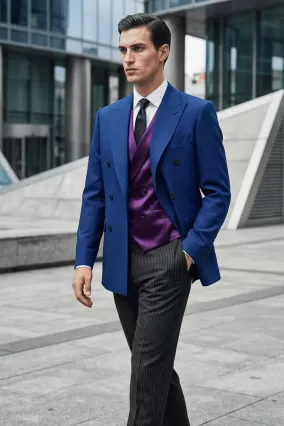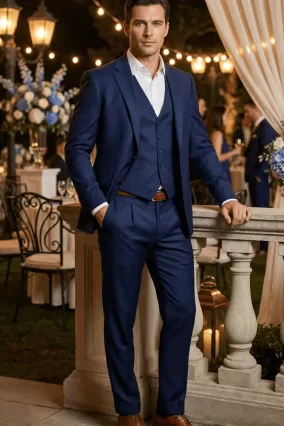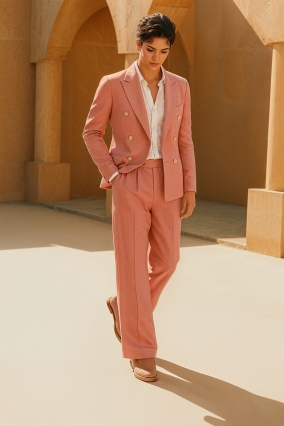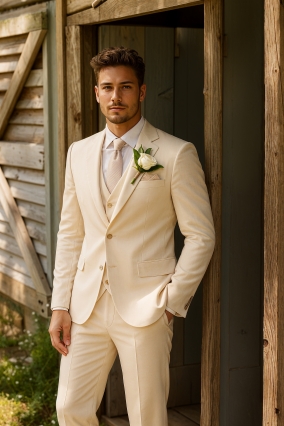
Few garments have lasted as long, shifted as little, and remained as relevant as the pea coat for men. Born from the decks of European naval warships and refined across three centuries of maritime life, the peacoat is one of menswear's most dependable icons. In 2026, it has become the quiet luxury outerwear choice for men who want something with genuine heritage behind it not just a logo. This guide covers everything you need to know: where the pea coat came from, what separates a true one from a cheap imitation, how to wear it for your body type, and how to style it across every occasion from a winter commute to a wedding. Whether you are asking "are pea coats still in style?" or hunting for the ideal short peacoat for men, this is the only guide you need.
1. What is a pea coat? History and origins of an icon
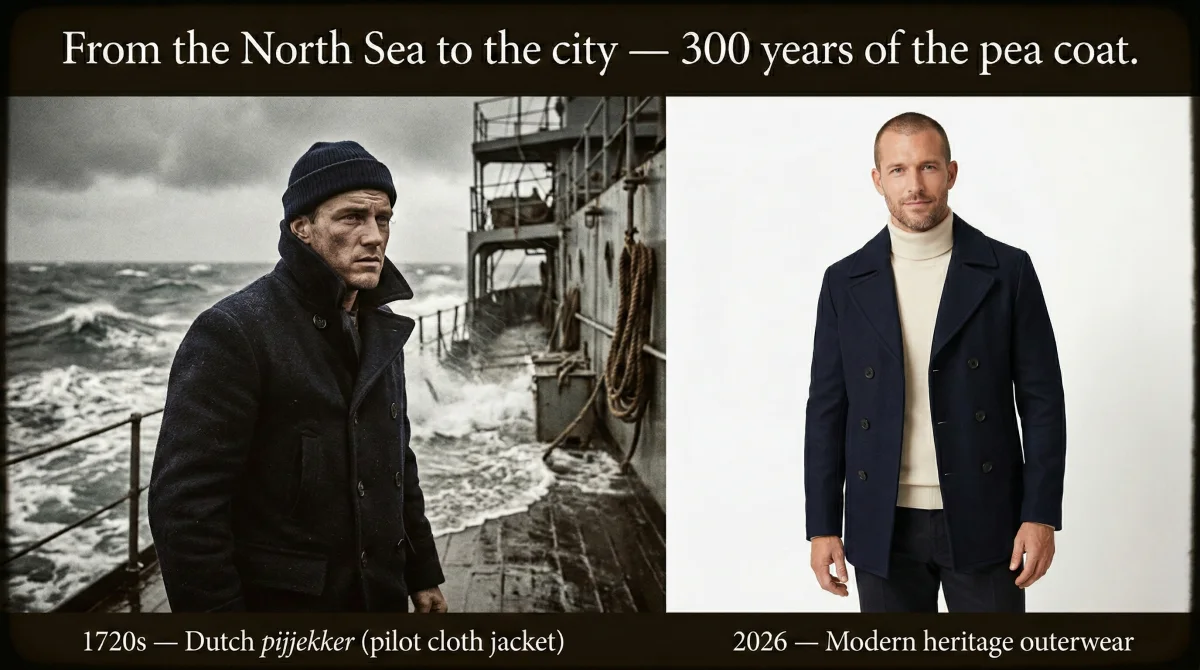
The pea coat for men is not simply a double-breasted wool jacket. It is the product of centuries of engineering by European naval forces who needed outerwear tough enough to withstand sub-zero temperatures, salt spray, and North Sea gales.
1.1 Where the name comes from
The etymology of "pea coat" is genuinely contested, and the debate itself reveals how many naval traditions shaped this garment.
-
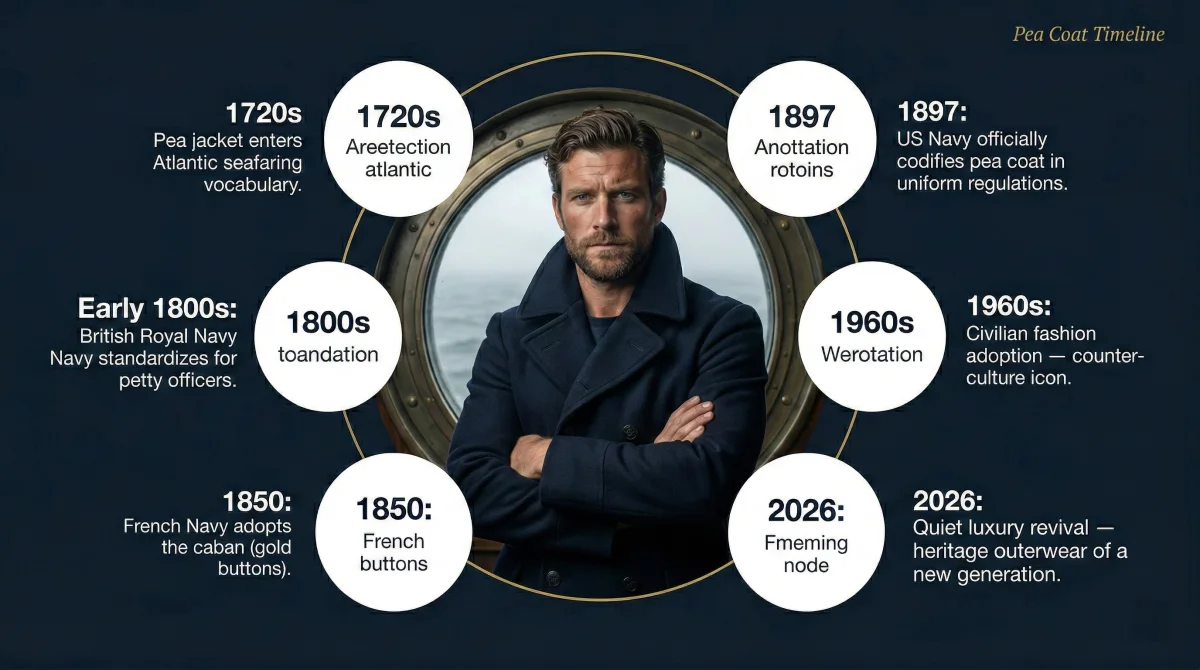
Dutch/West Frisian origin: The most substantiated root is the Dutch word pijjekker or pijjakker, where pij refers to a coarse, twilled blue cloth with a nap on one side, and jekker means a short man's coat. The garment was already referenced in American newspapers by the 1720s, indicating it was an established Atlantic seafaring staple.
-
US Navy "pilot cloth" theory: The US Navy's own historical records favor the idea that the "P" in pea coat stands for "pilot cloth" a heavy, stout twilled blue fabric. The resulting "P-jacket" gradually softened into "pea coat."
-
French and Mediterranean origins: The French term caban traces back to the Portuguese gabaö and possibly to the 15th-century Maghreb region, where Barbary pirates wore short freedom-of-movement capes called qaba. These Mediterranean influences were later refined by the British Royal Navy in the early 19th century and the French Navy by the 1850s.
1.2 The naval codification that changed everything
The institutionalization of the pea coat as formal military uniform was a turning point. In the British Royal Navy, the coat was made from dense, tightly woven melton wool and worn by petty officers who needed protection without the encumbrance of a longer bridge coat. Across the Atlantic, US Navy sailors called "reefers" tasked with climbing rigging to furl or adjust sails wore short, hip-length versions that gave them freedom of movement through the spars. By 1897, the pea coat was officially codified in US Navy uniform regulations.
1.3 What is the difference between a peacoat and a pea coat?
Nothing. "Pea coat" (two words) and "peacoat" (one word) are interchangeable. British usage tends toward "pea coat" while American English accepts both spellings. "Reefer jacket" is the Royal Navy variant term. All three describe the same garment.
2. The anatomy of a true pea coat: What makes it authentic
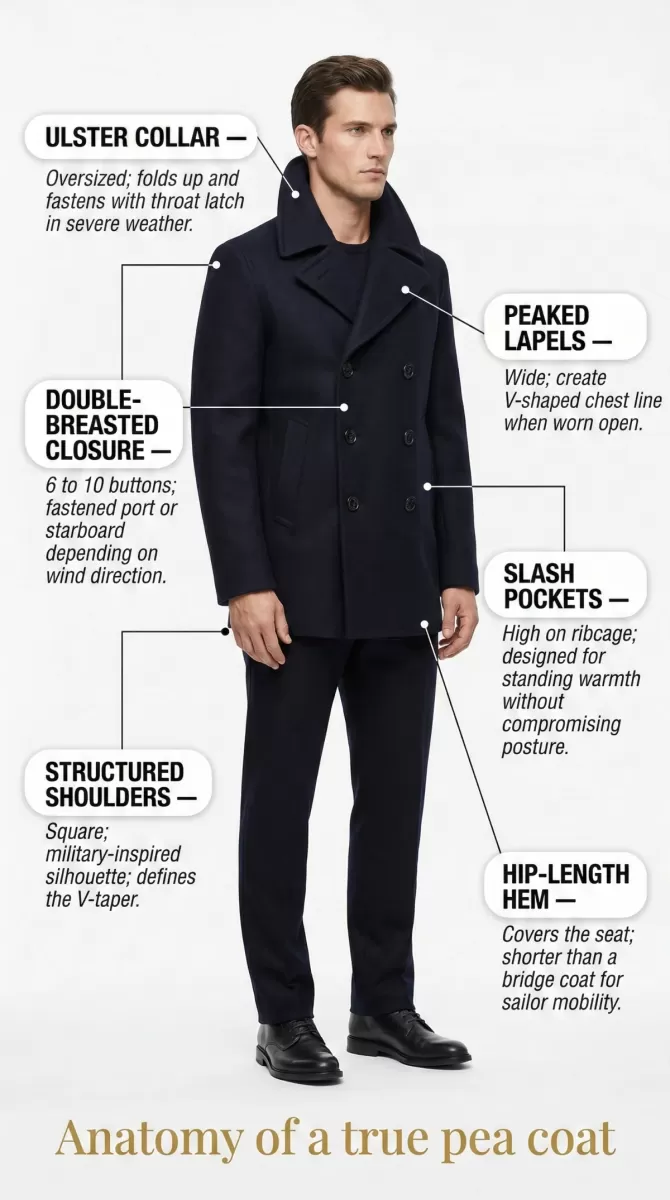
The pea coat's enduring appeal is grounded in its highly engineered design. Every element has a functional origin and understanding that function helps you evaluate quality when shopping.
2.1 The defining features
-
Double-breasted front: Two rows of buttons historically 6 to 10 designed to be fastened on either side depending on wind direction. The overlapping fabric creates a double layer of wool across the torso for serious insulation.
-
Oversized Ulster collar with throat latch: The broad lapels can be flipped up and secured across the throat in severe weather, creating a protective chimney that shields the neck and lower face. This is the feature that separates a true pea coat from a standard double-breasted overcoat.
-
Vertical or diagonal slash pockets: Positioned high on the ribcage, these hand-warmer pockets allow a sailor or a modern commuter to keep hands warm without compromising posture. Higher-end versions are lined with corduroy or polar fleece.
-
Heavy-duty buttons: In US Navy versions, flat black buttons decorated with a "fouled anchor" motif an anchor entangled in rope symbolising the challenges of maritime service. French Navy versions used gold-engraved buttons. Traditional British versions used pewter or metal. All are large and flat, designed to be operated with thick gloves.
-
Full lining: Necessary to prevent coarse wool from irritating the skin and to add windproofing. Modern luxury versions use cupro or satin lining for moisture-wicking properties and a smooth hand-feel.
2.2 Military vs. modern luxury: The key differences
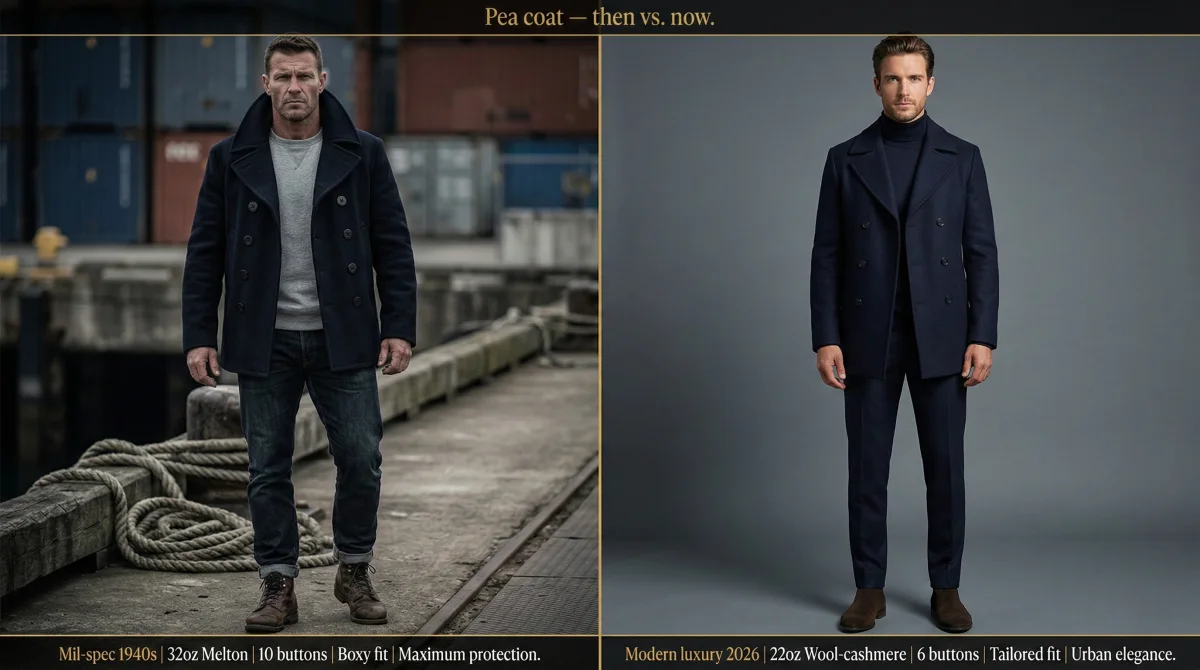
|
Feature |
US Navy spec (mid-20th century) |
Contemporary luxury |
Functional implication |
|
Wool weight |
32oz Kersey or Melton |
20–24oz wool-cashmere |
Thermal mass vs. urban comfort |
|
Button count |
10 (pre-1941); 8 (modern) |
6 (streamlined) |
Wind protection vs. aesthetic minimalism |
|
Pocket lining |
Cotton or corduroy |
Fleece or silk |
Durability vs. luxury tactile feedback |
|
Length |
Hip-length with seat coverage |
Cropped or thigh-length |
Mobility vs. modern silhouette trends |
|
Vent type |
Single center vent or none |
Double side vents |
Ease of movement when seated |
3. Pea coat fabrics: From 32oz kersey wool to modern luxury blends
The efficacy of any pea coat starts and ends with its wool. Understanding the material is what separates an informed buyer from someone who ends up with a coat that pills after a season.
3.1 The historical standards
-
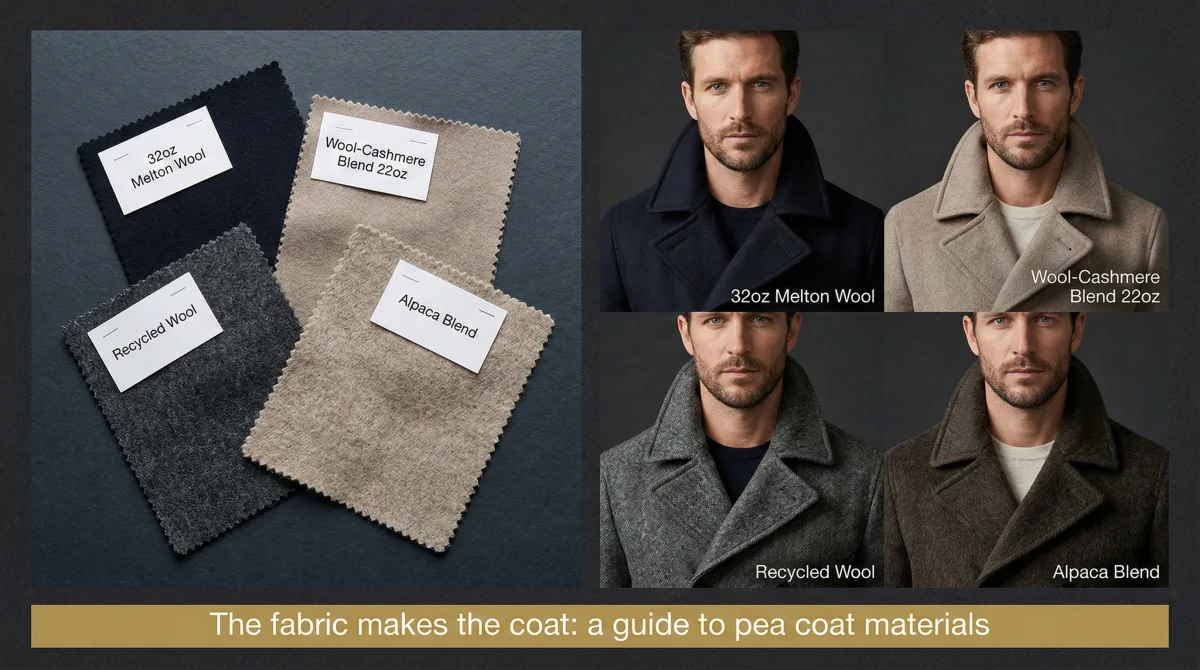
Kersey wool: The original naval benchmark. Smooth, heavy, extremely dense, and often left with natural lanolin oils to increase water repellency. The lanolin gives genuine Kersey a faint waxy feel and a satisfying weight in the hand.
-
Melton cloth: The US Navy's transition fabric. Thicker and more felt-like than Kersey, Melton offers exceptional wind resistance. Slightly less water-resistant than oil-rich Kersey, but more uniform and easier to produce at scale. A 100% Melton wool coat like those from heritage brands such as Schott NYC remains the gold standard for traditionalists.
-
A key metric: wool weight, measured in ounces per linear yard. A traditional mil-spec peacoat uses 32oz wool, which retains heat even when damp wool can absorb up to 30% of its weight in water and still insulate. Modern fashion versions use 20–24oz weights for a more urban-friendly drape.
3.2 Modern and luxury alternatives
-
Wool-cashmere blends: Prized for softness and luxury. Warmth-to-weight ratio is superior to standard wool but durability is slightly lower. Ideal for the urban professional who wants comfort without sacrificing structure.
-
Alpaca: Extremely low thermal conductivity with a warmth-to-weight ratio that rivals cashmere. Hypoallergenic and increasingly popular in high-end outerwear for the 2026 season.
-
Recycled wool: A growing presence in the 2026 market as sustainability becomes non-negotiable for many buyers. Quality varies by mill, but premium recycled wool can match virgin wool in insulation and durability.
-
Technical hybrids (2025–2026 trend): Brands like Mission Workshop are reimagining the pea coat using three-layer technical fabrics with waterproof membranes, stretch-woven exteriors, and eco-friendly DWR coatings maintaining the silhouette while dramatically improving weather performance.
3.3 Dunnio Tailor fabric options
At Dunnio Tailor, we offer two fabric tiers for custom jackets and outerwear:
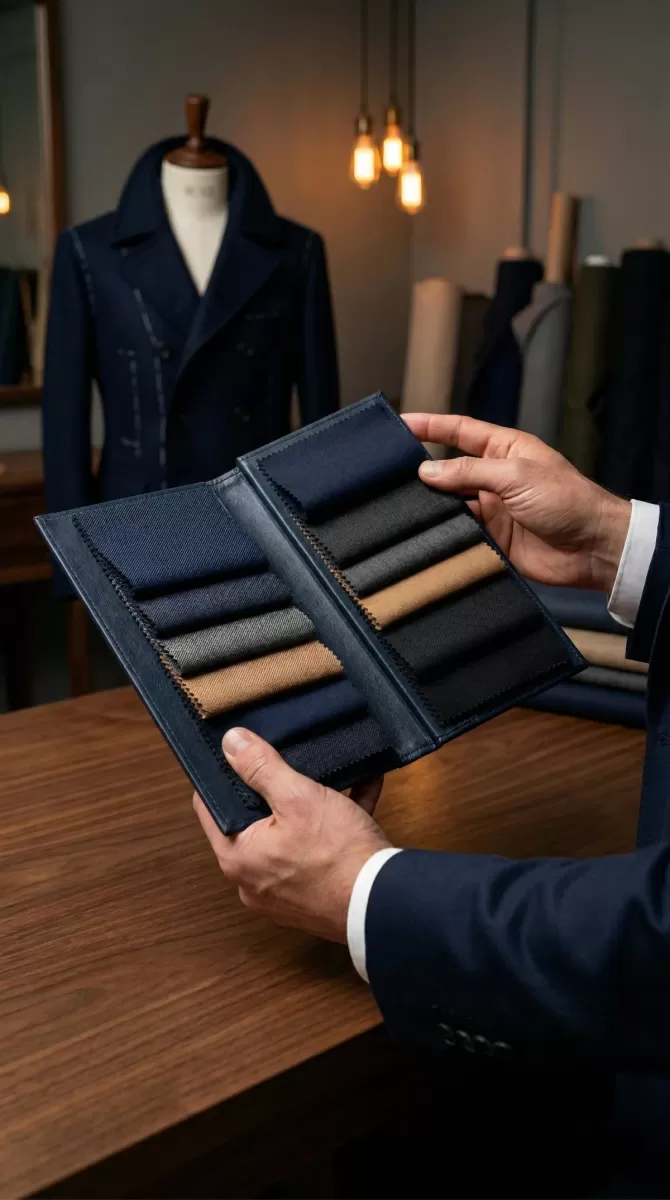
Premium fabrics (from $99 to $135):
-
Twill (technical) excellent drape and structure.
-
Oxford weave breathable and versatile.
-
Chambray lightweight, ideal for transitional seasons.
-
Barathea fine ribbed texture with a formal finish.
-
Satin (technical) subtle sheen for evening occasions.
-
Hopsack cotton blend textured and casual-elegant.
-
Plain cotton blend clean and traditional.
-
Plain pure linen ideal for warm-weather iterations.
Luxury mill fabrics ($231):
-
Twill wool blends superior drape and warmth.
-
Wool 150s ultra-fine grade for the finest hand-feel and longevity.
For specialty fabric requests beyond these tiers, contact Dunnio Tailor directly to place a custom order for your specific requirements.
Visualise your jacket configurator
4. Are pea coats still in style in 2026?
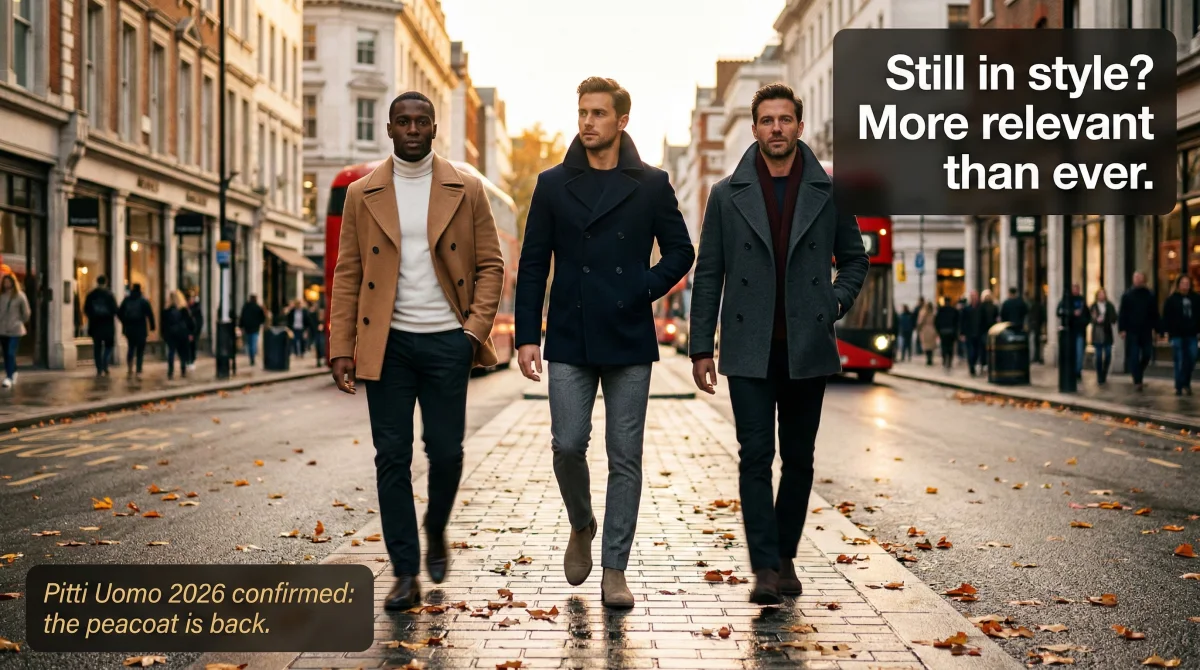
Yes and the evidence is compelling. The pea coat has survived the passing of every other early-20th-century outerwear trend precisely because it was never a trend in the first place. It was engineered utility that happened to look exceptional. In 2026, several converging forces are making the peacoat more culturally relevant than it has been in years:
- The "quiet luxury" movement: The fashion backlash against logo-heavy streetwear has elevated understated, heritage-grounded garments. A navy or vintage navy pea coat signals exactly the kind of considered, confident taste that quiet luxury demands no branding required.
- The Pitti Uomo 2026 confirmation: At Pitti Uomo, the world's most closely watched menswear trade show, pea coats appeared repeatedly in "neo-Dandy" combinations: high-gauge turtlenecks, pleated wool trousers, and suede Chelsea boots. This is the style world's most credible endorsement.
- The sustainability surge: Recycled wool melton peacoats have gained significant traction as environmentally conscious consumers seek outerwear that lasts decades rather than seasons. A pea coat bought thoughtfully in 2026 is genuinely a lifetime investment.
- The vintage navy pea coat secondary market: In Australia, the UK, and the US, demand for authentic vintage US Navy surplus peacoats has climbed noticeably among younger consumers who value mil-spec construction at a lower price point. The "authentic military look" carries genuine cultural cachet in 2026.
In short, pea coats are not just still in style. They are having one of their strongest cultural moments in decades.
5. Peacoat vs. trench coat: Which is right for you?
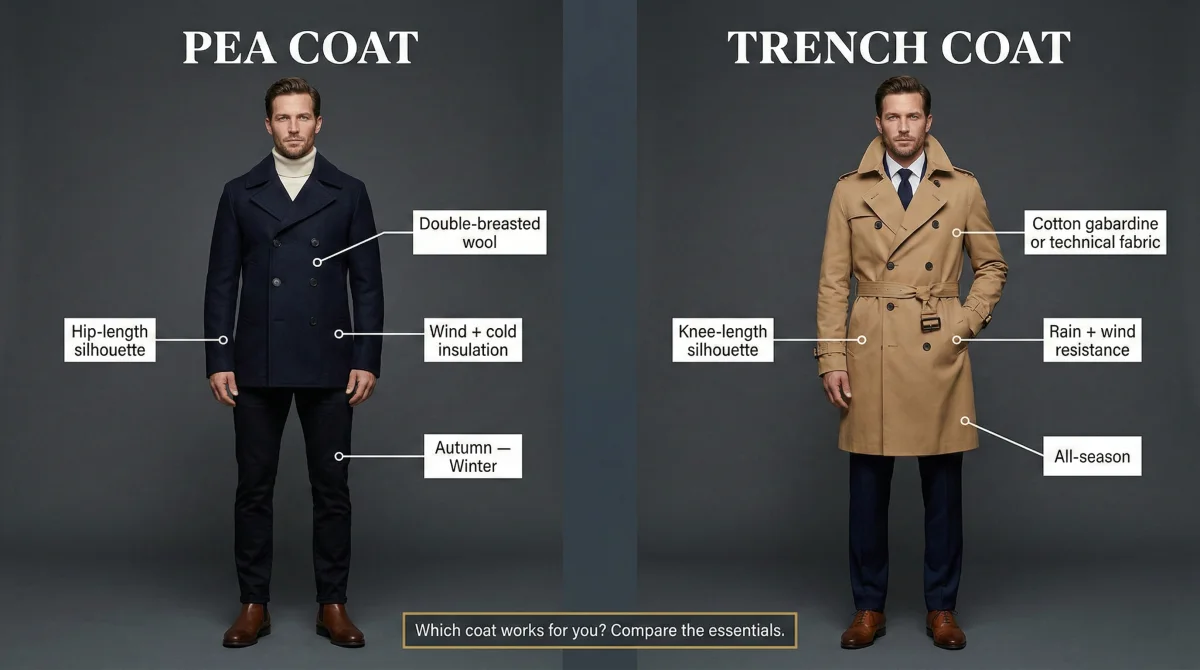
The peacoat vs. trench coat question is one of the most searched comparisons in men's outerwear, and it is worth answering with precision.
5.1 The fundamental differences
5.2 When to choose a pea coat
-
When the primary threat is cold wind rather than rain.
-
When you want a shorter, more structured silhouette.
-
When you prefer a heritage military aesthetic over a cinematic spy look.
-
When layering over knitwear rather than a suit jacket.
5.3 When to choose a trench coat
-
When you need genuine rain protection.
-
When your wardrobe leans formal and the longer length suits your proportions.
-
When you regularly layer over suit jackets (the raglan sleeve accommodates this better).
For a deeper comparison of the trench coat, including body type guides and outfit formulas, read our full guide on how to wear a trench coat for men.
6. Pea coat colors for men: Choosing your signature shade
Color is where personality meets practicality. A pea coat works hardest when its color integrates seamlessly with the rest of your wardrobe but that does not mean it must be boring.
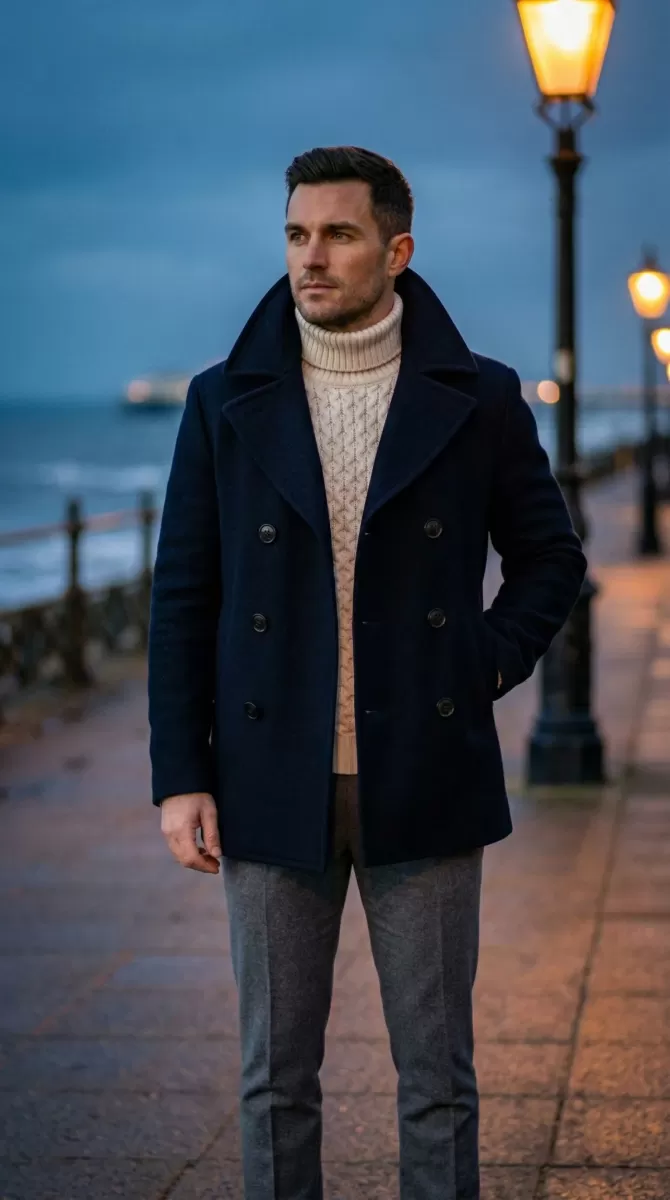
6.1 Midnight navy and vintage navy pea coat
Navy is the original and still the definitive peacoat color. It references the garment's naval heritage directly and pairs effortlessly with virtually every suit color, every denim wash, and every casual base.
A vintage navy pea coat whether genuine surplus or a modern reproduction in Indigo-washed melton adds an aged, weathered authenticity that is particularly resonant with the quiet luxury aesthetic of 2026.
Best pairings: Cream or ivory knitwear; mid-grey tailored trousers; raw selvedge denim; tan leather boots.
6.2 Black peacoat
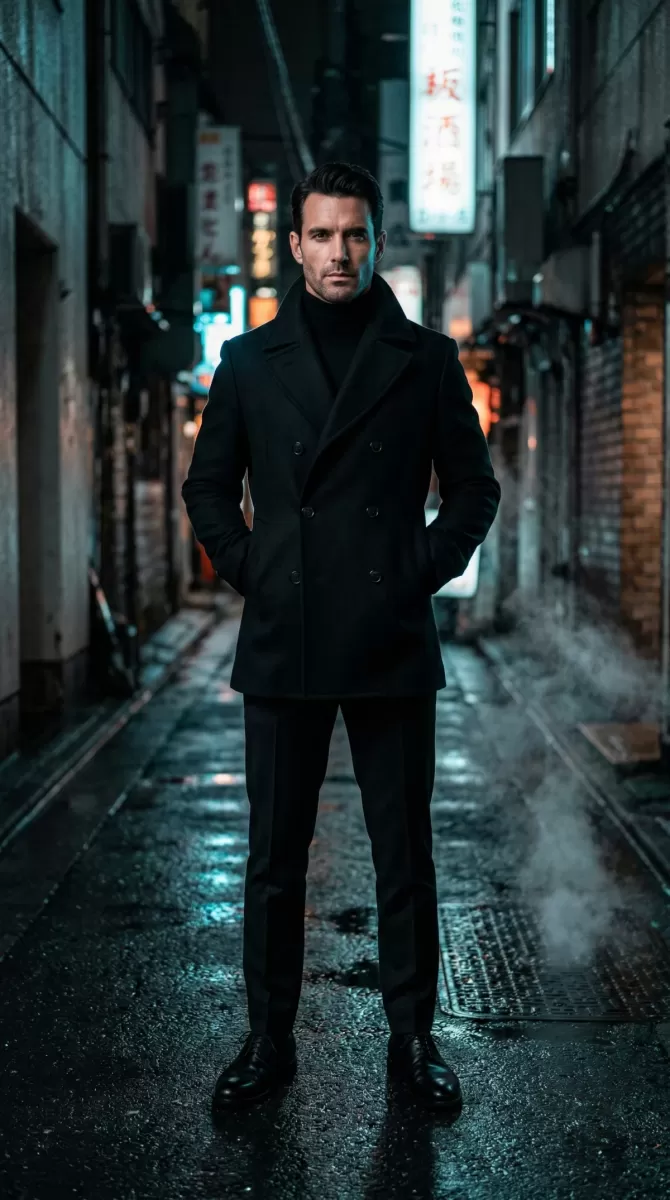
The black peacoat is urban authority distilled. It performs best at evening events, creative industry environments, and city commutes where the visual sharpness of a black wool coat makes a decisive statement.
Best pairings: Charcoal or grey suits; black roll-neck sweaters; leather Chelsea boots. The black-on-black combination with slim trousers is a perennially strong choice.
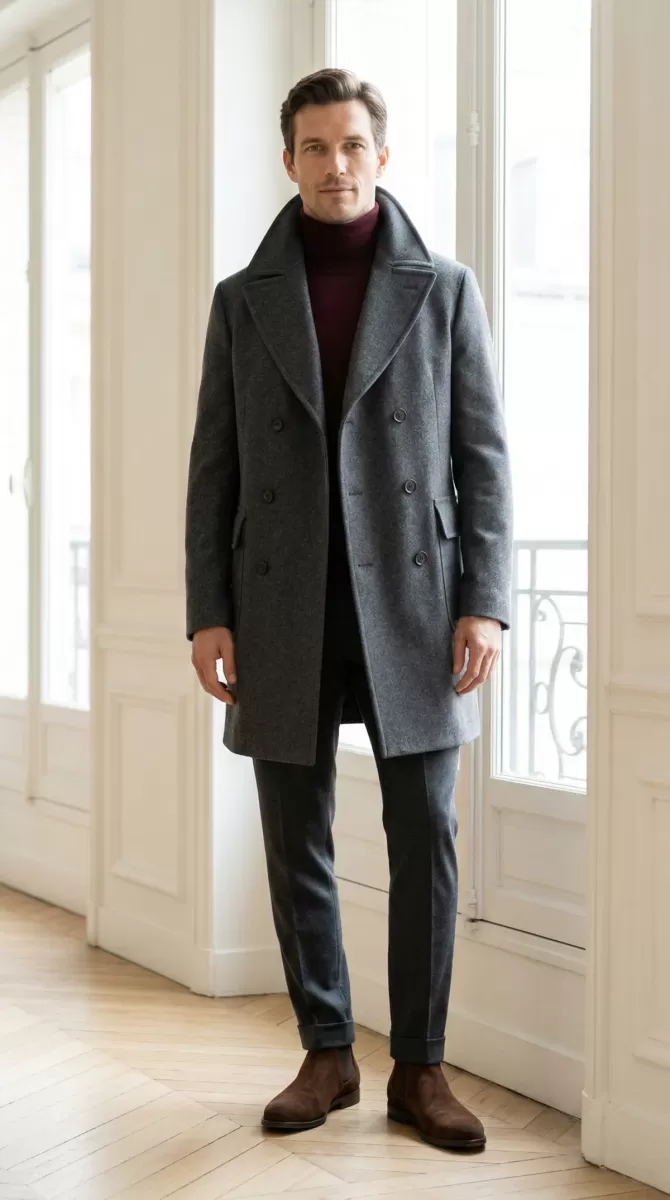
6.3 Charcoal and gray long peacoat
Mid-grey is the surprise color story of 2026. The gray long peacoat has emerged as an alternative to navy that reads as both professional and approachable. Where navy is heritage, grey is modern.
Best pairings: Burgundy or wine knitwear for contrast; charcoal tailored trousers for a tonal look; white or pale blue dress shirts.
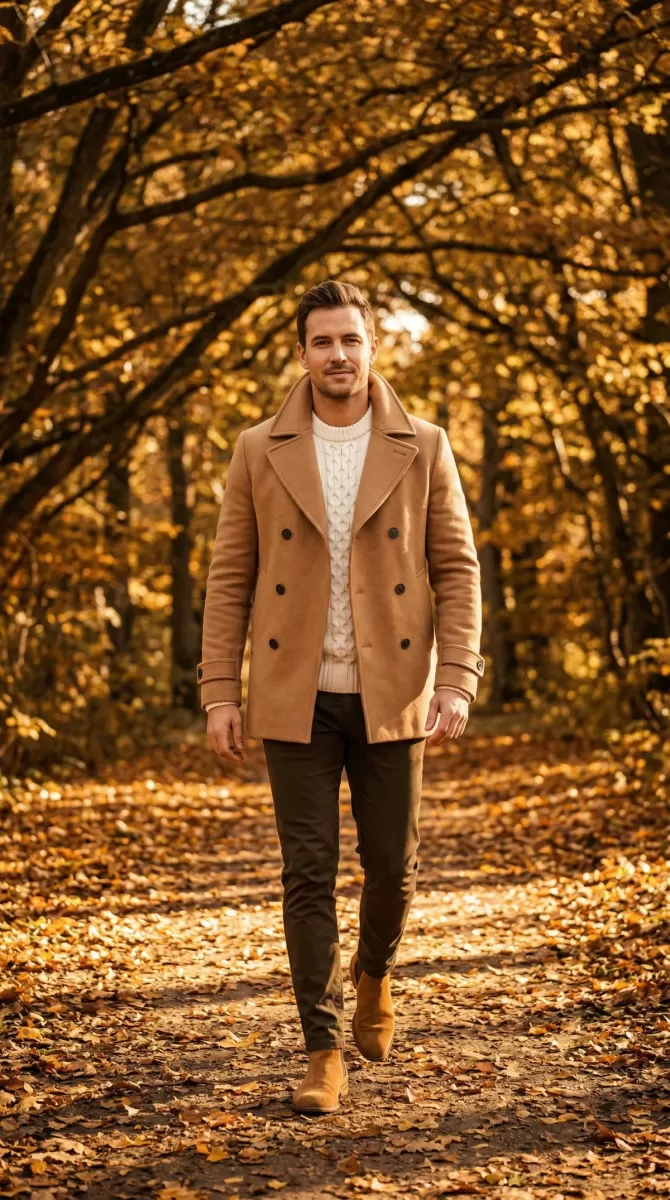
6.4 Camel pea coat
Camel is the dandy's choice. It brings warmth and dimension that navy and charcoal do not offer, and it pairs beautifully with cream, ivory, and cognac tones throughout the rest of the outfit.
Best pairings: Cream turtleneck; tobacco-brown leather gloves; dark olive or chocolate trousers. The "camel pea coat ladies" search traffic is significant too it is a genuinely unisex color and silhouette.
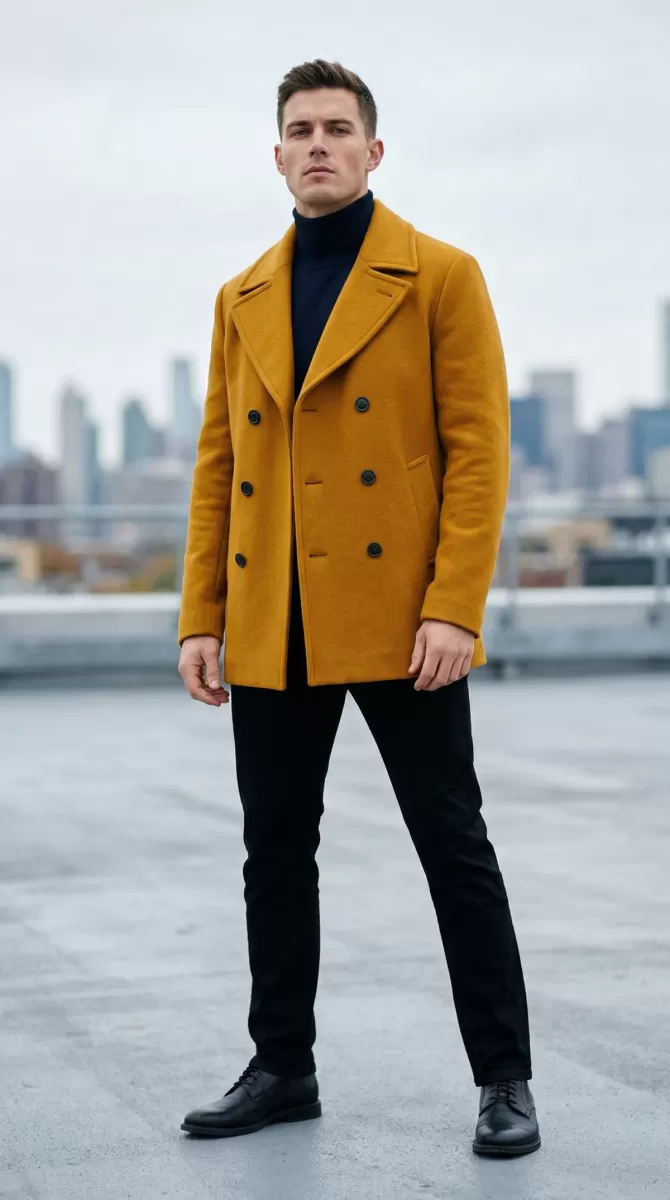
6.5 Mustard peacoat
For the man comfortable with standing out. A mustard peacoat makes a bold statement in autumn's muted tonal environment. Wear it with dark navy or black underneath to let the color lead without overwhelming the ensemble.
Best pairings: Dark navy jeans; black crew-neck jumper; black leather Derby shoes.
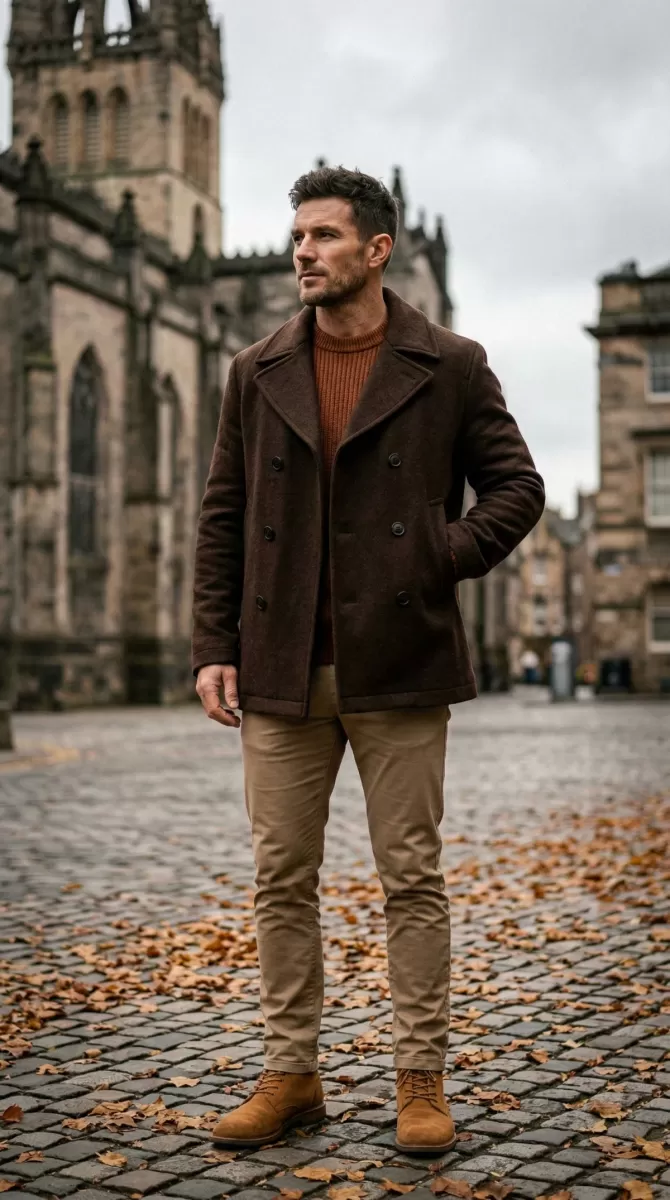
6.6 Chocolate peacoat
The chocolate peacoat operates in the same earthen warmth as camel but with more depth. It is particularly strong in autumn (fall) when the surrounding palette mirrors its warmth.
Best pairings: Rust, terracotta, or camel knitwear; khaki or stone trousers; tan suede boots.
6.7 Color-to-wardrobe compatibility matrix
|
Pea coat color |
Navy suits |
Grey suits |
Denim |
Casual weekend |
Recommended occasion |
|
Navy |
✓ |
✓ |
✓ |
✓ |
Universal |
|
Black |
✓ |
✓ |
✓ |
◐ |
Formal/evening |
|
Charcoal grey |
◐ |
✓ |
✓ |
✓ |
Modern professional |
|
Camel |
✓ |
✓ |
✓ |
✓ |
Dandy/smart casual |
|
Mustard |
◐ |
◐ |
✓ |
✓ |
Weekend/statement |
|
Chocolate |
✓ |
◐ |
✓ |
✓ |
Autumn/winter casual |
|
✓ = excellent pairing |
◐ = works with care |
||||

7. Pea coat fit guide for men: Finding the right size for your body
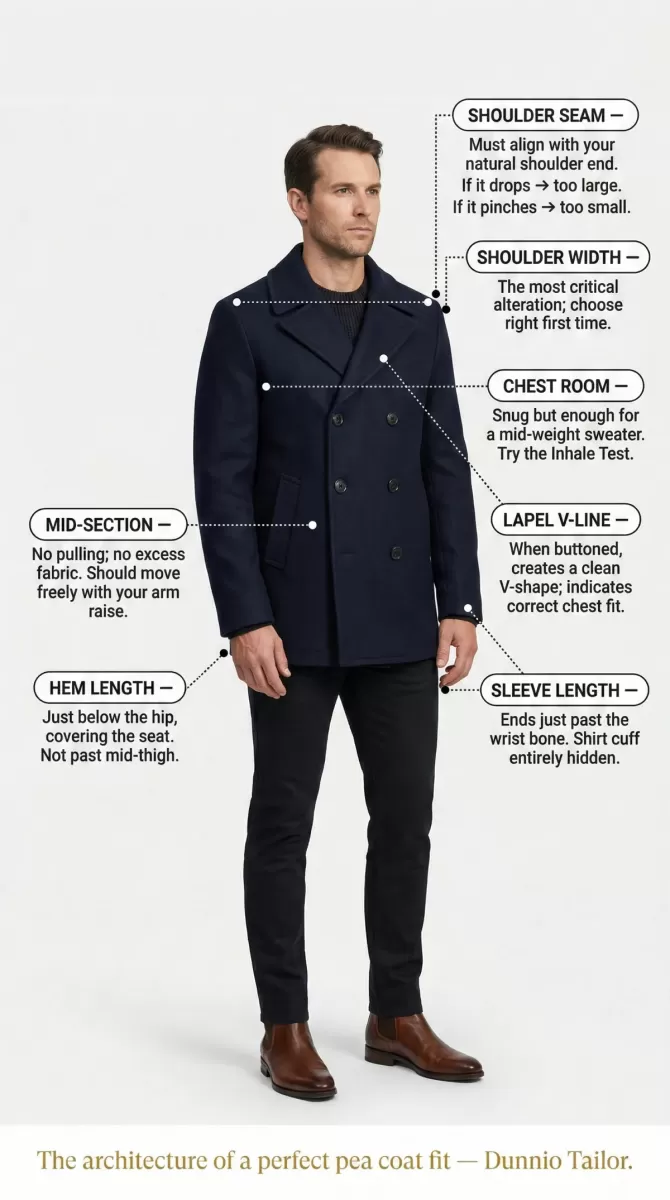
Fit is the most critical variable in a pea coat purchase. The density of the wool leaves almost no room for the usual "close enough" compromise a poorly fitting pea coat feels either like a straitjacket or an oversized box draped over you.
7.1 Universal fit rules
Regardless of body type, these principles apply:
-
Shoulder seams: The seam must align precisely with the natural end of your shoulder. If it drops down the arm, the coat is too large. If it pinches your deltoid, it is too small. This is the single most important area to get right shoulder alterations are nearly impossible even for skilled tailors.
-
Chest room: The coat should be snug but allow a deep breath and a mid-weight sweater underneath. A useful measuring technique: inhale fully, measure chest circumference, then subtract two inches for a fitted silhouette.
-
Sleeve length: Should end just past the wrist bone, with your shirt cuff hidden beneath.
-
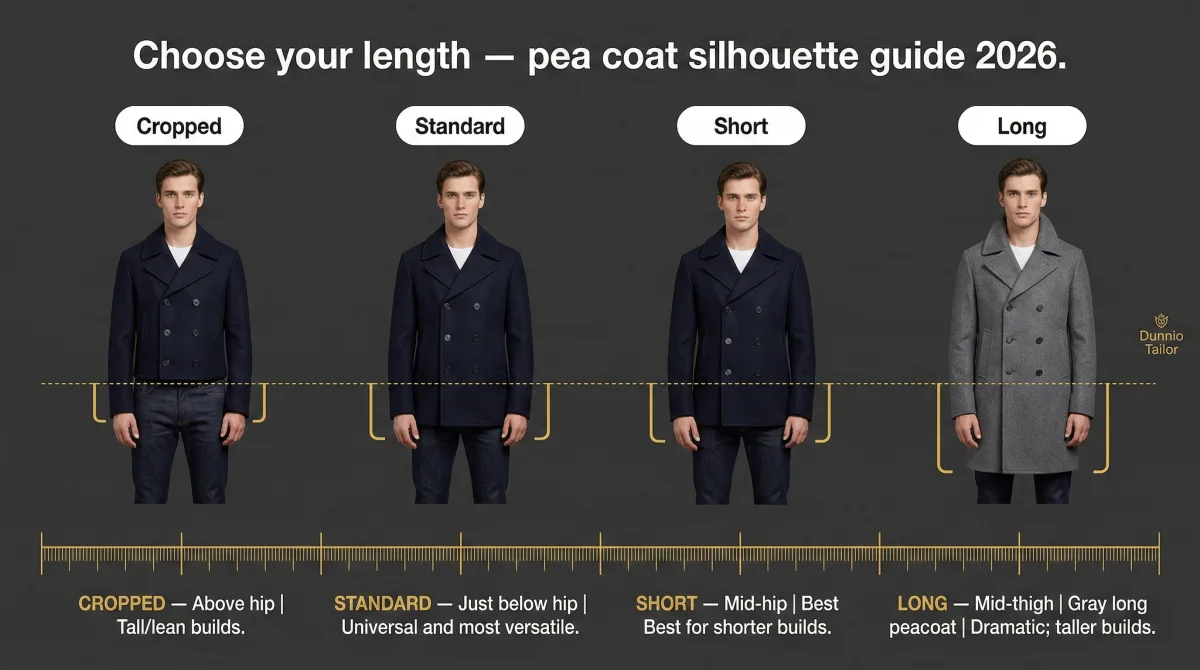
Hem length: Standard pea coat length hits just below the hip, covering the seat but not extending to mid-thigh at which point it becomes a bridge coat.
7.2 Pea coat for big men and heavier builds
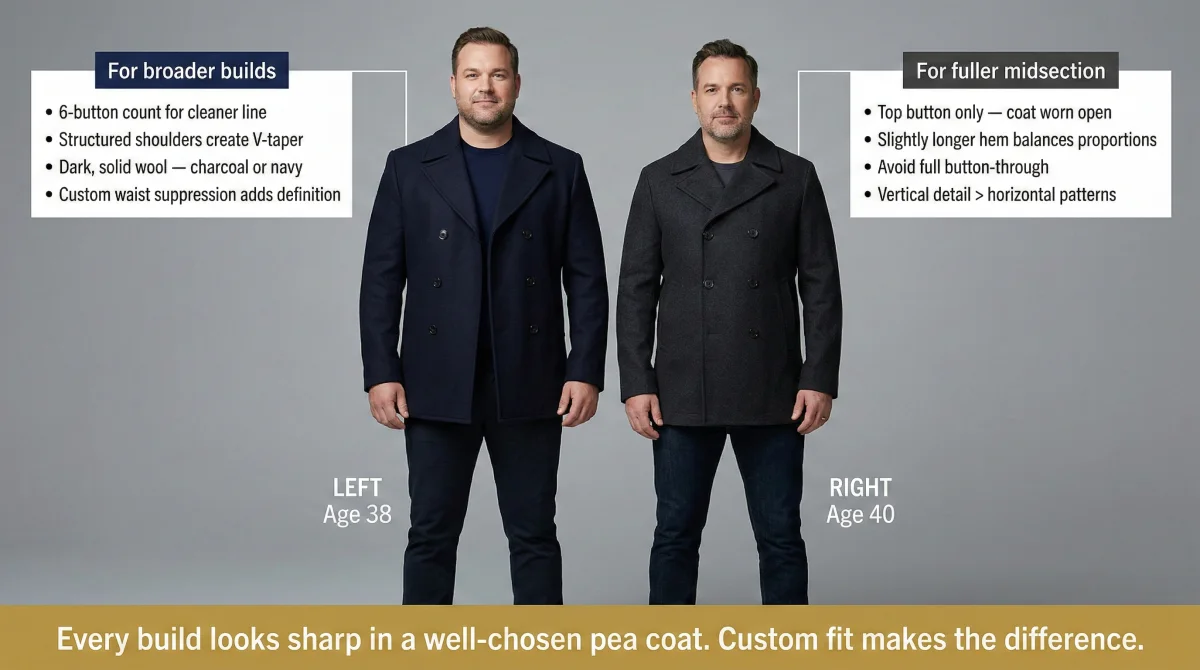
Heavier builds can look extremely sharp in a well-chosen peacoat the key is making the right decisions:
-
Choose dark, solid colors: Midnight navy and charcoal visually recede. Avoid light or mid-toned colors that add visual mass.
-
Opt for fewer buttons (6-button versions): Fewer buttons create a cleaner vertical line across the chest, which is inherently more slimming than a 10-button spread.
-
Prioritise structured shoulders: Strong, defined shoulders draw the eye upward and create the illusion of a V-taper.
-
Consider waist suppression tailoring: A competent tailor can take in the waist of a pea coat for approximately $30–$50, transforming a boxy silhouette into a genuinely flattering one. Ensure the tailor has heavy-duty equipment capable of stitching through multiple layers of heavy wool.
For a pea coat for fat men or those carrying significant weight across the midsection, a custom-made coat from Dunnio Tailor removes the compromise entirely. Every measurement from the shoulder width to the chest circumference is built around your specific body, not a generic size chart.
7.3 Pea coat for big-bellied men
Men carrying most of their weight in the stomach face a specific challenge with double-breasted closures, which pull and gap across a fuller midsection.
-
Never button all buttons: Leave the coat partially open or button only the top button.
-
Go slightly longer: A hem that covers more of the midsection balances proportions.
-
Avoid fully belted or cinched versions, as these emphasise rather than conceal the waist area.
-
Dark, vertical-line details: Avoid horizontal stripe, check, or pattern fabrics that add visual width.
7.4 Pea coat for tall and slim men
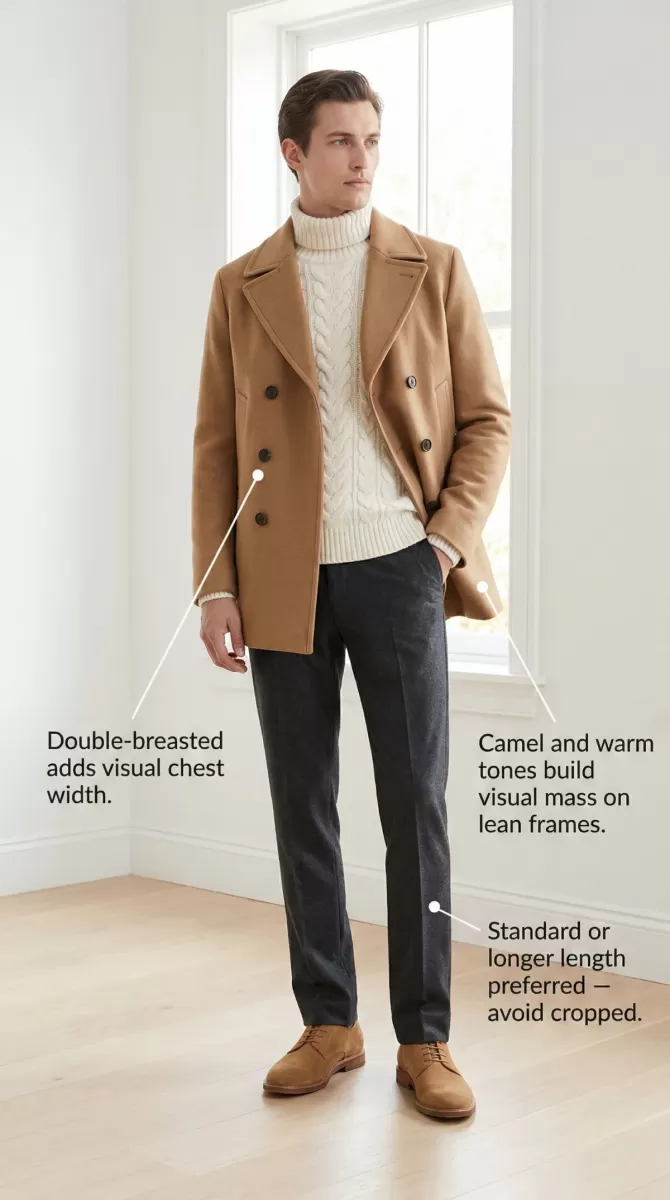
Lean builds need the opposite approach adding visual weight and dimension:
-
Double-breasted is your best friend: The extra fabric across the chest adds visual mass and makes you appear broader and more substantial.
-
Avoid cropped lengths: A cropped peacoat will make proportionally long legs look even more elongated. Stick to standard hip-length or even a gray long peacoat that extends toward the thigh.
-
Layer for dimension: Use the generous interior volume to layer a chunky knit sweater or substantial scarf underneath. This builds out your silhouette.
-
Consider light or warm colors: Camel and charcoal add visual mass in a way that navy and black would not.
7.5 Pea coat for short men
-
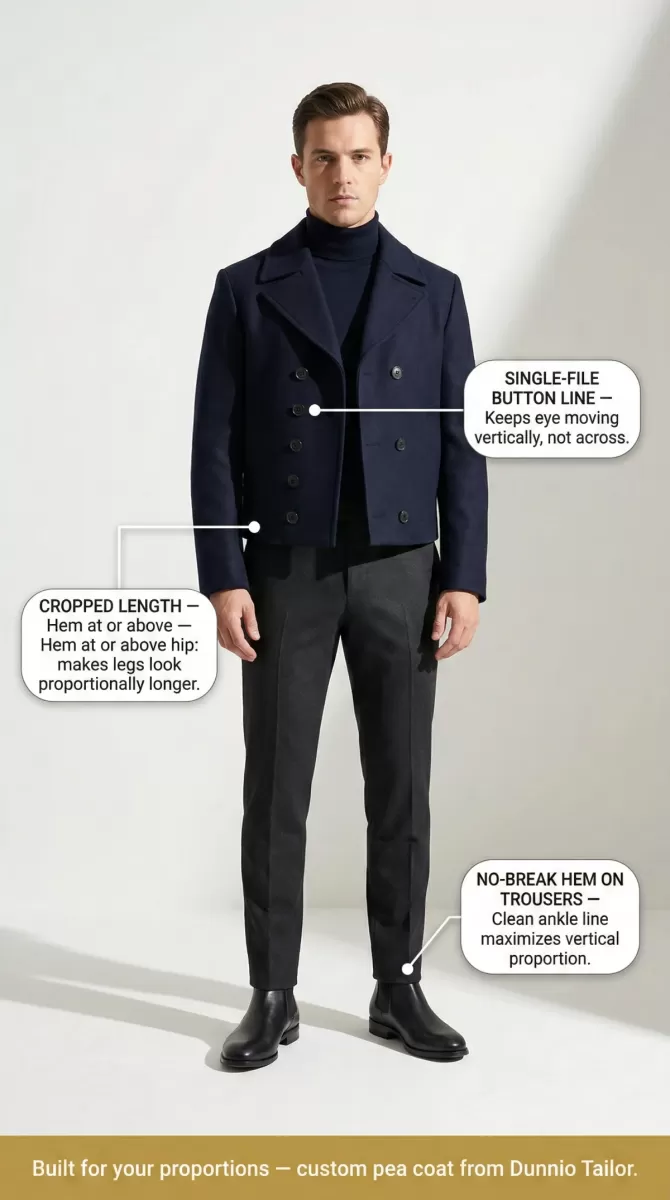
The cropped peacoat is ideal: A shorter hem that sits above the hip keeps proportions balanced and makes the legs appear longer. This is one of the clearest applications of cropped peacoat styling.
-
Single-breasted is preferred: Creates a cleaner, uninterrupted vertical line.
-
Avoid double-break hem trousers: Pair the coat with slim, no-break or slight-break trouser hems to create maximum vertical line.
Explore our custom jacket options
8. How to style a pea coat for men: Outfit formulas for every occasion
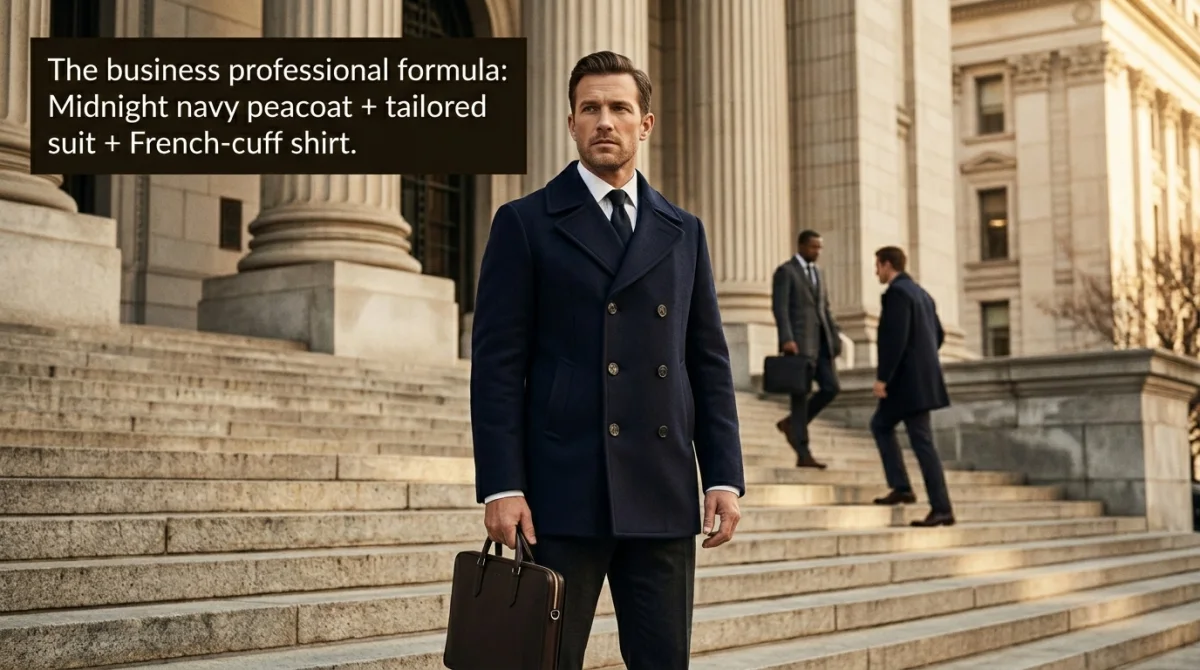
8.1 Business professional formula
The pea coat serves as a sophisticated alternative to the formal overcoat in professional settings, provided it is styled with intention.
The classic formula:
-
Midnight navy peacoat + tailored suit (navy or charcoal) + white or pale blue French-cuff shirt + silk tie + leather Oxfords.
-
Button the coat completely, keep the collar flat, and ensure the suit jacket does not peek below the hem.
Key rules:
-
Dark colors only for formal business settings.
-
The suit jacket must not extend below the pea coat hem.
-
No visible knitwear collar above the coat collar keep layers hidden.
For the suit beneath, explore Dunnio Tailor's custom suits or build a complete three-piece look with our custom 3-piece suits. Pair with custom pants for complete coordination.
8.2 Smart casual and neo-dandy formula
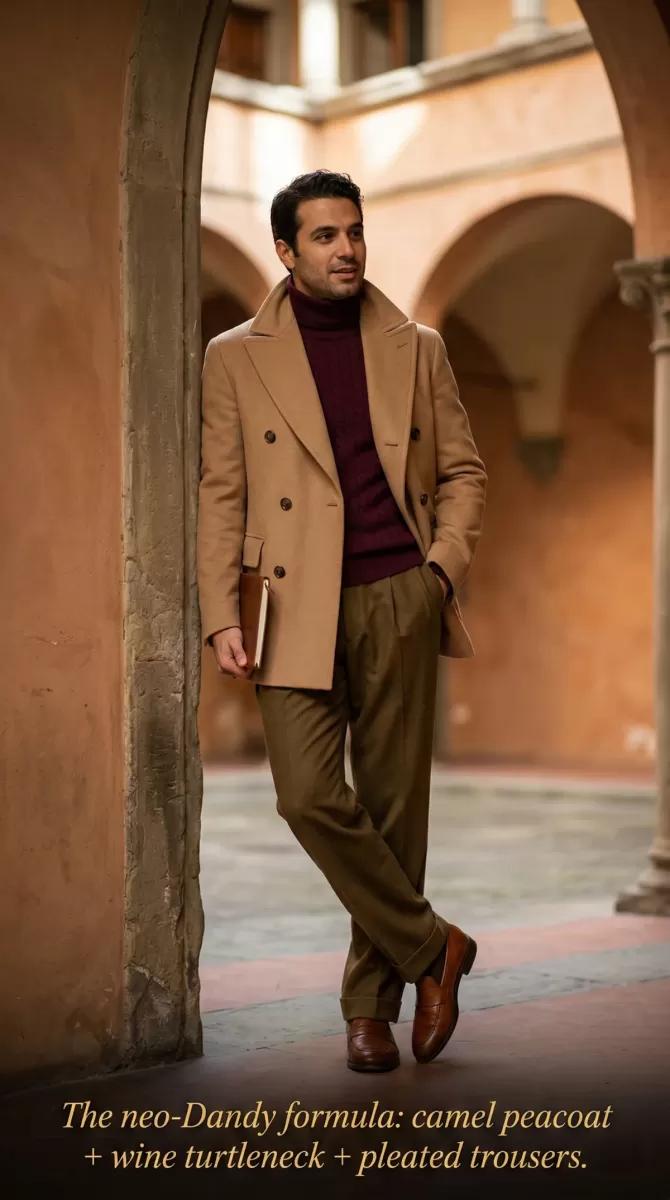
The rise of the neo-Dandy aesthetic where tailored heritage pieces are worn with expressive knitwear is the natural home of the modern pea coat.
The formula:
-
Navy or camel pea coat + high-gauge turtleneck (wine, ivory, or charcoal) + pleated wool trousers in earthy tones + suede Chelsea boots.
-
Wear partially unbuttoned, allowing the turtleneck to fill the V-shaped opening.
-
No scarf needed the turtleneck creates a clean uninterrupted line from neck to waist.
Why it works: The turtleneck eliminates the need for a scarf while maintaining a sleek, fashion-forward silhouette that references both Pitti Uomo runways and classic Parisian street style.
Craft your perfect jacket before ordering
8.3 Weekend and casual formula
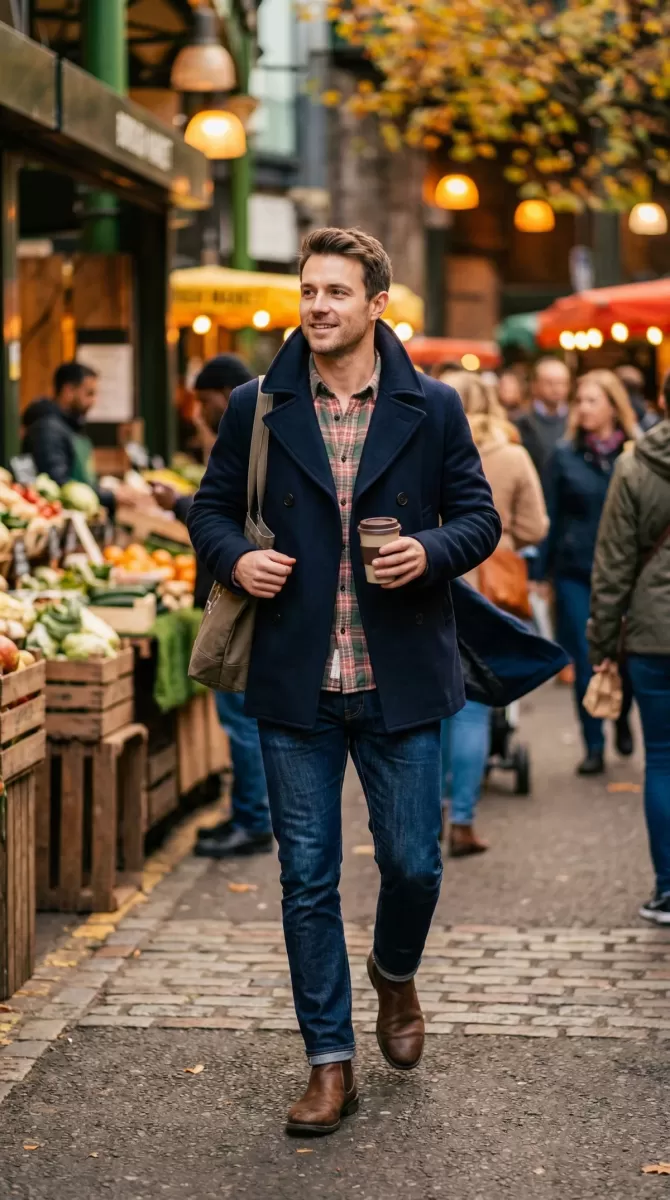
The peacoat transitions effortlessly from professional to casual contexts with a few simple swaps.
The classic casual formula:
-
Black or navy peacoat + raw selvedge denim + simple white t-shirt or flannel shirt + rugged work boots or leather Chelsea boots.
-
Wear the coat unbuttoned or partially buttoned for a more relaxed, movement-friendly silhouette.
The 2026 streetwear layer: Do not be afraid to wear a quality hoodie underneath your pea coat and pull the hood over the collar. This streetwear-meets-heritage combination is very much on-trend for 2026, combining the structured formality of the coat with the casual energy of the hoodie.
Accessories: A chunky knit beanie or a structured scarf adds textural depth. The peacoat hooded silhouette either from a built-in hood attached version or from a hoodie worn beneath is increasingly common.
8.4 Date night and evening formula
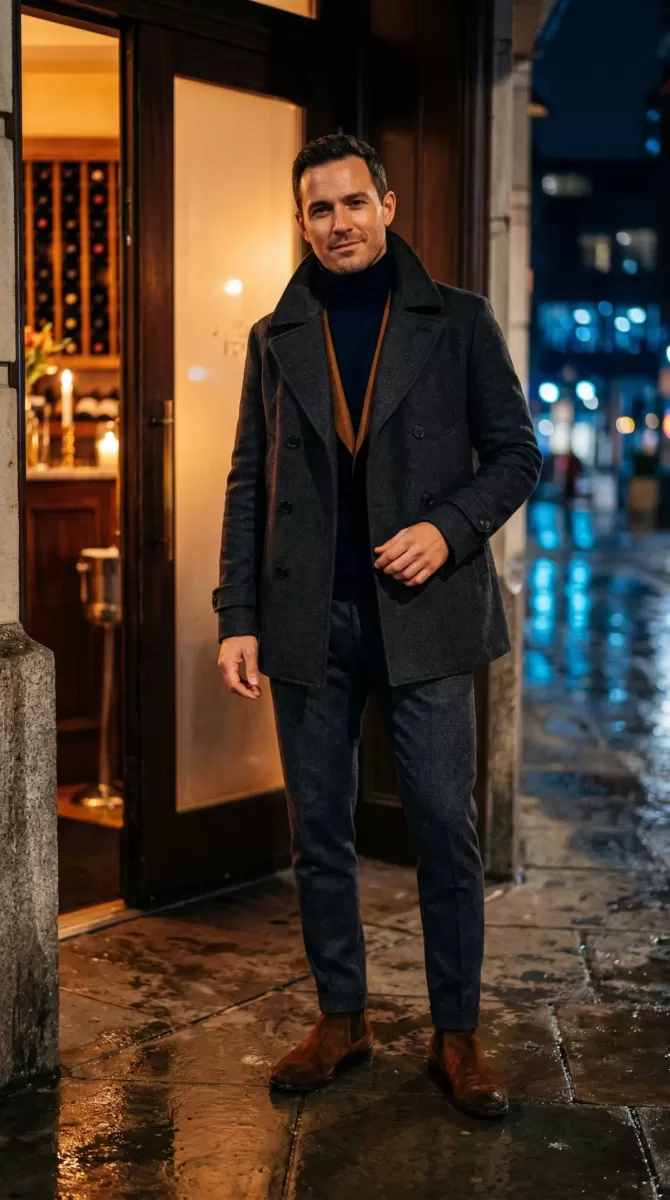
The formula:
-
Charcoal or navy peacoat + cashmere or merino turtleneck + tailored trousers + suede Chelsea boots.
-
Wear the coat slightly open at the collar to show the turtleneck this is an intentional style statement, not carelessness.
-
No tie needed; the turtleneck provides enough formality.
Color psychology: Darker peacoat colors navy, charcoal, or black read as more mysterious and evening-appropriate than lighter camel or mustard tones. Reserve lighter colors for daytime or outdoor occasions.
Elevate your evening foundation with a custom 3-piece suit beneath your coat for maximum impact at formal dinners.
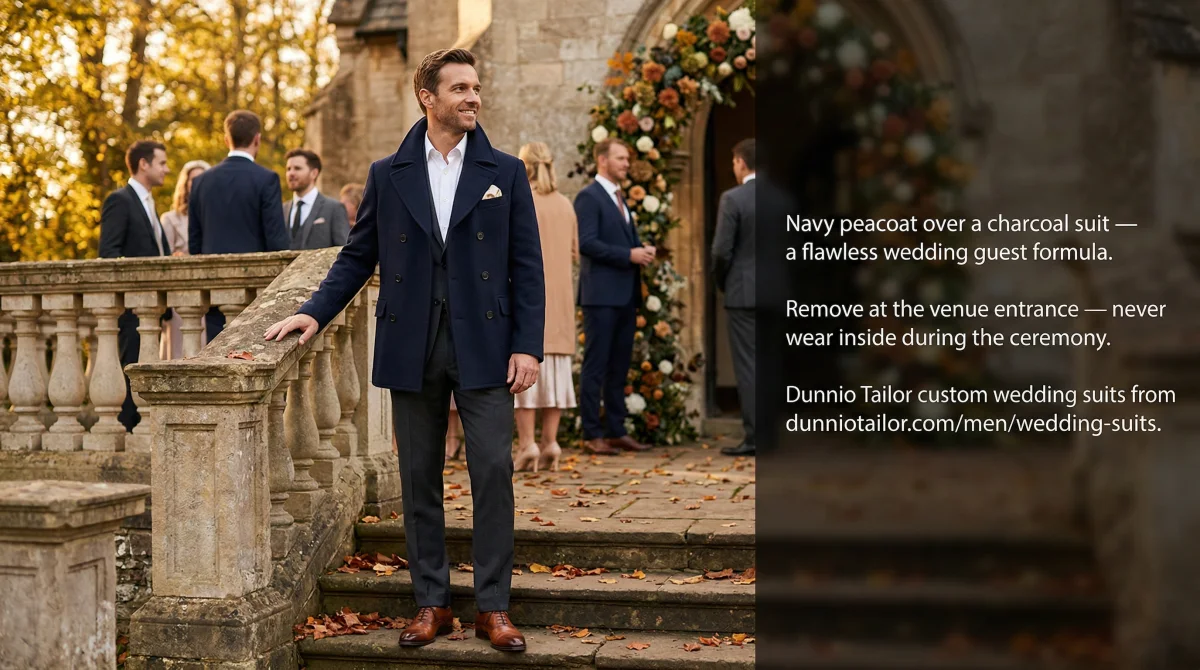
8.5 Wedding guest formula
Wedding outerwear etiquette is rarely discussed but always observed by other guests.
For smart-casual and semi-formal weddings:
-
Navy or charcoal peacoat + wedding suit + dress shirt + pocket square + leather Oxfords.
-
Remove the coat when entering the venue; wearing it inside during the ceremony is poor form.
For outdoor ceremonies (particularly in cooler months):
-
A well-fitted peacoat over a lighter-weight suit is both practical and elegant. Choose a color that contrasts or complements the suit a navy coat over a charcoal suit, or a charcoal coat over a navy suit.
For the suit beneath:
-
Custom wedding suits precision tailoring for the occasion.
-
Linen wedding suits for warm-weather and outdoor ceremonies.
-
Custom tuxedo for black tie winter weddings.
-
Custom wedding vest add a waistcoat for a complete three-piece wedding look.
Design your full wedding look using Dunnio's 3D tools: suits, 3-piece suits, and tuxedo.
8.6 Occasion-based styling matrix
|
Occasion |
Recommended color |
Companion pieces |
Footwear |
Formality |
|
Corporate office |
Midnight navy |
Suit, French-cuff shirt, silk tie |
Leather Oxfords |
Formal |
|
Business meeting |
Charcoal |
Wool trousers, dress shirt |
Derbies or loafers |
Semi-formal |
|
Dinner date |
Navy or charcoal |
Cashmere turtleneck, tailored trousers |
Suede Chelsea boots |
Smart casual |
|
Weekend outing |
Shadow grey or navy |
Flannel shirt, raw denim |
Work boots or sneakers |
Casual |
|
Social gathering |
Camel or mustard |
Black hoodie, slim dark jeans |
Minimalist leather sneakers |
Casual |
|
Wedding (guest) |
Navy or charcoal |
Custom suit, pocket square |
Leather Oxfords |
Semi-formal |
9. Pea coat by climate and region: Making it work where you live
The pea coat's ideal climate is cold, wind-driven, and occasionally damp northern European winters, after all, gave birth to it. But it is remarkably adaptable across different climates with the right weight and construction choices.
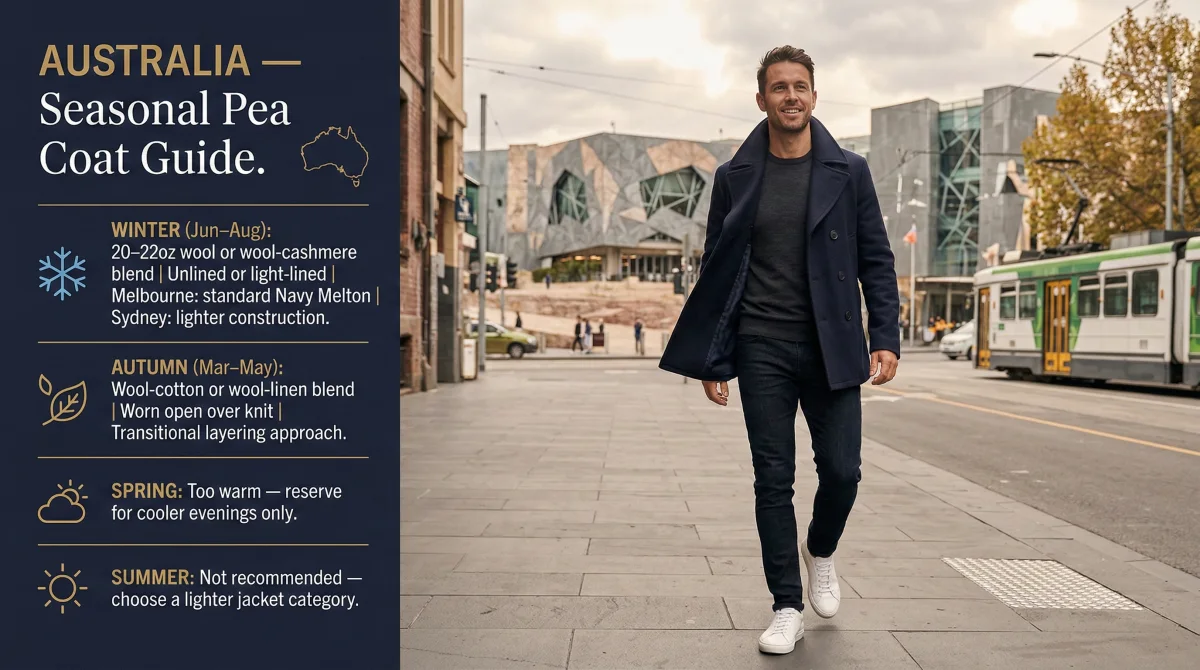
9.1 Pea coat for winter and fall in Australia
Australia presents a genuine challenge: winters in Sydney are mild by European standards, and even Melbourne winters though colder rarely demand the 32oz wool that US Navy sailors needed in the North Atlantic.
For winter in Australia (June to August):
-
20–22oz wool or wool-cashmere blends are the practical sweet spot heavy enough for cold mornings and evenings, light enough not to overheat during warmer afternoon spells.
-
Unlined or lightly lined versions allow layering flexibility: add a mid-weight merino knit underneath on cold days, remove it when temperatures climb.
-
Melbourne winters are robust enough for traditional navy melton peacoats. Sydney winters suit lighter constructions.
For fall/autumn in Australia (March to May):
-
A lighter wool-cotton or wool-linen blend worn open over a flannel shirt handles the unpredictable transitional temperature swings.
-
Unlined versions of the pea coat are ideal the structured exterior provides wind protection without the excess heat retention of a lining.
For regional expertise in fabric selection and weight, contact Dunnio Tailor to discuss climate-appropriate custom options.
Hotline - WhatsApp: +84 968996668
Email: support@dunniotailor.com
9.2 Pea coat for fall and winter in the uk
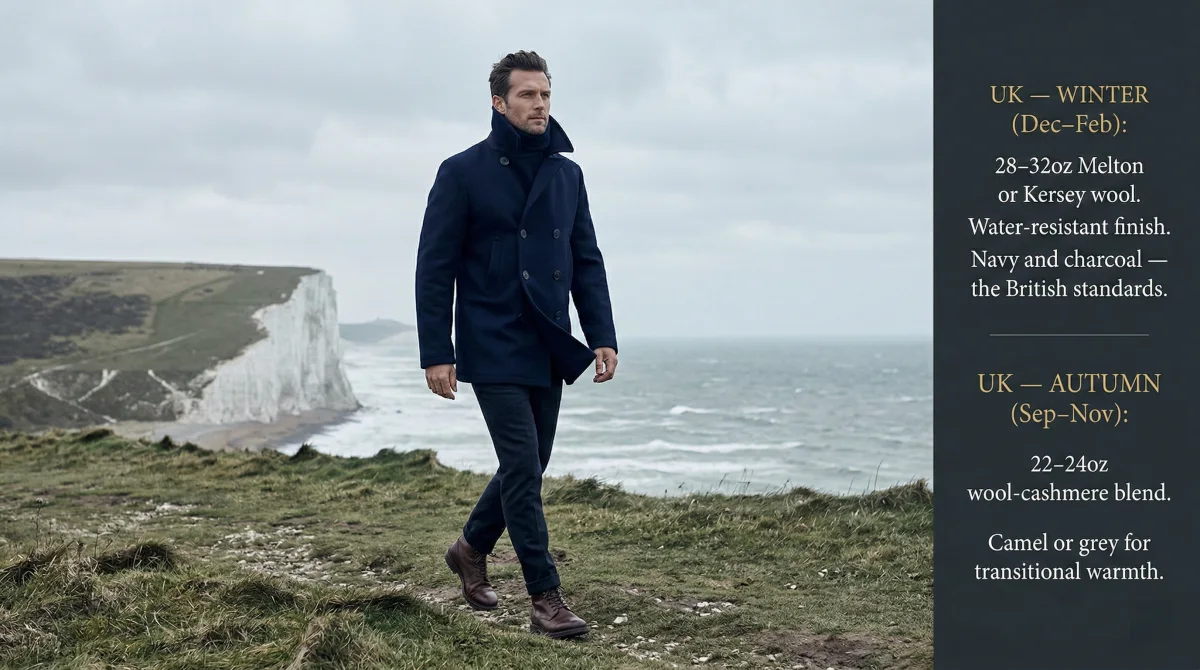
The UK provides the most natural alignment with what the pea coat was designed to withstand. British winters are cold, persistently damp, and frequently wind-driven.
For winter in the UK (December to February):
-
Traditional 28–32oz Melton or Kersey wool is the appropriate weight for sustained cold and coastal wind.
-
Water-resistant finishes or naturally lanolin-treated wools provide meaningful protection in the persistent drizzle of British winters.
-
Navy and charcoal peacoats dominate British heritage wear. Brands like Private White V.C. and Mackintosh have built entire reputations on this heritage.
For fall in the UK (September to November):
-
A slightly lighter wool-cashmere blend (22–24oz) handles the transitional months, when temperatures vary significantly from morning to evening.
-
A camel or grey peacoat transitions more naturally from the warmth of October afternoons to the chill of November evenings.
9.3 The united states: Coast-to-coast variation
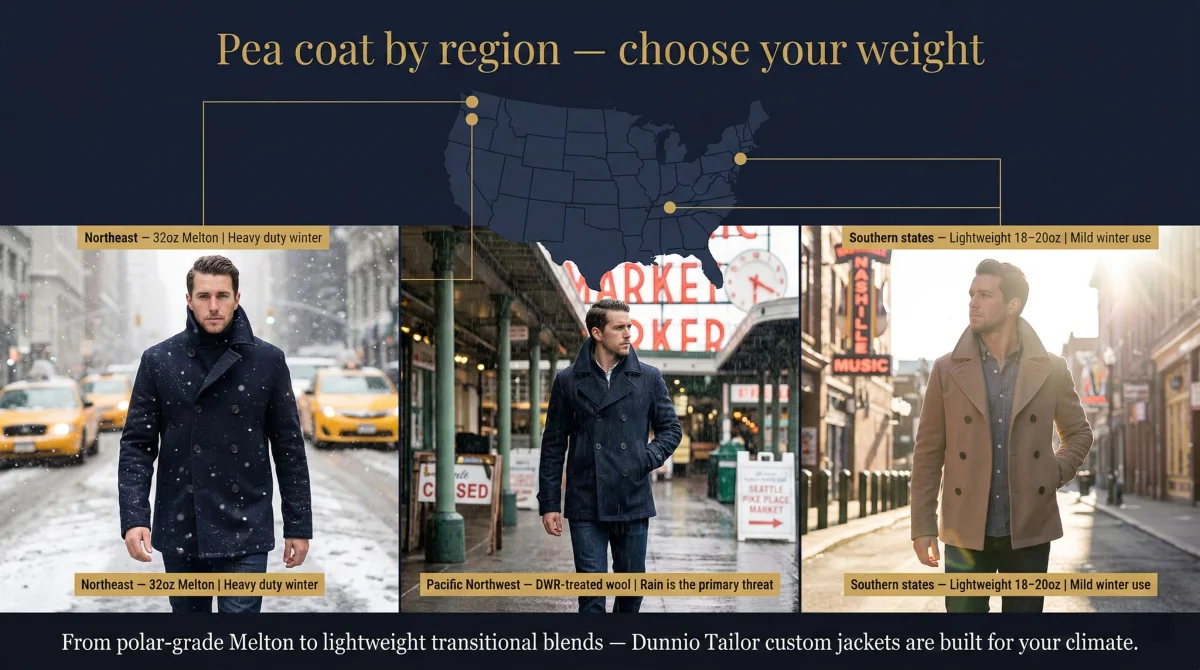
The US market is the most diverse climatically and was the primary force behind the pea coat's codification as a civilian garment post-World War II.
-
Northeast (New York, Boston, Chicago): Full 32oz Melton wool for proper winter defence. The heritage market here is strongest Schott NYC's 740 model remains the benchmark.
-
Pacific Northwest (Seattle, Portland): Water resistance is critical. A DWR-treated wool or a technical hybrid in the pea coat silhouette handles the relentless drizzle more effectively than untreated Melton.
-
Southern states: A light 18–20oz wool or wool-cotton blend in a shorter silhouette handles the mild winters without overheating.
10. Cropped peacoat and modern silhouette trends for 2026
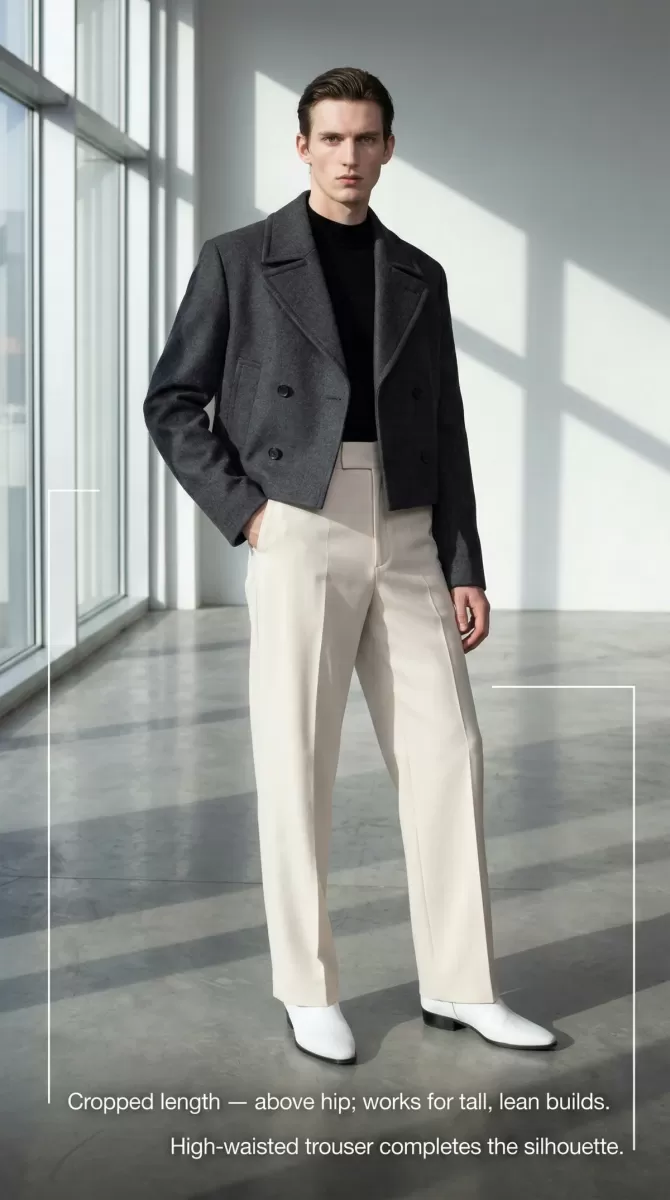
The cropped peacoat is 2026's most clearly directional update to this heritage style. Where the traditional peacoat ends at the hip, the cropped version terminates above the hip sometimes at the waist creating a bold, fashion-forward silhouette.
10.1 Who the cropped peacoat is for
-
Ideal for: Tall men (above 6 feet), lean and athletic builds, men who want to showcase high-waisted trousers or the waistband of their outfit.
-
Less suited for: Shorter men (the cropped length can make the torso look short and the legs disproportionately long) and heavier builds (where a full hip-covering length provides more structure and balance).
10.2 How to wear a cropped peacoat
-
High-waisted trousers are non-negotiable: The cropped length requires a high waistband to prevent an exposed middle section from looking unintentional.
-
Visible footwear is the point: Ankle boots, Chelsea boots, or clean leather sneakers become a feature of the outfit rather than an afterthought.
-
Layer consciously: A fitted rollneck or slim crew-neck beneath works well. Avoid chunky knits that add visual bulk at exactly the point where the cropped hem draws attention.
10.3 The length spectrum: Cropped to long
The gray long peacoat, in particular, is making a strong return in 2026 collections, offering a dramatic alternative to the shorter standard length. Its elongated line pairs beautifully with slim tailored trousers and knee-height boots.
11. Women's pea coat: A brief cross-reference
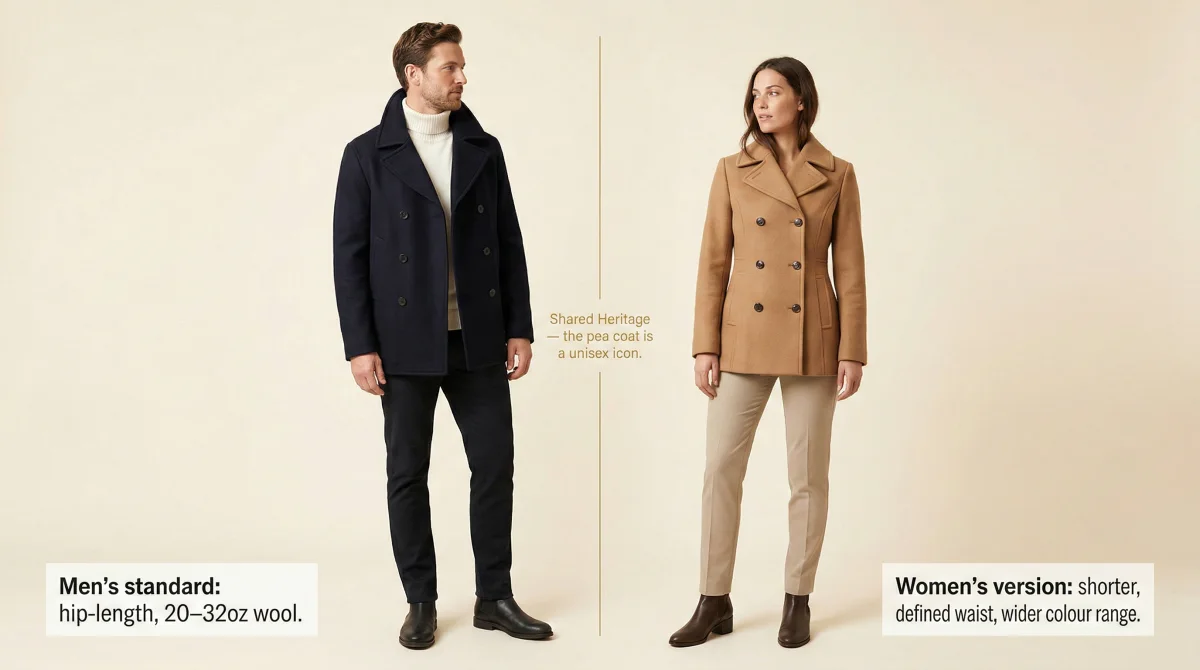
The pea coat is, at its origin, a unisex garment. Sailors of all genders wore versions of it, and women adopted the civilian peacoat enthusiastically in the 1960s alongside the rise of mod fashion.
Women's pea coat versions share the core design DNA double-breasted closure, heavy wool, convertible collar but are typically:
-
Cut with a more defined waist (either seamed or slightly belted).
-
Made in shorter lengths that hit above the mid-thigh.
-
Offered in a wider range of softer colors: camel pea coat ladies and blush or dusty rose options appear frequently alongside traditional navy and black.
Searches for "pea jacket womens," "wool pea coat womens," and "women's pea jacket" reflect the same purchasing intent as men's searches warmth, heritage style, and versatility across occasions. The same principles of fit and color theory apply across genders.
Note: Dunnio Tailor specialises in men's custom tailoring. For a custom pea coat built precisely to your measurements, explore our custom jacket options.
12. Pea coat care and maintenance: Protecting a lifetime investment
A pea coat made from quality wool should last decades but only with proper care. The construction requires specific maintenance that is different from other outerwear.
12.1 Cleaning protocol
-
Dry cleaning frequency: Maximum once or twice per season, or only when visibly soiled. The chemicals in the dry cleaning process strip wool of its natural lanolin over time, leading to brittleness and reduced water resistance. More is not better.
-
Daily maintenance: Use a garment brush ideally with natural boar bristles to remove surface dirt, lint, and dust before they work their way into the fibers and cause abrasion.
-
Spot treatment: For minor marks, use a barely damp cloth applied gently in blotting motions rather than rubbing. Rubbing works dirt deeper into the fiber structure.
12.2 Storage
-
Wide wooden hanger essential: The weight of heavy wool will physically deform the shoulder line over weeks if stored on a wire or thin plastic hanger. Use a wide, contoured wooden hanger.
-
Breathable cotton garment bag: Never plastic. Plastic traps moisture and creates conditions for mold and mildew growth. Store in a breathable cotton or canvas bag in a cool, dry environment.
-
Moth protection: Wool is a highly attractive protein source for moths. Use cedar blocks or lavender sachets rather than chemical mothballs, which can leave odors that penetrate deep into the fibers.
12.3 Emergency wet-coat protocol
If your pea coat becomes thoroughly soaked:
-
Do not hang it to dry the wet wool will stretch vertically under its own weight, permanently distorting the fit.
-
Lay it flat on a clean dry towel to air dry away from direct heat sources (radiators, sunlight, and heating vents).
-
Once completely dry, use a handheld steamer to remove any remaining creases or distortion.
-
If ironing is necessary, use a pressing cloth between the iron and the fabric on the lowest wool heat setting.
13. Why a custom pea coat from Dunnio Tailor changes everything
Off-the-rack peacoats are designed for a statistical average body that does not actually exist in the world. The man whose shoulders sit at exactly 18 inches, whose chest is exactly 40 inches, and whose arms are exactly 25 inches long he is not a real person. He is a size chart.
13.1 What custom tailoring actually delivers
A Dunnio Tailor custom jacket or custom coat is constructed around your precise measurements:
-
Shoulder width: The single most important measurement, built to your exact shoulder structure so seams sit precisely where they should.
-
Chest and midsection: Enough room for your preferred layering without excess fabric that creates a boxy, unstructured appearance.
-
Sleeve length: Ending exactly past your wrist bone not an inch above or below.
-
Hem length: Positioned exactly where you want it, whether that is a cropped silhouette, a standard hip-length, or an extended gray long peacoat style.
13.2 The 21-day advantage
Traditional bespoke tailoring can require months of waiting. Dunnio Tailor has streamlined the custom production process to deliver garments in 21 days without compromising on the quality of construction or the precision of the fit.
This means you can commission your pea coat at the start of autumn and have it ready well before the first serious cold front arrives.
13.3 Interactive 3d design: See it before you commit
One of the most powerful tools Dunnio Tailor offers is the ability to visualise your custom garment in 3D before your order is confirmed. Select fabrics, adjust details, and rotate the design before committing.
Experience the Dunnio Tailor 3D design tools:
- Customize your suit
- Customize your 3-piece suit
- Customize your jacket
- Customize your vest
- Customize your tuxedo
- Customize your pants
Explore the full Dunnio Tailor custom range:
14. Frequently asked questions about the pea coat for men
14.1 What is a pea coat for men?
A pea coat for men is a double-breasted, hip-length heavy wool jacket with an oversized convertible collar, vertical slash pockets, and a military heritage tracing back to European naval forces of the 17th and 18th centuries. Its defining features are its double-breasted button closure, its robust wool construction (typically 20–32 ounces per linear yard), and its ability to protect the wearer from extreme cold and wind.
14.2 Are pea coats in style in 2026?
Yes. The pea coat is having one of its strongest cultural moments in recent years, driven by the quiet luxury trend, Pitti Uomo runway appearances, the heritage revival movement, and growing interest in sustainable, long-lasting outerwear. A quality pea coat bought in 2026 is both fashionable and an investment piece that will remain relevant for decades.
14.3 What is the difference between a peacoat and a trench coat?
The key differences are:
-
Length: pea coats are hip-length; trench coats are knee-length to mid-calf.
-
Function: pea coats insulate against cold and wind; trench coats are primarily rain-resistant.
-
Fabric: pea coats use heavy wool; trench coats use cotton or synthetic gabardine.
-
Closure: pea coats are double-breasted buttons only; trench coats use a belt plus buttons.
For a full breakdown, read our trench coat guide for men.
14.4 How should a pea coat fit?
The shoulder seams must align precisely with the end of your natural shoulder this is the most critical measurement. The chest should have room for a mid-weight sweater without excess fabric. Sleeves should end just past the wrist bone. The hem should hit just below the hip. For a tailored silhouette, a waist suppression alteration of $30–$50 from a skilled tailor can dramatically improve the appearance of a boxy coat.
14.5 What is the best color for a men's pea coat?
Navy is the most versatile single choice it references the garment's heritage and pairs with virtually every suit color, denim wash, and casual base. Black is a strong choice for formal and urban settings. Charcoal grey is the emerging neutral of 2026. Camel, mustard, and chocolate offer personality for men who want to move beyond traditional navy.
14.6 Can you wear a pea coat with a suit?
Yes, absolutely. The pea coat was originally designed for layering it works well over a suit provided the suit jacket does not extend below the coat's hem and the coat accommodates your suit jacket's shoulder padding comfortably. Keep the collar flat and the coat fully buttoned for a formal professional appearance.
14.7 What fabric is a pea coat made from?
Authentic pea coats are made from heavy wool typically Melton cloth (a dense, felt-like fabric) or Kersey wool (a smoother, lanolin-treated variant). Modern luxury versions use wool-cashmere blends (20–24oz) for softness and urban comfort. Technical versions use recycled wool or hybrid technical fabrics with waterproof membranes. At Dunnio Tailor, premium fabrics range from $99 to $135 and luxury mill fabrics are available at $231.
14.8 How do I care for a wool pea coat?
Dry clean no more than twice per season. Brush daily with a garment brush to remove surface debris. Store on a wide wooden hanger in a breathable cotton garment bag. If the coat gets soaked, lay it flat to dry never hang wet wool. Use a steamer, not an iron, to remove wrinkles.
14.9 Is a pea coat good for winter in Australia?
Yes, with the right weight. Australian winters (particularly in Melbourne) suit 20–22oz wool or wool-cashmere blends lighter than the traditional 32oz naval spec but still providing genuine warmth. For Sydney winters, even lighter constructions and unlined versions are appropriate. Spring and autumn in Australia are good seasons for transitional wool-cotton or wool-linen peacoats worn open over knitwear.
14.10 Can a bigger man wear a pea coat?
Absolutely. The key choices are: dark, solid colors (navy or charcoal); fewer button rows (6-button versions over 10); structured shoulder construction to create a V-taper visual effect; and custom tailoring with waist suppression for a fit that flatters rather than overwhelms. A custom pea coat from Dunnio Tailor built to your exact measurements removes the compromise that off-the-rack sizing imposes.
Conclusion
The pea coat for men has endured for over three centuries not because fashion sustained it, but because function did. And in 2026, when menswear's most influential voices are championing heritage, quiet luxury, and sustainability over trend-chasing and logomania, the pea coat has found itself precisely positioned for another generation of relevance.
Whether you are a style-conscious professional in London seeking a formal-leaning overcoat alternative, a man in Melbourne looking for autumn outerwear that handles the city's unpredictable weather, or a heritage enthusiast searching for a vintage navy pea coat with genuine naval provenance the principles in this guide give you the authority to choose, wear, and maintain this garment with real confidence.
The short peacoat for men who want modern proportions, the gray long peacoat that makes a dramatic statement, the chocolate peacoat that anchors an earthen autumn palette each is an expression of the same engineering logic, refined over centuries for the same purpose: to make the man wearing it look sharp, stay warm, and feel prepared for whatever the day brings.
If you are ready to go beyond off-the-rack and have a pea coat designed specifically for your body, your fabric preference, and your lifestyle, Dunnio Tailor's custom jacket service delivers exactly that in 21 days.