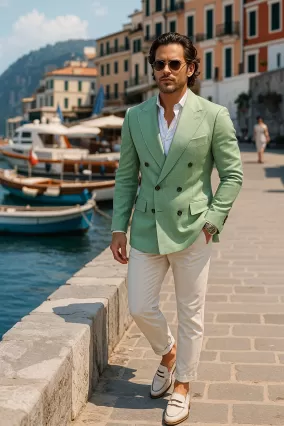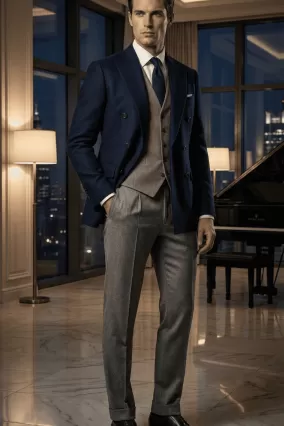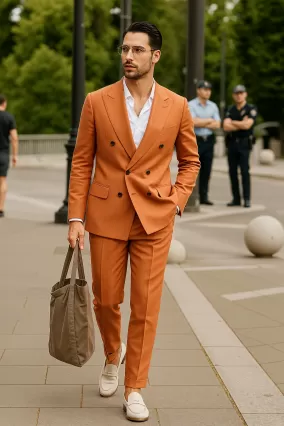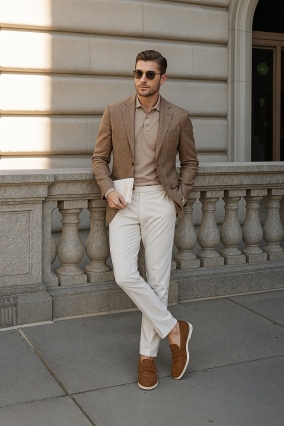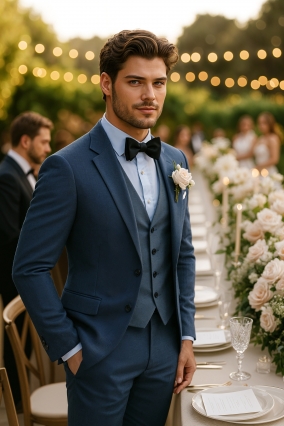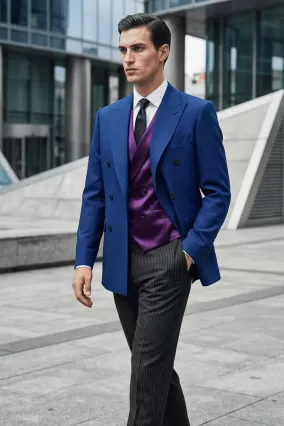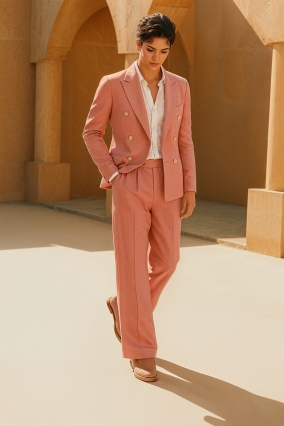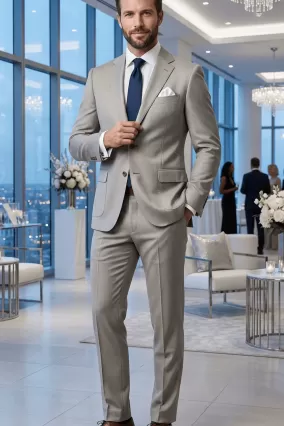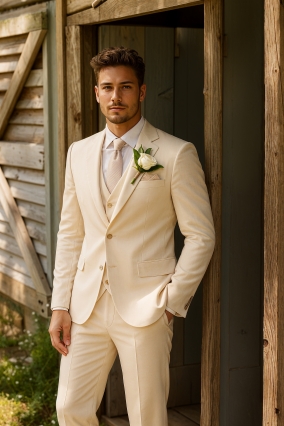
The difference between a sharp-looking man and a disheveled one is rarely the price tag on his suit. It is the fit. A well-crafted jacket cut for your actual body will always outperform an expensive off-the-rack piece that was never designed for your proportions. At Dunnio Tailor, we hear this question constantly - how should a suit fit? The answer is always the same: a second skin. Structured enough to give you shape, relaxed enough to let you breathe and move. In this guide, our craftsmen walk you through every detail - jacket shoulder to trouser ankle break - with practical advice for different body types, fabric choices, and occasions. Whether you are buying your first suit or commissioning a custom piece, this is the reference you will return to.

1. What does a perfectly fitted suit look like?
Step back and look at the full picture before you check individual details. A properly fitted suit looks effortless. There is no pulling at the chest, no sagging at the seat, no bunching of fabric at the ankles. Every line flows cleanly from the shoulder to the hem, enhancing your silhouette without constricting your movement.
1.1. The psychology of a good fit
Psychologists use the term "enclothed cognition" to describe how clothing shapes the way you think and the way others perceive you. Research consistently shows that men in well-tailored clothing are rated as more confident, more competent, and more authoritative than men in ill-fitting garments - even when the fabric and colour are identical. A well-fitted suit does not just look better. It makes you perform better.
The opposite is also true. An oversized jacket, sagging trousers, or sleeves that cover your hands do not just look sloppy - they quietly signal a lack of attention to detail. In professional and social settings, that costs you.

1.2. The three tailoring traditions: A framework for fit
Understanding where suit conventions come from helps you make smarter choices. Three tailoring traditions have shaped how suits are cut around the world:
-
British (Savile Row): structured and authoritative. Strong shoulder line, "drape" through the chest, tapered waist, double side vents. Built for a formal, powerful silhouette.
-
Italian (Continental): slim and aesthetic. Minimal padding, shorter jacket length, very high armholes, clean V-shaped torso. Built for a sleek, modern silhouette - particularly flattering on slim frames.
-
American (Sack Suit): relaxed and functional. No waist suppression, natural (unpadded) shoulders, low armholes. Built for comfort and mass fit - less flattering, but accessible.
None of these is objectively best. The right tradition for you depends on your body, your industry, and your personal style. At Dunnio Tailor, our bespoke approach draws from all three - building the structure your frame needs while honouring the aesthetic you prefer.


2. How should a suit jacket fit?
The jacket is the centrepiece of any suit. When it fits correctly, it sharpens your posture, narrows your waist, and broadens the perception of your shoulders. When it does not, nothing else in your outfit can compensate. Here is what to examine, measurement by measurement.
2.1. Shoulders - the non-negotiable anchor
The shoulder seam of your jacket must terminate exactly where your natural shoulder bone ends. Not one centimetre in front, not one centimetre behind.
-
If the seam drops beyond your shoulder: you get a "shoulder divot" - a deep indentation in the fabric where the sleeve begins. This signals the jacket is a size too large.
-
If the shoulder seam sits too narrow: the jacket pulls across the upper back, the lapels buckle, and you lose all freedom of movement. The shoulder is the most expensive and difficult part of a jacket to alter. A skilled tailor can let out a chest or take in a waist. Rebuilding a shoulder requires deconstructing almost the entire garment. If the shoulders do not fit perfectly when you try on a jacket, do not buy it with the intention of fixing them later.
- A useful diagnostic: stand sideways against a wall. Your shoulder pad should touch the wall just before your arm does. If the pad compresses significantly before your arm makes contact, the jacket is too wide.

2.2. Collar and gorge - the invisible sign of quality
The jacket collar should rest against your shirt collar smoothly, sitting flush with the curve of your neck. Approximately 1.3 cm to 1.9 cm of your shirt collar should be visible above the jacket collar at the back. This is one of the clearest signs separating a precision-made garment from a generic one.
Two problems to watch for:
-
Collar gap: the jacket pulls away from the neck, creating a visible space at the back. Often caused by forward posture or a jacket back that is too long for your torso.
-
Collar roll: excess fabric bunches below the collar at the back. Usually a sign of sloping shoulders or a mismatch between the jacket's construction and your posture.
These are not minor vanities. A collar that does not sit flush disrupts the entire rear silhouette of your suit, and it is often the first thing people notice from behind.

2.3. Chest, lapels, and button stance
When the jacket is buttoned, the chest should lie flat across the torso. A practical test: slide two fingers comfortably between your chest and the buttoned jacket. You should be able to do so with ease - but a full fist should feel genuinely restrictive.
-
If you see an "X" shape of stress lines radiating from the buttons: the jacket is too tight at the chest.
-
If the lapels bow outward or collapse inward: the chest is too narrow or the armholes are too low.
On a two-button jacket, the top button should sit 3.8 cm to 5 cm above the navel - just at your natural waist. This is called the button stance, and it directly affects how the jacket frames your torso. Too high and the jacket feels constricting. Too low and the jacket flares below the waist, throwing off the proportions.

The lapels themselves must lie flat against your chest. Whether you prefer notch, peak, or shawl lapels - they should rest quietly against the torso, enhancing your build without pulling away.
If you are looking at custom suits or a custom jacket, Dunnio Tailor adjusts the button stance and lapel width to complement your specific physique.
2.4. Waist suppression - the masculine v-shape
A well-fitted jacket tapers slightly at the waist. This creates a subtle "V" shape from the shoulders to the hips - the defining silhouette of a proper suit. It should not be so aggressive that you feel squeezed when you breathe, but the taper should be visible enough to give you shape.
When you move or sit and the jacket "balloons" out in a wide rectangle, that is a sign the waist needs suppression. If horizontal wrinkles form across the stomach when buttoned, the waist is too tight.
For broader-waisted men: a gentle taper still improves the silhouette substantially. The goal is not to hide your frame but to give it a defined outline.

2.5. Jacket length - the knuckle rule and the seat rule
Two reliable guidelines exist for jacket length:
-
The knuckle rule: when your arms hang naturally at your sides, the bottom hem of the jacket should reach your second knuckle. This is the classic, time-tested reference.
-
The seat rule: the jacket must cover your entire seat. A jacket that falls too short will expose the seat of your trousers - making you appear as though you have outgrown your clothing.
Cropped jackets are a fashion choice, not a fit choice. They can look intentional and contemporary in the right context, but they are not appropriate for formal professional settings. Equally, an excessively long jacket truncates your legs and makes shorter men appear shorter.

2.6. Sleeves - length, pitch, and cuff exposure
Jacket sleeve length matters both visually and functionally. The golden rule: the sleeve should end at the break of your wrist, allowing 0.6 cm to 1.3 cm of your dress shirt's cuff to show. This visible cuff is not affectation - it provides a clean finish and signals that your outfit has been considered to the last detail.
Equally important is the sleeve's pitch - the angle at which it is attached to the jacket body. If the pitch does not match how your arm naturally hangs, horizontal wrinkles will form along the sleeve. A properly pitched sleeve falls cleanly whether your arms are at rest or moving.
For reference: if your sleeves completely hide your shirt cuffs, they are too long. If they expose more than 2.5 cm of shirt at the wrist, they are too short. Both are immediately visible and difficult to ignore.

3. How should suit trousers fit?
Trousers are the foundations of your suit. A jacket that fits beautifully will be undermined if the trousers sag, bunch, or pull in the wrong places.
3.1. Rise and waistband
The rise is the distance from the waistband to the crotch seam. It determines where your trousers sit on your body and how they interact with your torso.
-
Mid-rise: the most versatile option. Sits just below or at the natural waist. Works with almost every body type and pairs well with both tucked shirts and sport coats.
-
High-rise: sits above the natural waist. Creates the illusion of longer legs, suits a more formal or vintage aesthetic, and pairs particularly well with suspenders or a custom 3-piece suit.
-
Low-rise: sits near the hips. Can disrupt the clean vertical line of the suit and feels uncomfortable when seated.
The waistband should be snug enough to stay in place without a belt but never tight enough to dig in. Test it simply: slide two fingers inside the waistband. If you can do so comfortably, the fit is correct.

3.2. Seat and hips
The seat of the trousers - covering your backside - should lie smooth and flat. No horizontal stretch lines across the rear (indicating the trousers are too tight), and no sagging or excess fabric (indicating they are too loose).
From behind, the trousers should follow the natural contour of your hips without clinging or ballooning. "Hungry butt" lines - horizontal creases pulling below the seat - are one of the most common signs of ill-fitting trousers.

3.3. Thighs and taper
Standard suit trousers should gently skim the thighs, offering enough room to walk, sit, and cross your legs comfortably. They should taper gradually toward the ankle - not so aggressively that the fabric pulls at the calf, and not so wide that the leg opening creates a "bell-bottom" silhouette.

If your side pockets flare outward rather than lying flat, the trousers are too tight through the hips or thighs. Well-fitted custom pants will have pockets that rest flush against the body with no distortion.
3.4. Trouser break - the finish that defines the look
The "break" is the fold of fabric formed where the trouser hem meets the top of the shoe. This is one of the most personal elements of suit fitting, and it varies by occasion, age preference, and body proportions.
For most men in most contexts, the slight break is the safest and most versatile choice. It creates a clean vertical line without looking deliberately cropped.
Shorter men benefit from a no-break or slight-break. The clean, uninterrupted line adds visual height. Taller men can use a half break to add horizontal interest and prevent their legs from looking overly narrow and long.

3.5. Trouser length - when longer becomes sloppy
If your trousers puddle at the ankles, they are too long. If they expose your socks while you are standing (and you are not intentionally wearing a cropped-cut trouser), they are too short. The hem should gently rest on or just brush the top of your shoe - never pool on the floor.
4. How to measure for a suit jacket at home
Knowing how to measure for a suit jacket gives you the foundation for any tailored purchase - whether bespoke, made-to-measure, or online. You will need a flexible measuring tape and a second person to take the measurements accurately.
Key measurements to take:
-
Chest: wrap the tape around the fullest part of your chest, under your armpits. Keep the tape parallel to the floor. This is your primary jacket size.
-
Shoulders: measure across the back from shoulder seam to shoulder seam. This determines whether a jacket's frame will align with your actual shoulder bone.
-
Natural waist: measure around your torso at the narrowest point between your hips and ribcage. This determines how much the jacket needs to be suppressed or left straight.
-
Sleeve length: measure from the centre back of the neck, across the top of your shoulder, and down to your wrist bone. This gives your total sleeve measurement.
-
Jacket back length: measure from the base of the neck (where the collar sits) straight down to the desired hem point - typically just below the seat.
-
Hips: measure around the fullest part of your hips and seat, keeping the tape parallel to the floor.

For detailed measurement guidance, refer to Dunnio Tailor's dedicated blog post: how to measure for a suit. Alternatively, use your measurements directly in our 3D suit customization experience to see your fit in time.
5. How a suit should fit for different body types
A well-fitted suit does not come from buying a size chart. It comes from understanding how a jacket interacts with the particular way your body is built. Here is how to approach suit fit based on specific physical builds.
5.1. Slim and lean men
Slim men face the challenge of suits that swim on a narrow frame - extra fabric in the torso, drooping shoulders, and trousers that sag through the seat and thighs.
-
Choose a slim-fit or Italian-inspired cut with high armholes and a defined waist.
-
Opt for structured shoulders (light padding): this adds perceived width and keeps the jacket from looking hollow.
-
Avoid excessive waist suppression - a lean frame benefits from subtle definition, not a cinched hourglass.
-
Select trousers with a slight taper to clean the leg line without emphasising thinness.
-
Consider a custom 3-piece suit - the waistcoat adds layering and visual mass, giving a slimmer frame a more substantial presence.

5.2. Athletic and muscular men
A broad chest paired with a narrow waist is actually close to the ideal tailoring silhouette - but off-the-rack suits are rarely cut for it. Jackets sized for the chest will be loose through the waist; jackets sized for the waist will not button across the chest.
-
Commission a custom suit or made-to-measure jacket with independent chest and waist measurements.
-
Look for jackets cut with a higher armhole - this allows the sleeve to move freely without lifting the entire jacket body.
-
Ensure the shoulder seam sits precisely at the shoulder point; shoulder divots are particularly visible on muscular frames.
-
Choose trousers with extra room through the seat and thighs, tapering cleanly below the knee.
This is exactly the scenario where the difference between a properly fitted suit and an off-the-rack compromise is most visible.

Explore Dunnio Tailor's 3D jacket customizer
5.3. Big, stocky, or big-bellied men
Heavier frames have the most to gain from a properly fitted suit. A jacket that fits at the chest and hangs well through the torso can create a substantially more polished and professional appearance than any other garment in a man's wardrobe.
-
Prioritise the chest and shoulder fit first. A jacket that is too tight here will create stress lines across the chest and pull the lapels apart - a look that undermines everything else.
-
Allow two to three centimetres of ease through the waist: enough to move comfortably without the jacket becoming a tent.
-
Opt for a jacket with a lower button stance. This creates a longer "opening" below the breast and gives the illusion of a longer torso.
-
Avoid double-breasted cuts if you carry significant weight through the midsection - the extra fabric across the front draws attention rather than redirecting it.
-
Choose slightly higher-rise trousers. They sit above the belly rather than below it, which is far more comfortable and creates a cleaner silhouette.
-
A single-breasted, two-button, lightly structured jacket in a dark colour (navy, charcoal, or dark grey) is the most flattering starting point.

For guidance on how different body types relate to suit selection, also see Dunnio Tailor's guide on male body types and finding your perfect suit.
5.4. Tall men
Tall men often struggle to find jackets with long enough sleeves and trouser inseams - and when they do find them, the proportions are frequently off.
-
Look for jackets specifically graded in "Long" or "Extra Long" body lengths.
-
Wider lapels, half-break or full-break trousers, and broader shoulders all help keep proportions in scale with a tall frame.
-
Avoid excessively slim, cropped jackets - on a genuinely tall man, these read as undersized rather than modern.
-
Pleated trousers in a full or half break are often more proportionate for tall men than a slim no-break cut.

5.5. Short and petite men
For shorter men, the goal is to maintain the longest possible vertical line from shoulder to shoe.
-
Choose a jacket with a shorter body length that still covers the seat - this opens up the proportion of the leg below.
-
The Italian tradition (short jacket, slim trousers) naturally suits shorter frames.
-
Opt for a no-break or slight break at the trouser hem - any pooling of fabric visually shortens the leg.
-
Avoid wide peak lapels or strong horizontal design details; these add width and draw the eye sideways rather than upward.
-
A single-button jacket raises the focal point of the outfit and creates the longest possible torso-to-leg proportion.

6. How fabric affects the fit of your suit
Fit is not just about measurements - it is also about the material the suit is made from. The weight, weave, and fibre composition of your fabric determine how the garment responds to gravity, movement, and your body's heat over the course of a day.
6.1. Fabric weight and drape
Fabric weight is measured in grams per square metre. This figure tells you how the fabric will "hang" on your frame.
-
Lightweight fabrics (below 250 GSM): tropical wools, linen, and cotton blends. These drape softly and breathe well, but they have less structure. They reveal the body's contours more clearly and are more prone to wrinkling throughout the day.
-
Mid-weight fabrics (270 to 350 GSM): the most versatile range. They drape cleanly, hold their shape, and remain comfortable across most climates and interior environments.
-
Heavyweight fabrics (above 350 GSM): flannels, tweeds, and wool-cashmere blends. These create a highly structured, almost architectural silhouette that is excellent for winter but can feel restrictive in warmer settings.

6.2. Worsted wool vs. woolen fabrics
These two categories of wool behave very differently on the body:
-
Worsted wool: tightly spun, dense, and smooth. This is the professional standard for suiting. It returns to shape after stretching (excellent "memory"), creates a crisp, sculpted fit, and is the most durable over repeated wear. Worsted fabrics are unforgiving of poor tailoring - they show every line clearly.
-
Woolen fabrics (flannels, tweeds): fluffier, softer, and warmer. They drape in a more relaxed, cosy way and can mask minor tailoring imperfections. They are exceptional for winter and for a more casual, textured aesthetic.

6.3. Does elastane help?
Modern suiting often incorporates 1% to 3% elastane or a polyester blend to improve stretch and movement. For men with physically demanding roles or long commutes, this can meaningfully improve comfort. However, stretch blends can "bag out" over time - particularly at the elbows and knees - permanently distorting the suit's shape.
6.4. Dunnio Tailor's fabric range and how each performs
At Dunnio Tailor, every fabric in our collection has been selected with fit and drape in mind:
- Premium fabrics (from $99 to $135): these include Twill Technical, Oxford, Chambray, Barathea, Satin Technical, Hopsack Cotton Blend, Plain Cotton Blend, and Plain Pure Linen. These fabrics offer excellent drape and comfort, extensive customisation options, and are suited to a wide range of climates and occasions. The Pure Linen, in particular, is ideal for summer events, garden weddings, and warmer markets - explore our range of linen wedding suits as an example of how this fabric performs when cut specifically for the wearer.
- Luxury mill fabrics ($231): Twill Wool Blends and Wool 150s. These are among the finest suiting fabrics available, with a clarity of drape, a richness of handle, and a structural precision that only high-count worsted wool can deliver. A Wool 150s suit will mould beautifully to your body over time - responding to your posture and movements in a way that no synthetic can replicate.
If you have specific fabric requirements - a specialty weave, a heritage cloth, or a technical performance fabric for travel - contact Dunnio Tailor directly to discuss a custom order.
For more on how colour and fabric intersect, visit our guide on what suit colour to choose.
7. Off-the-rack vs. made-to-measure vs. bespoke: The fit hierarchy
Understanding these three tiers helps you make an informed buying decision - and explains why most men are walking around in suits that do not actually fit them.
- Off-the-rack suits are designed for an "average" body that rarely exists in practice. If you happen to fit a standard size well in the chest and shoulders, OTR can work - after alterations to the sleeve length, waist, and trouser inseam. But if the shoulder does not fit in the store, no tailor can truly fix it without a near-complete reconstruction.
- Made-to-measure suits take your measurements and apply them to an existing base pattern before the suit is cut. This accounts for differences in arm length, waist suppression depth, and trouser rise - the most common points of divergence from standard sizing.
- Bespoke tailoring cuts a unique pattern from scratch for your specific body. This process can account for postural nuances - a forward-leaning neck, an asymmetrical shoulder, a rotated pelvis - that MTM cannot easily address. It is an investment in both time and money, but the result is a garment that genuinely fits like a second skin.

Dunnio Tailor combines the precision of bespoke craftsmanship with accessible technology. Our 3D customisation tool allows you to visualise your suit before it is made, while our craftsmen interpret your measurements into a garment built for your specific proportions. Explore how this approach eliminates the pain points of off-the-rack suits.

Also see our detailed breakdown of these options in the complete guide to types of suits for men.
8. The new suit checklist: Things most men forget
A suit's fit can be undermined before you even wear it. When you receive a new suit - off-the-rack or custom - run through this checklist before the first outing.
Remove the sewn-shut vents: the back vents of a new jacket are stitched closed with an X pattern to maintain their shape in the store. If you forget to remove this stitch, the jacket will not hang and flare correctly when you walk. Use a seam ripper or small scissors.
Open the exterior pockets (or leave them): exterior pockets are often sewn shut to prevent distortion during display. You can open them with a seam ripper, but if you tend not to use jacket pockets, leaving them sewn maintains a cleaner silhouette.
Remove the sleeve label: the brand or fabric label stitched to the left sleeve is a temporary tag for display purposes. Leaving it on is one of the most widely recognised sartorial faux pas. Remove it before wearing the jacket.

The buttoning rules:
-
Two-button jacket: fasten the top button only. The bottom button must always remain undone. This preserves the intended silhouette of the jacket's lower half and prevents awkward bunching at the hips.
-
Three-button jacket: "always, sometimes, never." The top button is never fastened; the middle is optional; the bottom is always left undone.
-
When sitting: unbutton all buttons. A buttoned jacket when seated causes the collar to ride up, the chest to buckle, and the entire jacket to distort. This is standard practice, not an oversight.
9. Quick fit reference table
Use this table when trying on or reviewing any suit - jacket or trousers.

10. Suit fit trends for 2026
The fit landscape is shifting meaningfully. Understanding where the current moment sits helps you invest in a suit that will look contemporary for years rather than seasons.
10.1. The end of extreme slim
The hyper-slim suits that dominated the 2010s - so tight they constrained movement and produced visible stress lines in every photograph - are being replaced. Designers across the major markets are moving toward broader chests, more relaxed shoulders, and wider-leg trousers for 2026.
This is not a return to the boxy silhouettes of the 1990s. It is a more refined direction - "relaxed architecture" is the most accurate description. More fabric, better drape, and a silhouette that communicates elegance rather than effort.

10.2. Liquid tailoring and versatile suiting
The boundary between formal and casual continues to erode. "Liquid tailoring" - lightweight, unstructured blazers in flowing fabrics - is becoming a staple for smart-casual offices, social events, and creative settings. Blazers are styled with textured fabrics (tweed, herringbone), worn with quality knitwear, and paired with tailored trousers that lean more toward pleated than pegged.
For weddings, this translates to lighter-weight, softer-structure custom wedding suits that move beautifully in photographs and remain comfortable across a full day of events. Linen wedding suits in particular align perfectly with this direction for warmer climates and outdoor ceremonies.

10.3. Technical and travel suiting
Demand for wrinkle-resistant, lightweight travel suits continues to grow, particularly in the North American and Australian markets. These garments often feature elasticated waistbands, stain-resistant finishes, and four-season weights (around 270 to 300 GSM) that pack without creasing. For men who travel frequently for work, the investment in a technically engineered suit fabric pays off quickly.
11. Frequently asked questions
How do you know if a suit fits properly?
A properly fitted suit meets the following criteria at every point:
-
The shoulder seam ends exactly at the natural shoulder bone.
-
The collar rests flush against the shirt collar, no gap and no roll.
-
The lapels lie flat with no bowing or flaring.
-
The chest and waist show a subtle taper without stress lines.
-
The jacket length covers the seat and reaches the second knuckle of the thumb.
-
Sleeves show 0.6 to 1.3 cm of shirt cuff.
-
Trousers fit smoothly through the seat, skim the thighs, and break gently at the ankle.
If every check passes, the suit fits. If one fails, one area needs attention. If multiple fail, the suit was not made for your body.
Is it better for a suit to be tight or loose?
Neither extreme is correct. The ideal fit is close to the body - structured enough to give you a defined silhouette, relaxed enough to allow full movement. A tight suit creates visible stress lines, restricts movement, and degrades faster at pressure points. A loose suit makes the wearer appear as though he borrowed the jacket from someone larger. The answer is a well-fitted suit, built for your specific measurements.
How should a suit fit for a heavier or plus-size man?
The principle is the same as for any body type - a well-made suit, cut to actual measurements. The key adjustments are:
-
Prioritise chest and shoulder fit above all else.
-
Allow enough ease through the chest and waist for comfortable breathing and movement.
-
Opt for a lower button stance to create a longer vertical line.
-
Choose higher-rise trousers for comfort and a cleaner silhouette.
-
Darker colours (navy, charcoal, dark grey) in smooth worsted wool create the most polished, flattering result.
A bespoke or made-to-measure garment makes the biggest difference here - standard sizing rarely accommodates larger frames without compromising somewhere.
How long should a suit jacket be?
The jacket hem should reach the second knuckle of your thumb when your arms hang naturally at your sides. It must also fully cover your seat. These two rules together ensure the jacket creates a balanced proportion between your upper and lower body.
Should suit trousers touch the shoes?
Yes - lightly. The hem should rest on or just brush the top of the shoe when you are standing. The exact interaction depends on your preferred break style (see section 3.4), but no fabric should puddle on the floor and no ankle should be exposed unless you are deliberately styling a no-break or cropped trouser.
Why do off-the-rack suits so rarely fit perfectly?
Because they are pattern-graded from a single "average" body that does not reflect how most men are actually built. Two men with the same chest measurement may have significantly different shoulder widths, arm lengths, or waist-to-hip ratios. Off-the-rack suits account for none of this variety - which is why tailoring post-purchase is almost always necessary, and why the shoulders - the one thing that cannot be effectively altered - so often remain wrong.
How do I choose between a 2-piece and a 3-piece suit?
A custom 3-piece suit adds a waistcoat to the jacket and trousers. The waistcoat adds a layer of visual formality and structure, covers the shirt where the jacket opens, and creates a more complete, sophisticated look. It is particularly useful for tall and lean men (who benefit from the extra layering) and for formal events such as weddings. For a detailed comparison, see the guide to vest vs. waistcoat on the Dunnio Tailor blog.
What is the proper suit fit for a wedding?
For the groom, the standard applies with added precision: every detail must be correct, because wedding photographs last a lifetime. The shoulder seam must sit perfectly, the sleeve length must be exact, and the trouser break should be agreed before the final fitting. Consider a custom wedding suit or a custom tuxedo for black-tie celebrations.
For groom parties and guests, the same principles apply - a well-fitted suit in an appropriate colour for the occasion. See also custom wedding vests for an elegant third-piece option that works even when the full three-piece suit feels too formal.
Conclusion
Understanding how a suit should fit is the single most powerful step you can take to upgrade your appearance. Before the fabric, before the colour, before the lapel style - the fit is what determines whether a suit enhances your frame or works against it.
A properly fitted suit:
-
Sits at the shoulder, not beyond it.
-
Tapers at the waist without constricting.
-
Covers the seat and falls at the knuckle.
-
Moves with you, not against you.
-
Shows the right amount of shirt at the collar and cuff.
No off-the-rack suit can guarantee all of this. Your body is not a standard size - it is yours, with its own proportions, posture, and physical character. That is exactly why Dunnio Tailor builds every suit from your measurements, crafted by hand, designed to perform across years of wear.
Explore our custom suits or begin designing your own with our interactive 3D suit customizer. For special events, explore custom wedding suits, custom 3-piece suits, and custom tuxedos - all made to fit how a suit should fit: perfectly.
When choosing groom's suits at Dunnio Tailor, you will receive:
- Tailoring is based on personal measurements.
- Customize according to preferences.
- Instructions from a professional technical team.
- Tailored by skilled craftsmen.
- Fitting and adjusting as required.
- Fabric pattern options with a collection of more than 500 different fabric patterns.
- Free 720-day warranty.
- Free hangers and specialized storage bags.
- Support and shipping policies for international customers.
Hotline - WhatsApp: +84 968996668
Email: support@dunniotailor.com