Table of Contents[Hide]
- 1. The Regulatory Guillotine: The Victory Suit and the Administration of Austerity
- 2. The Architecture of Textiles: Wool, Mills, and the Coverdine Legacy
- 3. The Tropical Groom: Regional Adaptations in Queensland and Western Australia
- 4. The Haberdashery Crisis: Buttons and Structure
- 5. The Post-War Renaissance: The Bold Look
- Conclusion: The Legacy of the 1940s Silhouette
For the modern gentleman, the 1940s Australian wedding suit offers a compelling study in duality, evolving from government-mandated austerity to post-war exuberance. These sartorial choices were dictated not just by aesthetics, but by supply chains, legislation, and the harsh Australian climate. At Dunnio Tailor, we believe understanding this history elevates the appreciation of modern bespoke tailoring. By examining the technical limitations of the "Dedman" economy suit, the structural integrity of 16-ounce worsted wools, and tropical adaptations like linen, we gain insight into enduring principles of fit and fabric selection that remain relevant today.
1. The Regulatory Guillotine: The Victory Suit and the Administration of Austerity
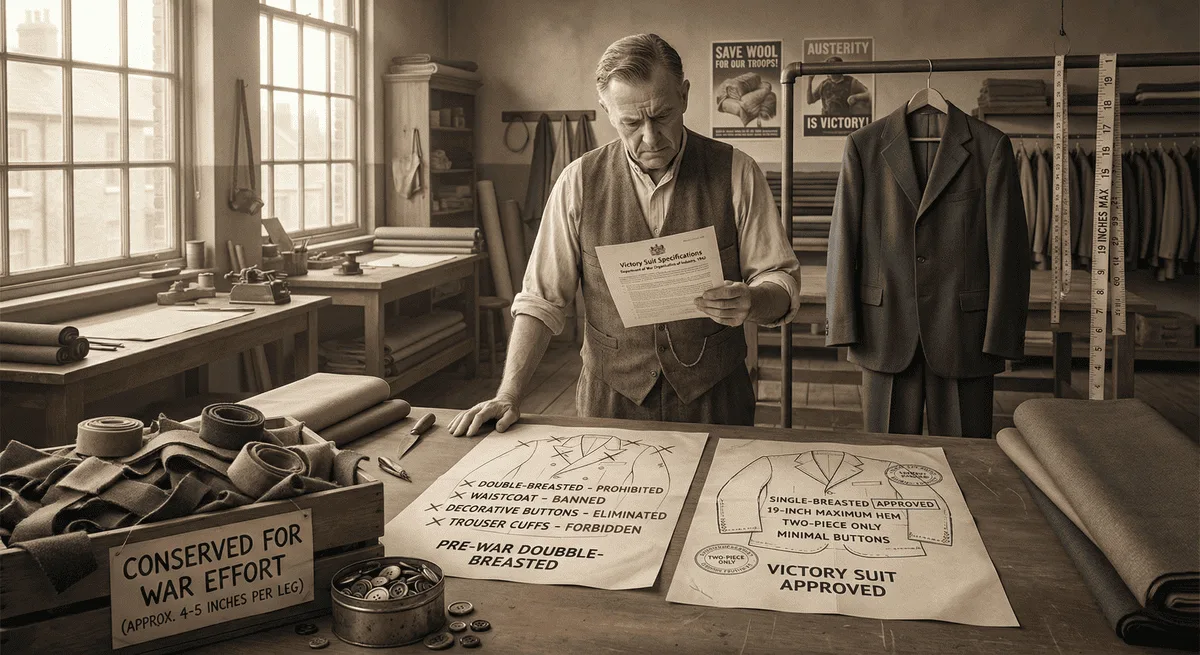
In the early 1940s, the Australian tailoring industry faced a radical transformation under the Department of War Organisation of Industry. Led by Minister John Dedman, the government enforced the "Victory Suit" regulations in 1942 to conserve wool and labor for the military. These regulations fundamentally altered the anatomy of the suit, stripping away the Edwardian flourishes that had defined menswear for decades.
For the bespoke enthusiast, the technical specifications of the Victory Suit reveal a fascinating exercise in minimalism. The regulations mandated single-breasted jackets, eliminating the fabric-heavy overlap of the double-breasted cut. Waistcoats were initially banned, reducing the standard three-piece suit to a two-piece utilitarian garment.
The most specific changes occurred in the trousers and finishing. Cuffs, or "turn-ups," were prohibited to save the four to five inches of fabric required to fold them back. Trousers were restricted to a maximum width of 19 inches at the hem, creating a straighter, more severe silhouette. Even the sleeves were affected, with the removal of decorative buttons to save thread and labor. While these "Dedman" suits were often derided at the time for their severity, they introduced a streamlined aesthetic that prioritized functional tailoring over excess.
2. The Architecture of Textiles: Wool, Mills, and the Coverdine Legacy
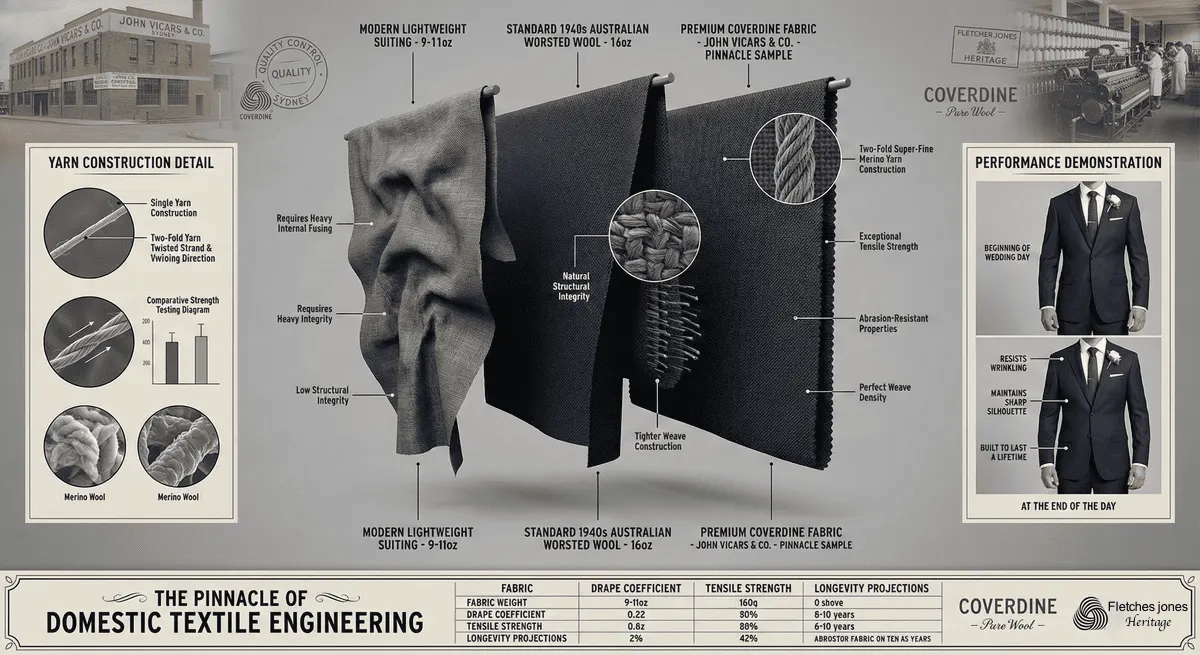
To understand the drape and performance of a vintage men's wedding suit in 1940s, one must understand the weight of the cloth. Unlike the lightweight superfine wools common in modern ready-to-wear, the standard Australian suiting of this era was a formidable 16 to 17-ounce worsted wool.
This heavyweight cloth possessed inherent structural integrity. A 16oz fabric falls in a clean, unbroken line from shoulder to hem, requiring less internal fusing to maintain its shape. For a groom, this meant a suit that resisted wrinkling and maintained a sharp silhouette throughout the wedding day. The benchmark for this quality was often found in the "Coverdine" fabric produced by John Vicars & Co. in Sydney.
Coverdine was a pure wool fabric made from two-fold super-fine Merino yarn. The two-fold construction, where two single yarns are twisted together before weaving, increased tensile strength and resistance to abrasion. This fabric became legendary in the trade, eventually becoming the foundation for the Fletcher Jones empire. A groom wearing a suit of Vicars Coverdine was wearing the pinnacle of domestic textile engineering a cloth built to last a lifetime.
3. The Tropical Groom: Regional Adaptations in Queensland and Western Australia
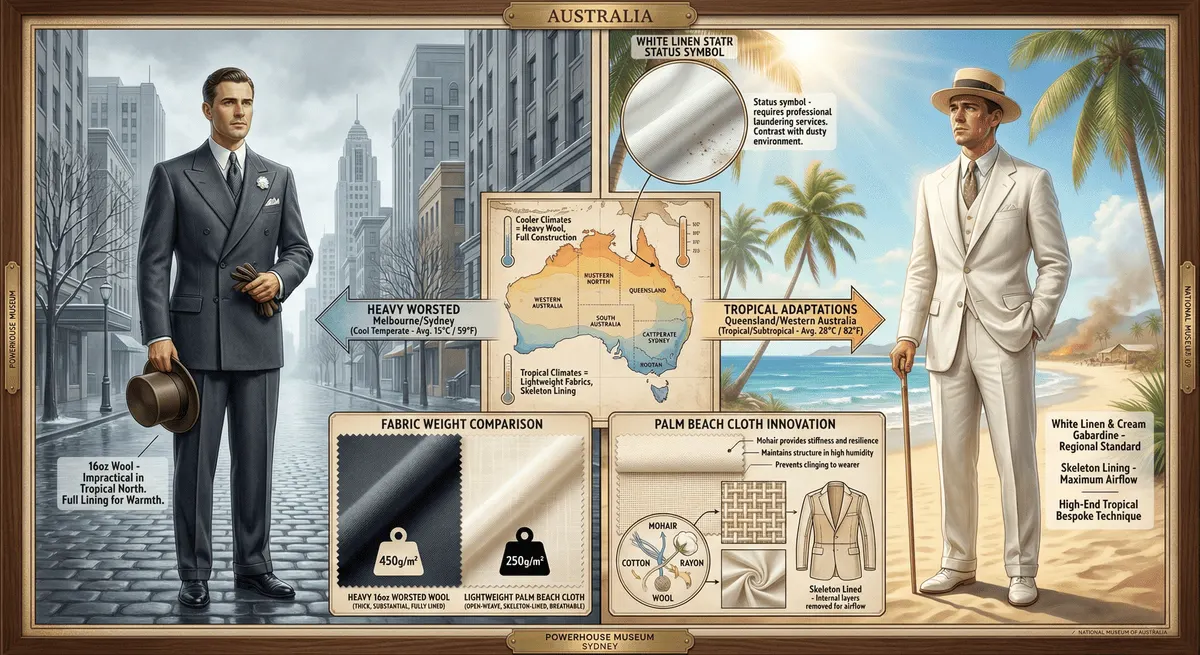
Australia's vast geography demanded that tailors adapt British traditions to local realities. While Melbourne and Sydney adhered to heavy worsteds, the tropical north developed a distinct aesthetic that prioritized thermal regulation without sacrificing formality.
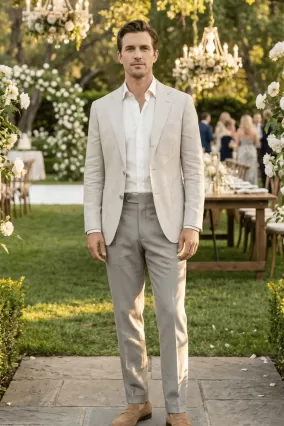
In Queensland and Western Australia, the 16oz wool suit was physically impractical. Archival records from the era highlight the prevalence of white linen and cream gabardine for weddings. The white linen suit became a status symbol, implying access to professional laundering services necessary to keep the pristine look in a dusty environment.
The most significant innovation for the summer wedding was the "Palm Beach" cloth. Originally a proprietary blend from the US, the term became generic in Australia for lightweight summer suiting made from mohair, cotton, rayon, and wool. The inclusion of mohair provided a crucial technical benefit: its stiffness and resilience allowed the open-weave fabric to maintain its structure in high humidity, preventing the suit from collapsing or clinging to the wearer. These suits were often "skeleton lined," removing internal layers to maximize airflow a technique still used today in high-end tropical bespoke tailoring.
4. The Haberdashery Crisis: Buttons and Structure
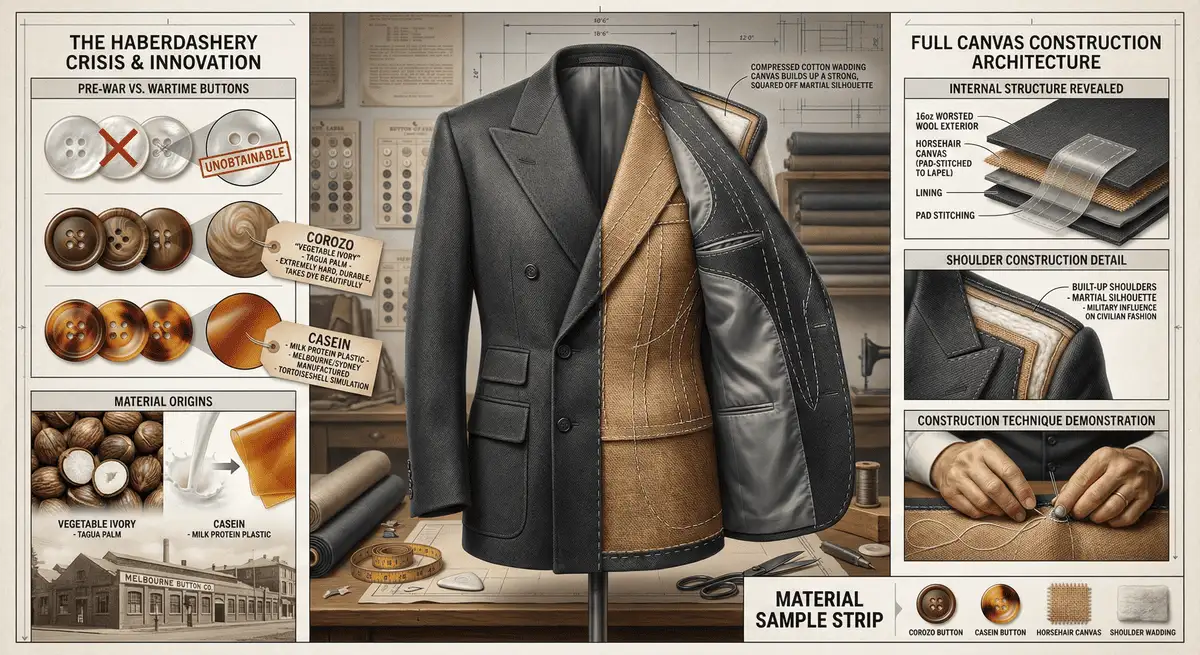
The war disrupted the global supply chain for haberdashery, forcing Australian manufacturers to innovate. The pearl shell industry collapsed, making traditional Mother-of-Pearl buttons unobtainable. In their place rose buttons made from Corozo and Casein.
Corozo, known as "vegetable ivory," is derived from the nut of the Tagua palm. It is extremely hard, durable, and possesses a grain structure similar to ivory. Unlike cheap modern plastics, Corozo was a quality material that took dye beautifully, becoming the standard for better suits. Casein, a plastic derived from milk protein, was also widely manufactured in Melbourne and Sydney, often dyed in rich autumn tones to simulate tortoiseshell.
Structurally, these suits relied on a "full canvas" construction. A layer of horsehair canvas was pad-stitched to the lapel, providing the internal architecture that allowed the heavy wool to roll elegantly over the chest. The shoulders were typically "built up" with wadding to create a strong, martial silhouette, a reflection of the military influence on civilian fashion.
5. The Post-War Renaissance: The Bold Look
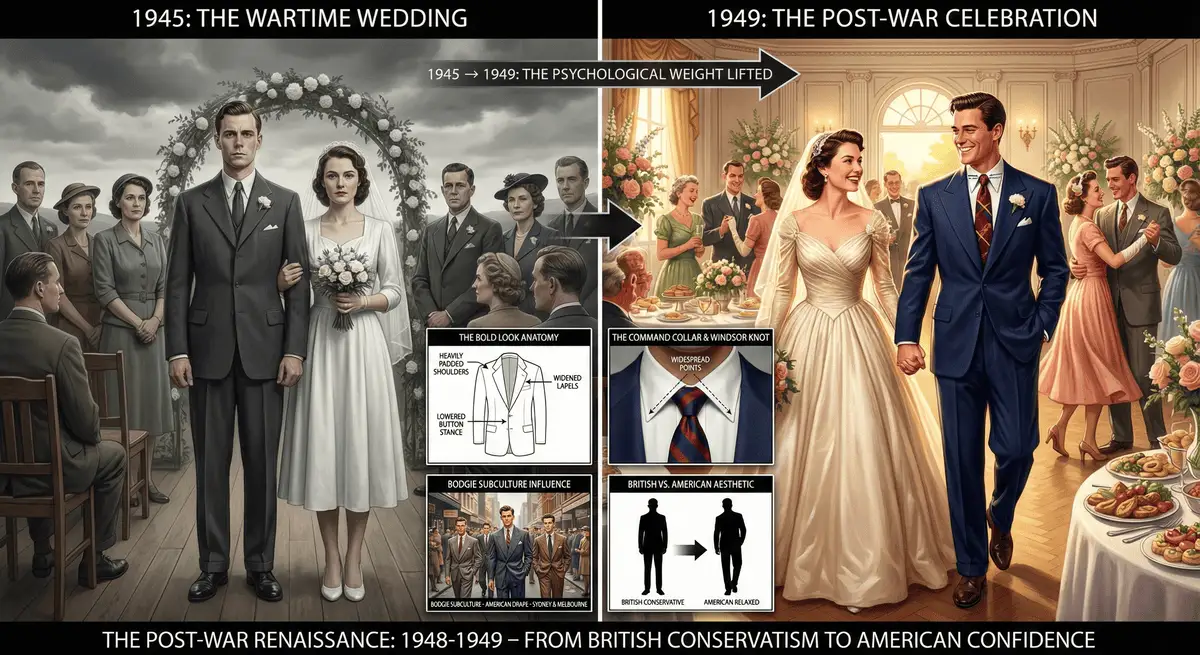
As the 1940s drew to a close, the psychological and material weight of the war lifted. By 1948 and 1949, Australian menswear began to embrace the "Bold Look," a term coined to describe the new assertive American aesthetic that replaced the parsimony of the Victory Suit.
The Bold Look was characterized by a looser, boxier jacket with heavily padded shoulders that extended beyond the natural shoulder line. The button stance was lowered, creating a deep "V" that showcased the shirt and tie. Lapels widened, and the "Command Collar" shirt with widespread points became fashionable, often paired with a thick Windsor knot.
Culturally, this period also saw the rise of the "Bodgie" subculture in Sydney and Melbourne. While distinct from traditional wedding attire, the Bodgie preference for the "American Drape" cut—with excessive fabric in the chest and "pegged" trousers—influenced the broader fashion landscape. It pulled the center of gravity away from British conservatism toward a more relaxed, voluminous American silhouette.
Conclusion: The Legacy of the 1940s Silhouette
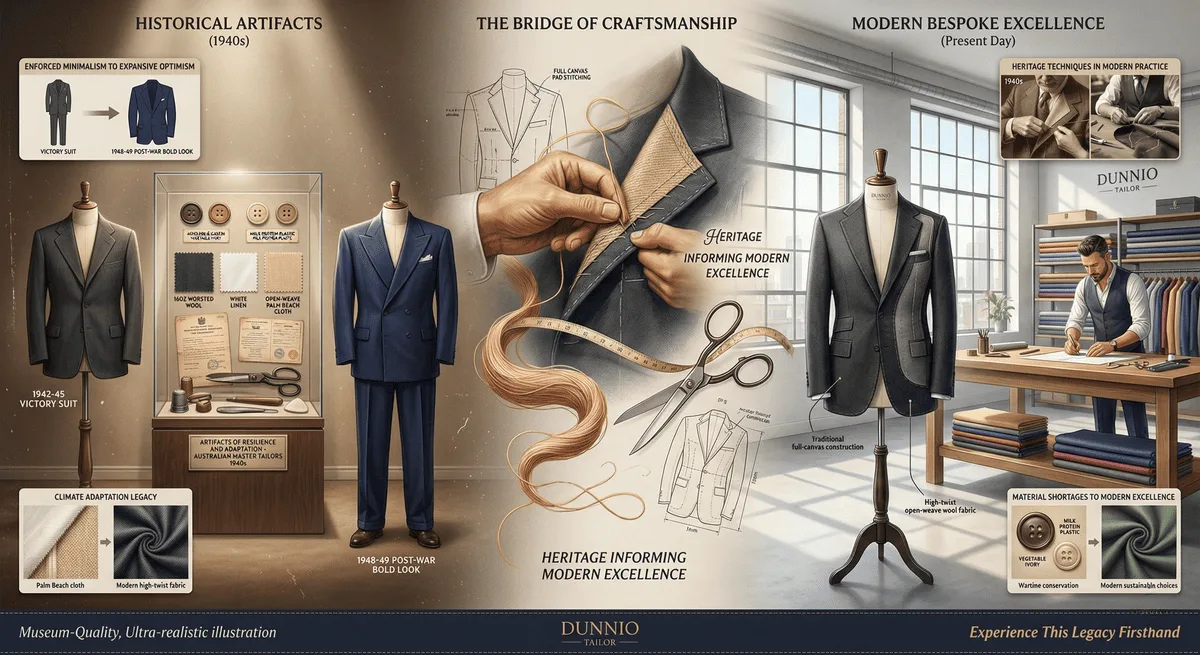
The 1940s Australian wedding suit is a garment of deep contradictions, transitioning from the enforced minimalism of the Dedman era to the expansive optimism of the post-war boom. For the bespoke enthusiast, these garments are artifacts of resilience and adaptation. They demonstrate how Australian master tailors navigated material shortages and climatic challenges to create garments of enduring dignity.
At Dunnio Tailor, we draw inspiration from this heritage. Whether it is the use of high-twist open-weave fabrics for breathable summer suits or the structural integrity of a full-canvas construction, the lessons of the 1940s continue to inform our approach to modern custom tailoring. We invite you to experience this legacy firsthand, crafting a suit that honors tradition while meeting the demands of the modern world.
To bring this timeless 1940s aesthetic to life with your own unique measurements, we invite you to use our innovative 3D configuration tool custom suits, where you can customize every detail of your bespoke suit to achieve a perfect, personalized fit. Are you ready to write your own chapter in fashion history? Discover our custom-made suits & tuxedo for wedding services, where we blend a century of Australian inspiration with world-class tailoring. Whether you’re looking for the sharp "English Drape" of the Golden Age, the soft "Sprezzatura" of contemporary linen, or a ruggedly elegant look paired with your favorite R.M. Williams boots, we craft garments that don't just fit your body - they tell your story.