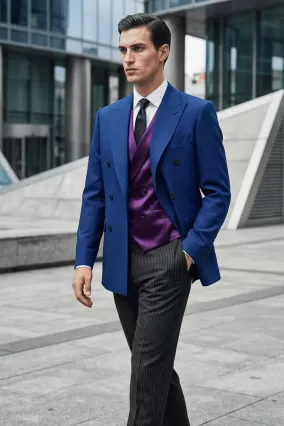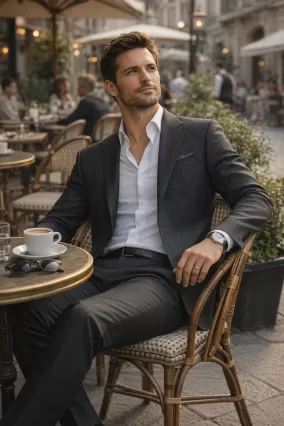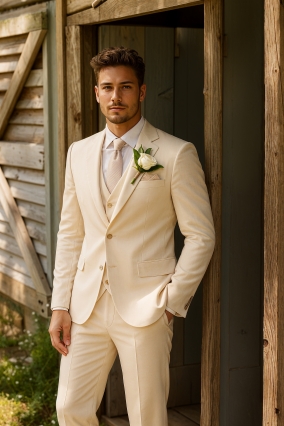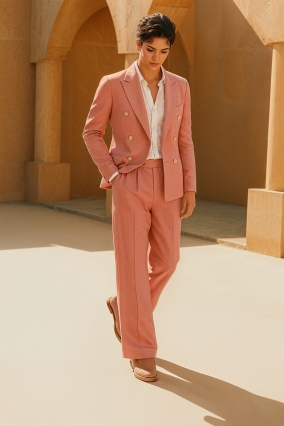
Understanding men body types is the foundation of exceptional wedding tailoring-and at Dunnio Tailor, we've perfected this art. With years of expertise crafting bespoke suits for Australian grooms, groomsmen, and guests, we know that your body shape-whether rectangle, triangle, inverted triangle, oval, or trapezoid-determines everything from shoulder construction to fabric selection. This comprehensive guide from our master tailors shows you exactly how to dress for your specific body type men proportions, ensuring you look confident and polished from ceremony to reception, regardless of Australia's diverse climate and wedding venues.
1. Understanding male body types for wedding suits
The foundation of exceptional wedding attire lies in recognizing that one size truly does not fit all. The Australian wedding landscape has evolved dramatically over the past decade, moving away from the cookie-cutter approach of identical rental tuxedos toward a more sophisticated understanding of individual proportions and personal style.
1.1. The five main body types for men
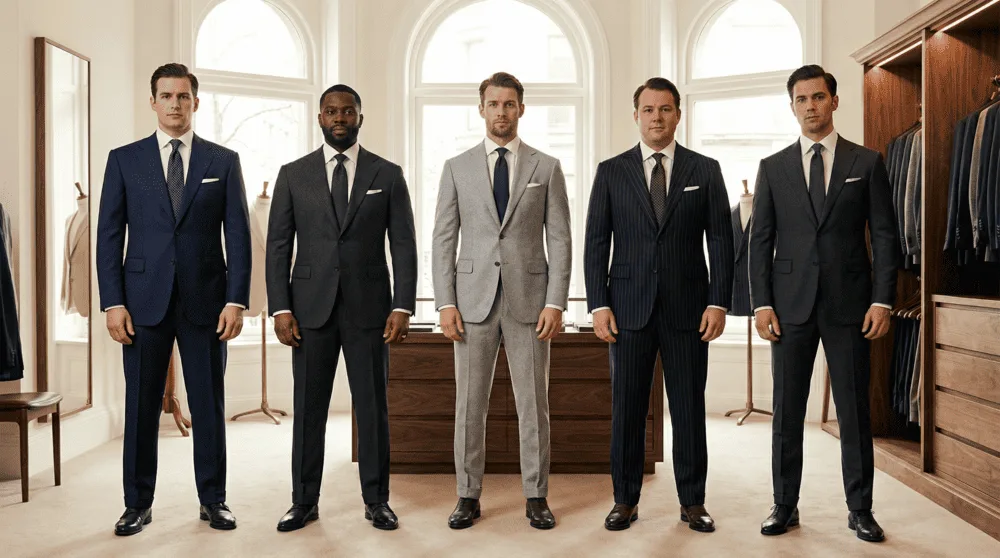
When it comes to men's body shapes, there are five primary archetypes that influence how clothing sits, drapes, and photographs. Each types of male body types has unique characteristics that affect everything from shoulder width to waist definition, and understanding yours is the first step toward creating a wedding look that enhances your best features.
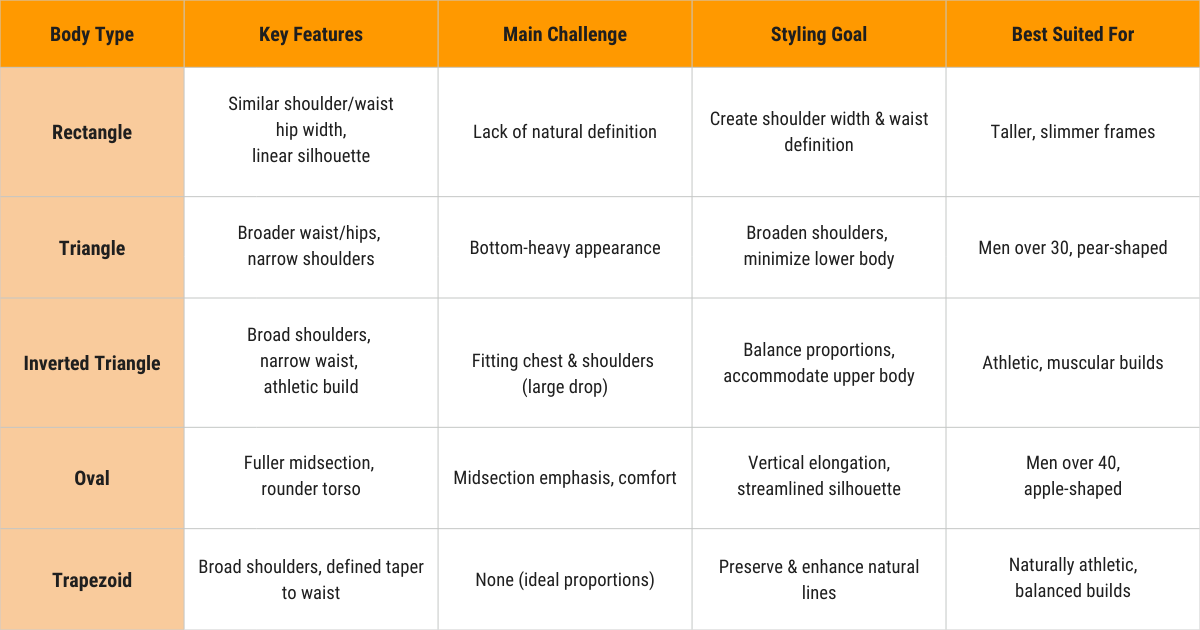
- Rectangle (columnar build): Men with this body type have shoulders, waist, and hips that are roughly similar in width, creating a balanced yet linear silhouette. This shape is commonly seen on taller, slimmer frames and tends to lack natural definition in the shoulders or waist. The styling goal is to create visual width in the shoulders and the illusion of a defined waist through strategic tailoring and fabric choices.
- Triangle (pear-shaped build): This male body shape features a broader waist and hips with narrower shoulders, creating a bottom-heavy appearance. It's increasingly common in men over 30 and can sometimes make the upper body seem smaller in comparison. The main objective is to broaden the shoulders and create balance between the upper and lower body, drawing attention away from the midsection.
- Inverted triangle (athletic build): Characterized by broad shoulders and chest that taper to a narrower waist, this body type is often associated with athletic or muscular builds. While broad shoulders are a strong feature, they can sometimes make the upper body look disproportionately large compared to the lower half. The focus is on minimizing bulk on top while adding some volume to the lower half for perfect proportions.
- Oval (apple-shaped build): Men with an oval body type have a fuller midsection and rounder torso, often with shoulders that may be slightly narrower than the waist and hips. This shape can make finding clothes that fit comfortably while providing a balanced, streamlined look challenging. The primary goal is to create vertical elongation and draw attention away from the midsection.
- Trapezoid (ideal proportions): The trapezoid body shape male is defined by broad shoulders and a well-defined chest, tapering down to a narrower waist and hips. This naturally athletic or muscular build creates a symmetric silhouette and is considered the ideal for ready-to-wear clothing. The styling approach focuses on highlighting these natural proportions while maintaining a structured, polished look.

Quick Reference: Body Type Comparison
1.2. Why body type matters for wedding attire
Understanding male body shapes isn't about conforming to an ideal or feeling inadequate. It's about leveraging the optical illusions of expert tailoring to create visual harmony and project confidence. Here's why it matters specifically for wedding occasions:
- Visual proportion optimization: Wedding photography is forever. Professional photographers capture you from every angle, in various lighting conditions, and alongside people of different heights and builds. A suit that's tailored to your body type ensures you look proportionate and polished in every shot, whether it's a close-up portrait or a full bridal party lineup.
- Confidence and comfort on your big day: Weddings are long events. From morning preparations through the ceremony, reception, and dancing into the night, you'll be wearing your suit for 8-12 hours. A suit that works with your body type rather than against it means you'll feel comfortable and confident throughout, without constantly adjusting or feeling self-conscious.
- The investment suit concept: The average Australian groom is approximately 32 years old and views his wedding suit as a strategic investment rather than a single-use costume. A suit tailored to your specific body type has longevity beyond the wedding day. It becomes a versatile piece for future formal events, business meetings, and other weddings, making it a smart financial decision.
- Accommodating diverse bridal parties: As a groom coordinating groomsmen, you're likely dealing with a diverse group of body types. Your best man might be tall and lean, while your brother has an athletic build, and your childhood friend carries weight around the middle. Understanding body types allows you to create a cohesive look where everyone feels confident, rather than forcing everyone into identical cuts that only flatter one or two people.
1.3. The Australian wedding context
Australia's wedding landscape presents unique considerations that make male body shape types awareness even more critical. Our climate diversity means a summer wedding in South Australia might reach 40°C, while a winter celebration in the Blue Mountains requires substantial warmth. Outdoor venues dominate the market, from coastal ceremonies to vineyard receptions, bushland settings to urban rooftop affairs.
The Australian aesthetic has evolved toward what industry experts call "relaxed formality." This distinctly antipodean approach bridges high ceremonial significance with practical realities of climate and landscape. It's sophisticated without being stuffy, elegant without being rigid. This philosophy extends to how we approach body types and tailoring.
Australian bespoke tailors like Germanicos in Melbourne explicitly state they achieve a perfect fit "no matter types of the body" and don't charge excess fees for larger or more challenging proportions. This inclusive approach reflects a broader cultural shift toward celebrating diversity and individual expression rather than forcing conformity to a single ideal.
The rise of made-to-measure services from brands like InStitchu, Oscar Hunt, and M.J. Bale has democratized access to body-type-specific tailoring. What was once the exclusive domain of Savile Row bespoke now exists at accessible price points for the average Australian groom. This means every man, regardless of his body shape, can experience the confidence that comes from a suit engineered specifically for his proportions.
2. The rectangle body type
2.1. Key features of the rectangle shape
Men with a rectangular body type typically have shoulders, waist, and hips that are roughly the same width. This creates a balanced yet linear look, most commonly seen on taller, slimmer frames. Without natural definition in the shoulders or waist, the silhouette can appear somewhat flat or one-dimensional when dressed in standard off-the-rack clothing.
The rectangle shape, sometimes called the columnar or H-shape build, is characterized by minimal variation in width from shoulders to hips. Your chest measurement might be only 2-4 inches larger than your waist, compared to the 6-8 inch difference seen in more V-shaped builds. This lack of natural taper means that standard suits often hang straight down from the shoulders, missing the opportunity to create the coveted masculine body type V-silhouette.
For wedding occasions, this presents both a challenge and an opportunity. The challenge is that without strategic tailoring, you can appear somewhat shapeless in photos, particularly in full-length shots. The opportunity is that the rectangle body type is one of the most responsive to expert tailoring techniques. Small adjustments in shoulder structure and waist suppression can create dramatic visual improvements.
2.2. Wedding suit styling strategy for rectangle body types
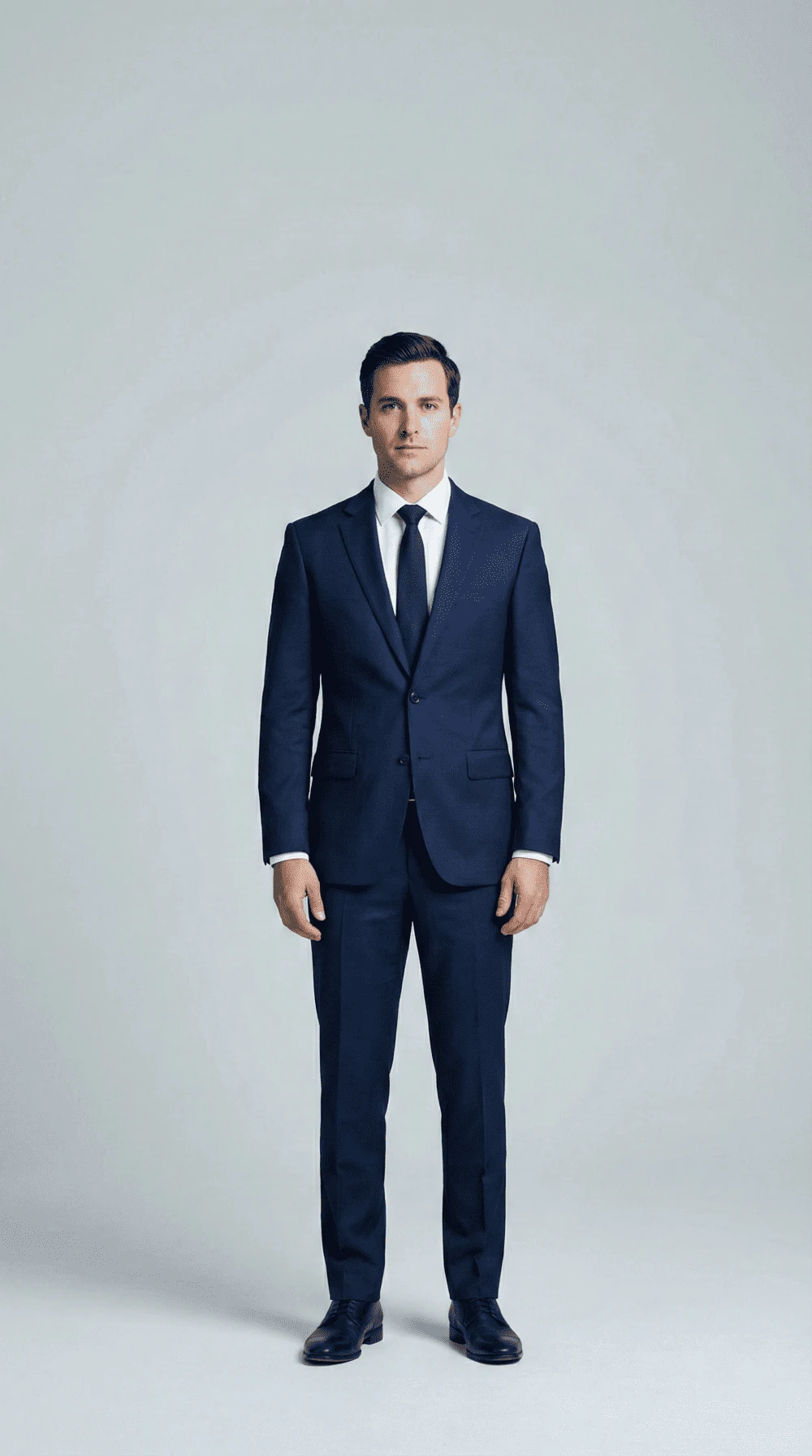
The fundamental goal when dressing a rectangle body shape for a wedding is to create visual width at the shoulders and the illusion of a defined waist. By strategically using structure, layering, and pattern, you can transform a linear silhouette into a dynamic, proportionate look that photographs beautifully.
2.2.1. For grooms with rectangle body types
As the groom, you have the luxury of being the focal point, which means you can employ more dramatic tailoring techniques than your groomsmen or guests might choose.
- Jacket architecture and structure: Look for structured blazers with built-in shoulder padding. This isn't the aggressive, linebacker-style padding of 1980s power suits. Modern shoulder construction uses subtle padding that extends your natural shoulder line by 1-2 centimeters, creating the illusion of broader shoulders without looking artificial. The jacket should feature a defined waist suppression, meaning it's aggressively nipped in at the button stance to create an hourglass effect.
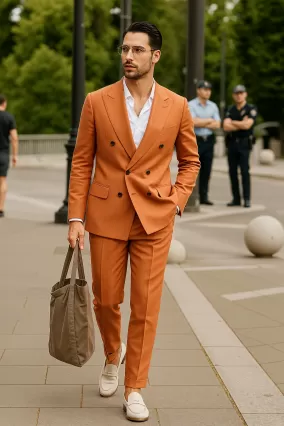
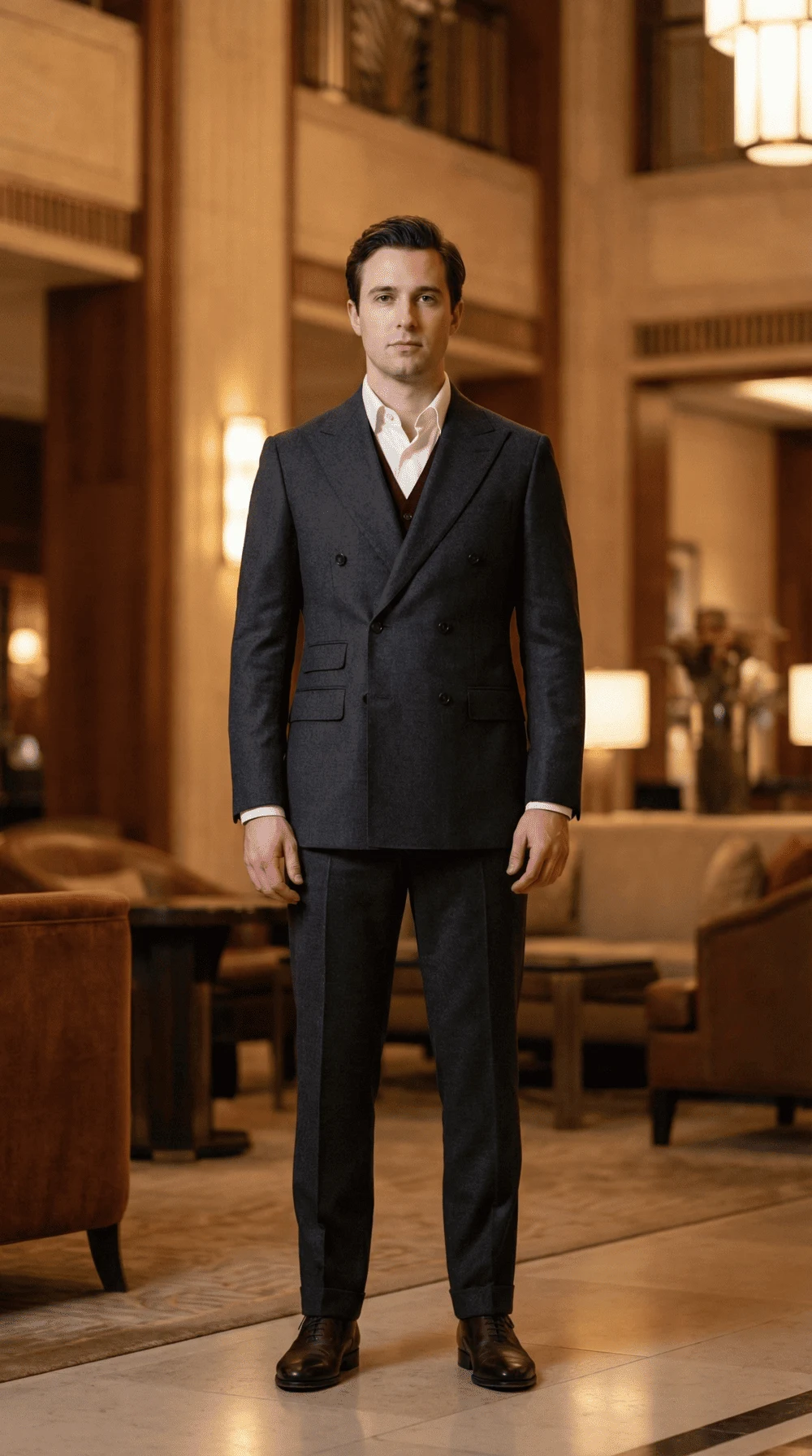
- The double-breasted advantage: For rectangle body types, the double-breasted jacket is a powerful tool. The overlapping fabric and offset button placement add horizontal bulk to the chest and shoulders, widening your frame. The wide peak lapels that typically accompany double-breasted jackets further emphasize shoulder width. In the context of Australian weddings, a double-breasted jacket in a lighter fabric like linen or cotton blend works beautifully for outdoor venues while still providing the structure you need.
- Three-piece suit benefits: Adding a waistcoat to your wedding ensemble serves multiple purposes for the rectangle build. First, it creates an additional layer that adds visual interest and breaks up the vertical lines of your torso. Second, it allows you to remove your jacket during the reception while still looking polished and formal. Third, the waistcoat itself can be cut with strategic shaping to create the illusion of a more defined waist. Consider a waistcoat in a complementary texture or subtle pattern to add depth.
- Fabric and pattern selection: Textured fabrics are your friend. Herringbone, tweed, or subtle windowpane checks add visual dimension that plain fabrics can't provide. For Australian summer weddings, consider a linen-cotton blend with a visible weave structure. The texture catches light differently than smooth fabrics, creating shadows and highlights that suggest more body shape. Horizontal elements like chest pockets with flaps or a ticket pocket can also disrupt vertical lines and add width.
- Color strategy for Australian venues: The 2025 trend toward earthy tones works exceptionally well for rectangle body types. A terracotta or warm stone-colored suit provides more visual interest than flat navy or grey. For vineyard weddings in regions like the Hunter Valley or Barossa, a sage green or olive suit in a textured fabric creates a sophisticated, grounded look that photographs beautifully against natural backgrounds.

2.2.2. For groomsmen with rectangle body types
As a groomsman, your goal is to look cohesive with the bridal party while still being individually flattering.
- Coordinated shoulder structure: If you're part of a made-to-measure bridal party through services like InStitchu or Oscar Hunt, ensure your consultant understands your need for shoulder structure. Even if the groom and other groomsmen don't require padding, you should have it. The beauty of custom tailoring is that you can all wear the same fabric and color while having cuts optimized for your individual builds.
- Layering for depth: If the dress code allows, add a knitted vest or cardigan under your jacket for morning preparations and photos. This creates additional layers that add bulk to your upper body. Even something as simple as a well-fitted dress shirt with a subtle texture can help. Avoid overly thin, clingy fabrics that emphasize the lack of body shape.
- Pattern coordination: If the bridal party is wearing solid suits, you might suggest incorporating subtle patterns through accessories. A tie with horizontal stripes or a pocket square with a bold geometric pattern draws the eye across your chest, creating the illusion of width.
2.2.3. For wedding guests with rectangle body types
As a guest, you have more freedom to experiment with styles that might be too bold for the bridal party.
- Separates strategy: Consider wearing a blazer and trousers in complementary but not matching colors. A textured blazer in one tone paired with trousers in another creates horizontal visual breaks that add interest to your silhouette. For instance, a charcoal herringbone blazer with mid-grey trousers, or a navy textured jacket with stone-colored chinos for a garden wedding.
- Layering freedom: Guests can be more creative with layering. A lightweight sweater or cardigan over your dress shirt but under your jacket adds bulk without overheating, particularly useful for evening receptions when temperatures drop. This works especially well for spring and autumn weddings in temperate regions like Melbourne or Adelaide.
- Accessory impact: Use accessories strategically to create horizontal lines. A tie bar positioned at the right height (between the third and fourth shirt buttons) creates a horizontal element. A belt with a statement buckle draws attention to the waist, suggesting definition even if it's not naturally there. A watch with a substantial face adds weight to your wrist, balancing your proportions.
2.3. Australian tailoring solutions for rectangle body types
Several Australian tailoring houses have developed specific expertise in addressing rectangle body shapes, particularly in the context of wedding attire.
- Dunnio Tailor's rectangle-specific approach: Our master tailors specialize in transforming linear builds through strategic shoulder construction and waist engineering. We use a proprietary measurement system that captures not just your dimensions but your posture and stance, allowing us to create shoulder padding that looks natural and waist suppression that doesn't pull or bunch. For rectangle shapes, we recommend structured fabrics with visible texture-herringbone, subtle checks, or basket weaves-that add visual dimension. Our consultation process includes showing you fabric samples on your body type so you can see exactly how different textures photograph. Unlike off-the-rack or basic MTM services, we engineer the internal canvas construction specifically for your frame, ensuring the jacket maintains its shape throughout a long wedding day. Our three-piece suit options for rectangle builds are particularly effective-the waistcoat creates an additional layer that breaks up vertical lines while adding definition to your midsection.
- YSG Tailors' approach: YSG Tailors in Melbourne takes over 25 data points including shoulder slope, posture, and stance to design a pattern unique to each individual. For rectangle body types, they focus on creating shoulder structure that complements your natural slope while engineering waist suppression that doesn't pull or bunch. Their understanding of how fabric drapes on a linear frame means they can recommend weights and weaves that add dimension without bulk.
- Germanicos' complexion and proportion analysis: Germanicos Bespoke Tailors offers what they call a "complexion and proportion analysis" that recommends styles to elevate your individual body type. For rectangle shapes, they might suggest peak lapels to widen the chest visually, or strategic pocket placement to create the illusion of a more tapered waist. Their commitment to achieving a perfect fit "no matter the body type" without excess fees makes them an excellent choice for grooms who need significant structural adjustments.
- InStitchu's inclusive sizing: InStitchu's "perfect fit guarantee" and extensive size range make them particularly valuable for rectangle body types who might fall between standard sizes. Their online platform allows you to specify exactly where you need more structure or suppression, and their stylists can guide you toward fabrics and cuts that work best for linear builds.

2.4. What to avoid with rectangle body types
Certain styling choices can exacerbate the challenges of a rectangle build, making you appear even more linear or shapeless.
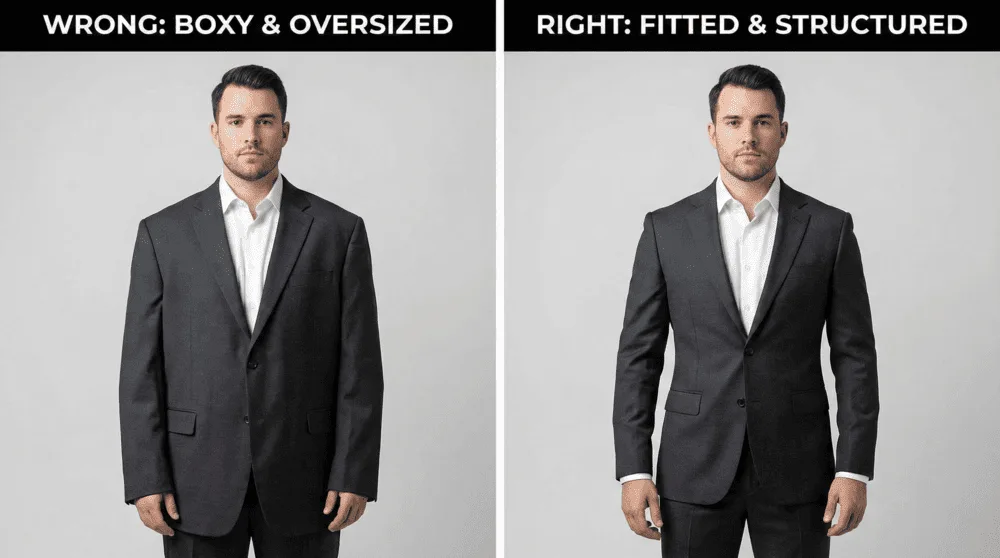
- Boxy or oversized clothing: The temptation might be to hide in loose clothing, but this is counterproductive. Oversized jackets and baggy trousers eliminate any opportunity to create shape through tailoring. They make you look like you're wearing someone else's suit, which photographs poorly and undermines confidence.
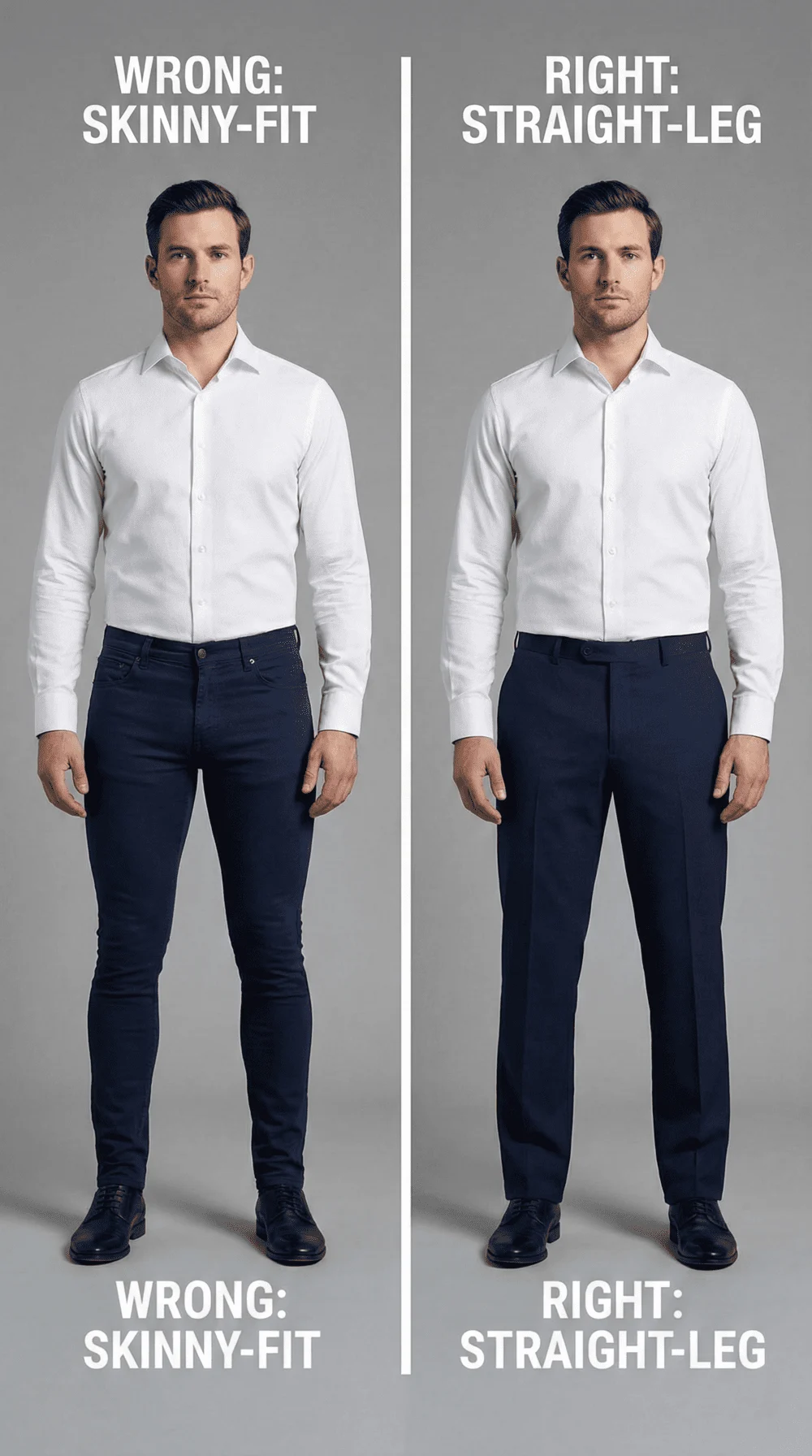
- Skinny or ultra-slim fits: Conversely, going too tight is equally problematic. Skinny-fit suits designed for very lean builds will cling to your body, emphasizing the lack of natural shape variation. They also tend to be uncomfortable and restrict movement, which is the last thing you want during a long wedding day.
- Vertical stripes without balance: While vertical stripes can elongate, they can also emphasize the columnar nature of a rectangle build if not balanced with horizontal elements. If you choose pinstripes, pair them with a horizontal element like a patterned tie or pocket square to create visual interest.
- Single-breasted, single-button jackets: The deep V created by a one-button jacket can make a rectangle torso look even longer and more linear. Unless you're very tall and specifically trying to create length, opt for two-button or double-breasted styles that create more horizontal visual interest.

3. The triangle body type
3.1. Key features of the triangle shape
The triangle body type, sometimes called the pear shape, is characterized by a broader waist and hips compared to narrower shoulders and chest. This creates a bottom-heavy appearance where the widest part of your body is around your midsection or hips rather than your shoulders. The shoulder line often has a natural slope, and the chest may appear somewhat narrow or underdeveloped relative to the lower body.
This body shape is increasingly common in Australian men over 30, often developing gradually as metabolism slows and weight distribution patterns change. It's important to understand that this is a completely normal body type, not a flaw to be hidden. The goal of strategic tailoring is simply to create visual balance and proportion.
For wedding occasions, the triangle shape presents specific challenges in photography and overall presentation. Wide-angle shots can emphasize hip width, while fitted clothing in the wrong cut can create an unflattering silhouette. However, with the right tailoring approach, you can create a balanced, confident look that photographs beautifully and feels comfortable throughout a long wedding day.
3.2. Wedding suit styling strategy for triangle body types
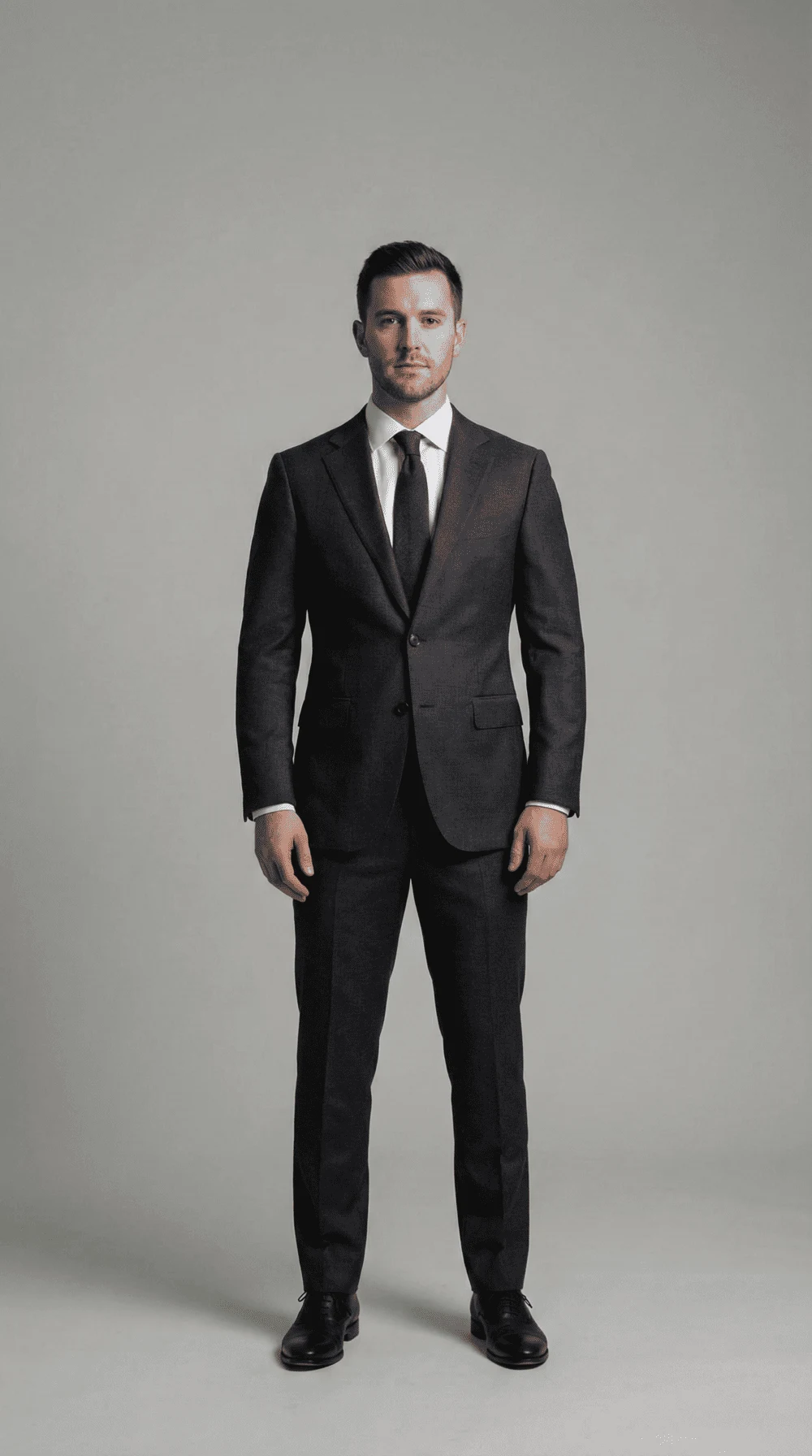
The fundamental objective when dressing a triangle body shape is to rebuild the shoulder line and minimize visual emphasis on the midsection. This creates the illusion of inverting the triangle, bringing your proportions closer to the coveted V-shape.

3.2.1. For grooms with triangle body types
As the groom, you have the advantage of working with expert tailors who can employ sophisticated techniques to address your specific proportions.
- Shoulder reconstruction is critical: This is the single most important intervention point for triangle body types. Your jacket must feature structured shoulders with moderate to substantial padding. This "ropping" extends your shoulder line beyond your natural deltoid, creating an overhang that widens your upper frame to match or exceed your hip width. The padding should be firm enough to create structure but not so aggressive that it looks unnatural or restricts movement.
- Peak lapels for visual width: Peak lapels point upward toward your shoulders, drawing the eye up and out. This creates the illusion of broader shoulders and a wider chest. For triangle body types, peak lapels should be on the wider side (3-3.5 inches) to maximize this effect. They work particularly well on double-breasted jackets, though they can also be incorporated into single-breasted designs.
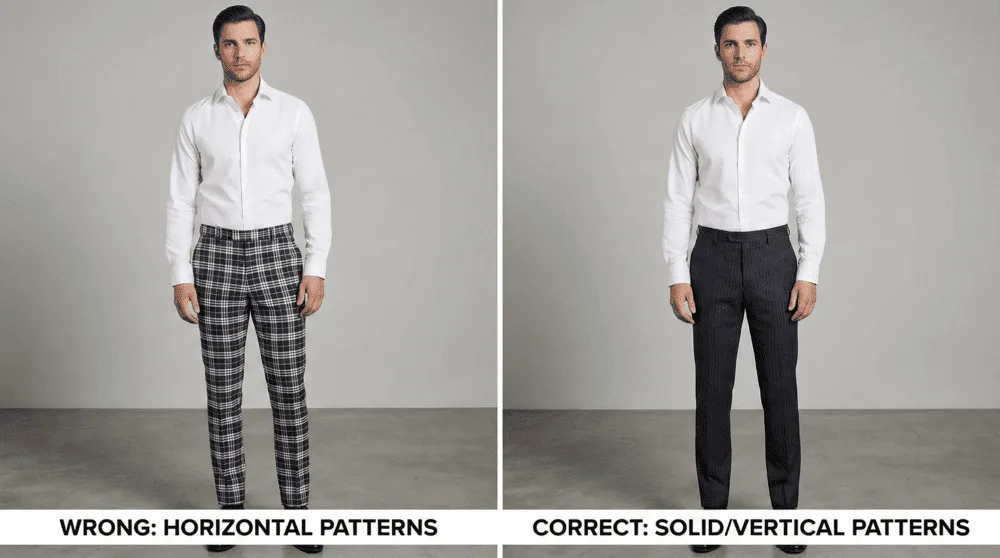
- Verticality through color and pattern: Dark, solid colors or vertical patterns like pinstripes are essential for triangle shapes. They draw the eye upward and create a slimming effect on the lower body. A charcoal or navy suit with subtle pinstripes elongates your frame and minimizes the appearance of hip width. Avoid horizontal patterns or bold colors on the lower half, as these will draw attention to the area you want to de-emphasize.
- Venting strategy: The vent (the slit at the back of your jacket) significantly impacts how the jacket drapes over your hips. A single center vent can pull open over a wider seat, creating an unflattering gap. Double vents (side vents) are far superior for triangle body types. They allow the jacket to drape cleanly over your hips without bunching or pulling, maintaining a smooth line from shoulder to hem.
- Trouser engineering: This is where many triangle body types make critical mistakes. Pleated trousers might seem like a comfortable choice, but they add volumetric bulk to the hip area, exacerbating the triangular shape. Instead, opt for flat-front trousers with a higher rise that sits closer to your navel. This helps smooth the transition from stomach to leg and creates a cleaner line. The trouser leg should be straight or very slightly tapered, not skinny. Skinny trousers will make your hips look even wider by comparison. A classic straight leg in a dark color (charcoal, navy, or black) creates a vertical column that balances the upper body.
- Fabric weight and drape: Heavier fabrics with good drape are preferable to lightweight, clingy materials. A substantial wool (10-12 oz) or a wool-cashmere blend will skim over your body rather than clinging to every contour. For Australian summer weddings, this might seem counterintuitive, but a well-constructed suit in quality fabric actually breathes better than cheap, thin material. Consider Australian Merino wool, which is naturally temperature-regulating.
3.2.2. For groomsmen with triangle body types
As a groomsman, you're working within the constraints of a coordinated look, but you can still optimize for your body type.
- Consistent shoulder structure: If the bridal party is using a made-to-measure service, ensure your consultant understands that you need more shoulder structure than other groomsmen might. The beauty of services like InStitchu or Oscar Hunt is that everyone can wear the same fabric while having individualized construction. Your jacket should have the padding you need, even if the groom and other groomsmen don't require it.
- Dark trouser coordination: If there's any flexibility in the bridal party look, advocate for dark trousers. Even if jackets are in a lighter color (sage green, light grey, terracotta), dark trousers will help minimize your lower half. This creates a natural visual balance that benefits triangle body types specifically.
- V-neck undershirts: This is a subtle but effective trick. Wearing a V-neck undershirt (rather than crew neck) under your dress shirt creates a V-line at your chest that draws the eye upward. It's a small detail that contributes to the overall effect of broadening your upper body.
3.2.3. For wedding guests with triangle body types
As a guest, you have more freedom to choose styles that specifically flatter your build.
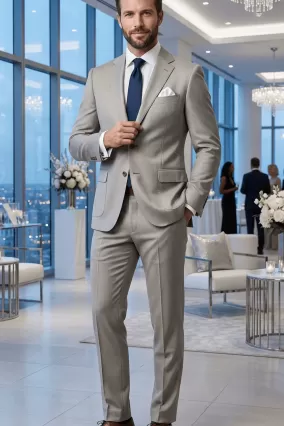
Lighter tops, darker bottoms: This is the golden rule for triangle body types. A lighter-colored jacket (light grey, tan, stone) paired with dark trousers (charcoal, navy, black) creates a natural visual balance. The light top draws attention upward and makes your shoulders appear broader, while the dark bottom minimizes hip width.
Structured blazers: Invest in a well-structured blazer with built-in shoulder padding. This becomes a versatile piece you can wear to multiple weddings and formal events. Pair it with different trousers to create various looks while always benefiting from the shoulder structure.
Strategic layering: A vest or waistcoat under your jacket adds bulk to your upper body without adding it to your hips. This creates more visual weight on top, balancing your proportions. Choose a vest in a complementary color or subtle pattern to add interest.
3.3. Australian tailoring solutions for triangle body types
Australian bespoke tailors have developed specific expertise in addressing the challenges of triangle body shapes, particularly for wedding contexts.
- Dunnio Tailor's triangle transformation: We've perfected the art of shoulder reconstruction for triangle body types. Our approach uses graduated padding that extends your shoulder line naturally, creating the visual width needed to balance broader hips without looking artificial. We pay particular attention to venting-always recommending double side vents that allow the jacket to drape cleanly over your hips. Our fabric recommendations for triangle shapes prioritize heavier weights (10-12oz wool) with excellent drape, ensuring the suit skims over your body rather than clinging to contours. We also specialize in trouser engineering-creating flat-front trousers with a higher rise that sits at your natural waist, smoothing the transition from midsection to leg. The result is a balanced, confident silhouette that photographs beautifully from every angle. Our stylists work closely with triangle builds to select dark, solid colors or subtle vertical patterns that elongate the frame while our shoulder construction creates the upper body width you need.
- Briggins' body-type specific approach: Briggins in Sydney offers detailed guidance for different body types, including what they call the "burly body type" (similar to triangle). They recommend three-piece suits with low contrast in the midsection, achieved through matching or complementary waistcoats. Their tailored approach ensures a fitted waist without making the jacket too tight, which is crucial for comfort during long wedding days.
- Oscar Hunt's holistic consultation: Oscar Hunt's made-to-measure service focuses on understanding your build, style, and life beyond just measurements. For triangle body types, their stylists consider not just your current proportions but how you'll be moving, sitting, and standing throughout the wedding day. This results in suits with proper structure that maintain their shape even after hours of wear.
- M.J. Bale's fit expertise: M.J. Bale's heritage in quality Merino wool and their understanding of different body types make them excellent for triangle shapes. Their "Kingston" and "Japan" collections offer different levels of structure, allowing you to choose the amount of shoulder padding and waist suppression that works for your specific proportions.

3.4. What to avoid with triangle body types
Certain styling choices can emphasize the very proportions you're trying to balance.
- Tight or skinny-fit trousers: These are the enemy of triangle body types. Skinny jeans or ultra-slim suit trousers cling to your hips and thighs, drawing maximum attention to your widest area. They also create a stark contrast with your narrower shoulders, making the triangle shape more pronounced. Stick to straight-leg or classic-fit trousers.
- Bulky tops with excess fabric: While you want structure in the shoulders, you don't want excess fabric billowing around your waist. Avoid boxy, oversized jackets that add bulk to your midsection. The jacket should be fitted (not tight) through the waist to create a clean line.
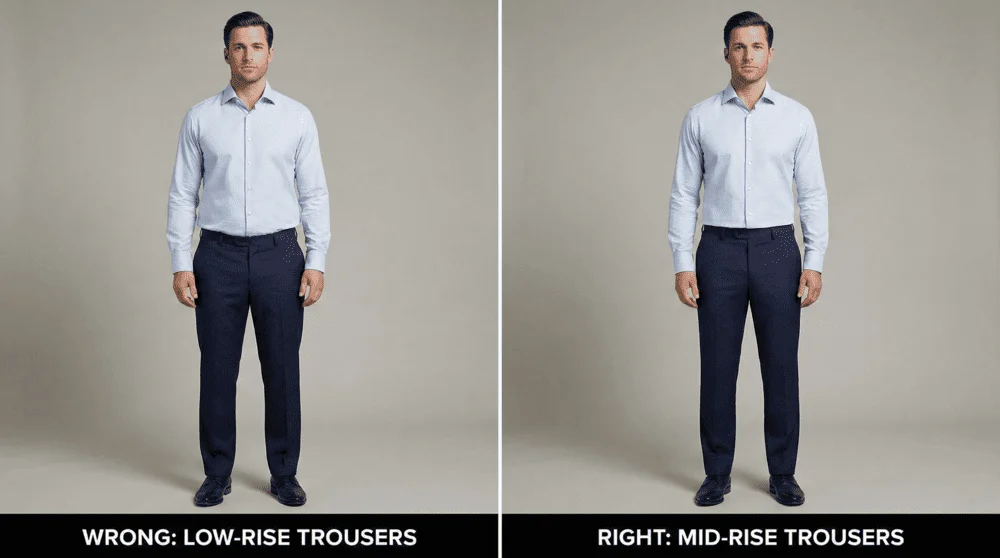
- Low-rise trousers: Trousers that sit on your hips rather than your natural waist will make your midsection appear wider and shorter. They also tend to create an unflattering gap between your shirt and trousers when you move. Opt for mid-rise or higher-rise trousers that sit at or just below your navel.
- Horizontal patterns on the lower half: Avoid checks, plaids, or horizontal stripes on your trousers. These create visual width exactly where you don't want it. Stick to solid colors or subtle vertical patterns.
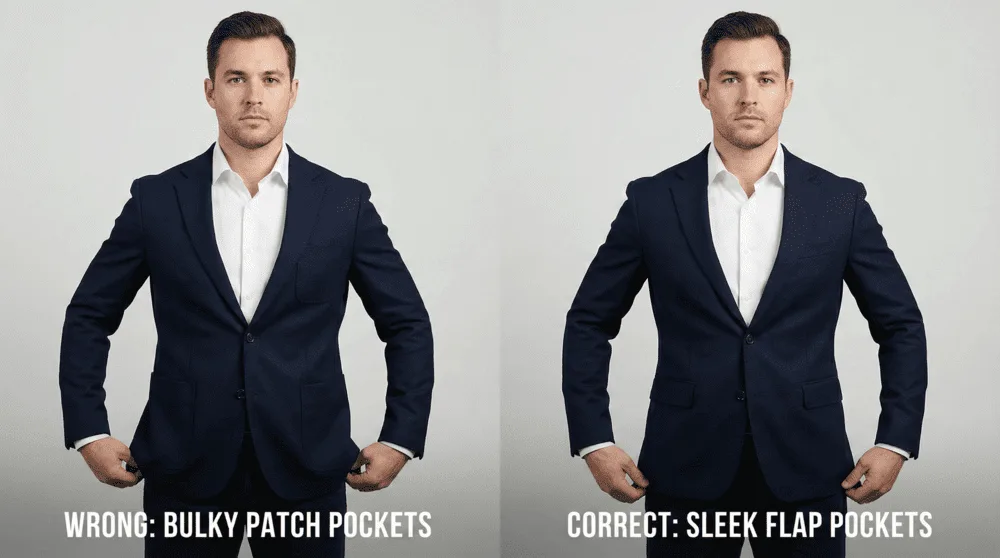
- Patch pockets on jackets: Patch pockets (sewn onto the outside of the jacket) add bulk and draw attention to the hip area. Opt for flap pockets or jetted pockets, which are sewn into the jacket and create a sleeker line.

4. The inverted triangle body type
4.1. Key features of the inverted triangle shape
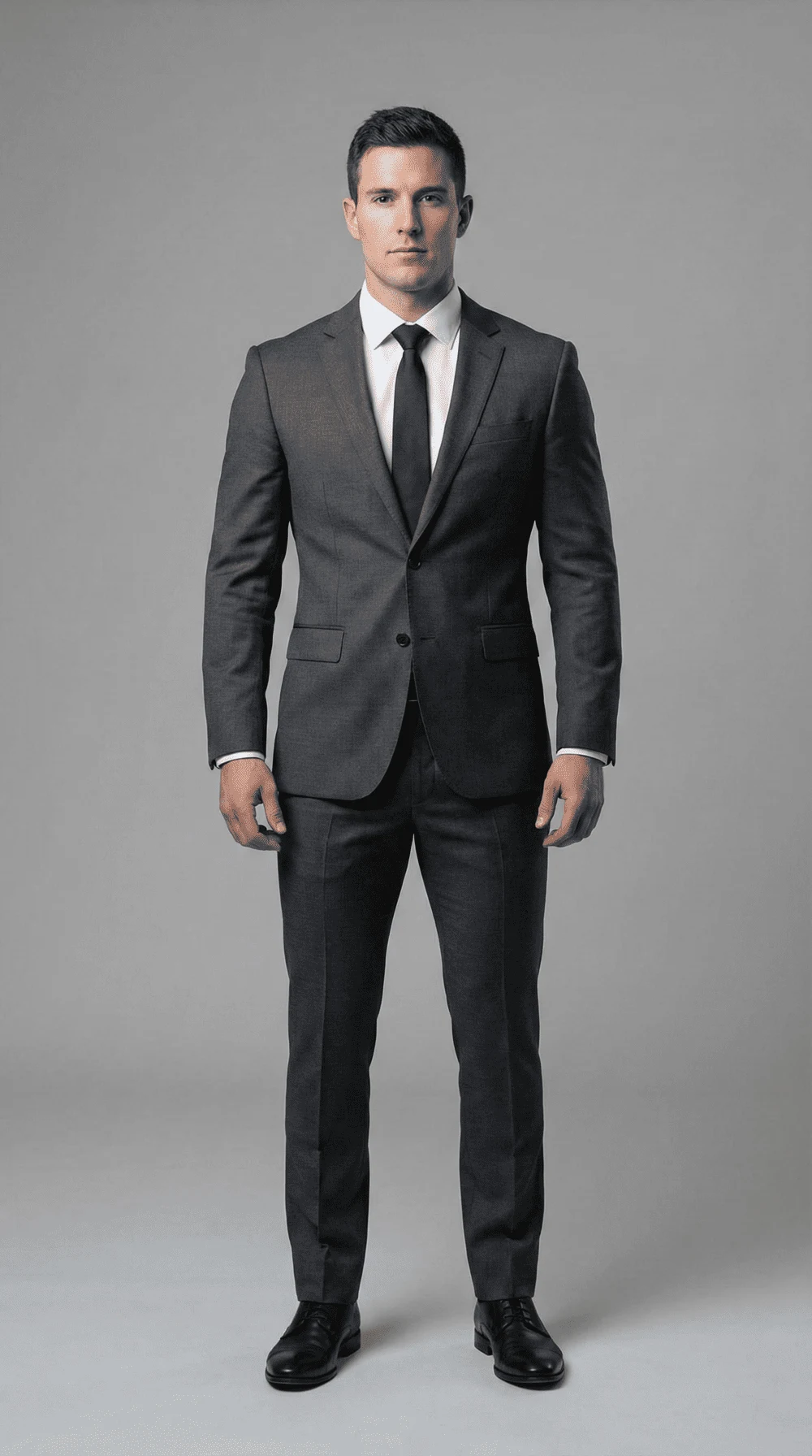
The inverted triangle body type, often called the athletic or mesomorph build, is characterized by significantly broad shoulders and chest that taper to a narrower waist and hips. This creates a V-shaped silhouette that's widely considered desirable in men's fashion. However, this body type presents unique tailoring challenges, particularly when it comes to achieving proper fit in ready-to-wear clothing.
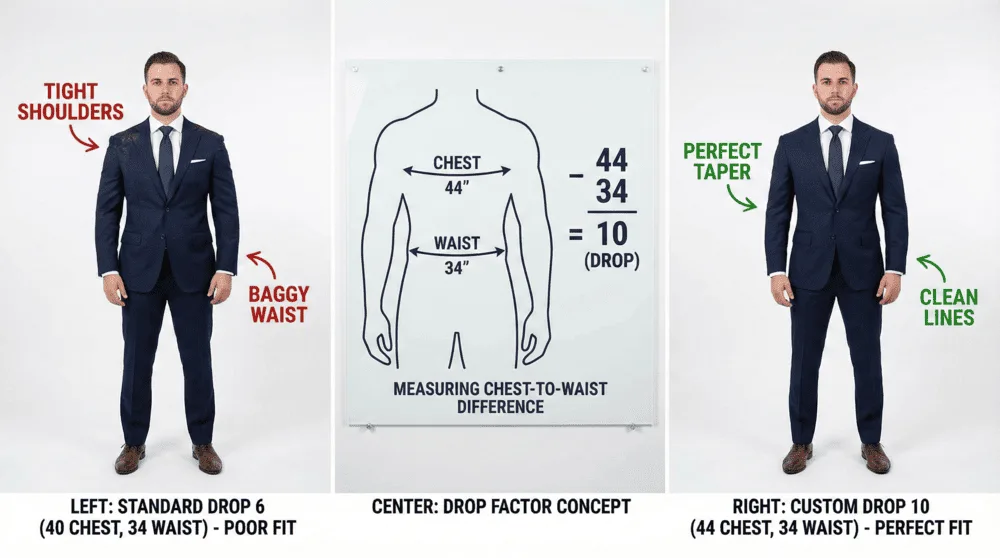
The defining characteristic of this shape is the "drop"-the mathematical difference between your chest circumference and waist circumference. While standard suits typically accommodate a drop of 6-7 inches (for example, a 40-inch chest with a 34-inch waist), athletic builds often present a drop of 8, 9, or even 10 inches. This means a jacket that fits your shoulders and chest will be enormously baggy around your waist, while a jacket that fits your waist will be impossibly tight across your shoulders.
For wedding occasions, this body type photographs exceptionally well from certain angles-the broad shoulders create a powerful, masculine silhouette. However, without proper tailoring, you risk looking bulky or disproportionate, particularly if your lower body appears too narrow in comparison to your upper body.
4.2. Wedding suit styling strategy for inverted triangle body types
The objective when dressing an inverted triangle shape is accommodation and balance. Your suit must fit your massive upper body without billowing around your waist, while your lower half needs enough visual weight to ground your proportions.

4.2.1. For grooms with inverted triangle body types
As the groom, you'll likely need to invest in made-to-measure or bespoke tailoring to achieve a proper fit. Off-the-rack suits simply aren't designed for your proportions.
- Understanding the drop factor: This is the most critical concept for inverted triangle body types. Standard Australian suit sizing assumes a drop of 6 (size 40 jacket with 34-inch waist trousers) or 7 (size 42 jacket with 35-inch waist trousers). If you're an athlete or bodybuilder with a drop of 9 or 10, you'll need custom tailoring. Services like InStitchu, Oscar Hunt, or Germanicos can accommodate extreme drops without the astronomical cost of traditional bespoke. When consulting with your tailor, be explicit about your measurements. Bring a jacket that fits your shoulders (even if it's too big in the waist) and trousers that fit your waist (even if they're too small for your thighs). This gives your tailor a clear starting point for understanding your proportions.
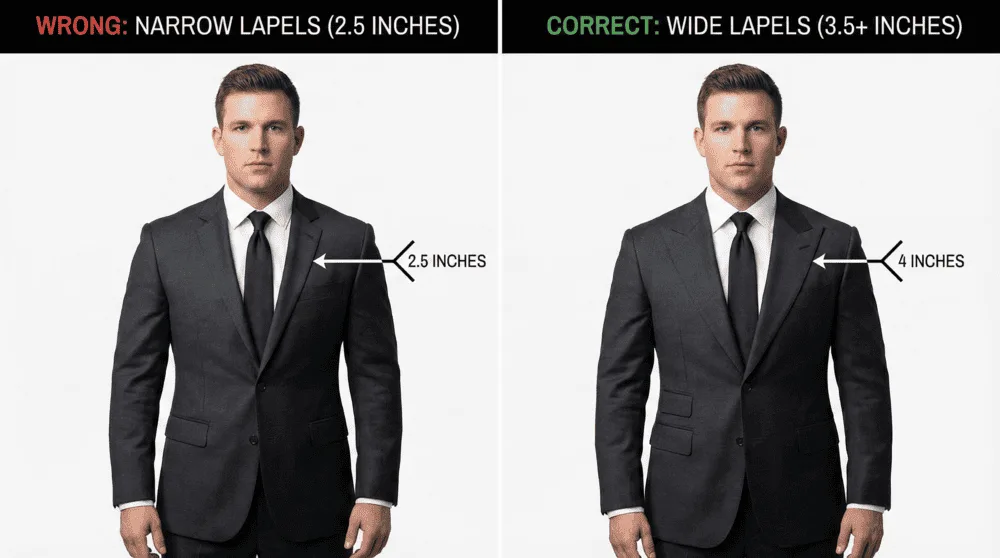
- Lapel proportion is crucial: This is where many athletic builds make mistakes. Skinny lapels on a broad chest make you look hulking and the suit look shrunken, like you've outgrown your clothes. You need wide peak lapels (3.5 inches or wider) to balance your chest width and harmonize with the scale of your body. The lapel width should be proportional to your shoulder width. A good rule of thumb: if your shoulders are 18+ inches wide, your lapels should be at least 3.5 inches. This creates visual harmony and prevents the "squeezed into a boy's suit" look.
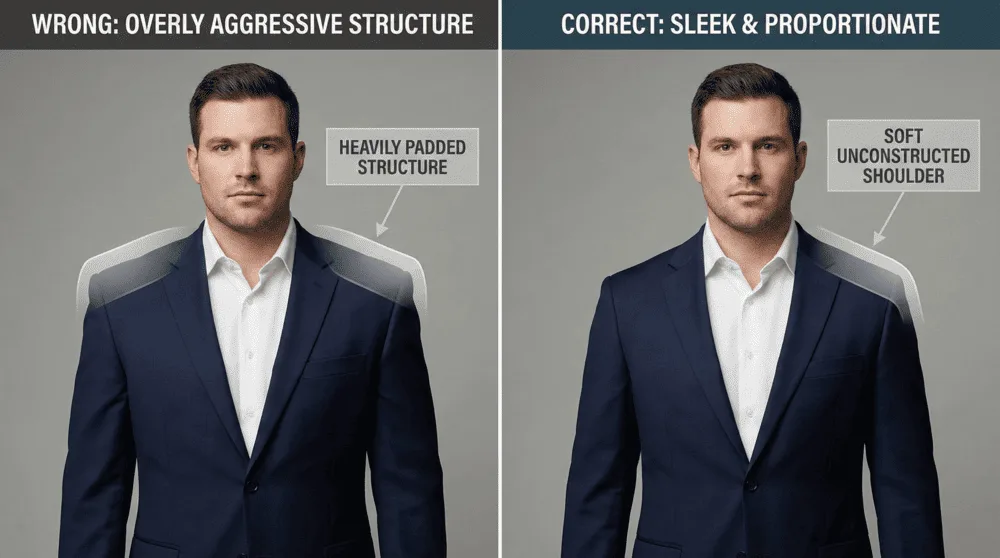
- Soft construction, not structured: This might seem counterintuitive, but inverted triangle body types should avoid heavy shoulder padding. Your shoulders are already massive; adding padding makes you look cartoonish and overly aggressive. Instead, opt for "soft" or "unconstructed" shoulders that follow your natural line without adding bulk. This is particularly important for Australian summer weddings. A heavily padded jacket in 35°C heat is not only uncomfortable but will make you look unnaturally broad. Soft construction in a breathable fabric like linen or lightweight wool allows your natural physique to shine through without exaggeration.
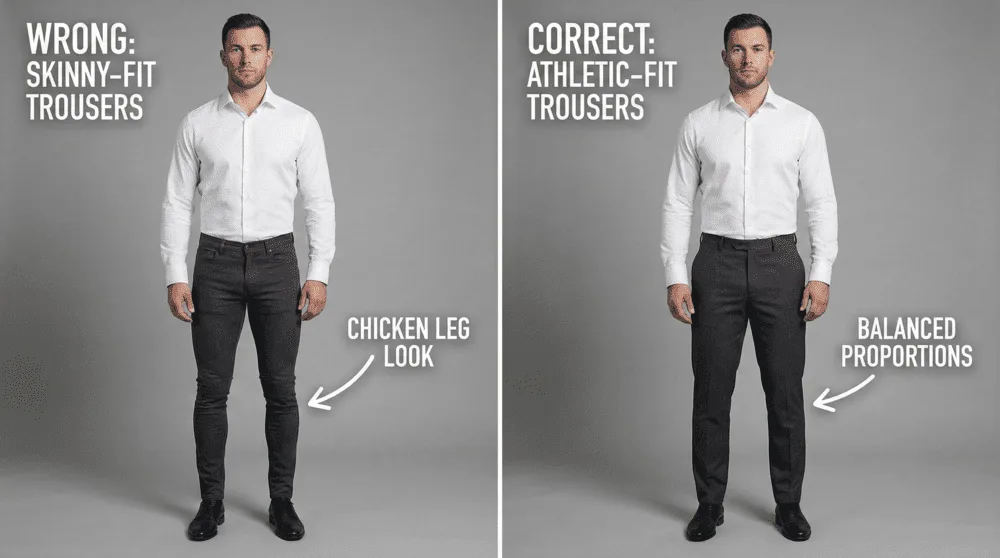
- Lower body balance: There's a real risk of the "chicken leg" look if your trousers are too tapered. While slim-fit might be fashionable, it's not flattering on inverted triangle builds. Your trousers need some fullness in the thigh to accommodate your quadriceps and create visual balance with your upper body. Opt for a "tailored" or "athletic" fit trouser rather than slim or skinny. The leg should have room through the thigh and a gentle taper from knee to ankle, rather than a skin-tight fit throughout. This grounds your upper body mass and creates a more proportionate overall silhouette.
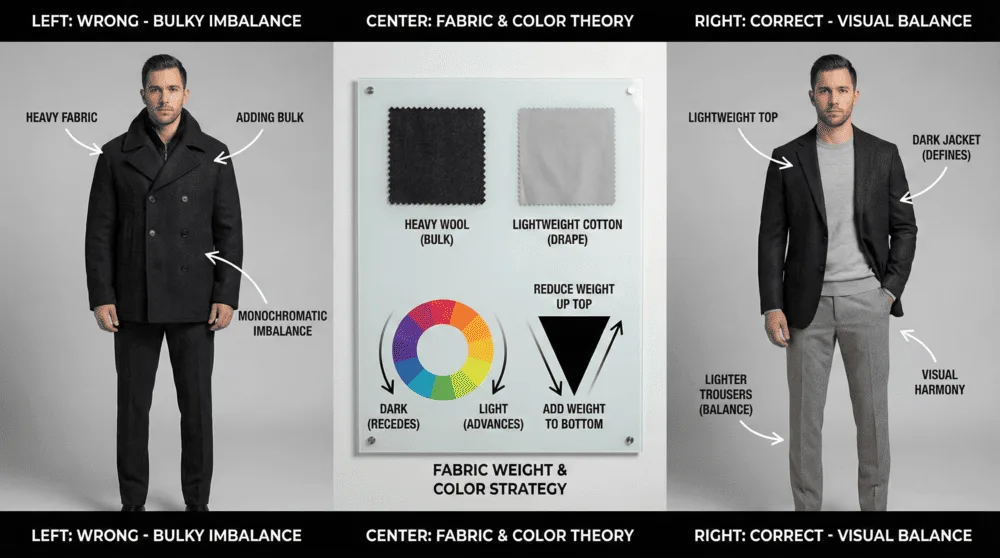
- Fabric and color strategy: Lightweight fabrics on top are essential. Heavy, thick fabrics add visual bulk to an already substantial upper body. For Australian weddings, this works in your favor-you can wear lighter-weight wools, linen blends, or cotton suits that keep you cool while creating a sleeker silhouette. Color-wise, darker tones on top help minimize your upper body, while slightly lighter trousers add visual weight to your lower half. A charcoal jacket with mid-grey trousers, or a navy jacket with stone-colored trousers, creates subtle balance without looking mismatched.
4.2.2. For groomsmen with inverted triangle body types
As a groomsman, you're working within the constraints of a coordinated look, but you absolutely need individualized fit.
- Made-to-measure is non-negotiable: If the groom is organizing suits for the bridal party, advocate strongly for a made-to-measure service rather than off-the-rack rentals. Explain your drop situation clearly. Services like InStitchu's "perfect fit guarantee" specifically accommodate diverse body types, making them ideal for bridal parties with varied builds. If the budget doesn't allow for full MTM, at minimum, you need significant alterations. Budget for taking in the waist substantially (this can cost $80-150 depending on how much needs to be done) and potentially letting out the thighs of the trousers.
- Trouser fullness coordination: If you're the only groomsman with an athletic build, your trousers will naturally have more fullness in the thigh than others. This is fine and necessary. What matters is that the fabric, color, and overall style match. The cut can be individualized without breaking the cohesive look.
- Avoid ultra-slim styling: If the groom wants a very slim, modern look for the bridal party, you may need to compromise. Explain that ultra-slim cuts don't work for your build and suggest a "modern" fit instead-it's still contemporary but more forgiving for athletic proportions.
4.2.3. For wedding guests with inverted triangle body types
As a guest, you have complete freedom to choose what works for your body.
- Invest in athletic-fit suits: Several Australian brands now offer "athletic fit" or "strong fit" lines specifically designed for inverted triangle body types. M.J. Bale's collections, for instance, accommodate broader shoulders and chests with more generous drops. These are worth the investment as they'll serve you for multiple weddings and formal events.
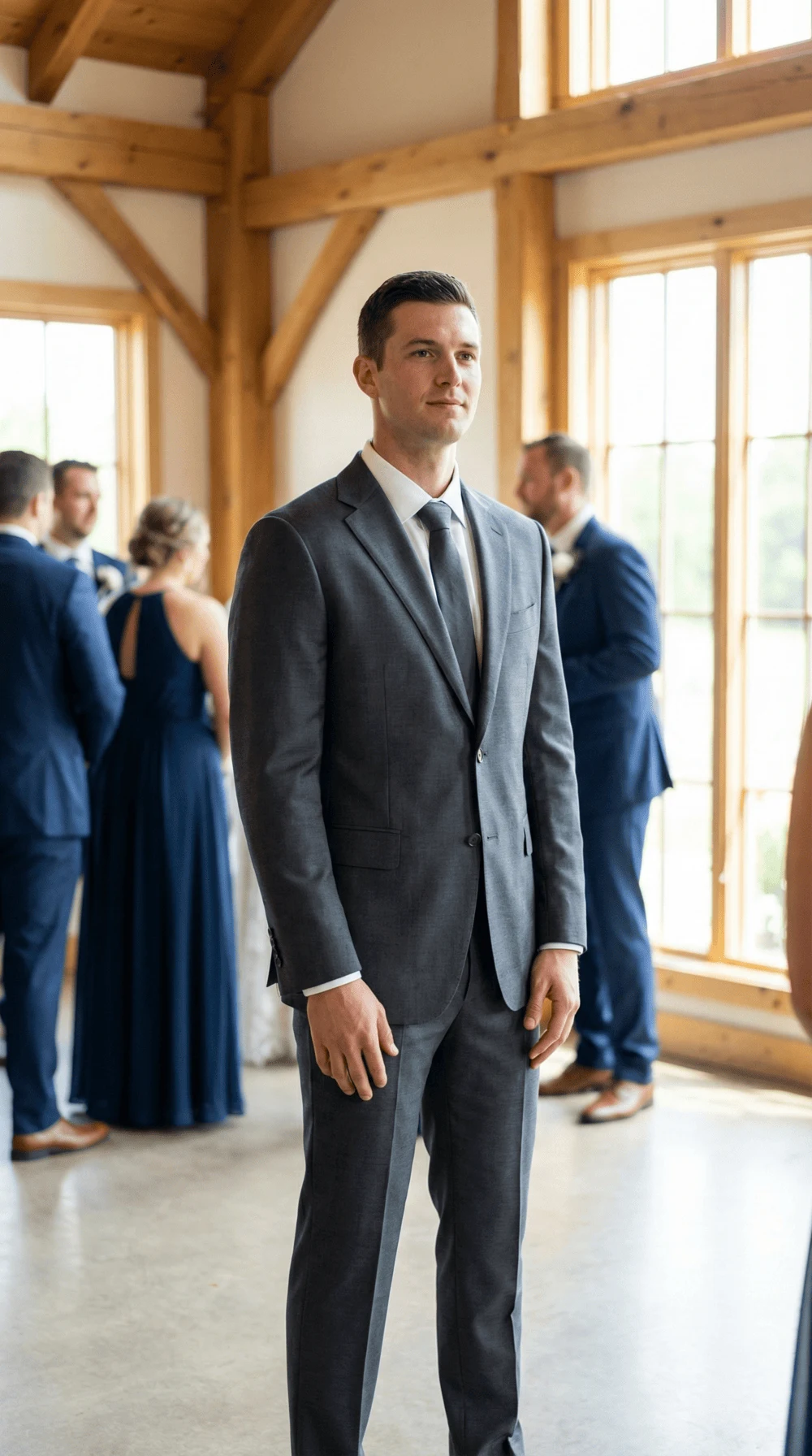
- Separates are your friend: Consider buying your jacket and trousers separately. You might need a size 42 or 44 jacket with size 34 or 36 trousers. Buying separates allows you to get the right fit in each piece without compromise. For Australian weddings, a navy blazer with grey trousers or a grey jacket with navy trousers creates a sophisticated, semi-formal look that's perfectly appropriate for most dress codes.
- Slim-fit shirts in lightweight fabrics: Your dress shirts should be slim-fit (to avoid billowing fabric around your waist) but in lightweight, breathable fabrics that don't cling or add bulk. Egyptian cotton or linen-cotton blends work beautifully. Avoid thick oxford cloth or heavy flannels that add unnecessary bulk to your chest.
4.3. Australian tailoring solutions for inverted triangle body types
Several Australian tailors have developed specific expertise in accommodating athletic builds.
- Dunnio Tailor's athletic build expertise: We understand the unique challenges of inverted triangle body types-the extreme drops, the difficulty finding jackets that fit shoulders without billowing at the waist, the risk of trousers that make legs look disproportionately small. Our bespoke process accommodates drops of 9, 10, even 11 inches without compromise. We use soft shoulder construction that follows your natural line without adding bulk, and we engineer lapels proportional to your chest width (typically 3.5-4 inches for broad-shouldered builds). For trousers, we create athletic-fit patterns with room through the thigh and a gentle taper-never skinny fits that create the "chicken leg" effect. Our fabric recommendations prioritize lightweight, breathable materials that create a sleeker silhouette while keeping you comfortable in Australian heat. The difference between a Dunnio Tailor suit and off-the-rack for inverted triangle builds is transformative-you'll finally experience what it's like to wear a suit that fits your shoulders AND your waist perfectly.
- M.J. Bale's athletic heritage: M.J. Bale understands athletic builds, likely because many of their clients are active professionals who maintain fitness. Their "Kingston" collection offers more generous drops and can be further customized through their made-to-measure service. They're particularly good at balancing the need for room in the chest and shoulders while maintaining a clean waist suppression.
- InStitchu's inclusive sizing: InStitchu's online platform allows you to input exact measurements for chest, waist, and hips, then automatically calculates the pattern adjustments needed. Their "perfect fit guarantee" means if the first suit doesn't fit perfectly, they'll remake it. For extreme drops, this guarantee is invaluable.
- Germanicos' no-excess-fee policy: Germanicos explicitly states they don't charge extra for "difficult" body types. For inverted triangle builds requiring significant pattern adjustments, this policy can save hundreds of dollars compared to traditional bespoke tailors who charge premiums for non-standard proportions.
4.4. What to avoid with inverted triangle body types
Certain styling choices will exaggerate your proportions in unflattering ways.
- Extra padding or thick fabrics on top: Your shoulders don't need help. Avoid any jacket with aggressive shoulder padding, thick lapels, or heavy fabrics that add bulk to your upper body. You want to showcase your natural build, not exaggerate it to cartoonish proportions.
- Ultra-skinny trousers: Skinny jeans or ultra-slim suit trousers will make your legs look like toothpicks supporting a massive upper body. This creates an unbalanced, almost comical silhouette. You need some substance in your lower half to ground your proportions.
- Horizontal stripes or patterns on top: Horizontal elements make you look wider. Avoid striped shirts, checked jackets, or any pattern that runs horizontally across your chest. Stick to vertical patterns or solid colors that create clean lines.
- Short jackets: A jacket that's too short (ending above your buttocks) will make your upper body look even more massive by comparison to your lower body. Your jacket should be long enough to cover your seat, creating a longer vertical line that balances your width.
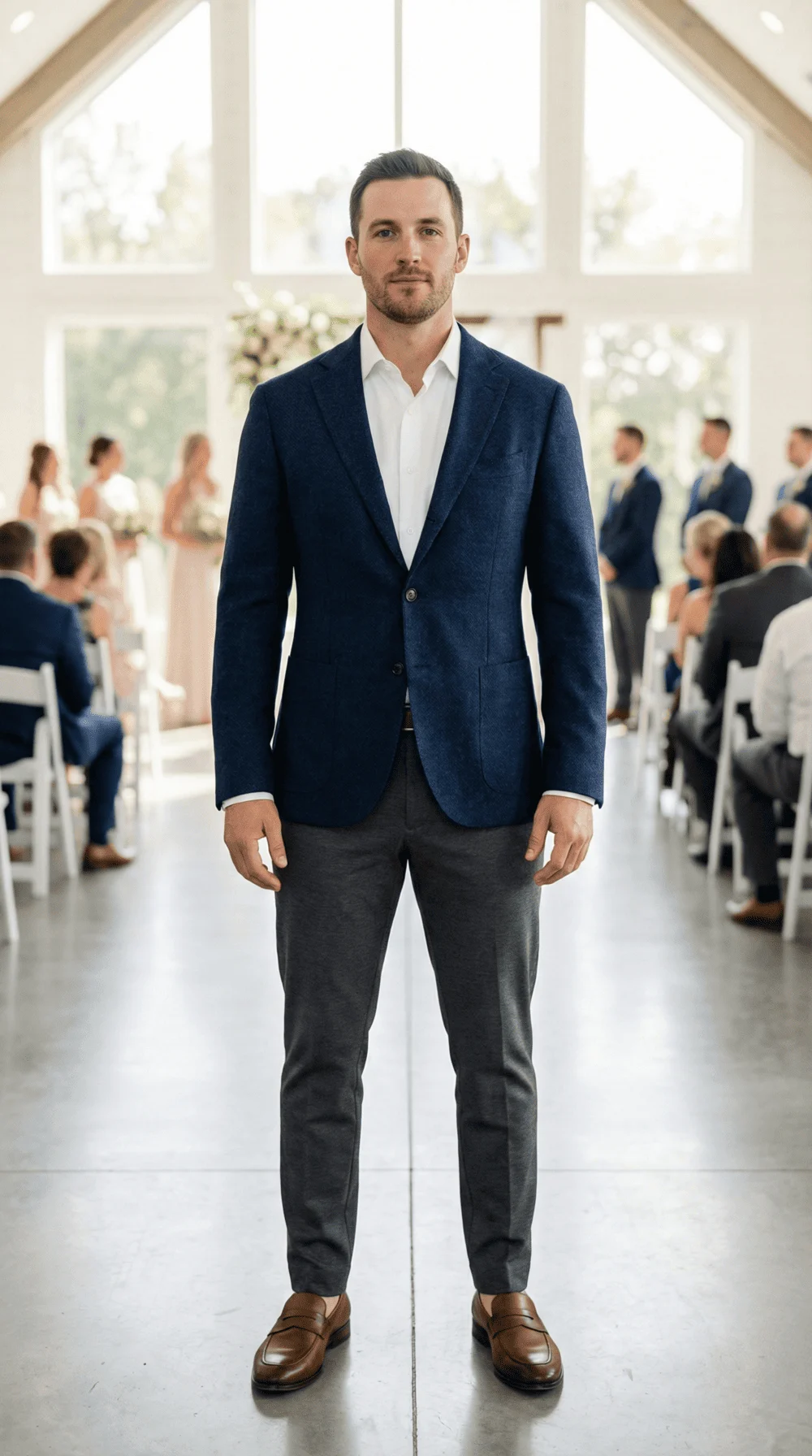
5. The oval body type
5.1. Key features of the oval shape
The oval body type, sometimes called the apple shape or endomorph build, is characterized by a fuller midsection and rounder torso. Your shoulders may be slightly narrower than your waist and hips, and you might carry most of your weight around your stomach. Limbs often appear shorter relative to the torso, and there may be less definition between your chest and waist.
This body shape is extremely common, particularly in men over 40, and is influenced by genetics, lifestyle, and metabolism. It's important to understand that this is a normal, healthy body type that simply requires specific tailoring strategies to look its best. The goal isn't to hide your body but to create a streamlined, elongated silhouette that photographs well and feels comfortable.
For wedding occasions, the oval shape can present challenges in terms of comfort (tight waistbands, restrictive jackets) and appearance (looking heavier than you are, appearing shorter). However, with expert tailoring and strategic fabric choices, you can create a sophisticated, confident look that serves you well throughout a long wedding day.
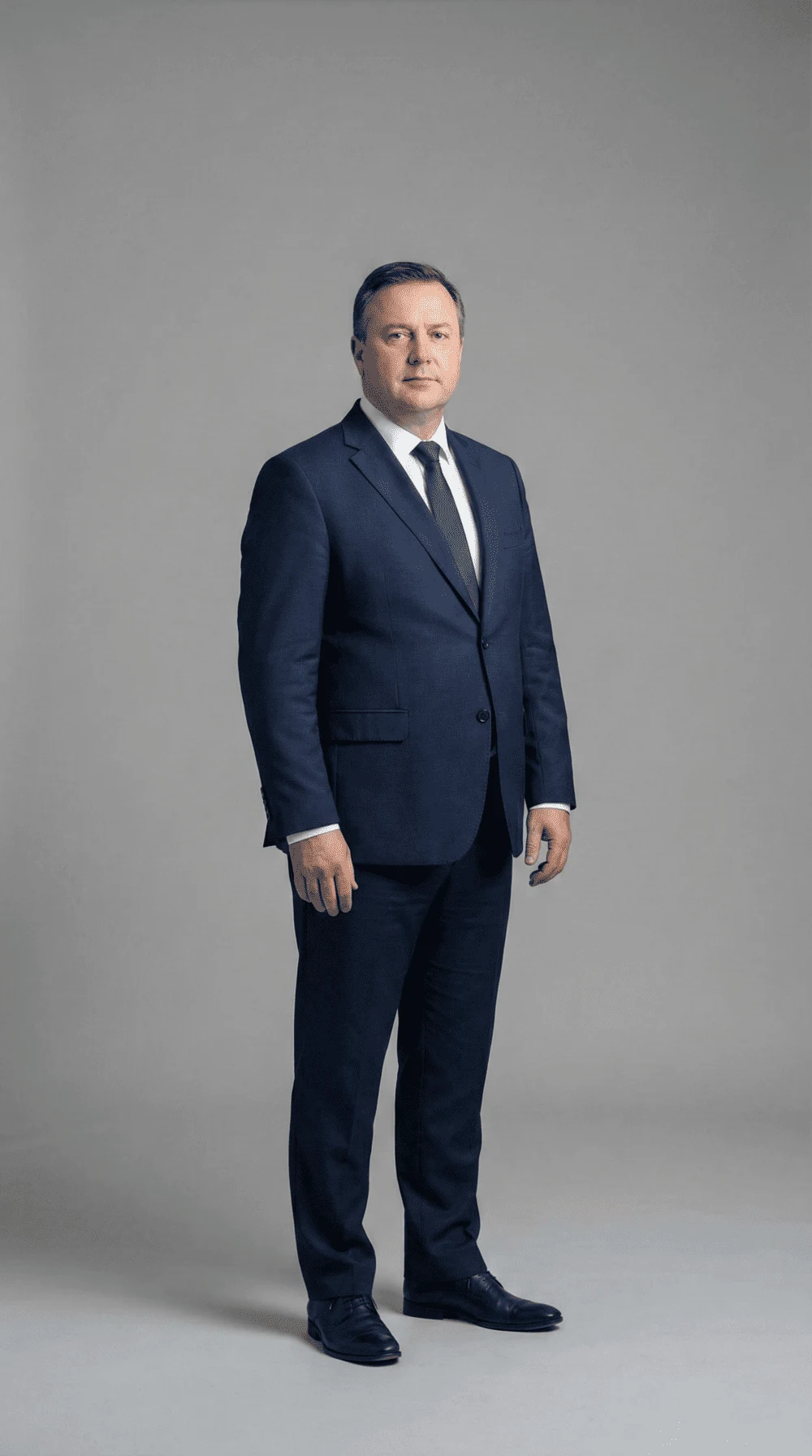
5.2. Wedding suit styling strategy for oval body types
The imperative for oval body types is vertical elongation and structural containment without constriction. You want to create the illusion of height and a defined waistline while ensuring comfort for all-day wear.
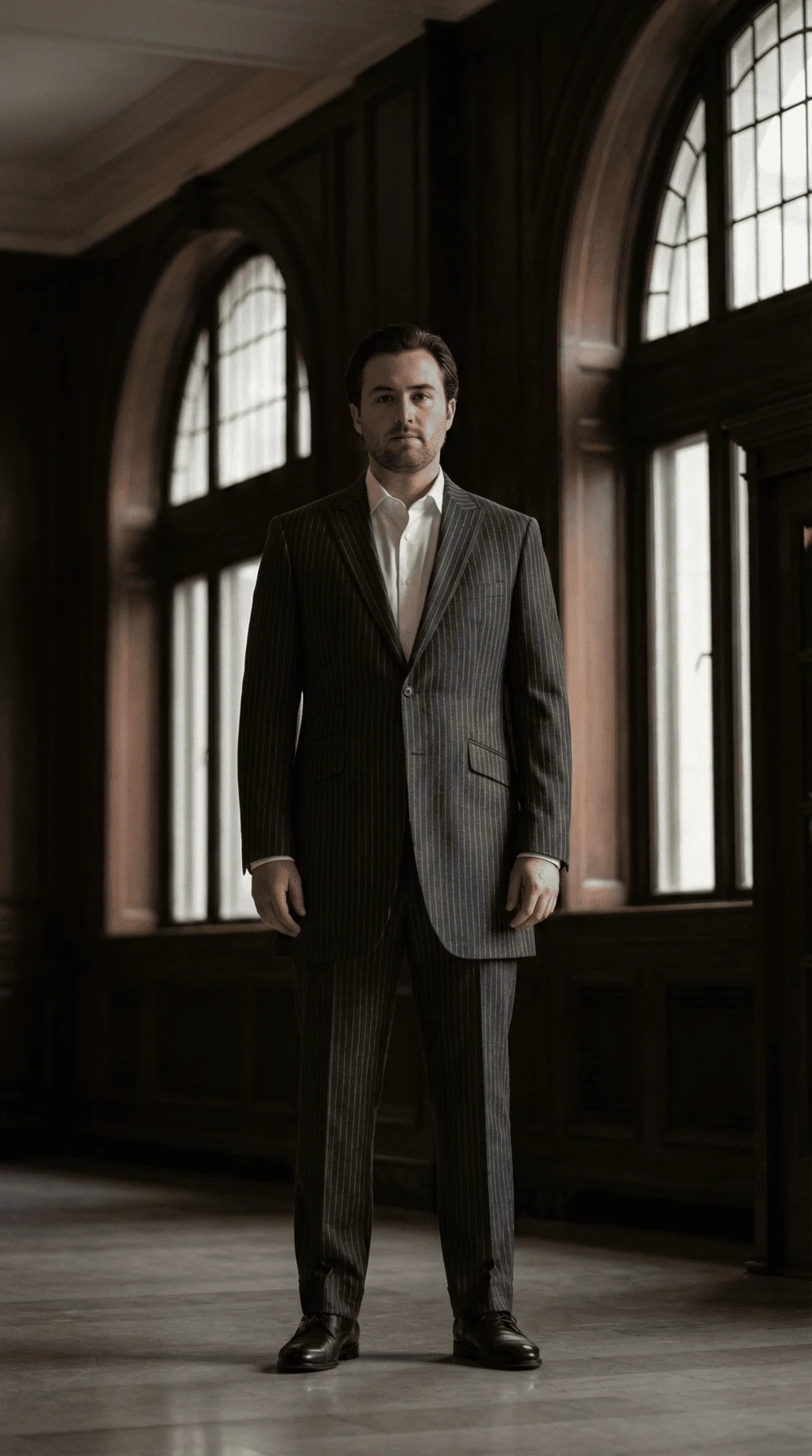
5.2.1. For grooms with oval body types
As the groom, you have the opportunity to work with expert tailors who can employ sophisticated techniques to flatter your proportions.
- Vertical elongation through button stance: The button stance (where your jacket buttons) dramatically affects how your torso appears. A lower button stance creates a longer, deeper V-neckline (the "gorge"), which elongates your torso visually. This is particularly effective for oval body types because it draws the eye upward and creates the illusion of a longer, leaner torso. Request a two-button jacket with the buttons positioned lower than standard. This creates a deeper V that exposes more of your shirt and tie, creating vertical lines that slim and elongate. Avoid three-button jackets, which have a higher button stance that shortens your torso and emphasizes your midsection.
- Fabric weight and construction: This is counterintuitive, but heavier fabrics with canvas construction are superior for oval body types. Lightweight, flimsy fabrics cling to every contour, emphasizing your midsection. Heavier fabrics (10-12 oz wool, substantial linen blends) drape over your body, smoothing out contours and creating a cleaner line. The construction matters too. Insist on at least half-canvas construction. The canvas layer (horsehair or wool) creates structure that helps the jacket maintain its shape rather than molding to your body. It also breathes better than fused (glued) construction, which is crucial for Australian weddings where you might be outdoors in warm weather.
- Trouser suspension with braces: This is a game-changer for oval body types. Belts tend to slip under your belly, shortening your leg line and requiring constant adjustment. Braces (suspenders) allow your trousers to hang from your shoulders, maintaining a clean vertical crease and a higher, more flattering waistline. For Australian weddings, this has the added benefit of eliminating the belt, which can dig in uncomfortably during long periods of sitting (ceremony, reception dinner). Braces keep your trousers in place without constriction. Make sure your trousers have buttons sewn inside the waistband for braces-don't use clip-on braces, which look cheap and can damage fabric.
- Jacket length is critical: Your jacket must cover the curvature of your buttocks. A jacket that's too short cuts your figure in half and draws attention to your midsection width. The proper length creates an unbroken vertical line from shoulder to mid-thigh, which elongates your entire silhouette. Have your tailor check the jacket length while you're standing naturally. The hem should end where your buttocks curve into your legs. This might be slightly longer than standard, but it's essential for creating the right proportions.
- Color and pattern strategy: Dark, solid colors are your foundation. Navy, charcoal, and black create a slimming effect and photograph beautifully. If you want to incorporate the 2025 trend toward earthy tones, choose darker versions-deep olive, chocolate brown, or dark terracotta rather than light sage or tan. Vertical stripes are highly effective for oval body types. A subtle pinstripe suit in charcoal or navy creates vertical lines that elongate your frame and slim your silhouette. The stripes should be subtle (thin, tonal) rather than bold, which can look costume-like.
5.2.2. For groomsmen with oval body types
As a groomsman, your focus is on comfort and looking polished within the coordinated bridal party aesthetic.
- Consistent vertical emphasis: If the bridal party is wearing solid suits, ensure yours has the same vertical emphasis through proper jacket length and trouser fit. If there's any flexibility in styling, advocate for elements that create vertical lines-peaked lapels, vertical pocket placement, or subtle pinstripes.
- Comfort without constriction: Wedding days are long. Your suit needs to be comfortable enough to wear for 8-12 hours without feeling like you're in a straitjacket. Work with your tailor to find the balance between a fitted look and comfortable ease. The jacket should button without pulling, and you should be able to sit comfortably without the fabric straining.
- Braces for all-day comfort: Even if other groomsmen wear belts, you can wear braces under your jacket. No one will see them, and you'll be far more comfortable throughout the day. This is particularly valuable during the reception when you're sitting for extended periods.
5.2.3. For wedding guests with oval body types
As a guest, you can optimize entirely for your body type without coordinating with others.
- Flat-front trousers, mid-rise: Pleated trousers add bulk to your midsection, which is the last thing oval body types need. Flat-front trousers with a mid-rise (sitting at or just below your navel) create a smooth line from waist to leg. The rise is crucial-low-rise trousers make your midsection appear wider and your legs shorter.
- Structured jackets for containment: A well-structured jacket with canvas construction acts almost like shapewear, providing gentle containment that smooths your silhouette without feeling restrictive. This is where investing in quality pays off-a cheap, fused jacket will feel stiff and uncomfortable, while a properly constructed canvas jacket molds to your body over time.
- Monochromatic dressing: Wearing your jacket and trousers in the same color creates an unbroken vertical line that elongates your frame. A full navy suit or charcoal suit is more slimming than separates in contrasting colors, which create horizontal breaks that shorten your silhouette.
5.3. Australian tailoring solutions for oval body types
Australian tailors have developed specific approaches to accommodate oval body types, particularly for wedding contexts.
- Dunnio Tailor's oval body type mastery: We approach oval shapes with a focus on vertical elongation and structural containment without constriction. Our jackets feature lower button stances that create deeper V-necklines, drawing the eye upward and elongating your torso. We insist on half-canvas or full-canvas construction-the floating canvas layer provides gentle structure that smooths your silhouette without the stiffness of fused jackets. For oval body types, we strongly recommend trouser suspension with braces rather than belts, and we sew button tabs inside every waistband as standard. This allows your trousers to hang from your shoulders, maintaining a clean vertical line and eliminating the discomfort of belts digging in during long wedding days. Our jacket length is precisely calibrated to cover your seat, creating an unbroken vertical line from shoulder to mid-thigh. We specialize in dark, solid colors and subtle vertical patterns (pinstripes) that elongate your frame while our heavier fabric recommendations (10-12oz wool, substantial linen blends) drape beautifully to smooth contours. The result is a sophisticated, streamlined appearance that makes you look taller and leaner while feeling comfortable for 8-12 hours.
- YSG Tailors' posture analysis: YSG Tailors' comprehensive measurement process includes posture and stance analysis, which is particularly valuable for oval body types. They understand how your weight distribution affects how fabric drapes and can adjust patterns accordingly. Their focus on creating suits that "move effortlessly" ensures comfort throughout a long wedding day.
- Oscar Hunt's holistic approach: Oscar Hunt's made-to-measure service considers your lifestyle and how you'll be using the suit. For weddings, this means they'll ensure your jacket has enough ease for sitting during the ceremony and reception, while still looking sharp when you're standing for photos. Their understanding of Australian wedding contexts (outdoor venues, varied temperatures) informs their fabric recommendations.
- Germanicos' no-judgment fitting: Germanicos' explicit policy of achieving perfect fit "no matter the body type" without excess fees creates a comfortable environment for oval body types who might feel self-conscious about their proportions. Their "complexion and proportion analysis" provides specific recommendations for styles that flatter your build.
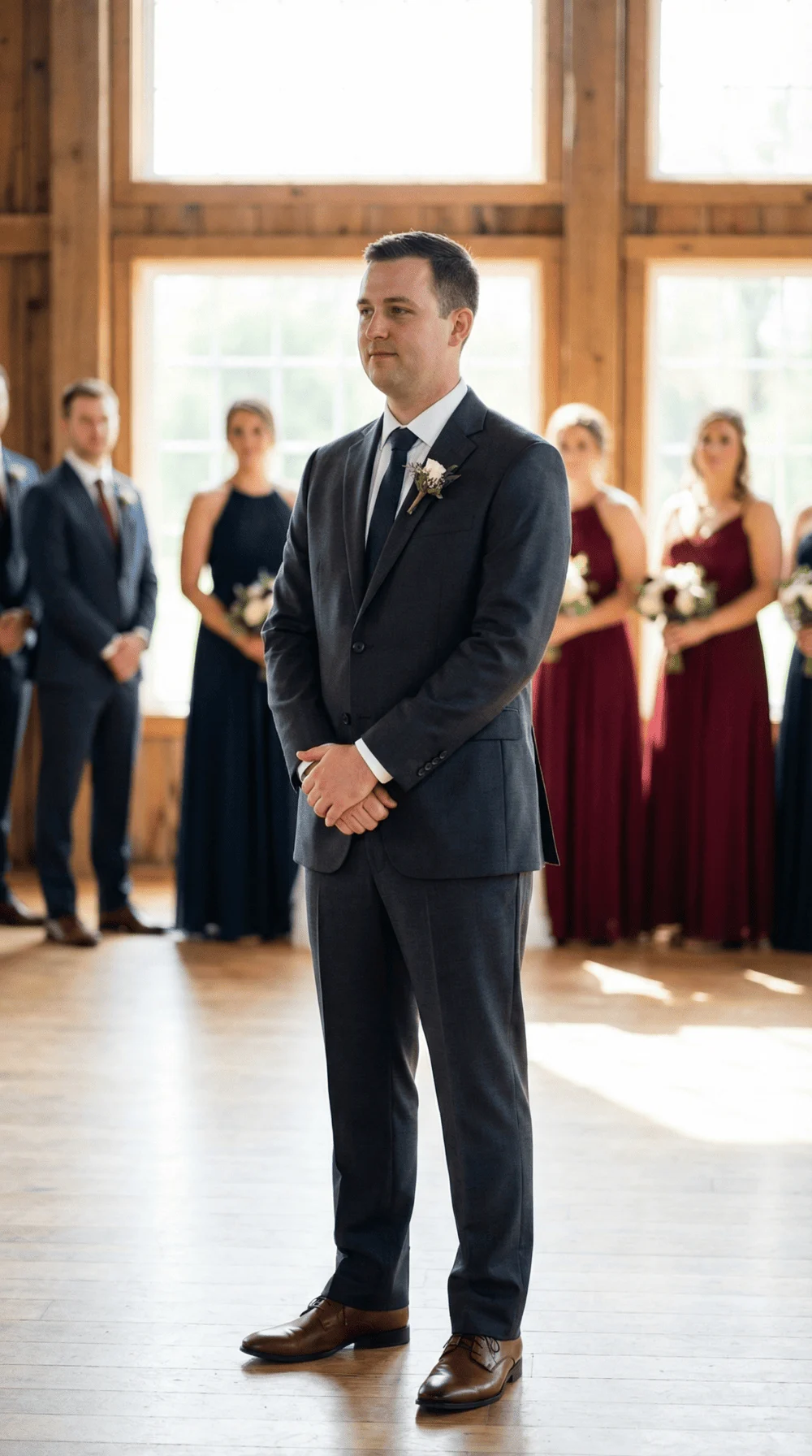
5.4. What to avoid with oval body types
Certain styling choices will emphasize your midsection and shorten your silhouette.
- Tight or clingy fabrics around the waist: Anything that clings to your midsection will emphasize its fullness. Avoid lightweight, stretchy fabrics or jackets that are too tight. The jacket should skim your body without pulling or gaping.
- Low-waist trousers: Trousers that sit on your hips rather than your natural waist will make your torso appear shorter and your midsection wider. They also create an unflattering gap between your shirt and trousers when you move or sit. Stick to mid-rise or higher-rise trousers.
- Horizontal patterns or bold colors: Horizontal stripes, checks, or plaids create visual width. Bold, light colors draw attention. For oval body types, these are best avoided in favor of dark, solid colors or subtle vertical patterns.
- Short jackets: A jacket that ends above your buttocks will make you look heavier and shorter. It cuts your body in half visually, emphasizing your midsection. Always opt for proper length that covers your seat.
- Double-breasted jackets: While double-breasted can work for some body types, they tend to add bulk to the midsection for oval shapes. The overlapping fabric and horizontal button rows create width exactly where you don't want it. Stick to single-breasted styles with a clean, vertical line.
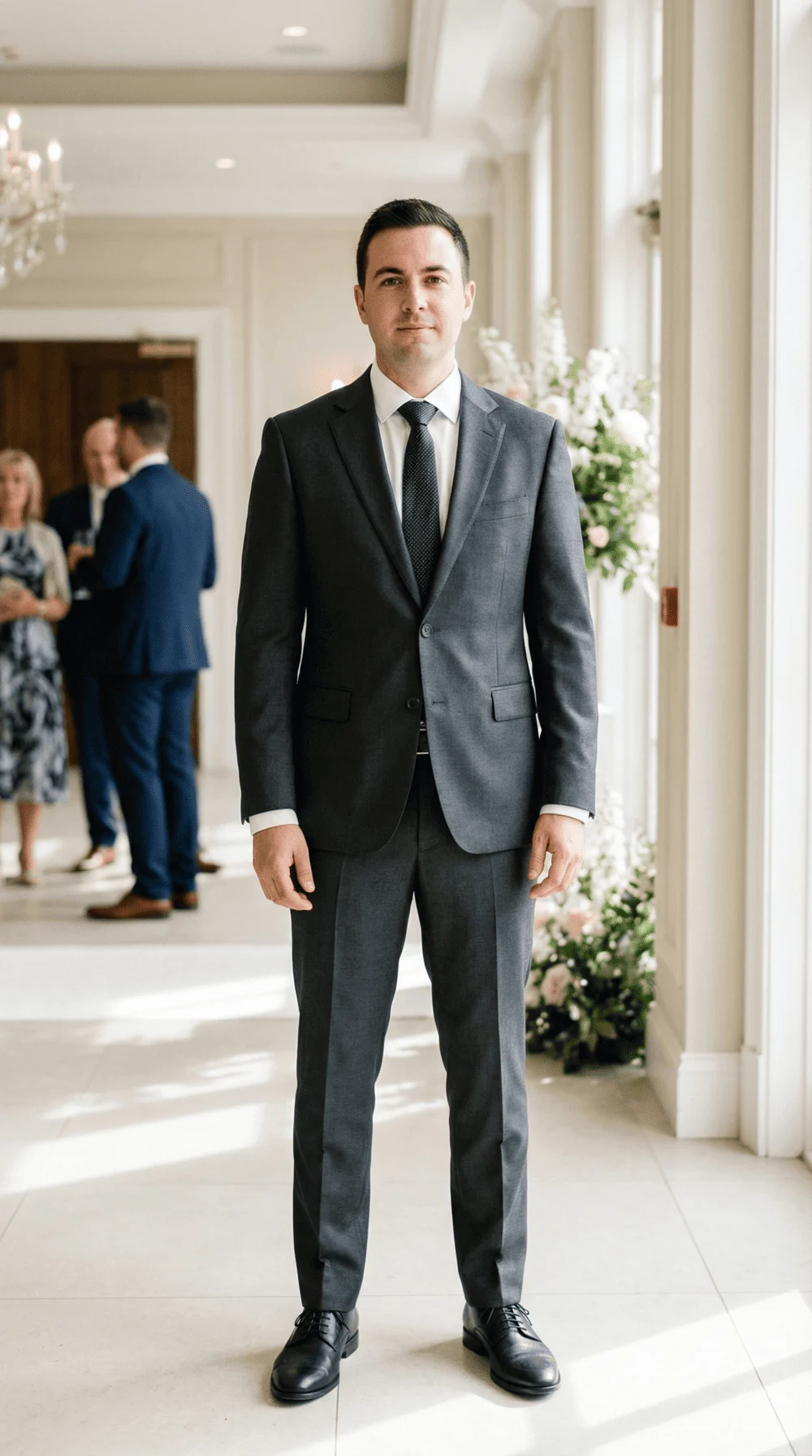
6. The trapezoid body type
6.1. Key features of the trapezoid shape
The trapezoid body type is often considered the ideal male proportions-broad shoulders and a well-defined chest that taper cleanly to a narrower waist and hips. This naturally athletic or muscular build creates a symmetric, V-shaped silhouette that's the benchmark for ready-to-wear suit patterning. If you have this body type, you're fortunate in that most standard suits are designed with your proportions in mind.
The defining characteristics include shoulders that are noticeably broader than your hips, a visible taper from chest to waist, and balanced proportions that don't require significant optical correction. Your chest measurement is typically 6-8 inches larger than your waist, which is the "drop" that standard suit sizing accommodates. This means off-the-rack suits are more likely to fit you well with minimal alterations.
For wedding occasions, the trapezoid build photographs exceptionally well from all angles. The natural V-shape creates a masculine, confident silhouette that looks polished in formal wear. However, this doesn't mean you can ignore fit and styling-even ideal proportions benefit from expert tailoring and strategic choices.
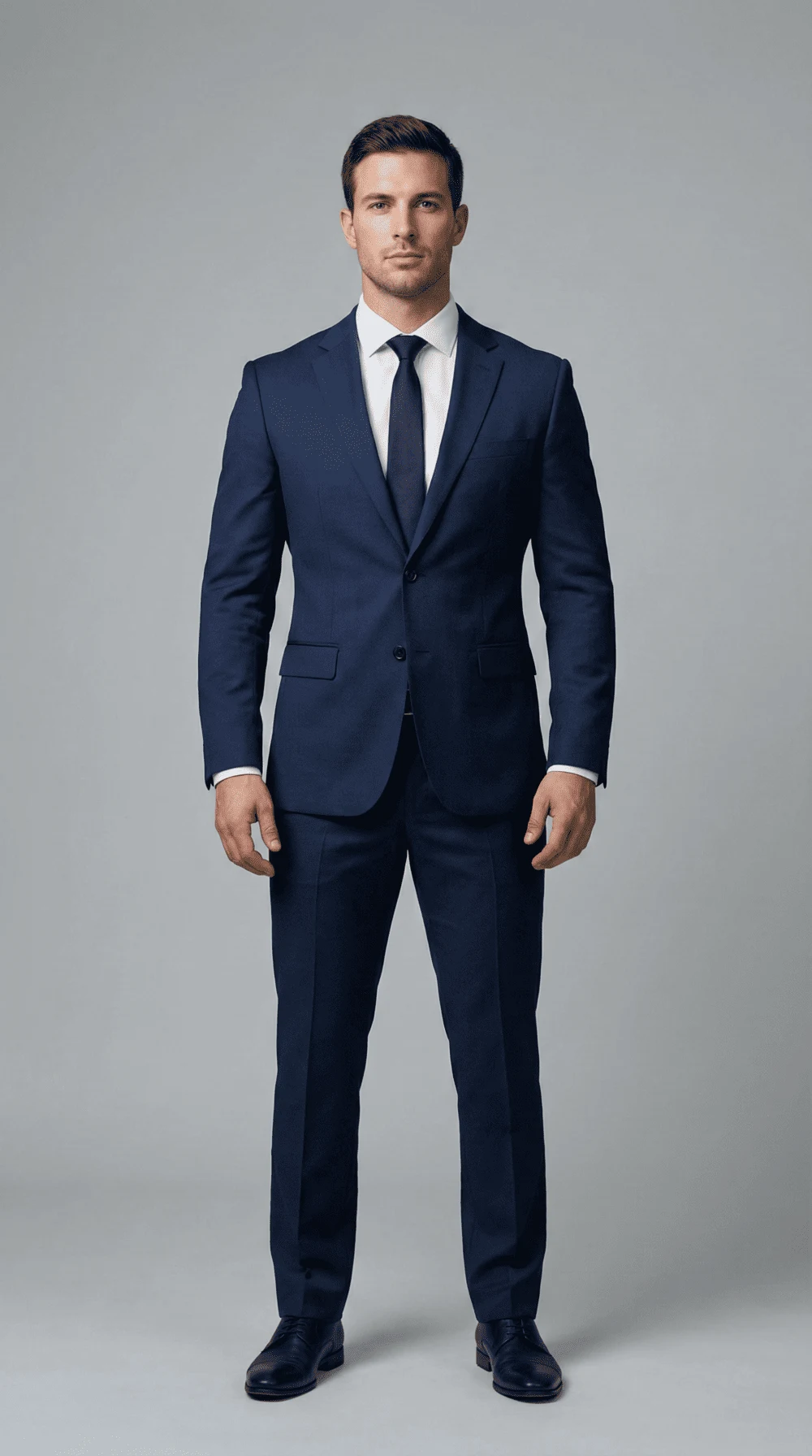
6.2. Wedding suit styling strategy for trapezoid body types
The approach for trapezoid body types is preservation and enhancement. Your goal is to follow your body's natural lines without creating artificial shapes, while showcasing your proportions through proper fit and strategic styling.
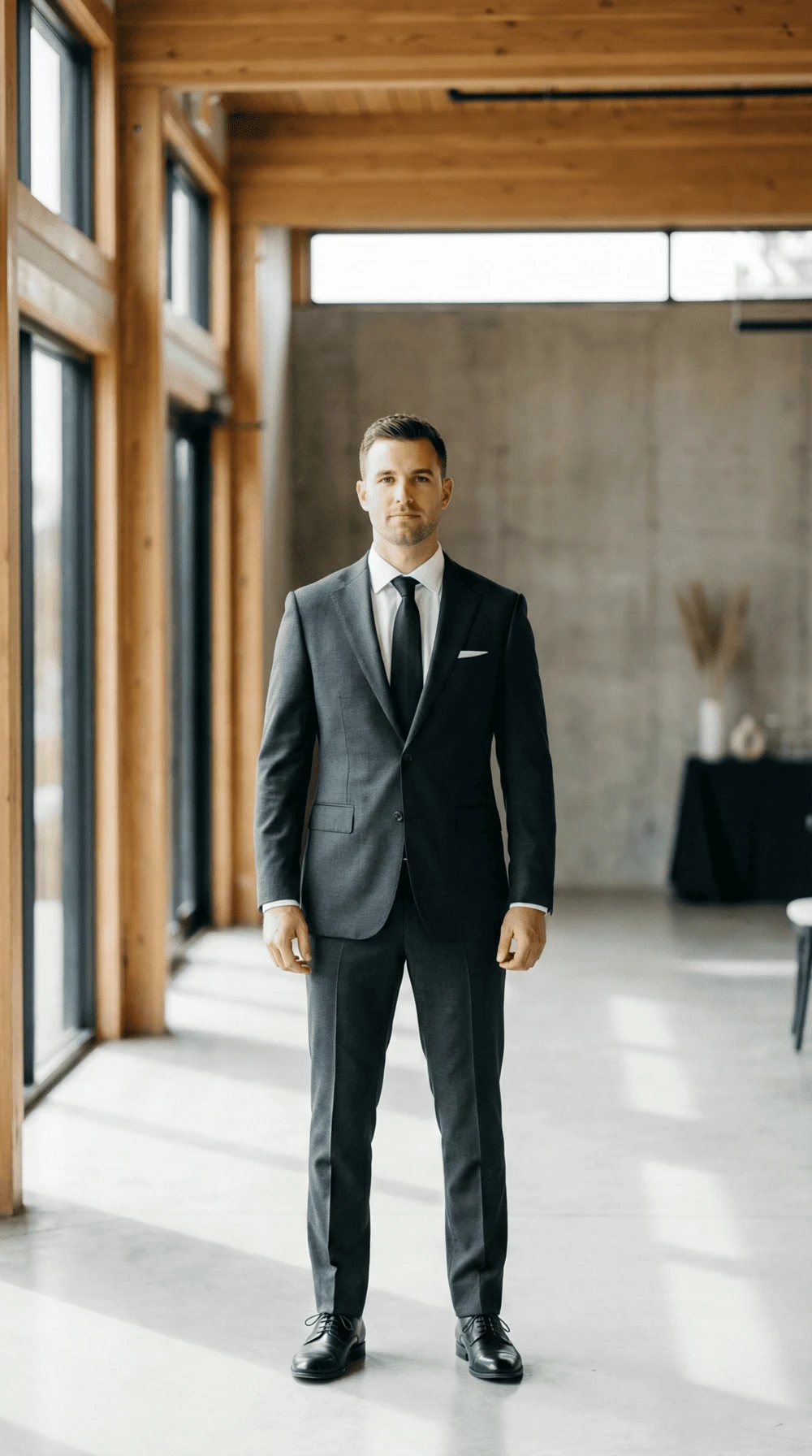
6.2.1. For grooms with trapezoid body types
As the groom with ideal proportions, you have the freedom to experiment with styles that might not work for other body types.
- Slim-fit excellence: The slim-fit cut is made for trapezoid body types. It should trace your ribcage without constriction, suppress at your natural waist (above your navel), and follow the line of your torso to create a clean, modern silhouette. The jacket should feel like a second skin-fitted but not tight, with enough ease to move comfortably but no excess fabric. For Australian weddings, a slim-fit suit in a breathable fabric like lightweight wool or linen blend gives you the sharp, contemporary look that's trending while keeping you comfortable in warm weather. The slim cut also photographs beautifully, creating clean lines that look polished in both close-up portraits and full-length shots.
- Pattern freedom: Unlike body types that need to minimize or enhance certain areas, trapezoid builds can experiment with bold patterns. Windowpane checks, glen plaids, herringbone, or even subtle Prince of Wales patterns all work beautifully because there are no disproportionate areas that need to be visually minimized. For 2025 Australian wedding trends, this means you can embrace the pattern play that's becoming popular-a checked three-piece suit in earthy tones, or a herringbone jacket with solid trousers. These patterns add visual interest and personality without creating unflattering optical illusions.
- Trouser integration: Your trousers should be streamlined to match the clean lines of your upper body. Flat-front trousers with a slight taper from knee to ankle create a modern, proportionate look. The leg opening should be narrow enough to look contemporary but not so tight that it restricts movement or looks costume-like. For Australian weddings where you might be standing on grass or uneven surfaces, ensure your trouser length is appropriate-a slight break (quarter break) or no break for a more modern look. Trousers that are too long and bunch at the ankle will disrupt your clean silhouette.
- Fabric and color versatility: With balanced proportions, you can wear both light and dark colors, both heavy and lightweight fabrics. This versatility is particularly valuable in the Australian market where weddings happen year-round in diverse climates. For summer vineyard weddings, a light grey or sage green linen suit showcases your build while keeping you cool. For winter formal events, a charcoal or navy wool suit with subtle texture (herringbone, birdseye) creates sophisticated elegance. You can even pull off the 2025 trend of velvet or corduroy for autumn weddings-fabrics that can overwhelm other body types look refined on trapezoid builds.
- Lapel and detail choices: You have freedom here too. Both notch and peak lapels work well, though peak lapels add a touch more formality and drama that's perfect for grooms. The width should be proportional to your shoulders-for most trapezoid builds, a 3-3.5 inch lapel width creates balance. Details like ticket pockets, working buttonholes, or contrasting buttons add personality without disrupting your proportions. These are the finishing touches that elevate a good suit to a great one.
6.2.2. For groomsmen with trapezoid body types
As a groomsman with ideal proportions, you're in the enviable position of looking good in whatever the groom chooses.
- Showcase natural proportions: If the bridal party is using made-to-measure services, you likely won't need significant adjustments beyond standard measurements. However, don't skip the fitting process. Even ideal proportions benefit from fine-tuning-sleeve length, trouser break, and waist suppression should all be optimized.
- Coordinated slim-fit approach: If the groom wants a modern, slim aesthetic for the bridal party, you're the ideal candidate to showcase this look. Your natural taper means slim-fit won't look forced or uncomfortable. This can actually help other groomsmen feel more confident-seeing the look executed well on you demonstrates how the coordinated aesthetic should appear.
- Versatility in styling: You can wear the same cut as other groomsmen even if they have different body types, because made-to-measure services can adjust the internal construction while maintaining the same external appearance. This makes you a valuable reference point for the group.
6.2.3. For wedding guests with trapezoid body types
As a guest with ideal proportions, you can focus on personal style and current trends.
- Well-fitted shirts and tailored blazers: Invest in quality basics that showcase your build. A well-fitted dress shirt in Egyptian cotton or linen, paired with a tailored blazer, creates effortless elegance. The fit should be close but comfortable-you should be able to pinch about an inch of fabric at your sides.
- Athletic-fit trousers: While you can wear slim-fit, athletic-fit trousers often work even better for trapezoid builds, particularly if you have muscular thighs from sports or gym work. Athletic fit provides room in the thigh while maintaining a tapered leg, creating a modern silhouette without restriction.
- Color and pattern experimentation: As a guest, you have freedom to experiment with the 2025 trends. A terracotta or olive suit for a vineyard wedding, a navy velvet jacket with grey trousers for an evening reception, or a subtle checked suit for a garden party-all of these work beautifully on trapezoid proportions.
6.3. Australian tailoring solutions for trapezoid body types
While trapezoid builds fit standard sizing better than other body types, Australian tailors still offer valuable services for optimization.
- Dunnio Tailor's trapezoid enhancement: While trapezoid builds fit standard sizing better than other body types, we believe even ideal proportions deserve exceptional tailoring. Our approach for trapezoid shapes focuses on preservation and refinement-following your natural lines while adding subtle enhancements that elevate your look from good to extraordinary. We offer slim-fit cuts that trace your ribcage without constriction, with precise waist suppression that sits at your natural waist (above the navel). For trapezoid builds, we have the freedom to experiment with patterns and textures-windowpane checks, herringbone, subtle Prince of Wales plaids-because your balanced proportions can carry bold choices. We also specialize in the details that matter: working buttonholes, custom linings, ticket pockets, and contrasting buttons that add personality without disrupting your proportions. Our fabric recommendations for trapezoid builds span the full spectrum-from light grey or sage green linen suits for summer vineyard weddings to charcoal or navy wool with subtle texture for winter formal events. A Dunnio Tailor suit on a trapezoid build is the difference between looking good and looking exceptional.
- M.J. Bale's ready-to-wear excellence: M.J. Bale's "Kingston" and "Japan" collections are designed with trapezoid proportions in mind. Their understanding of the Australian male physique (many Australian men have athletic builds from outdoor lifestyles) means their standard sizing often fits trapezoid body types exceptionally well. Their in-house alterations service can fine-tune the fit for perfection.
- InStitchu's customization options: Even though you fit standard sizing, InStitchu's made-to-measure service allows you to customize details that ready-to-wear can't offer-working buttonholes, custom lining, unique button choices, or specific lapel widths. This elevates your suit from good to exceptional without the premium cost of full bespoke.
- Oscar Hunt's style consultation: Oscar Hunt's strength lies in helping you develop your personal style within the framework of your proportions. For trapezoid builds, this means exploring different aesthetics-classic British tailoring, modern Italian slim fits, or relaxed Australian elegance-to find what resonates with your personality and the wedding context.
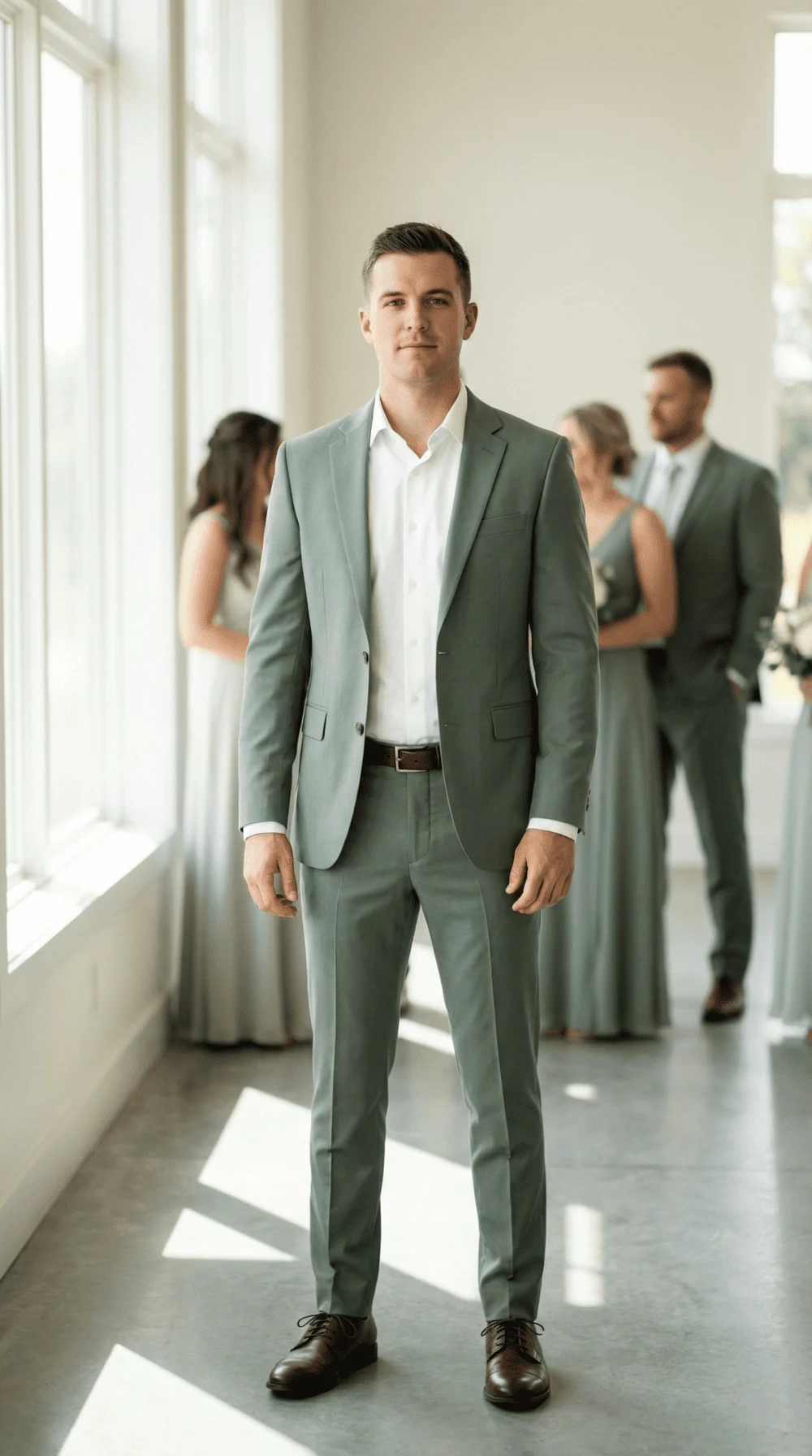
6.4. What to avoid with trapezoid body types
Even ideal proportions can be undermined by poor styling choices.
- Loose or overly baggy clothing: Your natural taper is an asset-don't hide it under shapeless, oversized clothing. Baggy suits make you look sloppy and waste your natural proportions. The fit should follow your body's lines, not obscure them.
- Extreme slim or skinny fits: While slim-fit works well, ultra-skinny or spray-on fits can look try-hard and restrict movement. There's a difference between fitted and tight. Your suit should allow comfortable movement-sitting, raising your arms, dancing-without straining.
- Ignoring the details: With great proportions, details matter more because they're what people notice. Poorly tied ties, wrinkled shirts, scuffed shoes, or ill-fitting accessories will stand out. Pay attention to the finishing touches-they're what elevate your look from good to exceptional.
7. Stature-based considerations
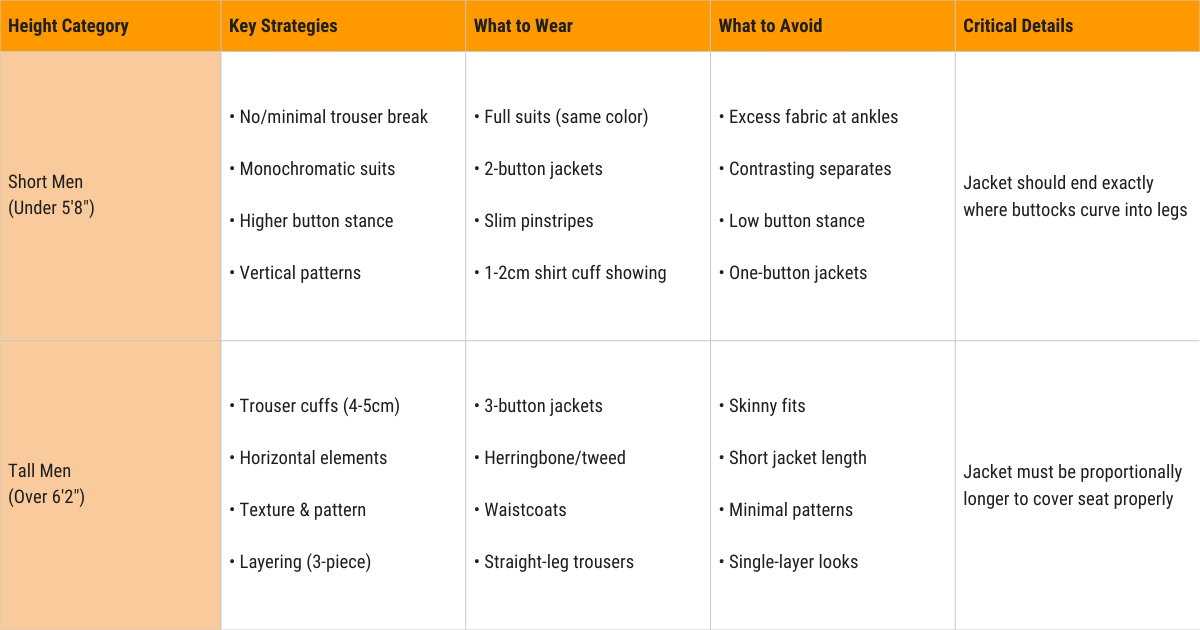
Beyond horizontal body shape, your height significantly influences how suits should be tailored and styled. These principles apply across all body types and are particularly important for wedding photography, where you'll be standing next to people of various heights.
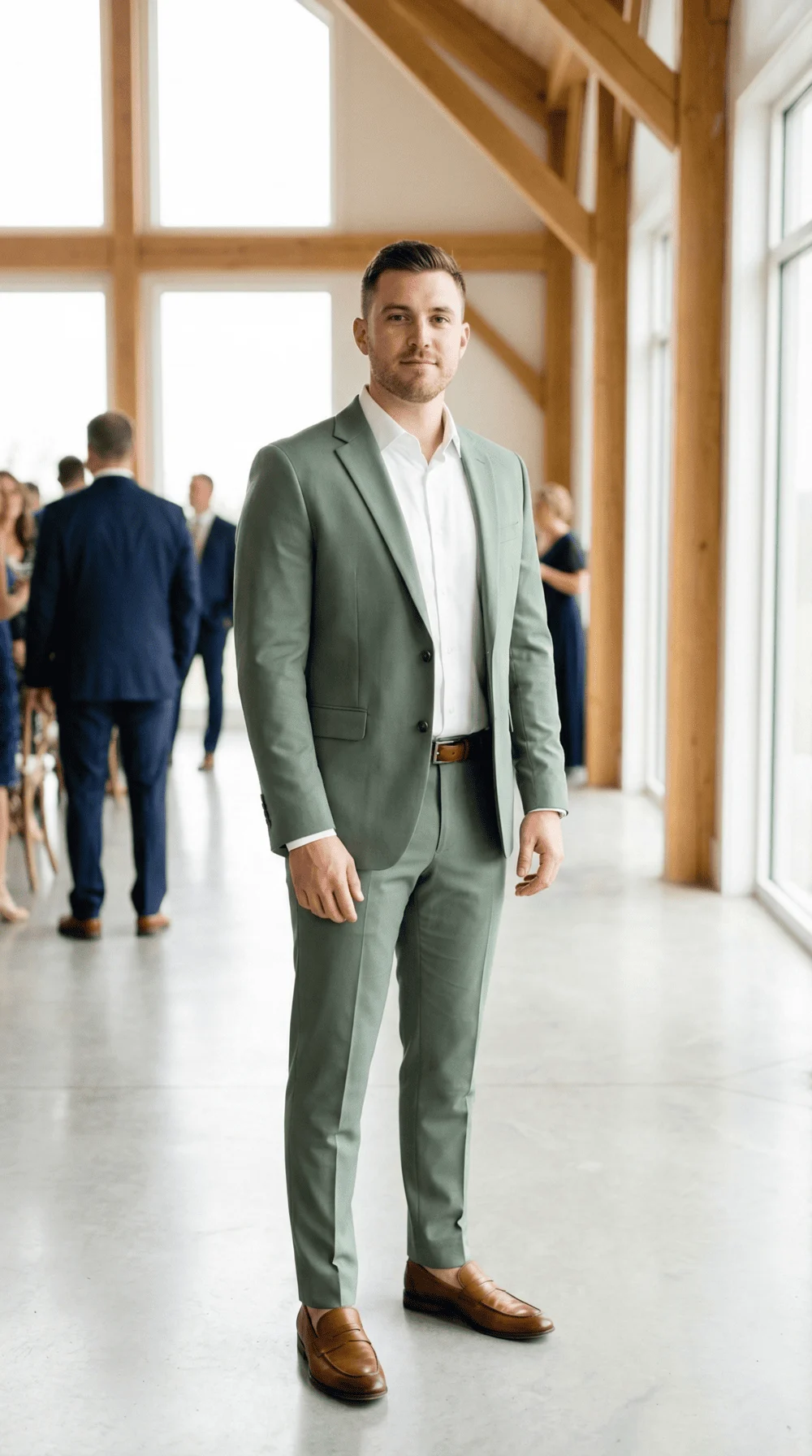
7.1. Styling for short men (under 5'8")
Height presents specific challenges in suiting, but strategic tailoring can create the illusion of additional inches.
- The enemy is the break: Trouser break (the fold of fabric where your trousers meet your shoes) is critical for shorter men. Excess fabric pooling at your ankles draws the eye down and visually shortens your legs. Opt for no break or a very slight quarter break. Your trousers should just kiss the top of your shoe, creating a clean, unbroken line from waist to floor. For Australian weddings where you might be photographed on grass or uneven surfaces, this is even more important. Long trousers that bunch create a sloppy appearance and make you look shorter than you are.
- Jacket length precision: Your jacket length is a delicate balance. Too long, and it shortens your legs. Too short, and it looks like you're wearing a boy's suit. The jacket should end exactly where your buttocks curve into your legs. Have your tailor check this while you're standing naturally-it might be slightly shorter than standard, but it's crucial for creating proper proportions.
- Monochromatic flow: Keeping your jacket and trousers in the same color creates an unbroken vertical line that adds height. A full navy suit or charcoal suit is more elongating than a navy jacket with grey trousers, which creates a horizontal break at your waist. For Australian weddings, this might mean choosing a full suit in one of the trending earthy tones rather than mixing separates.
- Higher button stance: A higher button stance (where your jacket buttons) shortens the jacket's skirt (the part below the button) and lengthens your legs visually. A two-button jacket with buttons positioned slightly higher than standard creates better proportions for shorter frames. Avoid one-button jackets, which have a very low button stance that can make you look stumpy.
- Sleeve exposure: Showing 1-2 centimeters of shirt cuff beyond your jacket sleeve elongates your arms and creates a polished, intentional look. This small detail makes a significant difference in how your proportions appear.
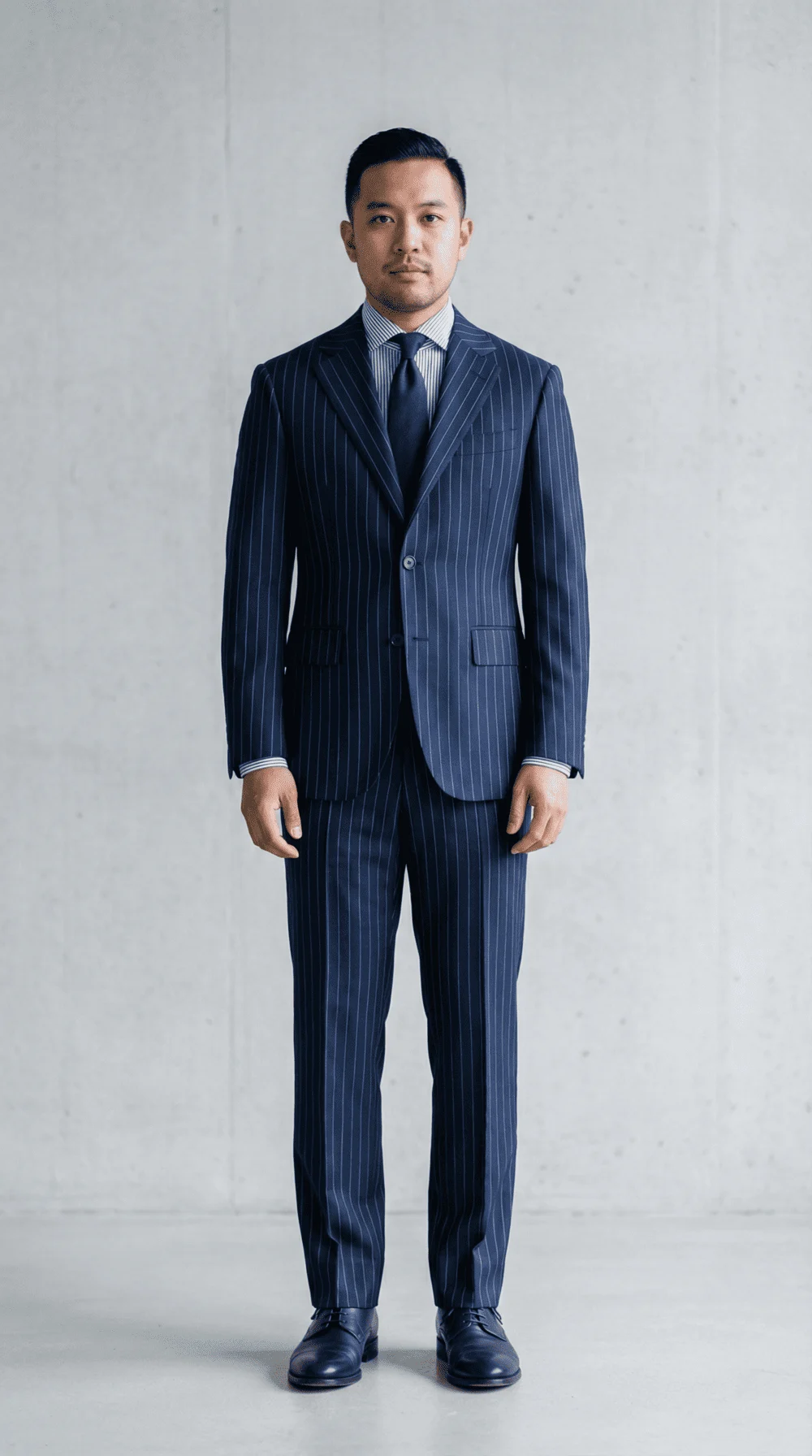
- Vertical patterns: Subtle vertical stripes (pinstripes) create the illusion of height by drawing the eye up and down rather than side to side. Choose thin, tonal stripes rather than bold contrasting ones for a sophisticated look that doesn't read as costume-like.
7.2. Styling for tall men (over 6'2")
Tall men face the opposite challenge-creating horizontal interest to avoid looking like a beanpole.
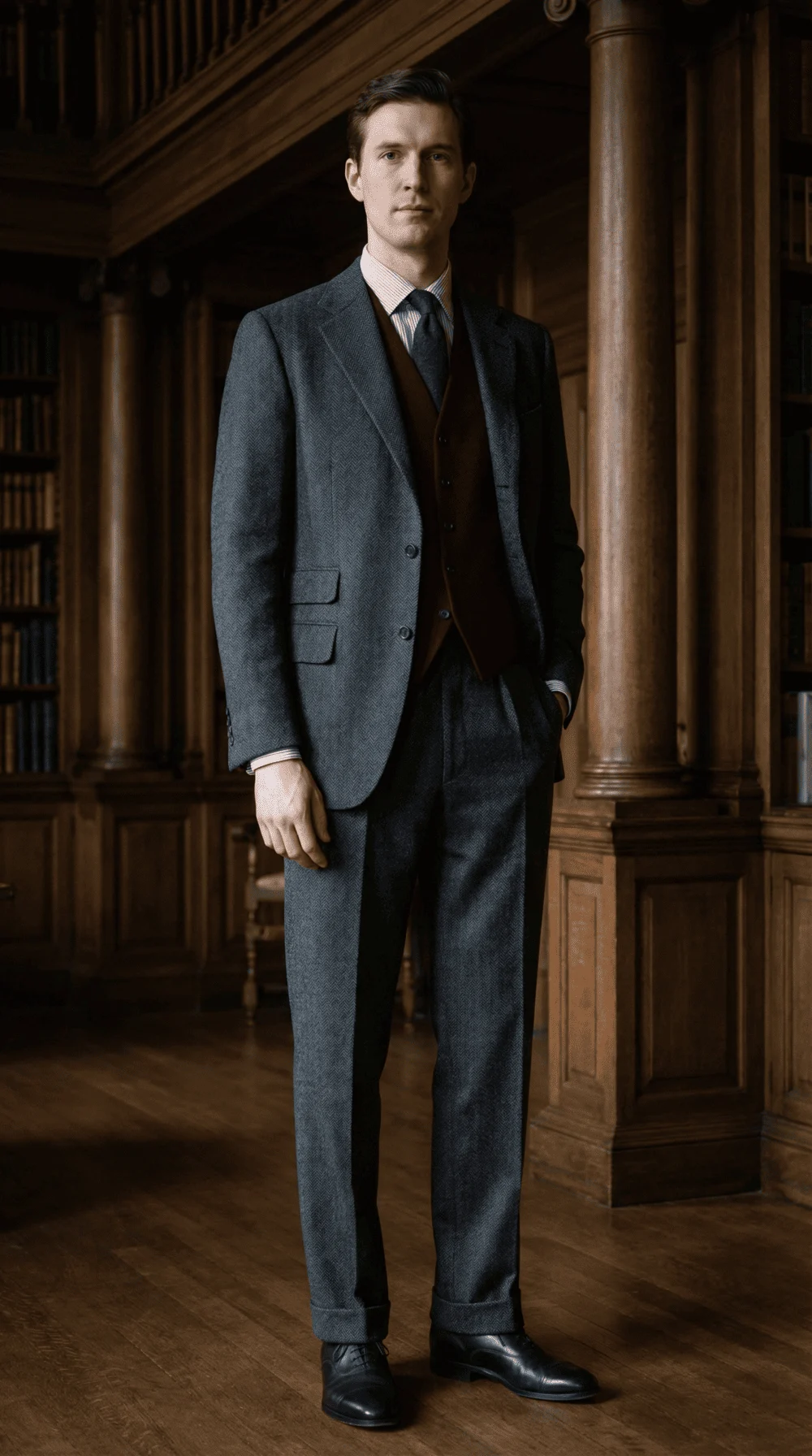
- Breaking the line: Tall men need to introduce horizontal elements to create visual breaks. Trouser cuffs (turn-ups) add weight to the bottom of your leg and create a horizontal line that grounds your height. A 4-5 centimeter cuff is appropriate for formal wedding wear.
- Button count: Three-button jackets (or a 2.5 roll where the top button rolls under the lapel) can work well for tall men. The higher button stance and additional button create more visual interest on your long torso. This style is less common in modern Australian tailoring but can be requested through made-to-measure services.
- Texture and pattern: Heavier textures and patterns add visual weight and interest, preventing the lanky appearance. Herringbone, tweed, checks, or plaids all work well. For Australian weddings, a textured linen or a subtle checked suit in earthy tones creates interest without overwhelming.
- Jacket length: Your jacket should be proportionally longer to cover your seat properly. Standard jacket lengths will often be too short on tall frames, exposing too much trouser and creating an awkward proportion. Ensure your tailor adjusts the length appropriately-this might mean going up a size and having the shoulders and waist altered.
- Avoid skinny fits: Skinny or ultra-slim fits exaggerate height and make tall men look gangly. Opt for modern or classic fits that have more substance. Your trousers should have a straight or slight taper, not a skinny leg that makes you look like you're on stilts.
- Layering: Waistcoats, vests, or even a cardigan under your jacket add horizontal bulk and break up your vertical line. For Australian weddings, a three-piece suit is an excellent choice for tall men-the waistcoat creates visual interest and proportion.
8. Australian wedding suit trends 2026
The 2026 Australian wedding season represents a sophisticated evolution in men's formal wear, moving decisively away from the conservative, cookie-cutter approaches of previous decades. The modern Australian groom is informed, style-conscious, and willing to embrace personal expression within the framework of wedding formality.
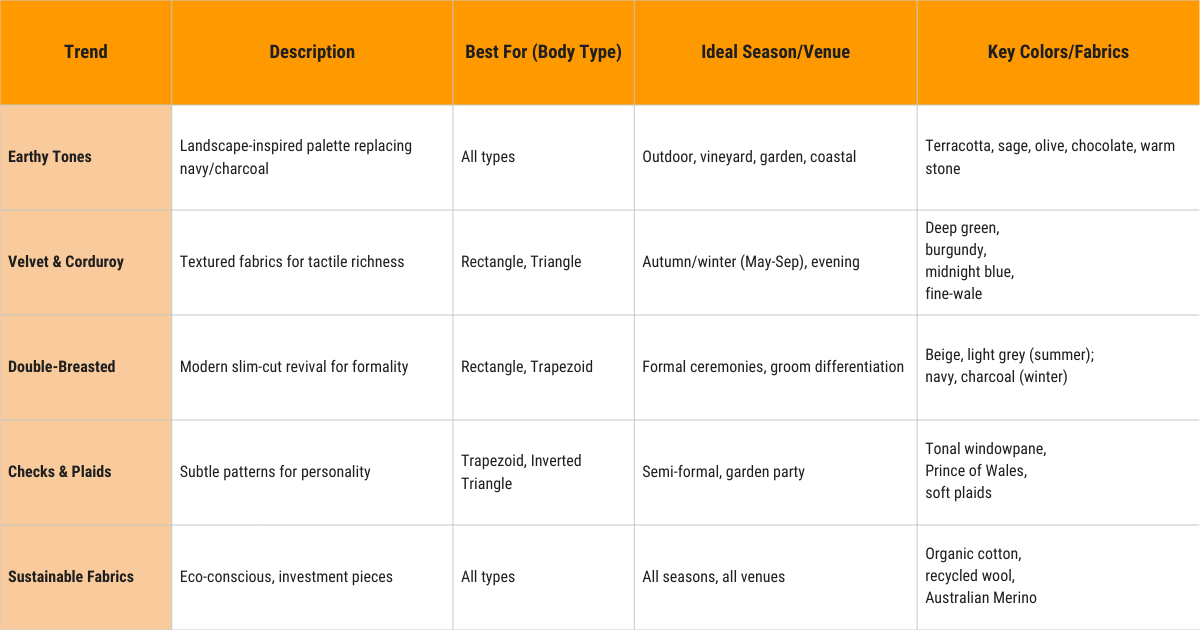
8.1. The rise of earthy tones
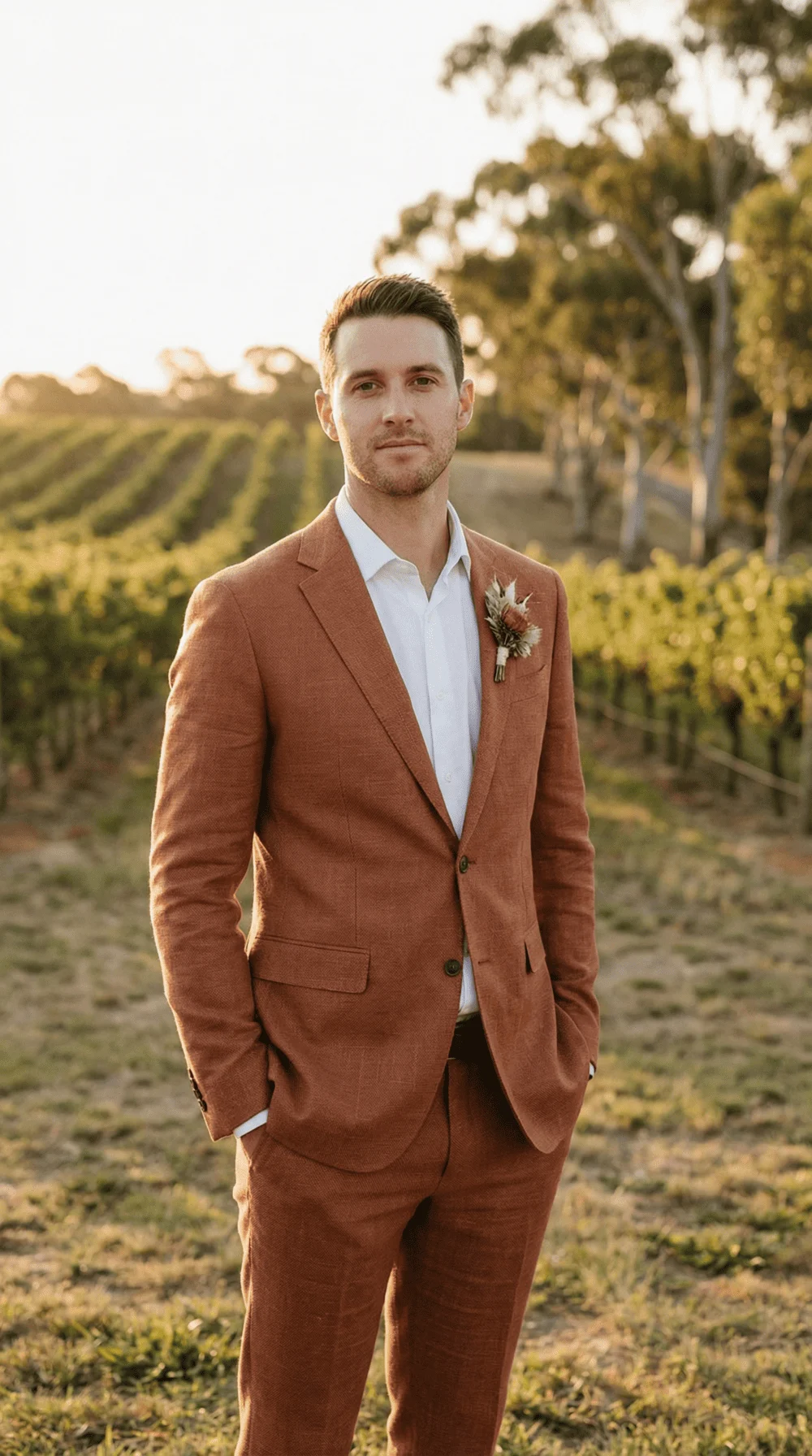
The dominance of the standard navy and charcoal suit is waning, replaced by a palette derived directly from the Australian landscape. This trend reflects the popularity of outdoor wedding venues and a broader cultural shift toward celebrating our unique environment.
- Key hues for 2025: Terracotta, sage green, olive, chocolate brown, and warm stone are the colors defining this season. These aren't loud or garish-they're sophisticated, muted tones that photograph beautifully against natural backgrounds. A sage green linen suit at a Hunter Valley vineyard wedding or a terracotta wool suit at a Barossa Valley celebration creates visual harmony with the surroundings.
- Styling implications: These earthy tones work particularly well in natural fabrics like linen, cotton blends, and lightweight wools. The texture of the fabric enhances the depth of the color, creating a rich, layered appearance that flat synthetic fabrics can't achieve. For body types that benefit from texture (rectangle, triangle), this trend is particularly advantageous.
- Venue coordination: The earthy tone trend aligns perfectly with Australia's most popular wedding venues. Coastal ceremonies, vineyard receptions, bushland settings, and garden parties all provide natural backdrops that complement these colors. The groom in a sage suit stands out against the bridal party in traditional navy while still looking cohesive and intentional.
8.2. The texture revolution: velvet and corduroy
For autumn and winter weddings, texture is becoming the primary differentiator, moving beyond simple color choices to tactile richness.
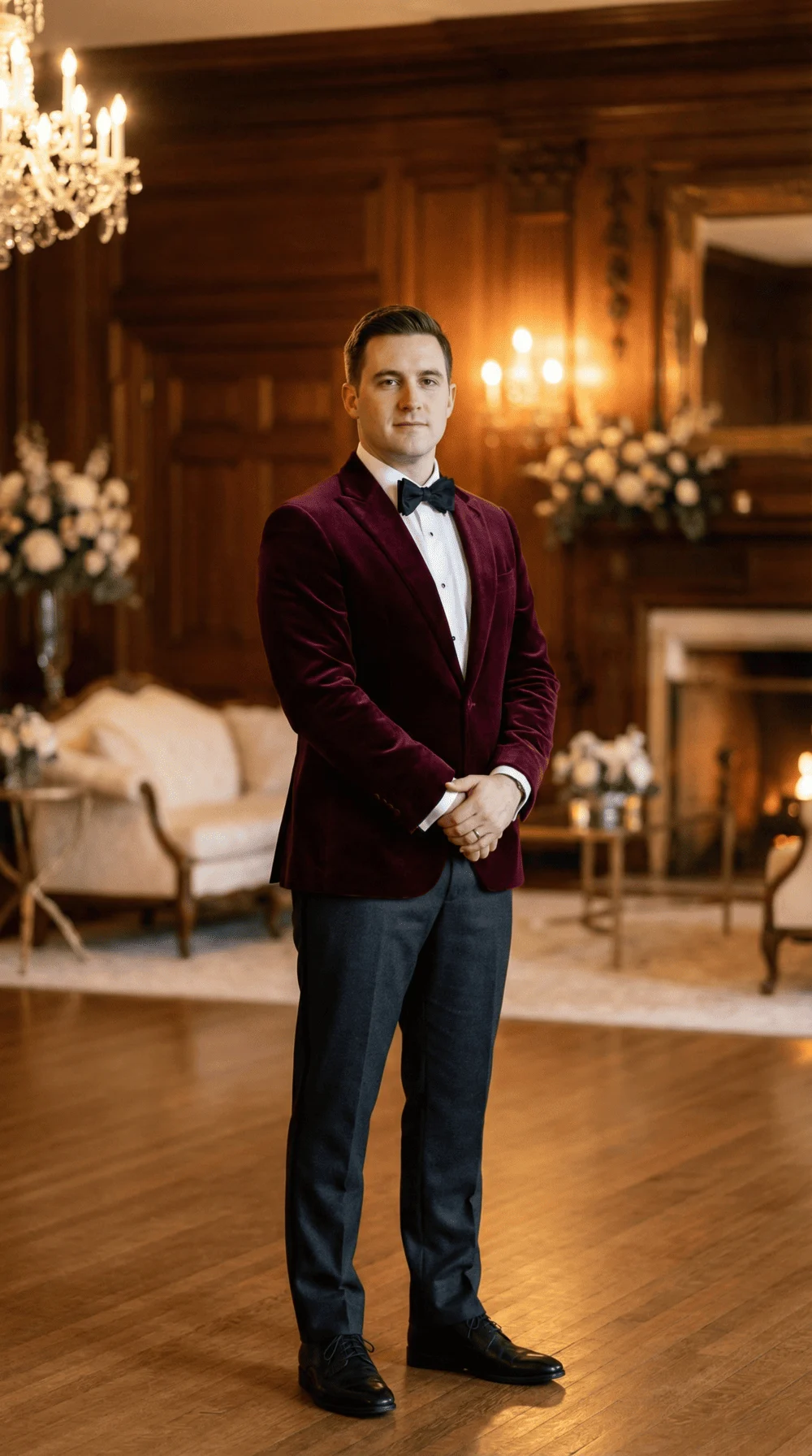
- Velvet jackets: Deep green, burgundy, or midnight blue velvet jackets paired with wool trousers create a "separates" look that's elegant yet distinct. This is particularly effective for grooms who want to stand out from their groomsmen without resorting to different colors. The velvet jacket catches light differently than wool, creating visual interest in photographs and adding a luxurious, tactile element.
- For body types: Velvet's dense pile adds some visual bulk, making it excellent for rectangle and triangle shapes who want to add dimension to their upper body. Inverted triangle and oval shapes should use velvet sparingly-perhaps a velvet bow tie or pocket square rather than a full jacket.
- Corduroy sophistication: Fine-wale corduroy suits offer a tactile richness that photographs exceptionally well. The subtle ribbing creates texture without pattern, providing visual interest while maintaining formality. Corduroy has shed its casual, professorial associations and emerged as a sophisticated choice for autumn and winter weddings.
- Application for Australian climate: These textured fabrics work best for cooler months (May-September) and evening events. A velvet jacket at a June wedding in Melbourne or a corduroy suit at an August celebration in the Blue Mountains provides both warmth and style. For warmer climates or daytime events, these fabrics can be overwhelming.
8.3. The return of the double-breasted jacket
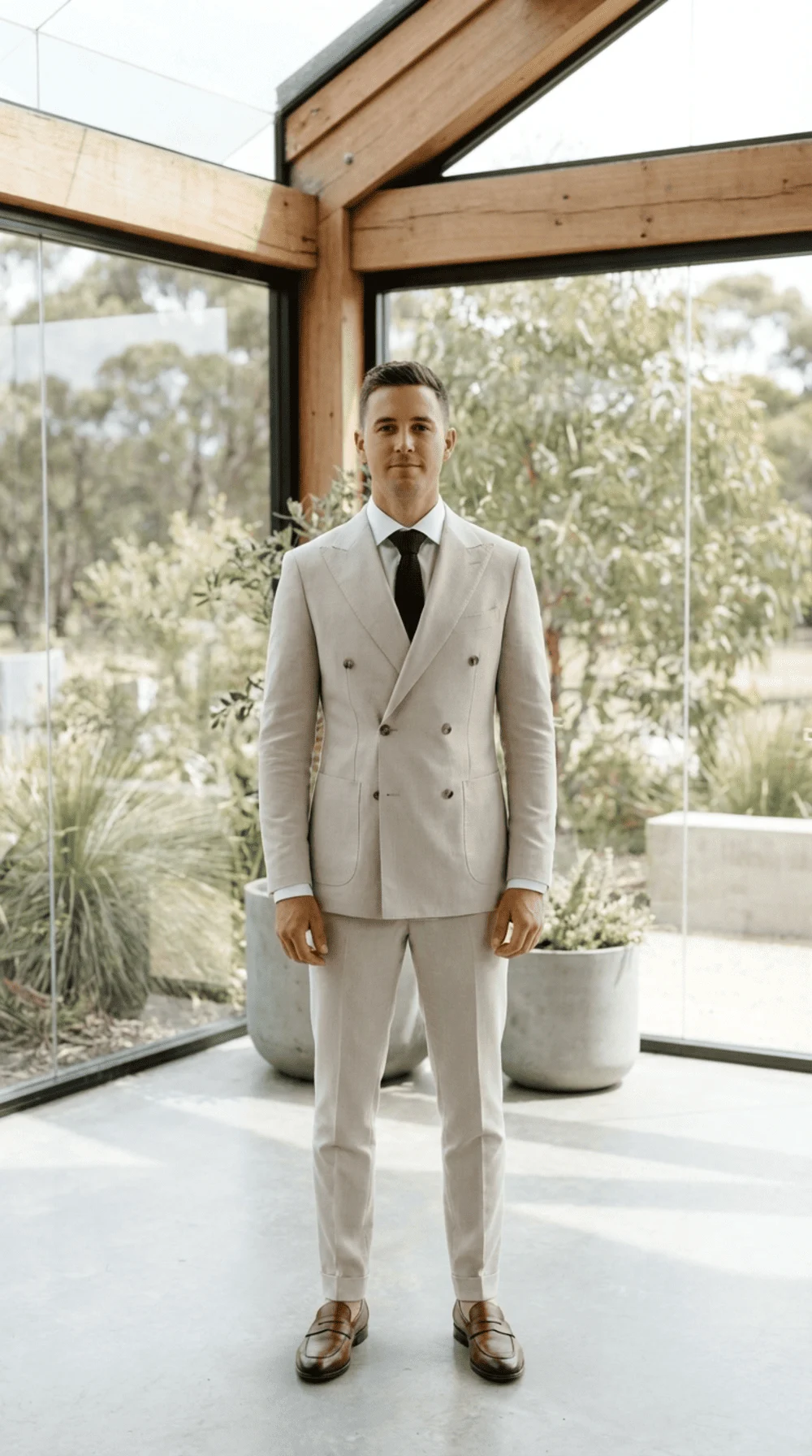
Once maligned as a relic of 1980s corporate excess, the double-breasted jacket has been rehabilitated through modern tailoring. The contemporary Australian double-breasted is cut slim, shorter, and softer than its predecessors.
- Why now: The double-breasted jacket offers instant formality and visual authority. For grooms, wearing a double-breasted suit while groomsmen wear single-breasted creates subtle but powerful differentiation. It signals "I'm the groom" without resorting to different colors or styles.
- Body type considerations: Double-breasted works exceptionally well for rectangle body types, adding width to the chest and shoulders. It can work for trapezoid builds as well, enhancing their natural proportions. However, triangle and oval shapes should approach double-breasted cautiously-the overlapping fabric can add unwanted bulk to the midsection. Inverted triangle builds can wear double-breasted but should ensure the lapels are wide enough to balance their broad shoulders.
- Australian styling: For Australian weddings, a double-breasted jacket in a lighter fabric (linen, cotton blend, lightweight wool) maintains the formality while accommodating our climate. A beige or light grey double-breasted suit for a summer wedding creates sophisticated elegance without the stuffiness of traditional dark double-breasted styles.
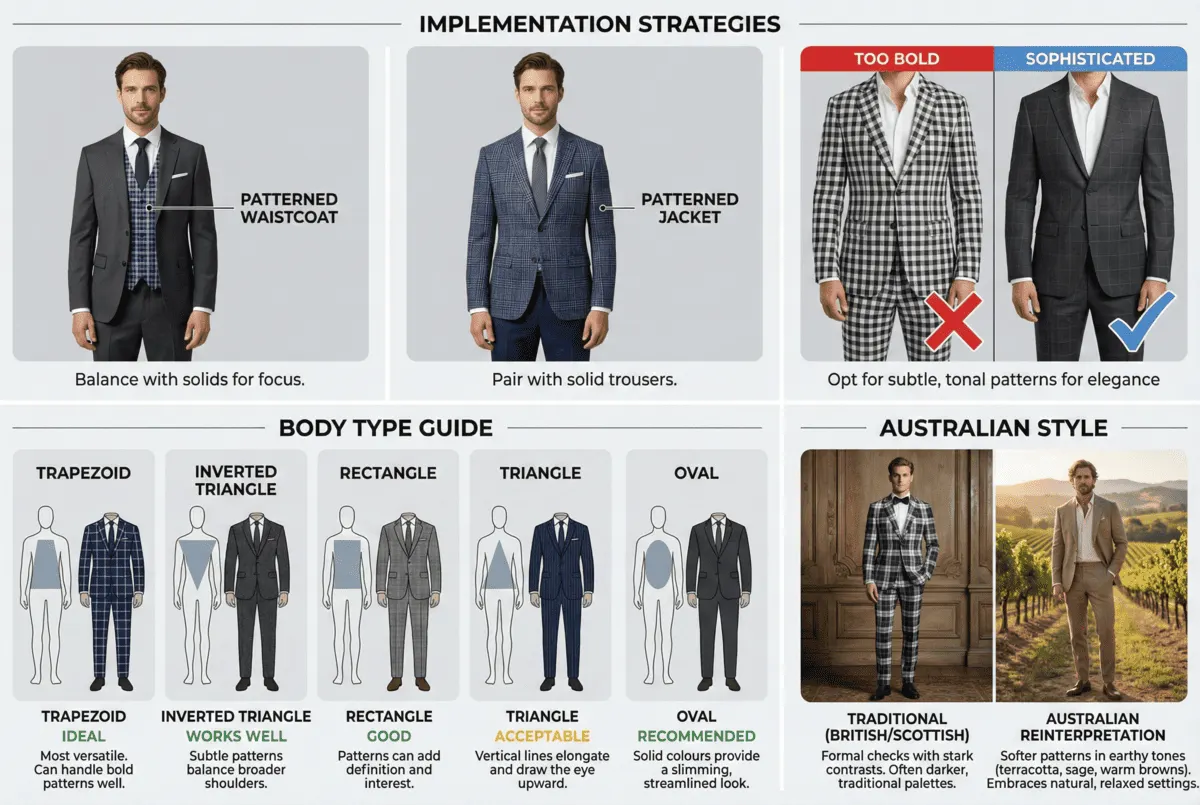
8.4. Pattern play: checks and plaids
Subtle checks, windowpanes, and Prince of Wales plaids are gaining traction as grooms seek to add personality without sacrificing sophistication.
- Implementation: A groom might wear a three-piece suit where the waistcoat is checked while the jacket and trousers are solid. Or a checked jacket with solid trousers creates a "mix and match" aesthetic that's central to the relaxed formality trend. The key is subtlety-bold, contrasting checks can look costume-like, while tonal or subtle patterns add interest without overwhelming.
- Body type applications: Patterns work best on trapezoid and inverted triangle builds who don't need to create optical illusions. Rectangle shapes can use patterns strategically to add visual interest. Triangle and oval shapes should stick to subtle, vertical patterns or solid colors to maintain a slimming effect.
- Australian context: Checks and plaids have a heritage association with British and Scottish tailoring, but they're being reinterpreted through an Australian lens. Softer, more relaxed patterns in earthy tones rather than stark contrasts create a look that's sophisticated without being stuffy.
8.5. Sustainability and eco-conscious fabrics
A growing segment of the Australian wedding market is prioritizing environmental responsibility, influencing fabric choices and purchasing decisions.
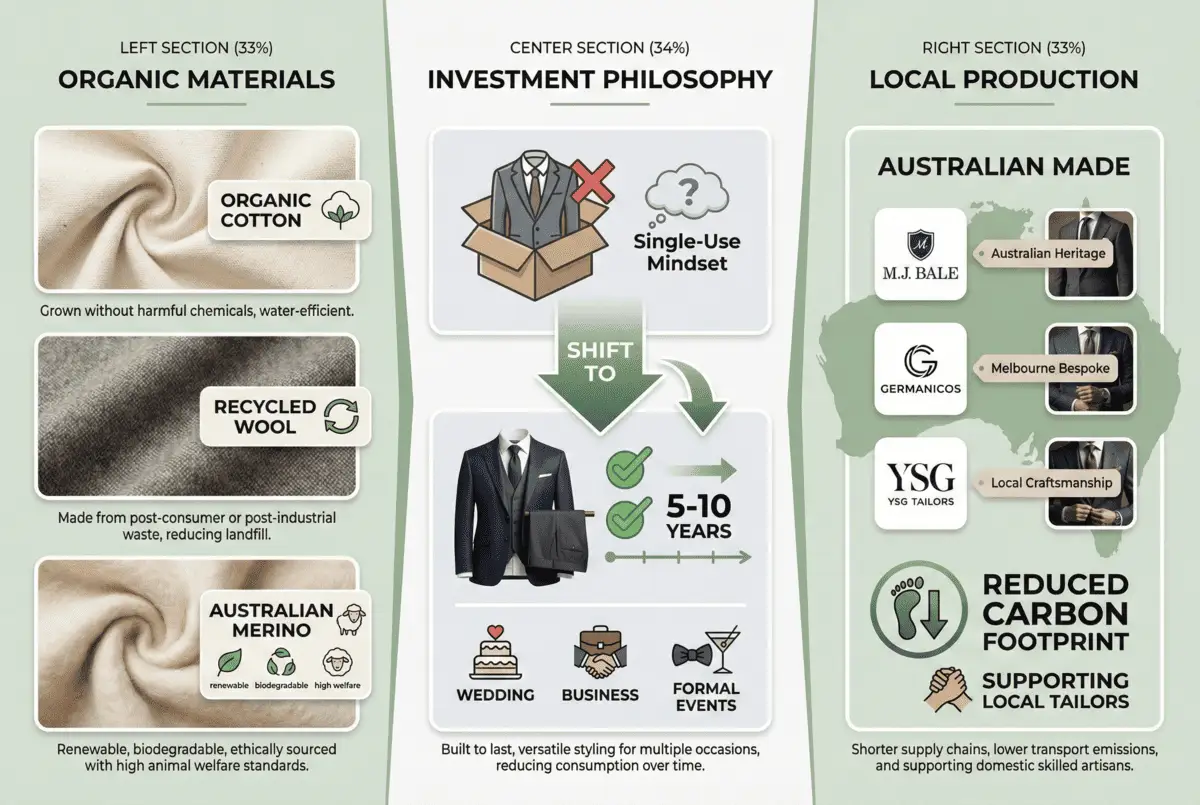
- Organic and recycled materials: Organic cotton, recycled wool blends, and ethically sourced Merino wool are gaining preference. Australian Merino wool, in particular, has strong sustainability credentials-it's renewable, biodegradable, and often produced with high animal welfare standards.
- The investment suit philosophy: This trend aligns with the broader shift away from single-use wedding attire toward investment pieces. The average Australian groom views his wedding suit as a long-term wardrobe addition, not a costume for one day. This drives choices toward versatile colors (navy, charcoal, grey) and high-quality fabrics that will last for years.
- Local production: There's increasing interest in locally produced suits, supporting Australian tailors and reducing carbon footprint. Brands like M.J. Bale emphasize their Australian heritage and local production, while bespoke tailors like Germanicos and YSG Tailors offer locally crafted garments.
9. Fabric engineering for Australian climate
Australia's vast geographic and climatic diversity means that "summer wedding" can denote the dry, scorching heat of South Australia (40°C+) or the suffocating humidity of tropical Queensland (30°C with 90% humidity). Fabric selection must be engineered for these specific thermal loads while maintaining the formality required for wedding occasions.
9.1. Understanding the hierarchy of breathability
Thermal comfort in suiting is determined by three factors: fiber type, weave structure, and fabric weight. Understanding these allows you to choose fabrics that keep you comfortable without sacrificing style.
9.1.1. Linen: The champion of high heat
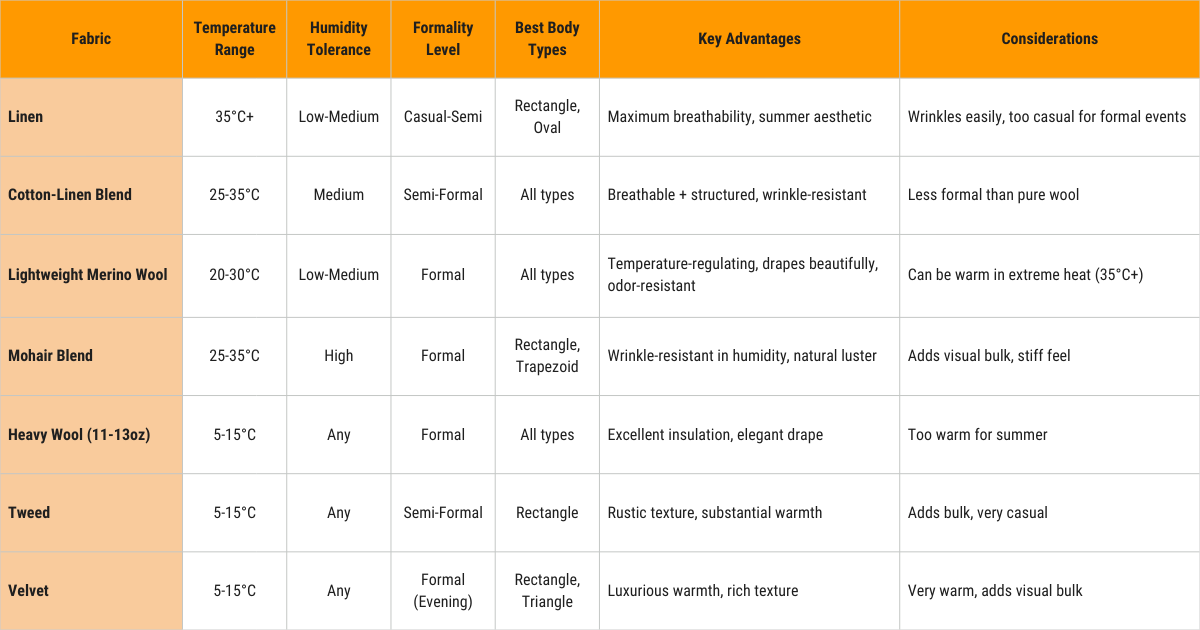
Linen, made from flax fibers, is the most breathable natural fabric available. The fiber itself is highly conductive, moving heat away from your body, and the traditional weave is naturally open, allowing maximum airflow.
- Pros: Unmatched breathability, distinctive summer aesthetic, lightweight, and comfortable in extreme heat. For beach weddings, outdoor ceremonies in Queensland or Northern Territory, or any event in temperatures above 35°C, linen is often the only comfortable choice.
- Cons: Creases instantly and dramatically. This "spezzatura" (studied carelessness) is acceptable and even desirable for beach weddings or garden parties, but it may look disheveled in formal church settings or evening receptions where crisp lines are expected.
- Body type considerations: Linen's natural texture adds visual dimension, making it excellent for rectangle body types. The fabric's tendency to drape loosely works well for oval shapes, as it doesn't cling to the midsection. However, inverted triangle builds should be cautious-loose linen can add bulk to an already substantial upper body.
- Australian application: Linen suits in light colors (stone, light grey, sage) are perfect for daytime summer weddings in coastal or tropical locations. For evening events or more formal venues, consider linen-cotton blends that offer breathability with more structure.
9.1.2. Cotton-linen blends: The practical compromise
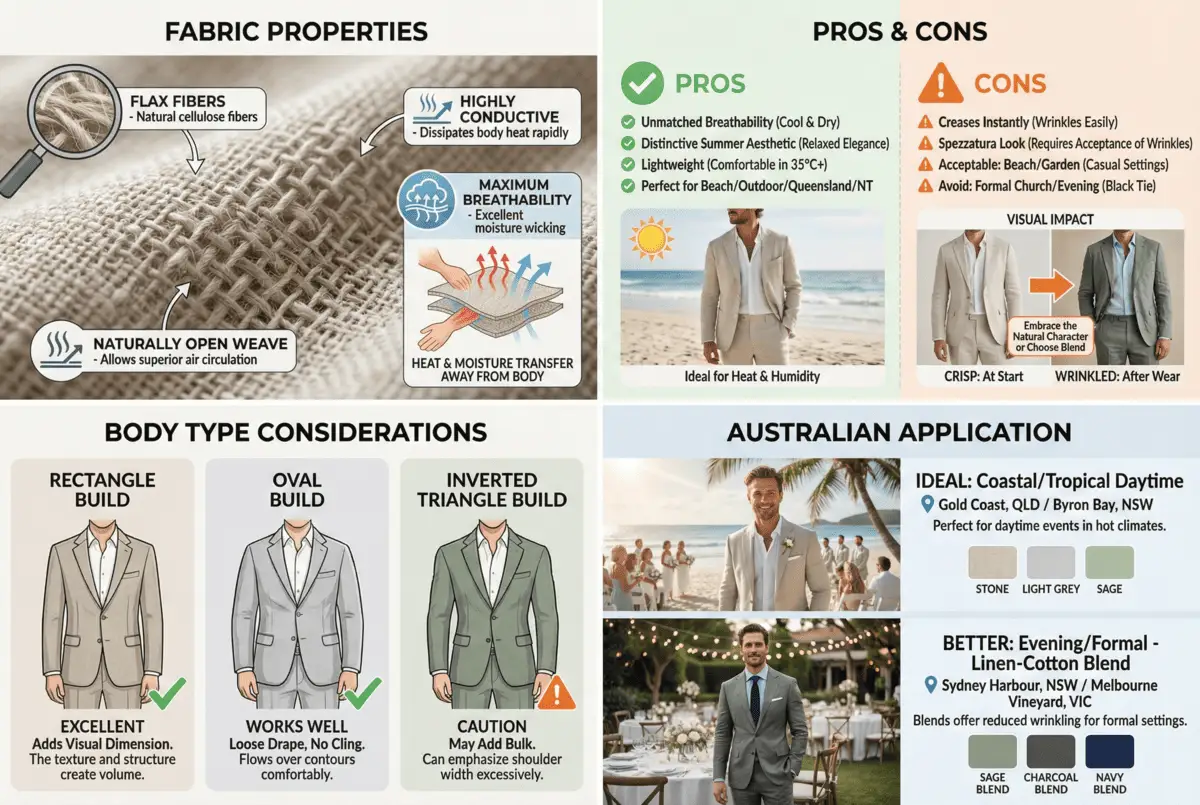
Blending cotton with linen creates a fabric that offers linen's breathability with cotton's structure and wrinkle resistance.
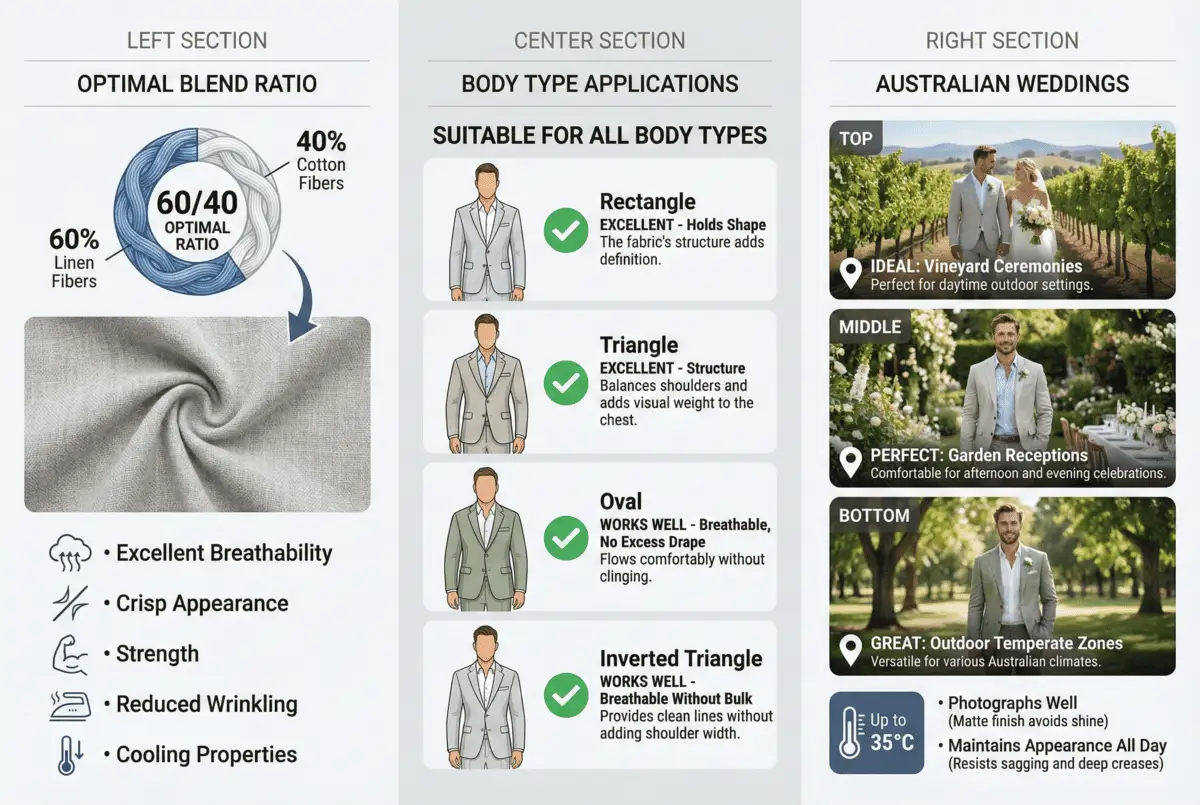
- Optimal ratios: A 60/40 linen-cotton blend provides excellent breathability while maintaining a crisp appearance. The cotton fibers add strength and reduce wrinkling, while the linen provides cooling properties.
- Body type applications: The added structure of cotton makes these blends suitable for all body types. Rectangle and triangle shapes benefit from the fabric's ability to hold shape, while oval and inverted triangle builds appreciate the breathability without excessive draping.
- Australian weddings: These blends are ideal for the majority of Australian summer weddings-vineyard ceremonies, garden receptions, outdoor celebrations in temperate zones. They photograph well, maintain their appearance throughout the day, and keep you comfortable in temperatures up to 35°C.
9.1.3. Australian Merino wool: The unexpected summer choice
Contrary to popular belief, wool can be excellent for summer if the weight is correct. Australian Merino wool, in particular, has unique properties that make it suitable for warm-weather weddings.
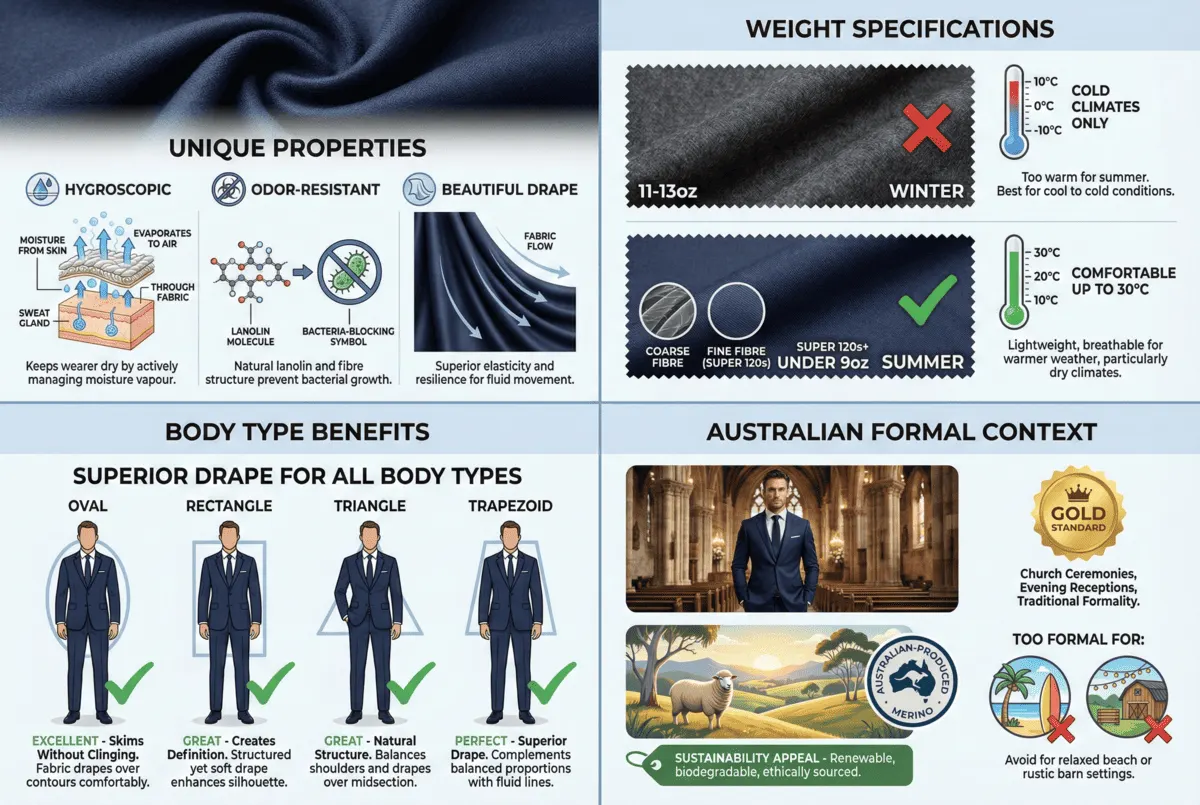
- Properties: Merino wool is hygroscopic, meaning it absorbs moisture vapor from your skin and releases it into the air. This keeps you feeling dry even when you're sweating. It's also naturally odor-resistant (the lanolin in wool inhibits bacterial growth) and drapes beautifully, creating a polished appearance.
- Weight matters: For summer weddings, choose Super 120s or finer wool in weights under 9 ounces. These lightweight wools are breathable and comfortable in temperatures up to 30°C, particularly in dry climates.
- Body type benefits: Wool's superior drape makes it excellent for all body types. Oval shapes particularly benefit from wool's ability to skim over the body without clinging. The fabric's natural structure helps rectangle and triangle shapes create definition.
- Australian context: Merino wool is the gold standard for formal weddings where linen might be too casual. Church ceremonies, evening receptions, or any event requiring traditional formality calls for wool. Australian-produced Merino wool also appeals to sustainability-conscious grooms.
9.1.4. Mohair blends: The humidity solution
Mohair, made from Angora goat hair, is often blended with wool to create a fabric that excels in humid conditions.
- Properties: Mohair has a high natural luster (shine), creating an elegant appearance. The fiber is stiff, which resists wrinkling-crucial in humid climates where other fabrics wilt. The weave is naturally open, providing excellent airflow.
- Ideal conditions: Mohair blends are perfect for humid summer weddings in Queensland, coastal New South Wales, or tropical Northern Territory. The fabric maintains a crisp line even in 90% humidity, where cotton and linen would be limp.
- Body type considerations: The fabric's stiffness and luster can add visual bulk, making it less ideal for inverted triangle builds. However, rectangle and trapezoid shapes benefit from the structure and sheen.
- Australian application: A mohair-wool blend suit in navy or charcoal is excellent for evening summer weddings in humid climates. The luster photographs beautifully, and the wrinkle resistance ensures you look sharp from ceremony through reception.
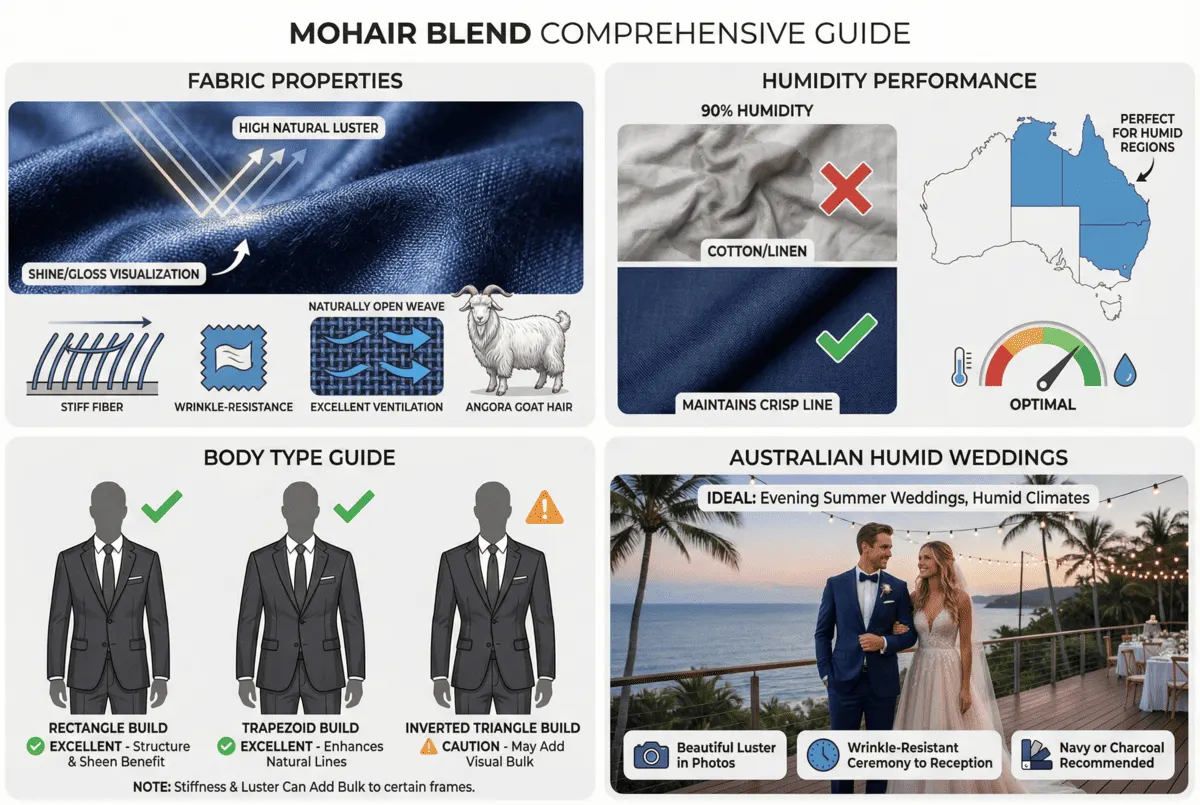
9.2. Winter wedding fabrics
Australian winters, particularly in southern regions, require substantial warmth without sacrificing elegance.
- Heavy Merino wool: Wool in weights of 11-13 ounces provides excellent insulation while maintaining breathability. This is ideal for winter weddings in Melbourne, Canberra, or Tasmania, where temperatures can drop to single digits.
- Tweed: This heavy, textured fabric offers rustic elegance perfect for country weddings or heritage venues. Herringbone tweed or Donegal tweed adds visual interest and substantial warmth. Body type note: Tweed's texture adds bulk, making it excellent for rectangle shapes but potentially overwhelming for inverted triangle or oval builds.
- Velvet: For evening winter weddings, velvet provides luxurious warmth and rich texture. The dense pile traps air, creating insulation, while the fabric's luster creates visual drama in low light.
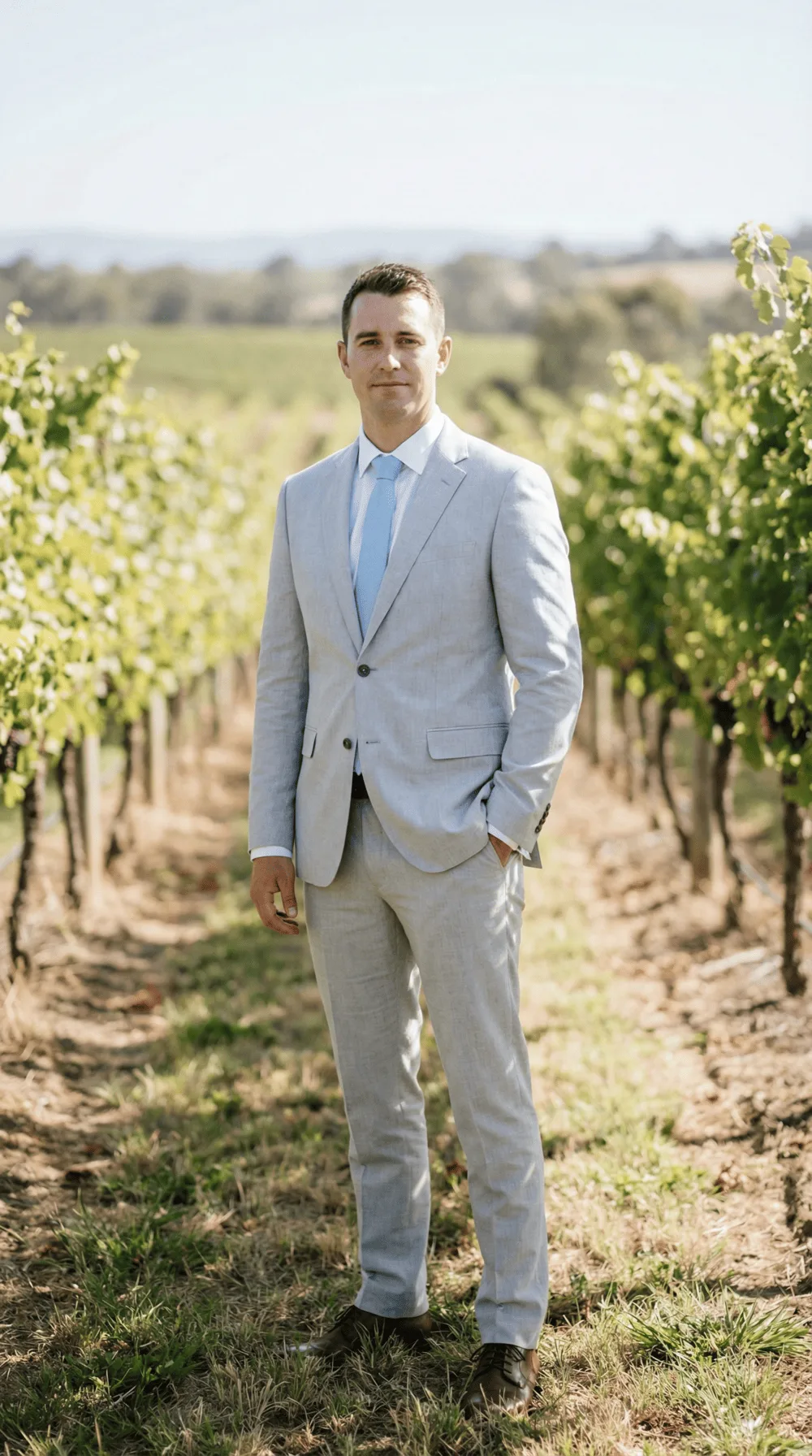
9.3. Internal construction: Canvas vs fused
The hidden architecture of your suit affects breathability and comfort as much as the outer fabric.
- Fused construction: Common in budget suits, this involves gluing a layer of interlining to the fabric. It's non-breathable and can bubble (delaminate) in high heat or after dry cleaning. Avoid fused construction for Australian weddings, particularly summer events.
- Canvas construction: A floating canvas layer (horsehair or wool) is sewn between the outer fabric and lining. This creates structure while allowing air circulation. The canvas molds to your body over time, improving fit with wear.
- Recommendation: Insist on at least half-canvas construction (canvas from shoulders to chest). Full canvas is ideal but significantly more expensive. The breathability difference is substantial-in Australian summer heat, a canvas suit can be 3-5°C cooler than a fused suit.
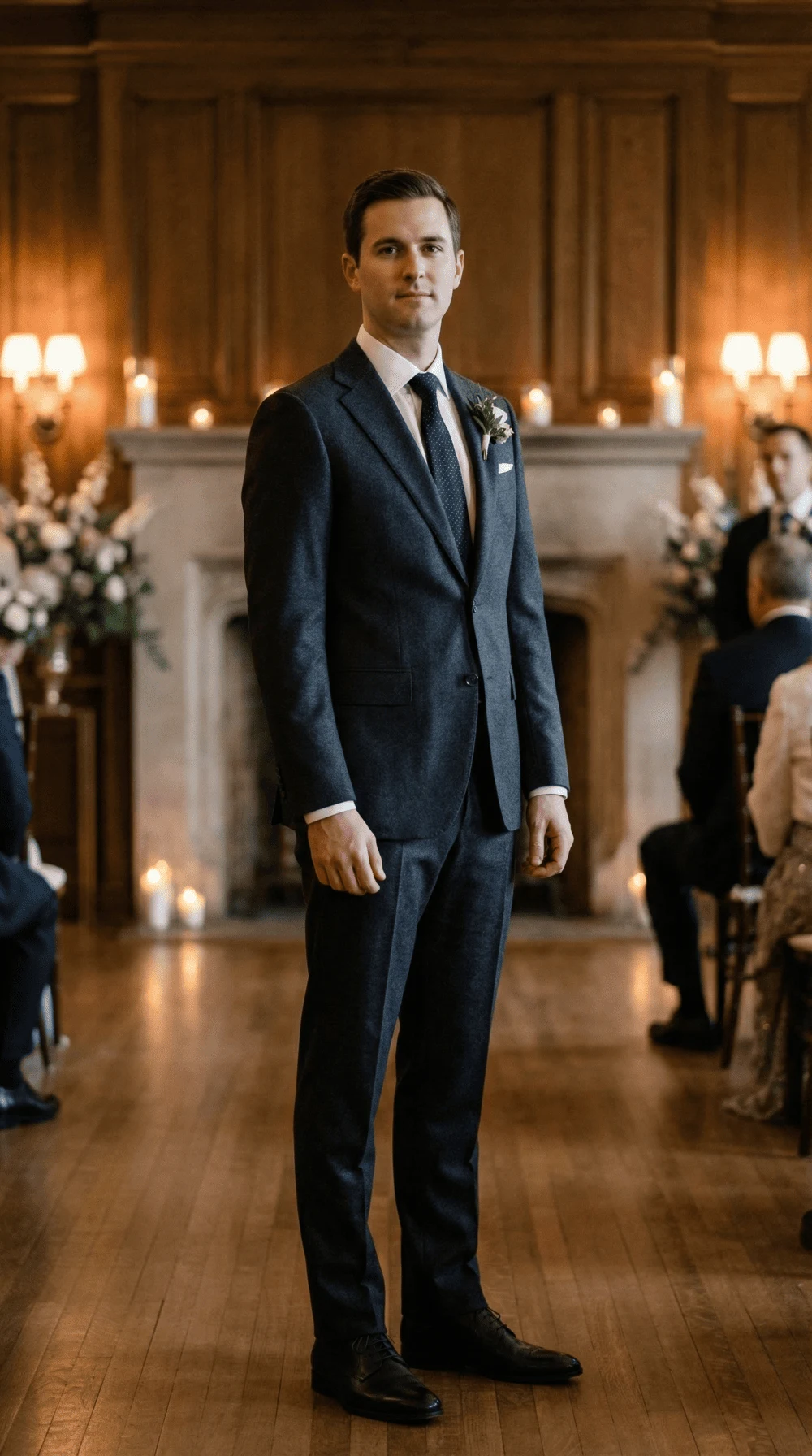
10. Role-specific styling strategies
Different roles in a wedding carry different expectations and requirements. Understanding these nuances ensures you're appropriately dressed while optimizing for your body type.
10.1. The groom: Standing out with sophistication
As the groom, you're the protagonist of the day. Your suit should differentiate you from the bridal party and guests while maintaining cohesion with the overall aesthetic.
Differentiation tactics:
- The three-piece advantage: Wearing a three-piece suit while your groomsmen wear two-piece creates immediate visual distinction. The waistcoat adds formality and allows you to remove your jacket during the reception while still looking polished. For body types: Rectangle and triangle shapes particularly benefit from the waistcoat's ability to create waist definition.
- Texture contrast: You wear velvet while groomsmen wear wool. You wear herringbone while they wear solid. This creates distinction through tactile difference rather than color, maintaining a cohesive look while clearly identifying you as the groom.
- Lapel variation: You wear peak lapels (more formal) while groomsmen wear notch lapels. This subtle difference signals hierarchy without being obvious. Peak lapels also photograph beautifully, drawing the eye upward and creating a strong shoulder line.
- Color depth: If the bridal party is wearing sage green, you wear a deeper, richer shade of the same color. If they're in light grey, you're in charcoal. This maintains color coordination while creating visual separation.
- The two-shirt strategy: Professional stylists recommend grooms purchase two identical shirts. Change into a fresh, crisp shirt halfway through the reception (usually after dinner, before dancing). This ensures you look immaculate in late-night photos when everyone else is showing signs of wear. For Australian summer weddings, this is particularly valuable-a fresh shirt eliminates any sweat stains or wilting from the ceremony and photos.
- Body type optimization: As the groom, you have the budget and justification to invest in perfect fit. Whether that's made-to-measure, bespoke, or extensive alterations to ready-to-wear, your suit should be optimized for your specific body type using all the strategies outlined in previous sections.
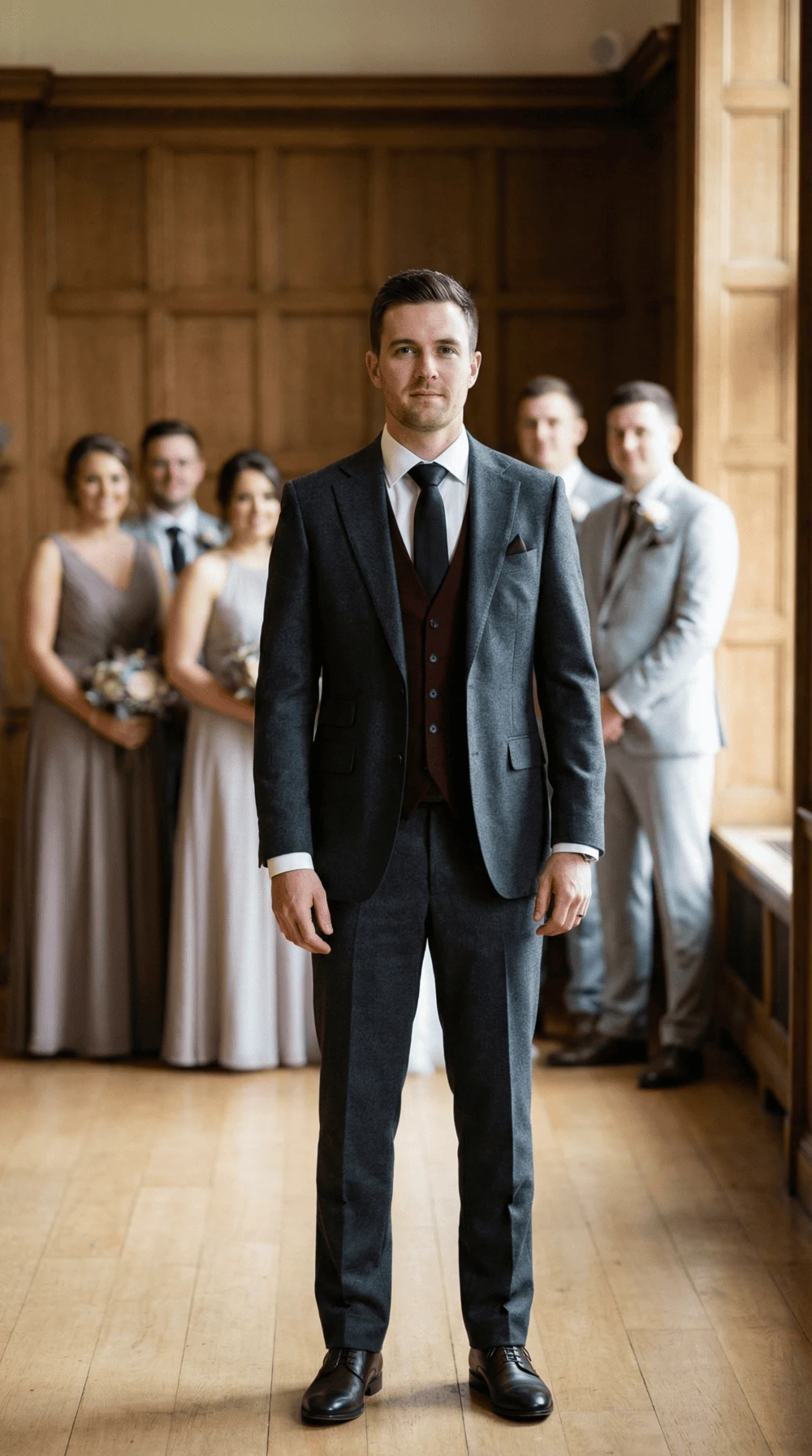
10.2. The groomsmen: Cohesive yet individual
Groomsmen face the challenge of looking coordinated while accommodating diverse body types within the group.
- Uniformity vs individuality: The trend is moving away from identical "rent-a-tux" looks toward "tonal" dressing-groomsmen wearing different shades of the same color family or different cuts of the same fabric. This allows for body-type-specific tailoring while maintaining visual cohesion.
- For example: All groomsmen wear the same fabric (navy wool), but the rectangle-shaped groomsman has shoulder padding and waist suppression, the inverted triangle groomsman has soft shoulders and fuller trouser thighs, and the oval-shaped groomsman has a longer jacket and mid-rise trousers. In photos, they look coordinated because the fabric and color match, but each man looks his best because the cut addresses his specific anatomy.
- Financial considerations: Groomsmen typically pay for their own suits, so selecting a versatile color (charcoal, navy, mid-grey) ensures they get value from the purchase. A suit that works for this wedding should also work for future formal events, job interviews, and business meetings.
- Made-to-measure for groups: Services like InStitchu and Oscar Hunt specialize in bridal parties, offering group discounts and coordinated fittings. This solves the mixed-body-type challenge-everyone gets a suit tailored to their proportions in the same fabric and style. The investment is worthwhile because each groomsman ends up with a suit that actually fits, rather than a rental that fits no one well.
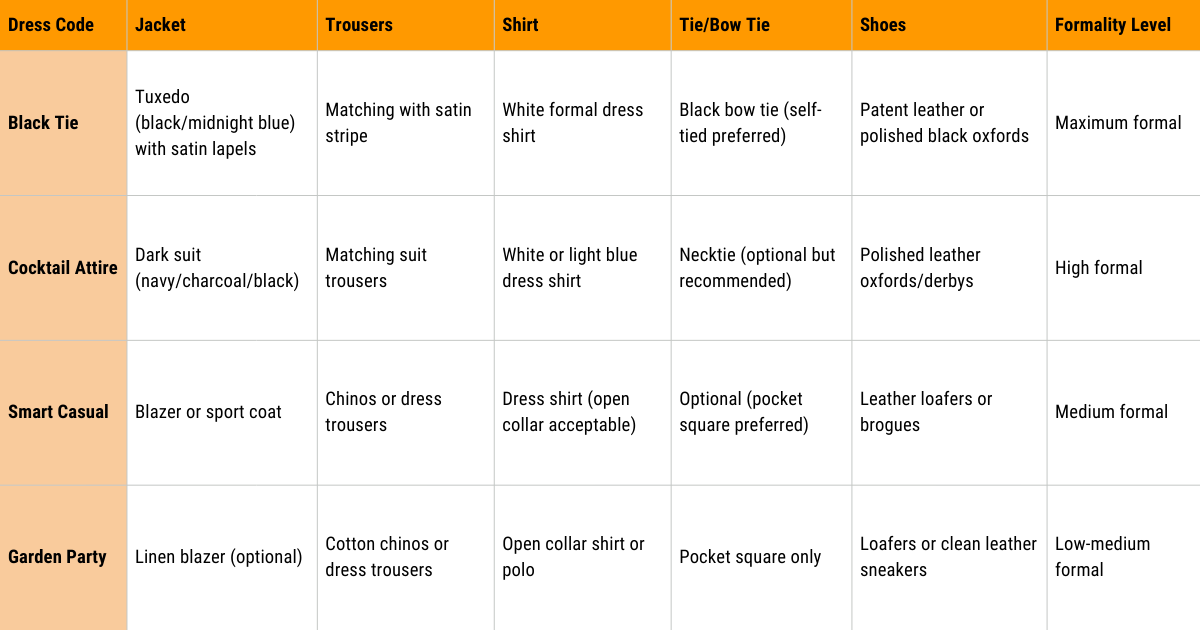
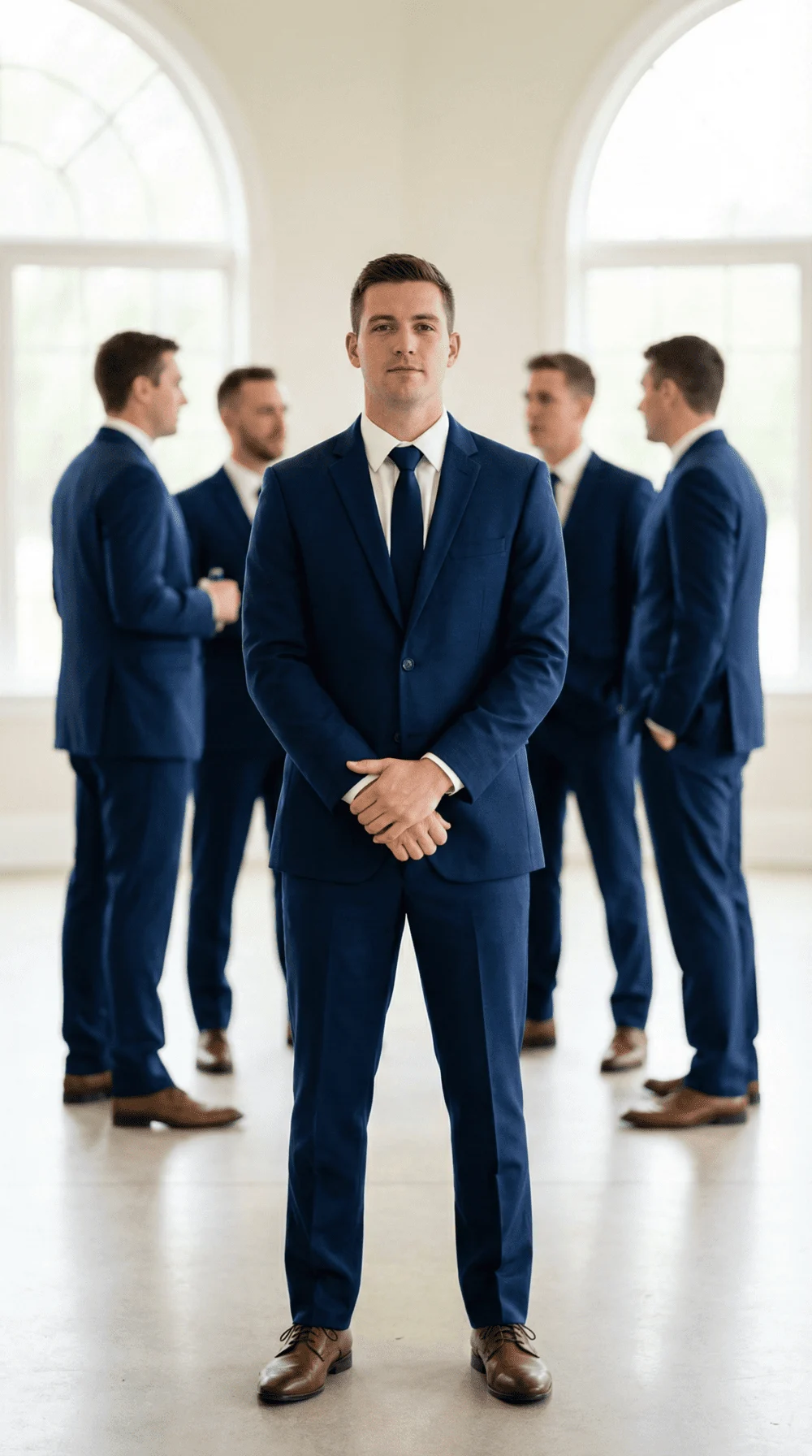
10.3. The guest: Respectful and appropriate
Wedding guests must balance looking polished with not upstaging the bridal party.
Decoding dress codes:
- Black tie: Non-negotiable tuxedo requirement. Black or midnight blue dinner jacket with satin lapels, matching trousers with satin stripe, bow tie (self-tied preferably), and patent leather or highly polished black oxfords.
- Body type note: Tuxedos typically come in slim or classic fit-choose based on your body type, not fashion trends.
- Cocktail attire: A dark suit (navy, charcoal, or black) is the safe choice. Separates (structured blazer with dress trousers) are acceptable if the blazer is tailored and shoes are polished leather. This is where body-type-specific styling shines-you can choose cuts and colors that flatter your build without coordinating with others.
- Smart casual / Garden party: Chinos or dress trousers with a blazer and open-collar shirt. Ties are optional, but a pocket square elevates the look. For Australian garden weddings, this might mean a linen blazer with cotton chinos in complementary earthy tones.
- Fabric etiquette: Don't wear a tuxedo to a beach wedding (unless specified) and don't wear linen to a black-tie event. Match your fabric formality to the occasion. When in doubt, err on the side of slightly more formal.
- Color considerations: Avoid wearing white, cream, or anything that could be mistaken for bridal colors. Avoid matching the bridal party colors exactly-if you know the groomsmen are wearing sage green, choose a different color entirely. Stick to classic neutrals (navy, grey, charcoal) or complementary colors that won't clash with the wedding palette.
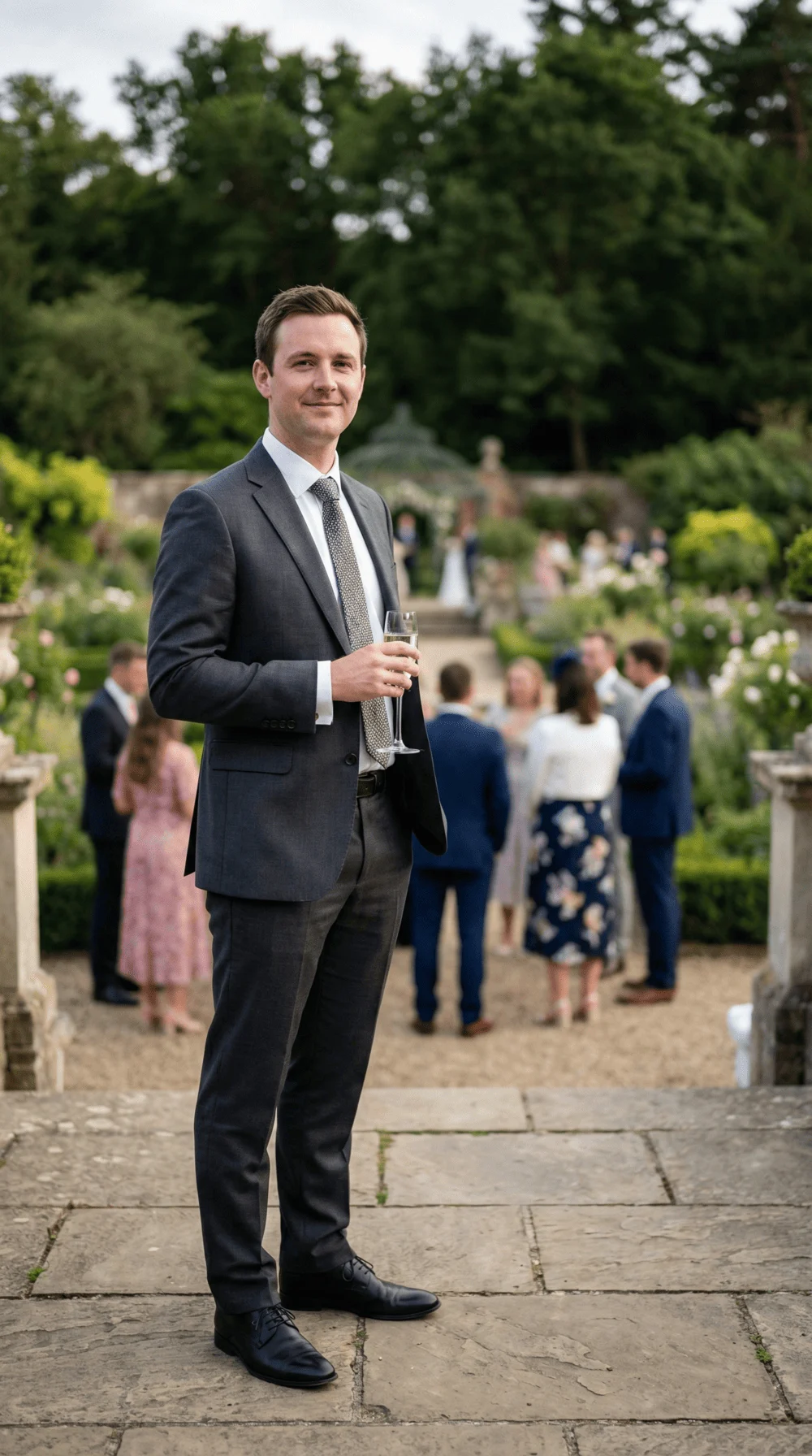
11. The made-to-measure advantage
The most significant structural shift in the Australian wedding market over the past decade has been the transition from rental to ownership, and specifically, to made-to-measure tailoring. This democratization of custom fit has transformed wedding suiting from a one-size-fits-all commodity into a personalized experience accessible to the mid-market.
11.1. The psychology of the investment suit
Unlike North American traditions where rental tuxedos dominate, the Australian groom typically purchases his wedding suit. This cultural difference has profound implications for how men approach wedding attire.
- The 32-year-old groom: The average Australian groom is approximately 32 years old and financially established. He's likely a professional with a career that requires formal wear occasionally. He views his wedding suit not as a sunk cost for a single day but as a capital expenditure that should yield returns through future use-business meetings, other weddings, formal events, job interviews.
- Long-term value: This investment mindset drives choices toward versatile colors (navy, charcoal, mid-grey) and high-quality fabrics (Australian Merino wool, quality linen blends) that have longevity. A well-made suit in a classic color can serve a man for 5-10 years, making the per-wear cost remarkably low compared to rental.
- Quality over quantity: The investment approach also means grooms are willing to spend more on a single, perfect suit rather than buying multiple cheaper options. This willingness to invest has fueled the growth of made-to-measure services that offer bespoke-quality fit at accessible price points.
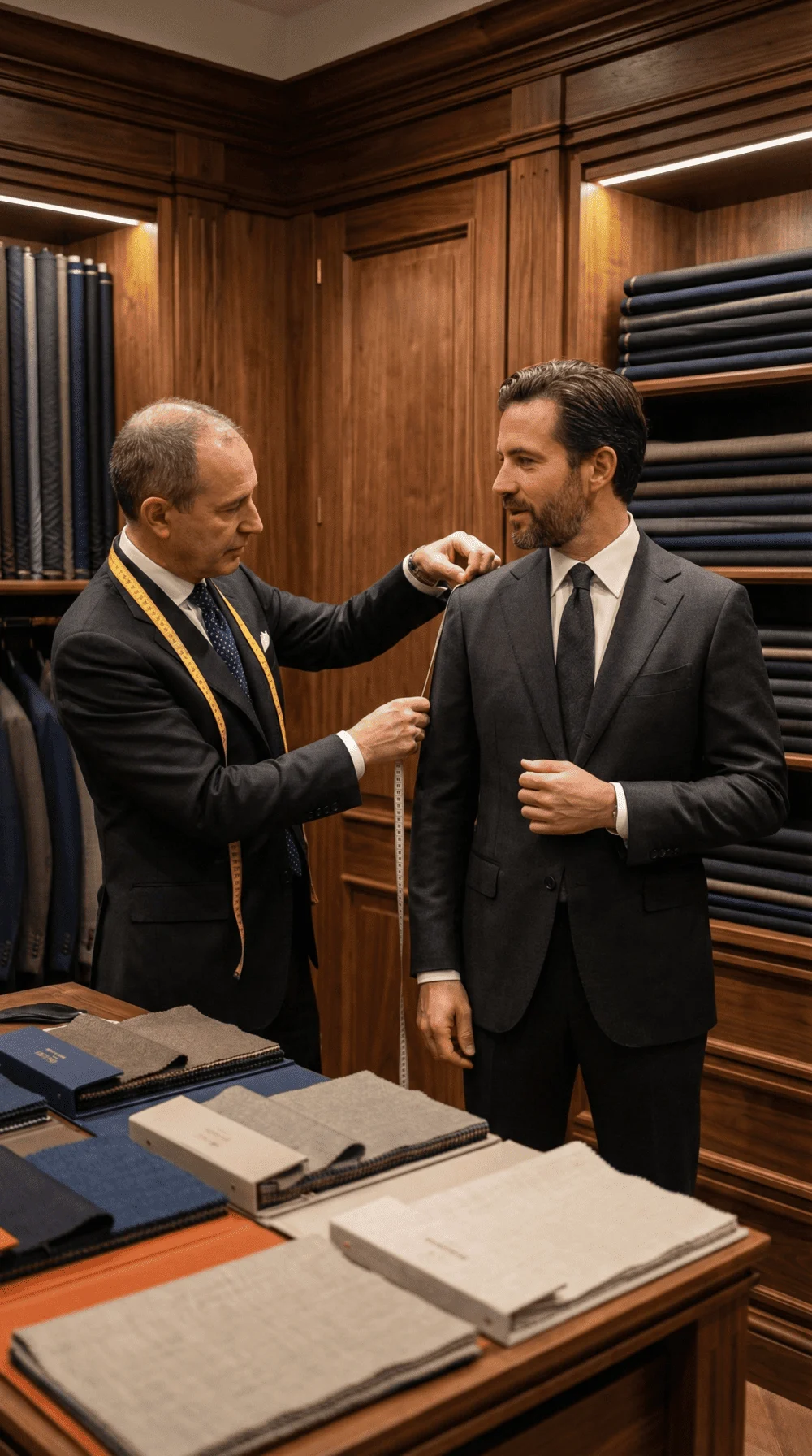
11.2. The made-to-measure process
Understanding the MTM workflow is essential for timeline planning and managing expectations.
Step 1: Consultation (3-6 months before wedding): You meet with a stylist to select fabrics, buttons, linings, and lapel styles. This is where body type considerations become critical. A good stylist will assess your proportions and recommend cuts, structures, and details that flatter your specific build.
Measurements are taken using a master garment as a baseline-you try on sample jackets to determine your starting size, then the stylist takes 15-25 measurements to customize the pattern. For body types with extreme proportions (high drops for inverted triangle, significant waist-hip difference for triangle), this consultation is where you communicate your specific needs.
Step 2: Construction (6-8 weeks): Your garment is crafted, often in specialized facilities in Shanghai, Portugal, or Italy, depending on the brand. Some Australian tailors (Germanicos, YSG Tailors) produce locally, which can reduce timeline but may increase cost.
During construction, your measurements are translated into a unique pattern. For mixed body types in bridal parties, this is where the magic happens-each groomsman's suit is cut to his specific proportions while using the same fabric and style, ensuring cohesion with individual optimization.
Step 3: First fitting (4-6 weeks before wedding): You try on the constructed garment. This is where drop issues, sleeve lengths, and trouser breaks are assessed. It's rare for a suit to be perfect at this stage-adjustments are expected and normal.
For body types requiring significant alterations (rectangle shapes needing waist suppression, oval shapes needing length adjustments), this fitting is crucial. Be honest about comfort and appearance. If something doesn't feel right, speak up-this is your opportunity to refine the fit.
Step 4: Final polish (2-3 weeks before wedding): After in-house alterations, you try on the suit again for final checks. The tailor assesses drape, comfort, and overall appearance. Minor tweaks might still be made-a sleeve shortened by 5mm, a trouser hem adjusted slightly.
Total timeline: A safe buffer is 3 months from first consultation to wedding day, though 6 months is recommended for bridal parties to accommodate potential delays or multiple fittings.
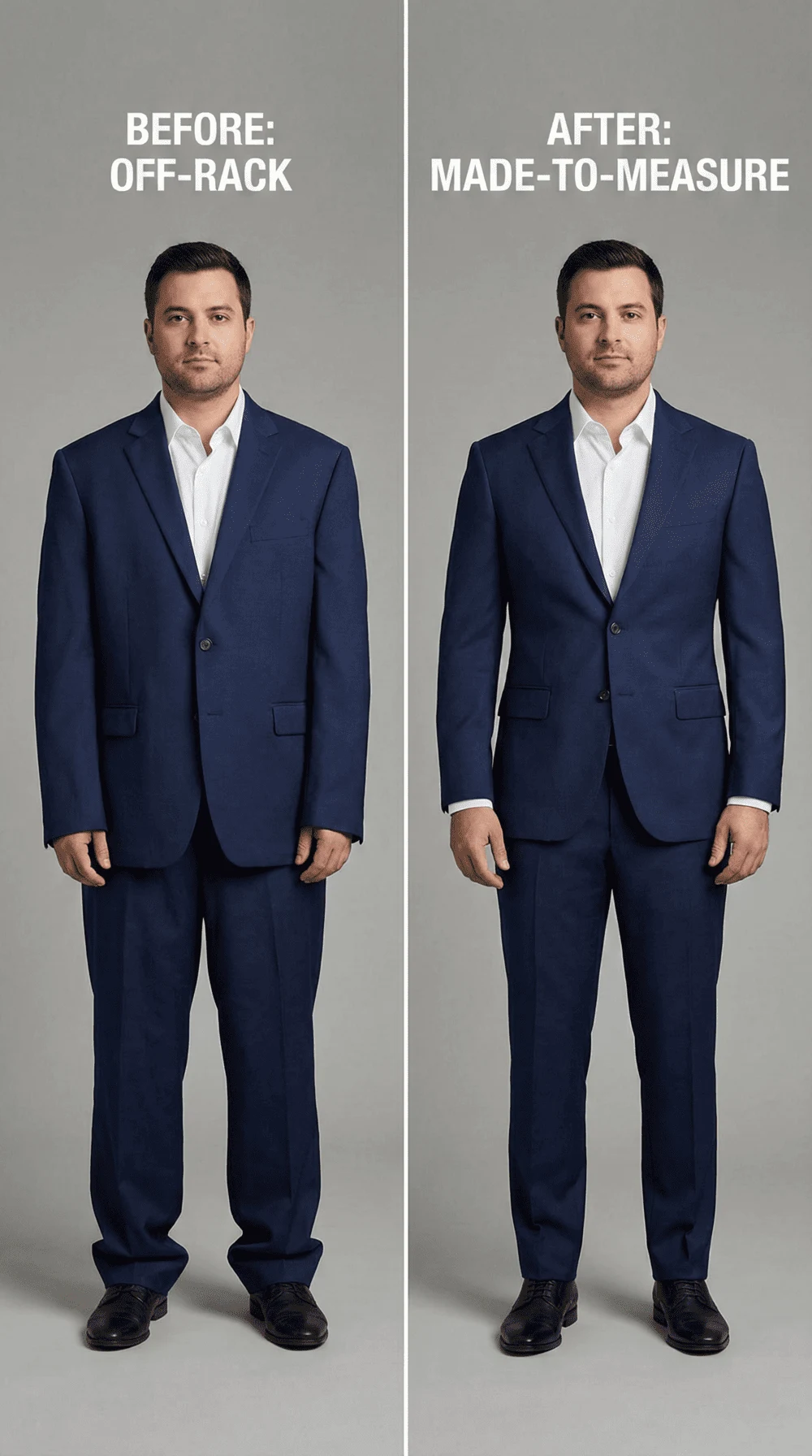
11.3. Solving the mixed body type bridal party
One of the most common stressors for grooms is coordinating a bridal party that includes diverse body types-the tall, lean best man; the shorter groomsman; the athletic brother; and the friend who carries weight around the middle.
The MTM solution: Made-to-measure allows the fabric to be the unifier while the cut is individualized. Everyone wears the same navy wool, but:
- The inverted triangle groomsman gets a jacket with wider lapels, soft shoulders, and roomier thighs in his trousers.
- The oval groomsman gets a single-breasted jacket with a lower button stance, longer length, and trouser buttons for braces.
- The short groomsman gets a jacket with a higher button stance, shorter length, and trousers with no break.
- The rectangle groomsman gets shoulder padding, aggressive waist suppression, and a double-breasted option if desired.
Result: In photos, the party looks cohesive because the fabric, color, and overall style are identical. But each man looks his best because the fit addresses his specific anatomy. This is the power of made-to-measure-uniformity where it matters (aesthetics) and individuality where it counts (fit).
11.4. Australian MTM vendor landscape
The Australian market offers several excellent made-to-measure options, each with distinct positioning and value propositions.
1. Dunnio Tailor (exceptional value with expert body-type specialization): Dunnio Tailor delivers bespoke-quality tailoring at accessible prices ($144-600 depending on design and fabric). Our master tailors have developed specific expertise in each of the five body types, with proprietary techniques for rectangle shoulder construction, triangle shoulder reconstruction, inverted triangle drop accommodation, oval vertical elongation, and trapezoid refinement. We take 25+ measurements including shoulder slope, arm pitch, posture variations, and stance-data points that generic MTM services miss.
Best for: Grooms seeking exceptional fit without premium pricing, bridal parties with diverse proportions and budgets, and anyone who has struggled to find suits that truly fit. Our expertise particularly shines with challenging body types-extreme drops for inverted triangles, significant waist-hip difference for triangles, or linear frames needing structure for rectangles. At $144-600, we offer unmatched value in the Australian MTM market.
What sets us apart: Unlike services that use standardized patterns with minor adjustments, we create truly custom patterns from scratch for each body type. Our "no excess fees" policy means you pay the same whether you have ideal trapezoid proportions or a challenging oval build. We also offer lifetime alterations-as your body changes over the years, we'll adjust your suit to maintain perfect fit. Our climate-engineered fabric selection process considers both your body type and Australian wedding contexts, ensuring you look exceptional while staying comfortable. With pricing starting at just $144, Dunnio Tailor makes expert body-type-specific tailoring accessible to every groom. Visit dunniotailor.com to book your consultation.

2. Oscar Hunt (premium experience-led): Oscar Hunt positions itself as a luxury experience. Their showrooms feature bars, lounges, and hospitality that make the fitting process feel like an event rather than a transaction. They excel at high-touch consultation, guiding grooms through fabric selection, style choices, and fit optimization.
Best for: Grooms seeking a premium showroom experience and willing to invest $1,500-3,000 per suit. Their expertise with diverse body types and local finishing (final alterations done in Australia) ensures exceptional fit.
InStitchu (tech-enabled MTM): InStitchu has democratized made-to-measure through technology and scale. Their "perfect fit guarantee" promises to remake your suit if the first one doesn't fit properly. Their extensive fabric range (500+ options) and inclusive sizing accommodate all body types, including non-binary and plus-size clients.
Best for: Large bridal parties needing tech-enabled ordering. Their online platform allows remote ordering (useful for interstate groomsmen), and their price point ($600-1,500) offers good value for standard MTM services.
3. M.J. Bale (hybrid RTW + custom): M.J. Bale offers both ready-to-wear and made-to-measure, allowing you to choose based on your proportions and timeline. Their "Kingston" and "Japan" collections feature high-quality Australian Merino wool, and their heritage in tailoring means they understand fit nuances.
Best for: Grooms who fit standard sizing but want customization options, or those needing quick turnaround. Their ready-to-wear can be purchased off-the-rack and altered in-house within weeks.
4. Germanicos (true bespoke): Germanicos offers genuine bespoke tailoring-patterns drafted from scratch for each client. Their "complexion and proportion analysis" provides detailed recommendations for styles that elevate your body type. Crucially, they don't charge excess fees for larger or "difficult" body types.
Best for: Grooms wanting the absolute best fit and willing to invest $3,000-5,000+. Their local production (Melbourne) and true bespoke process create heirloom-quality garments.
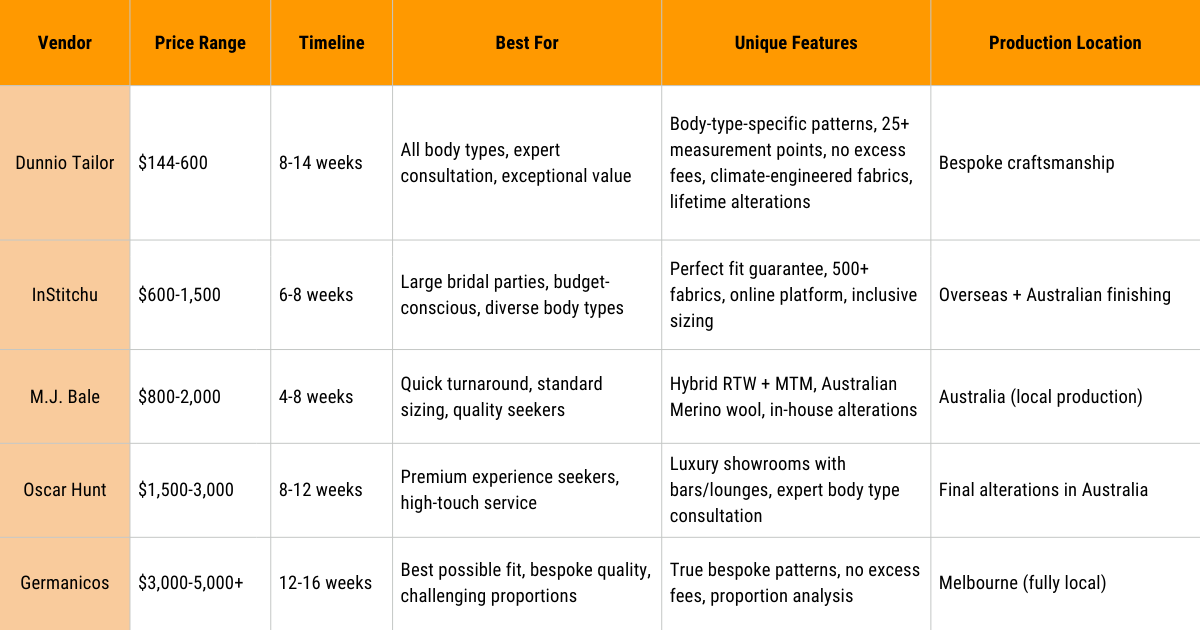
12. Accessories and finishing touches
Details are where "relaxed formality" is truly calibrated. Accessories allow you to express personality while maintaining wedding-appropriate polish.
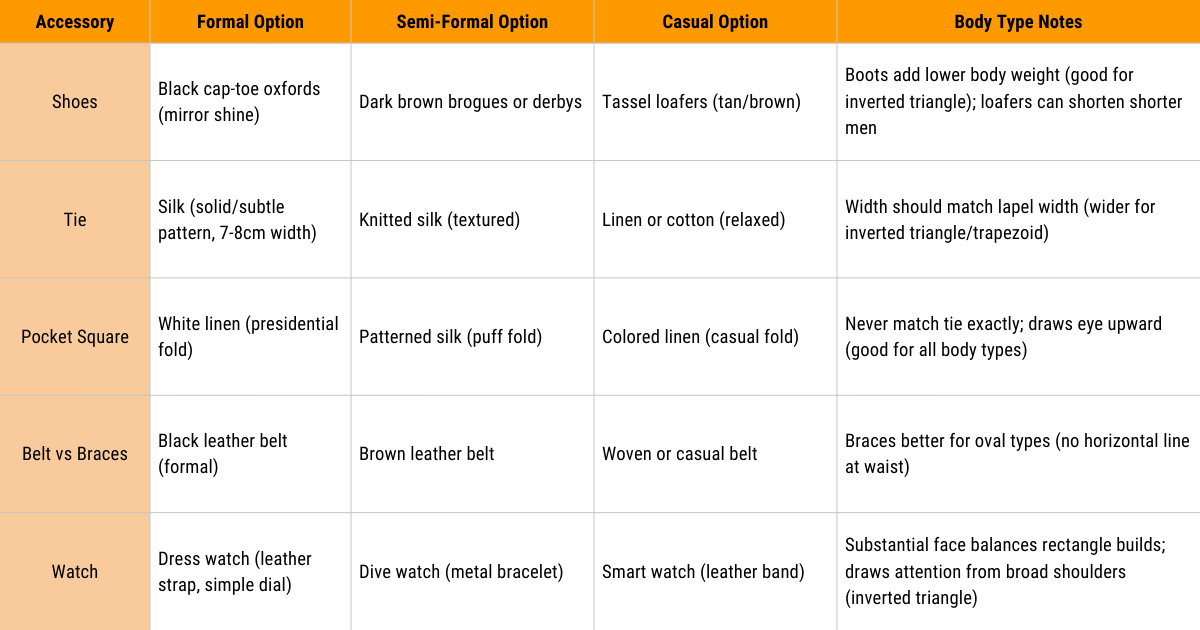
12.1. Footwear for different wedding contexts
Shoes significantly impact your overall appearance and must be chosen based on venue, formality, and personal style.
- Tassel loafers: These are the quintessential footwear for the "Australian garden party" or "vineyard" aesthetic. Tassel loafers in dark brown or tan bridge the gap between formal and relaxed. They work beautifully with linen suits, cotton blends, or lightweight wool for outdoor summer weddings.
- Body type note: Loafers have a lower profile than oxfords, which can make shorter men appear even shorter. If you're under 5'8", ensure your trousers have minimal break to maintain leg length.
- Oxford shoes: Strictly for black-tie events and formal church weddings. Black cap-toe oxfords are the gold standard-polished to a mirror shine, they create the formality required for evening wear and traditional ceremonies.
- R.M. Williams boots: A unique Australian cultural signifier. Pristine Craftsman boots in chestnut or black are widely accepted as formal wear in Australia, even with suits. This is particularly true for country weddings, vineyard celebrations, or any event with a rural or heritage theme.
- Body type note: Boots add visual weight to your lower body, which can benefit inverted triangle builds by balancing broad shoulders. However, shorter men should be cautious-boots can make legs appear shorter if trousers aren't properly hemmed.
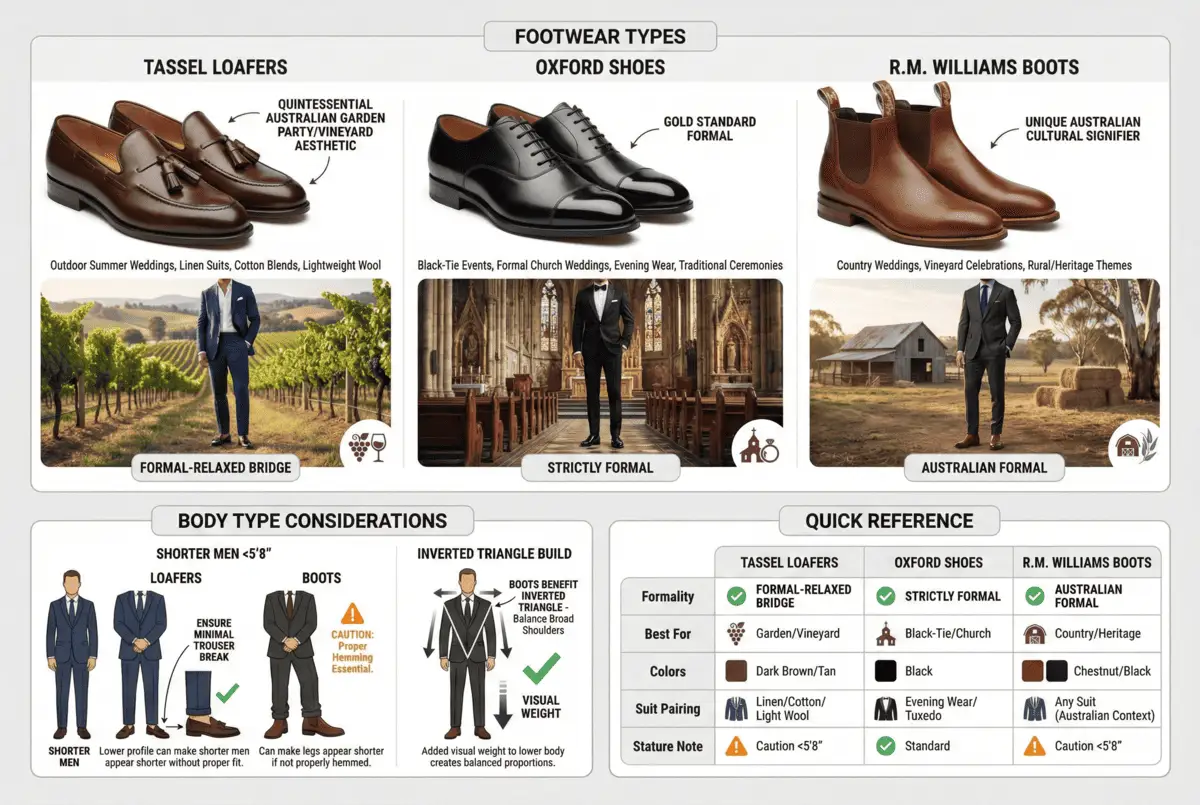
12.2. Neckwear and pocket squares
The tie and pocket square are opportunities for personality and color within formal constraints.
- Ties: Knitted silk ties offer texture and are less rigid than woven silk, fitting the "relaxed formality" vibe perfectly. For Australian weddings, ties in earthy tones (terracotta, sage, olive) or classic navy and burgundy work beautifully.
- Width matters: Your tie width should be proportional to your lapel width. Standard tie width is 7-8cm, matching standard lapel width of 7.5-8.5cm. Wider lapels (for inverted triangle or trapezoid builds) call for wider ties.
- Pocket squares: The golden rule-do not match your pocket square exactly to your tie. This looks catalog-bought and cheap. Instead, they should complement each other. For example, a navy tie with a burgundy and navy paisley square, or a sage tie with a cream linen square.
- Folding styles: The presidential fold (simple square) is most formal and appropriate for black-tie or traditional weddings. The puff fold (casual, organic shape) works for garden parties or beach weddings. Avoid overly complex folds that look fussy.
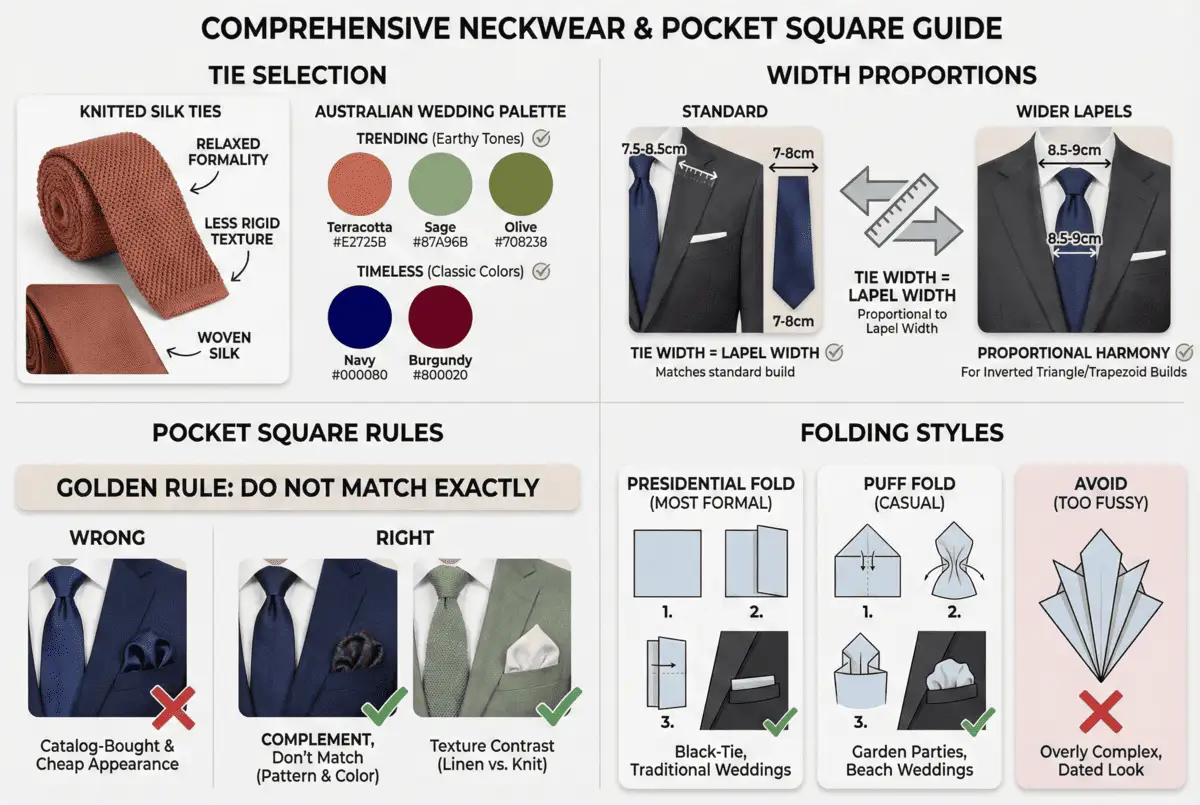
12.3. Grooming and personal presentation
Your suit is only part of the equation-grooming completes the look.
- Hair: The 2025 trend favors "clean but textured" styles. The military fade is softening into scissor-cut sides with movement on top. For weddings, your hair should look intentional but not overly styled-avoid helmet-hair from excessive product. Get your haircut 5-7 days before the wedding, not the day before. This allows the cut to settle and look natural rather than freshly shorn.
- Facial hair: Beards are perfectly acceptable for Australian weddings but must be groomed. A "sharp" neckline is essential-the beard should end in a clean line from ear to ear, defining your jaw. This is particularly important for oval body types, where a well-groomed beard can create the illusion of a stronger jawline. For the wedding day, trim and shape your beard 2-3 days before (not the morning of, in case of mistakes). Use beard oil to keep it looking healthy and conditioned.
- Hands and nails: Your hands will be visible in countless photos-ring exchange, cutting cake, toasts. Ensure your nails are clean and trimmed. If you work with your hands, consider a professional manicure the week before the wedding.
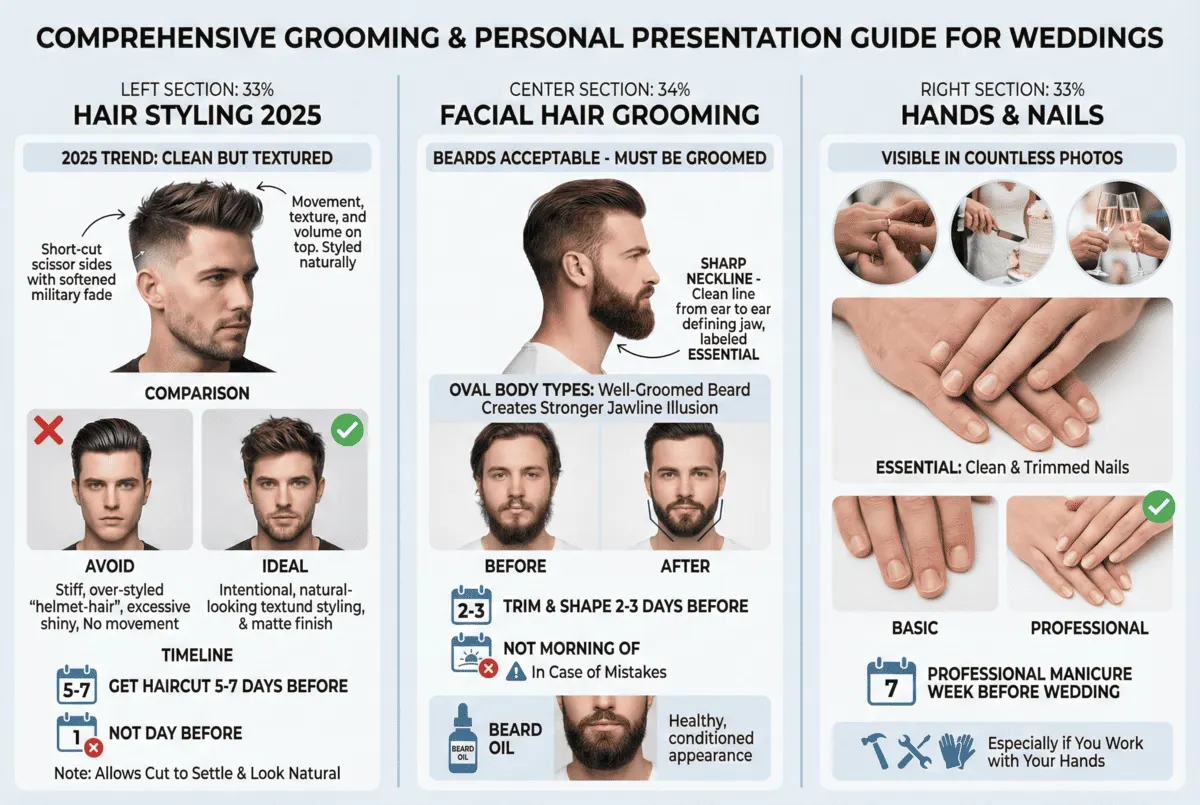
13. General styling tips for all body types
While each body type has specific considerations, certain principles apply universally and elevate any wedding look.
13.1. The power of fit
Fit is everything. No matter how expensive your suit, how trendy the color, or how luxurious the fabric, if it doesn't fit properly, it won't look good.
- The two-finger test: When your jacket is buttoned, you should be able to fit two fingers between your chest and the jacket fabric. More than that, and it's too loose. Less than that, and it's too tight. This ensures comfort while maintaining a fitted appearance.
- Sleeve length: Your jacket sleeve should end at your wrist bone, allowing 1-2cm of shirt cuff to show. This small detail makes a massive difference in how polished you look. Sleeves that are too long make you look like you're wearing your father's suit. Too short, and you look like you've outgrown your clothes.
- Trouser break: The break (where your trousers meet your shoes) should be minimal for modern looks. A quarter break (slight bend in the fabric) or no break creates clean lines. Avoid full breaks where fabric pools at your ankles-this looks sloppy and shortens your legs visually.
- Shoulder fit: The shoulder seam of your jacket should end exactly where your shoulder ends. If it extends past your natural shoulder, the jacket is too big. If it pulls or dimples, it's too small. This is the hardest alteration to fix, so getting it right initially is crucial.
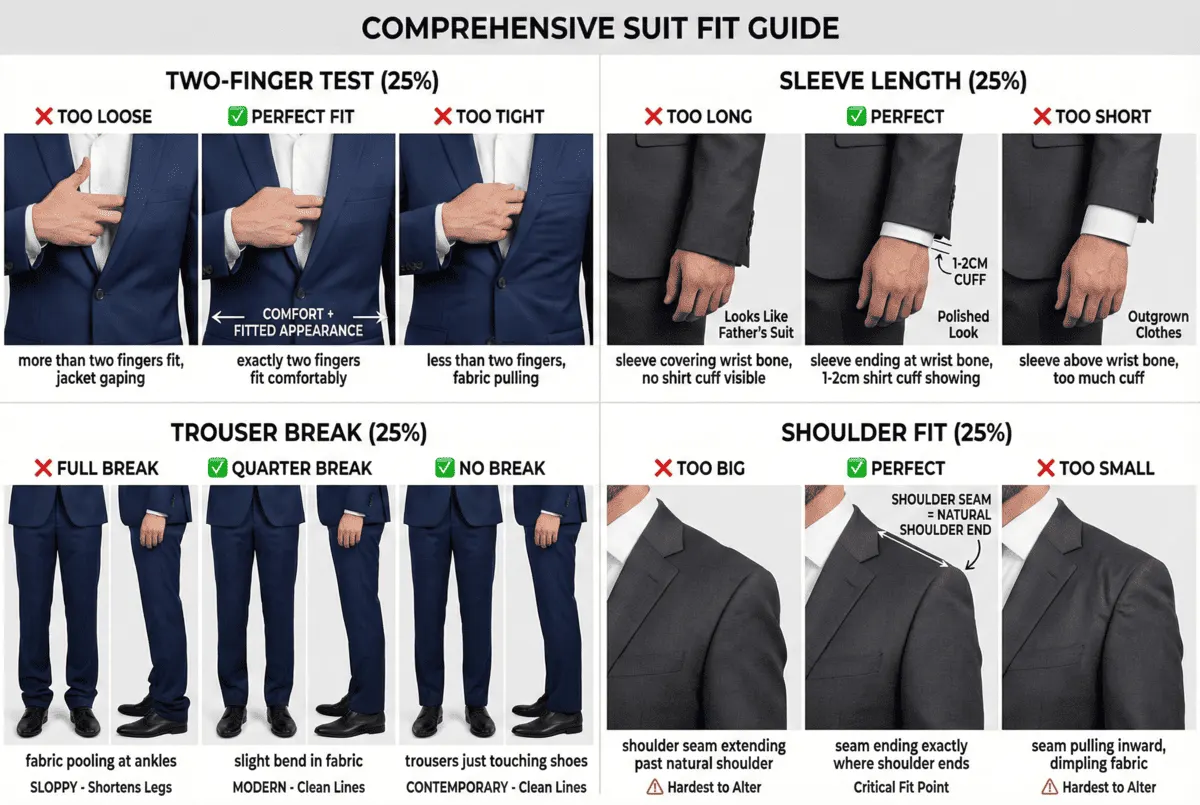
13.2. Color and pattern strategy
Strategic use of color and pattern can enhance your body type's strengths and minimize challenges.
- Dark colors slim, light colors highlight: This is fundamental color theory. Dark colors (navy, charcoal, black) recede visually, making areas appear smaller. Light colors (stone, light grey, tan) advance, making areas appear larger.
- Application: If you're an oval shape wanting to minimize your midsection, wear dark colors. If you're a rectangle wanting to add dimension, consider lighter tones or textures that catch light.
- Vertical stripes elongate: Pinstripes, chalk stripes, or any vertical pattern draws the eye up and down, creating the illusion of height and slimness. This is particularly effective for shorter men or those wanting to appear leaner.
- Horizontal stripes and plaids add width: Horizontal elements make you look broader. This can be useful for rectangle shapes wanting to add shoulder width (horizontal chest pocket, wide lapels) but should be avoided by triangle or oval shapes.

13.3. Fabric selection by body type
Different fabrics work better for different builds.
- Lightweight fabrics: Linen, cotton, lightweight wool (under 9oz) drape loosely and don't cling. Best for: Oval shapes who want fabric to skim over their midsection rather than cling to it.
- Medium-weight fabrics: Standard wool (10-11oz), wool-cotton blends provide structure without bulk. Best for: Rectangle and triangle shapes who need fabric with enough body to hold shape and create definition.
- Heavy fabrics: Tweed, heavy wool (12oz+), velvet add visual weight and texture. Best for: Rectangle shapes wanting to add dimension. Less ideal for inverted triangle or oval shapes who don't want additional bulk.
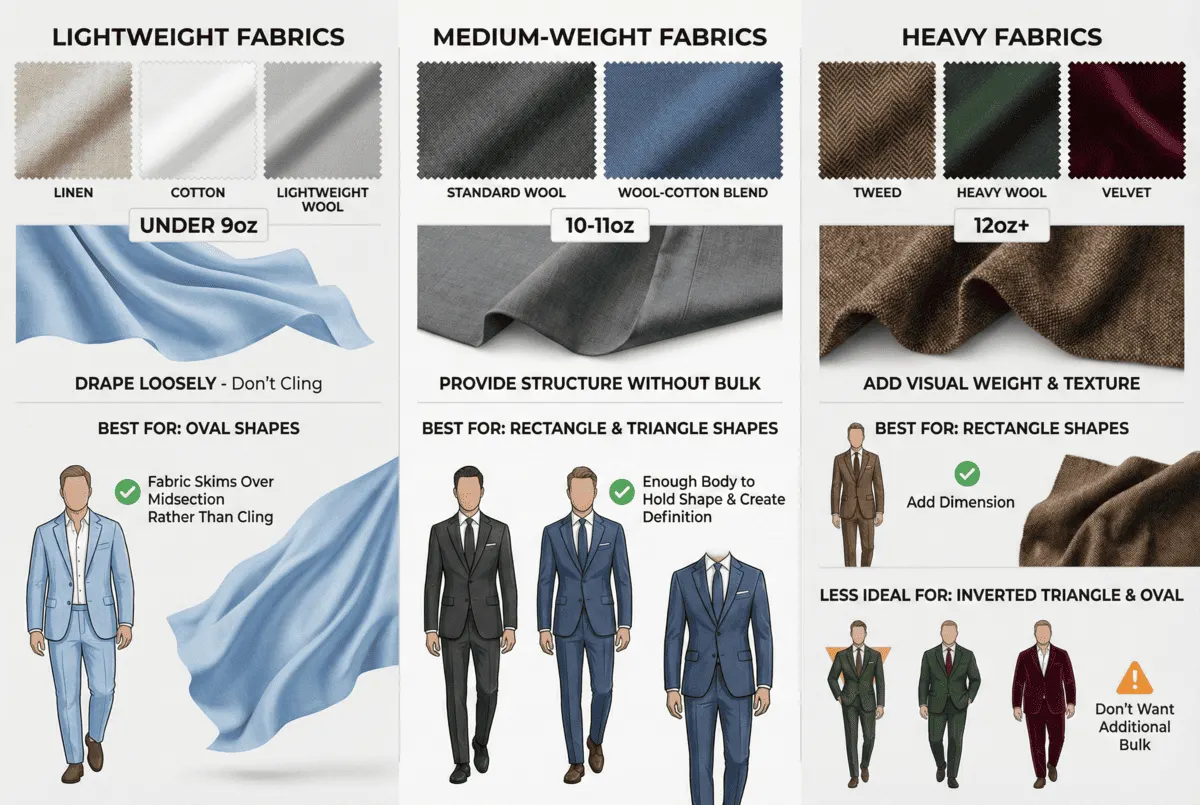
13.4. Accessory integration
Accessories are the final layer that completes your look.
- Belts for waist definition: A belt in a complementary color (brown belt with brown shoes, black belt with black shoes) creates a horizontal line at your waist, suggesting definition. For rectangle shapes, this is valuable. For oval shapes, braces are better as they don't create a horizontal line at the widest part of your body.
- Watches and jewelry: A watch with a substantial face adds weight to your wrist, balancing proportions. This is particularly effective for inverted triangle builds-a quality watch draws attention to your forearms and away from your massive shoulders.
- Keep other jewelry minimal-wedding ring, perhaps cufflinks if wearing French cuffs. Avoid anything flashy or distracting that pulls focus from the overall look.
- Pocket squares and boutonnieres: These add color and personality at your chest level, drawing the eye upward. For all body types, this is beneficial-it creates a focal point at your upper body, which is generally more flattering than attention on your midsection or lower body.
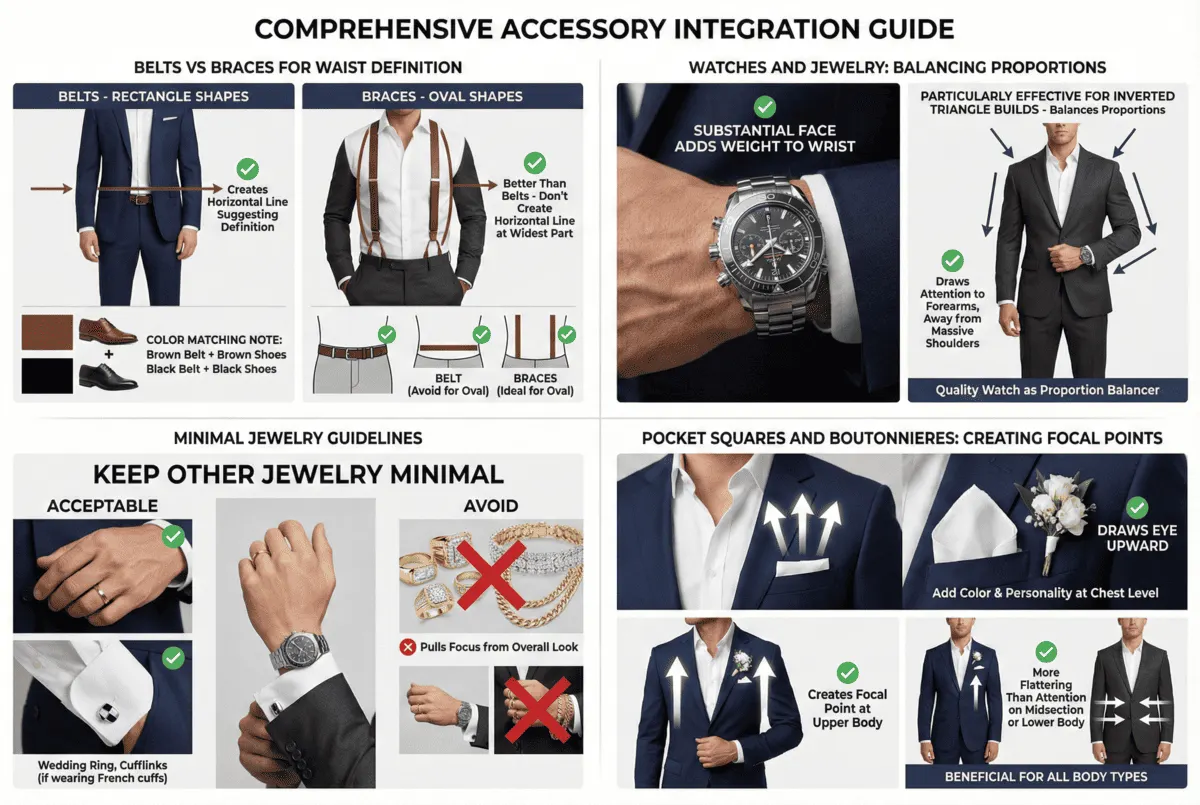
Conclusion: Your perfect wedding suit starts with expert guidance
At Dunnio Tailor, we've spent years perfecting the art of body-type-specific tailoring for Australian weddings. Understanding whether you have a rectangle, triangle, inverted triangle, oval, or trapezoid body shape is just the beginning-the real transformation happens when you work with master tailors who know exactly how to translate that knowledge into a suit that enhances your natural proportions.
Why Dunnio Tailor's approach is different?
While many Australian tailors offer made-to-measure services, our expertise goes deeper:
- Comprehensive body analysis: We don't just take measurements-we analyze your posture, stance, shoulder slope, and weight distribution to create patterns that work with your unique anatomy. For rectangle builds, this means engineering shoulder structure that creates definition. For triangle shapes, it's reconstructing your shoulder line to balance broader hips. For inverted triangle builds, it's accommodating extreme drops of 9, 10, even 11 inches without compromise. For oval shapes, it's creating vertical elongation through strategic button stance and jacket length. For trapezoid builds, it's refining already-ideal proportions to perfection.
- Climate-engineered fabrics: Our fabric selection process considers both your body type and the specific demands of Australian weddings. We guide rectangle and triangle shapes toward textured fabrics that add dimension-herringbone, subtle checks, basket weaves. For inverted triangle and oval builds, we recommend lightweight, breathable options that skim rather than cling. We understand that a summer wedding in South Australia (40°C+) requires different engineering than a winter celebration in Melbourne, and we match fabrics accordingly.
- No excess fees, perfect fit guarantee: Unlike many bespoke tailors who charge premiums for "difficult" proportions, we believe every body type deserves expert tailoring at fair prices. Whether you're a groom with an extreme drop, a groomsman with a fuller midsection, or a guest seeking the perfect fit, our pricing remains consistent. We also offer lifetime alterations-as your body changes over the years, we'll adjust your suit to maintain perfect fit.
The Dunnio Tailor wedding suit process
- Precision measurement (25+ data points): Beyond standard chest and waist measurements, we capture shoulder slope, arm pitch, posture variations, and stance to create a truly custom pattern. For rectangle shapes, we measure exactly where shoulder padding should extend. For triangle shapes, we calculate the precise shoulder reconstruction needed. For inverted triangles, we map your drop to engineer perfect waist suppression without billowing fabric.
- First fitting & refinement: We assess drape, comfort, and proportion, making adjustments specific to your body type. This is where the magic happens-you see how strategic tailoring transforms your silhouette. We're honest about what's working and what needs adjustment, and we make changes until it's perfect.
- Final polish & delivery: Your suit is perfected down to the millimeter, ensuring you look exceptional from every angle. We check sleeve length (showing exactly 1-2cm of shirt cuff), trouser break (quarter break or no break for modern looks), and overall drape. You walk out with a suit that fits like it was made for you-because it was.
If you're looking for expert guidance on design styles or want to add unique, personalized touches to your wedding suit, you can easily book a session with our design specialists.
We take the time to assess your body type and discuss the details of your wedding from the venue to the season to recommend specific cuts and fabrics that truly flatter your frame. This is a collaborative design experience, not a sales pitch, focused on helping you understand the best choices for your specific build.
Hotline - WhatsApp: +84 968996668
Email: support@dunniotailor.com
Investment in excellence
The average Australian groom is 32 years old and views his wedding suit as a strategic investment. A Dunnio Tailor suit serves you for 5-10 years beyond your wedding day-business meetings, formal events, future weddings, important life moments. When you calculate the cost per wear of a $144-600 suit worn 50+ times over a decade, expert tailoring becomes one of the smartest investments you can make.
More importantly, you'll look back on your wedding photos with pride for decades. You'll see a man who looked confident, polished, and authentically himself-not someone squeezed into an ill-fitting rental or drowning in an off-the-rack suit that ignored his proportions.
Discover how Dunnio Tailor’s online tailoring service preserves traditional artisanal craftsmanship while resolving the nagging frustrations of modern off-the-rack suits in our feature: How Dunnio tailor's bespoke approach eliminates the pain points of off-the-rack suits.
The key insights for Australian weddings in 2026
Embrace earthy tones and texture: The trend toward terracotta, sage, olive, and warm stone colors, combined with textured fabrics like velvet and corduroy, offers opportunities for personal expression while maintaining sophistication.
- Prioritize fabric engineering: Choose fabrics appropriate for your specific climate and venue. Linen and cotton blends for summer heat, Australian Merino wool for formal occasions, mohair blends for humidity.
- Invest in proper fit: The difference between a suit that fits and one that's tailored to your body type is transformative. Made-to-measure or bespoke tailoring isn't a luxury-it's the foundation of looking exceptional.
- Consider the long game: Choose versatile colors and quality fabrics that will serve you for years. Your wedding suit should be an investment piece, not a single-use costume.
- Work with experts who understand body types: Generic tailoring can't address the specific needs of rectangle, triangle, inverted triangle, oval, and trapezoid builds. You need tailors who specialize in body-type-specific construction.
Ready to experience the Dunnio Tailor difference?
Whether you're a groom planning your big day, coordinating suits for a diverse bridal party, or a guest wanting to look your absolute best, we're here to guide you. Our expertise in body-type-specific tailoring, combined with our understanding of Australian wedding contexts, ensures you'll look confident, polished, and authentically yourself.
Visit dunniotailor.com to book your consultation and discover how expert tailoring transforms not just how you look, but how you feel on one of life's most important occasions.
Your suit should submit to you, not you to the suit. Understanding your body type empowers you to make informed choices that enhance your natural proportions, project confidence, and create a visual legacy that honors the significance of the occasion.
Dunnio Tailor: Where expert craftsmanship meets individual expression. Serving Australian grooms, groomsmen, and distinguished gentlemen with bespoke tailoring that celebrates your unique proportions.
When choosing groom's suits at Dunnio Tailor, you will receive:
- Tailoring is based on personal measurements.
- Customize according to preferences.
- Instructions from a professional technical team.
- Tailored by skilled craftsmen.
- Fitting and adjusting as required.
- Fabric pattern options with a collection of more than 500 different fabric patterns.
- Free 720-day warranty.
- Free hangers and specialized storage bags.
- Support and shipping policies for international customers.