Table of Contents[Hide]
- 1. What is an overcoat? The complete definition
- 2. The history and evolution of the overcoat
- 3. Types and styles of men's overcoats
- 4. Overcoat fabrics and materials: the complete guide
- 5. Overcoat colors: classic and contemporary palettes
- 6. How to choose the perfect overcoat for your body type
- 7. Overcoat occasions and styling guide
- 8. How to wear and style an overcoat
- 9. Overcoat care and maintenance
- 10. Understanding overcoat construction quality
- 11. Buying guide: how to shop for your perfect overcoat
- 12. Current trends: the overcoat in modern menswear (2025-2026)
- Frequently asked questions
- Conclusion
The overcoat stands as one of the most essential investments in any gentleman's wardrobe. More than just protection against winter weather, a quality mens overcoat represents the final layer that defines your personal style and professional presence. Whether you're attending a winter wedding, heading to an important business meeting, or simply navigating cold city streets, the right long coat for men combines functionality with sartorial excellence. At Dunnio Tailor, we understand that choosing your perfect overcoat requires knowledge of styles, fabrics, construction quality, and fit principles. This comprehensive guide will walk you through everything you need to know about overcoats, from their rich heritage to modern variations, helping you select a coat that will serve you impeccably for decades to come.
1. What is an overcoat? The complete definition
An overcoat is fundamentally a long, structured garment designed to be worn over your indoor clothing, providing both warmth and a polished finishing touch to your ensemble. The term "overcoat" quite literally describes its purpose: a coat worn over your suit jacket, blazer, or casual wear.
1.1. Core definition and primary purpose
A true mens long coat serves two essential functions. First and foremost, it protects you against harsh weather conditions, particularly cold temperatures, wind, and light precipitation. Second, it acts as a sartorial statement, communicating professionalism, attention to detail, and personal style. Unlike lighter jackets or windbreakers, an overcoat for men is specifically engineered for substantial cold weather protection while maintaining an elegant silhouette.
The defining characteristics include:
- Length reaching from just above the knee to as far as the ankle, though most modern overcoats terminate just below the knee
- Long sleeves with sufficient room to accommodate a suit jacket underneath
- Substantial fabric weight, typically between 18 and 22 ounces per yard for contemporary designs
- Structured shoulders and lapels that maintain their shape
- Classic closures, usually with buttons, though some styles feature belts or toggles
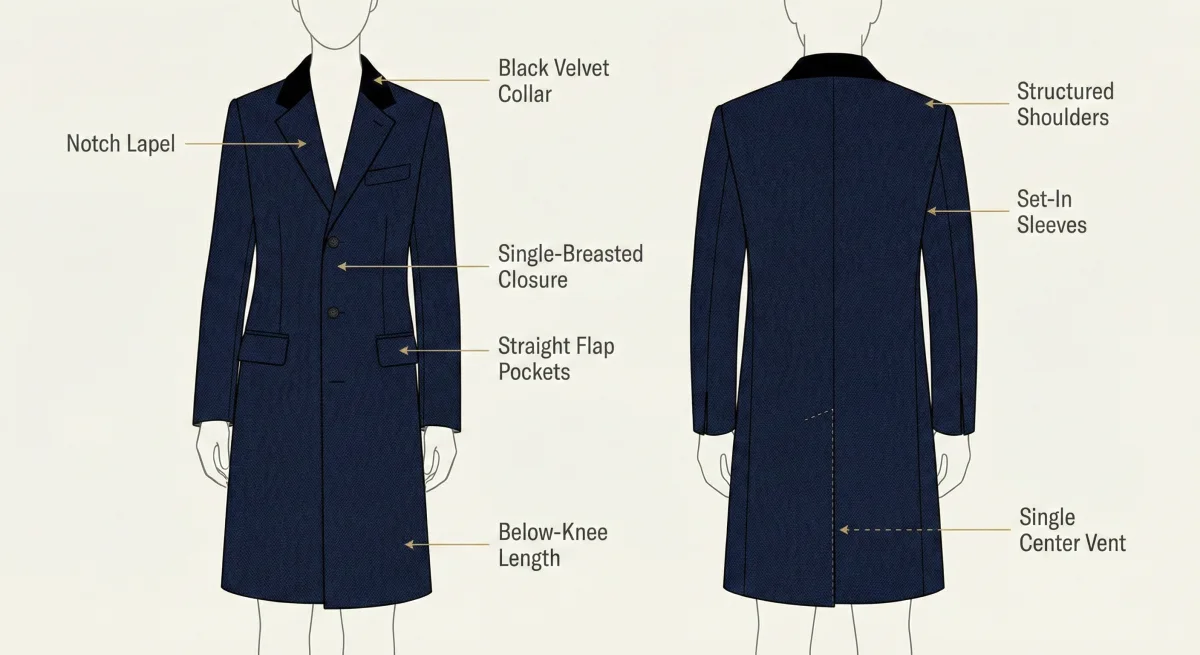
1.2. Technical characteristics that define an overcoat
Understanding the technical specifications helps distinguish a true overcoat from other forms of outerwear. At Dunnio Tailor, we emphasize these quality markers:
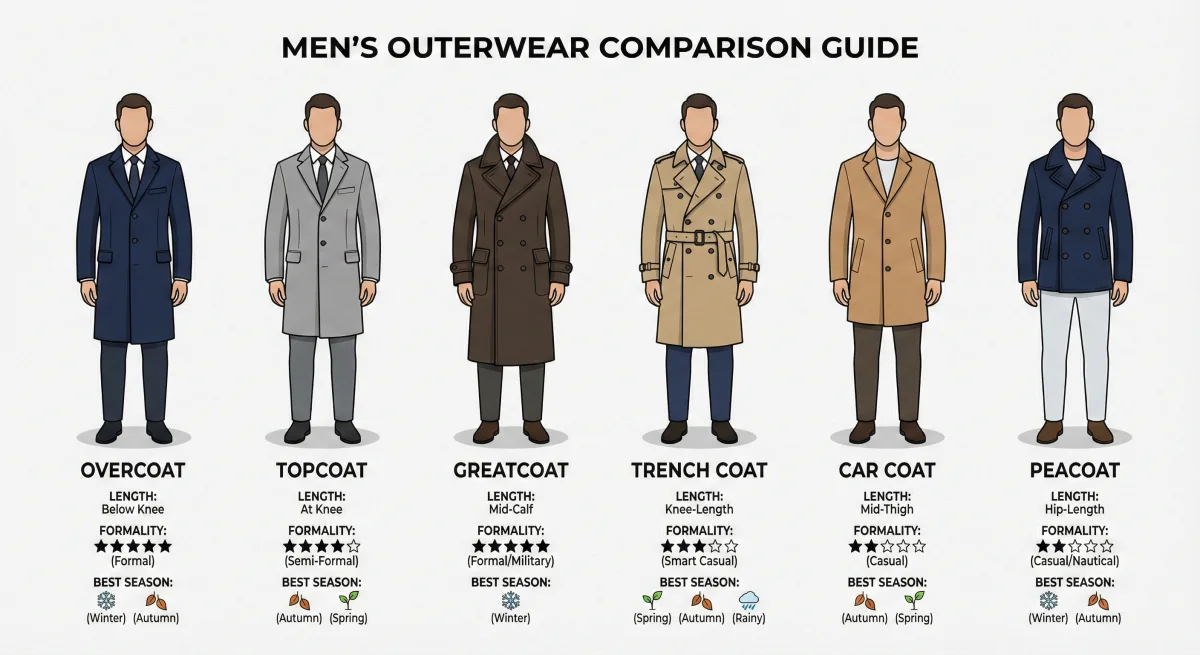
- Length specifications: Traditional overcoats were cut to mid-calf or even ankle length, maximizing coverage and warmth. Modern interpretations typically fall into three categories. Full-length overcoats extend from below the knee to mid-calf, offering maximum formality and protection. Three-quarter length coats reach just below the knee, providing the most versatile option for business and formal occasions. Shorter car coats terminate at mid-thigh, suited for business casual environments and easier movement.
- Weight classifications: Historically, a true overcoat required fabric weighing approximately 30 ounces per yard. However, advances in textile manufacturing and the prevalence of heated transportation have shifted the standard. Today's overcoats typically use fabrics between 18 and 22 ounces, with lighter topcoats around 16 to 18 ounces. This lighter weight doesn't compromise warmth thanks to improved wool density and natural fiber innovations.
- Construction features: The most common overcoat style is single-breasted with a notch lapel, featuring two to four buttons, straight flap pockets positioned at the hip, and either a single center vent or no vent at all. Double-breasted overcoats, while less common, project a more formal and structured appearance with peak lapels and a military-inspired aesthetic.
- Internal architecture: The quality of an overcoat's internal construction dramatically affects its longevity and appearance. Premium overcoats feature a sewn canvas layer between the outer fabric and lining. This floating canvas, often made from horsehair and wool, allows the coat to mold to your body over time while maintaining structural integrity. Fused construction, which uses heat-activated adhesive, offers a more affordable alternative but won't develop the same personalized drape or maintain its shape as long.
1.3. Overcoat vs. other outerwear: understanding the distinctions
Many men use the terms "coat," "overcoat," "topcoat," and "jacket" interchangeably, but these garments serve distinct purposes. Here's a comprehensive comparison:
This table illustrates that an overcoat occupies a specific niche: substantial enough for genuine cold weather protection, yet refined enough for formal and professional settings.
2. The history and evolution of the overcoat
The mens overcoat carries a fascinating heritage that spans military necessity, aristocratic status, and subcultural rebellion. Understanding this evolution enriches your appreciation for the garment's enduring significance.
2.1. Military origins (17th-19th century)
The overcoat's lineage traces back to 17th-century military uniforms, where soldiers required protective outerwear that could withstand harsh campaign conditions. These early overcoats were heavy, voluminous, and traditionally dark-colored to hide dirt and maintain a uniform appearance across regiments.
By the 18th century, the overcoat had evolved from the earlier cape and cloak, offering superior functionality through sleeves and a closer fit to the body. Military officers particularly favored long coats that signaled rank and authority while providing practical protection during winter campaigns.

2.2. The Regency period and Beau Brummell's influence
The early 19th century marked a revolutionary shift in men's fashion, led by George Bryan "Beau" Brummell, the quintessential English dandy. Brummell championed a philosophy that emphasized impeccable tailoring and perfect fit over ostentatious ornamentation. This Regency period saw coats drawn progressively closer to the body, creating a neoclassical silhouette that emphasized the chest and shoulders.
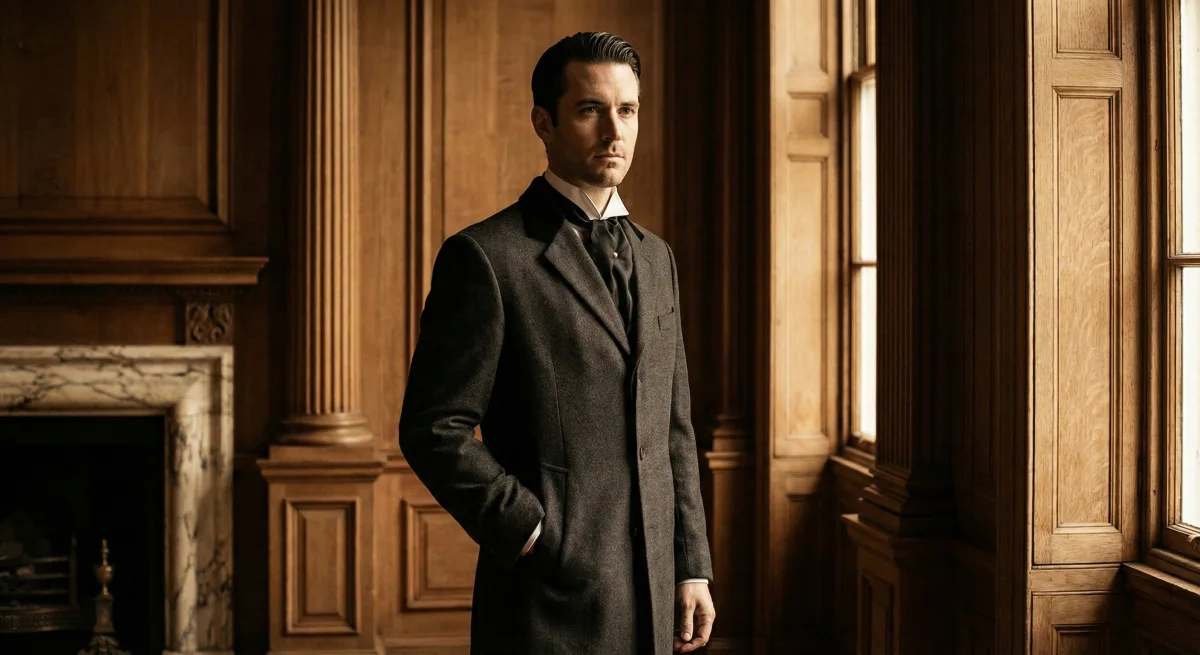
During this era, the Chesterfield coat emerged as a defining style, named after the 6th Earl of Chesterfield. This single-breasted design revolutionized outerwear by eliminating the waist seam typical of body coats, allowing it to be easily worn as a supplemental layer. The characteristic black velvet collar found on many Chesterfields is historically attributed to mourning for nobles executed during the French Revolution, a solemn detail that has endured as a hallmark of formal business attire.
2.3. 20th century evolution and subcultural adoption
The 20th century democratized the overcoat, transforming it from an elite luxury to a wardrobe staple across social classes. World Wars I and II played crucial roles in this transition. The trench coat, engineered by Burberry for British officers, featured innovative functional details: epaulettes for displaying rank, a storm flap for water runoff, and D-rings for equipment attachment. Similarly, the British Warm, a heavy greatcoat in melton wool, provided exceptional warmth for officers in colder European theaters.
Post-war decades saw the overcoat adopted by various subcultures as a tool for identity expression. In the 1950s, Teddy Boys wore oversized silhouettes to signal rebellion against conservative norms. The 1970s witnessed Suedeheads and Skinheads adopting the single-breasted Crombie coat as a symbol of sharp, aggressive neatness. By the 1980s, corporate culture reclaimed the overcoat, with strong shoulders and voluminous cuts mirroring the era's broader "power dressing" trend.
2.4. The modern overcoat (2020s-2026)
Today's overcoat market is defined by a return to quality, craftsmanship, and understated elegance. The "quiet luxury" movement prioritizes tactile experience and invisible details over conspicuous branding. Similarly, the "old money aesthetic" favors traditional patterns like herringbone and houndstooth as cultural shorthand for generational wealth and refined taste.
Technical innovation has also transformed the modern mens long coat. Brands now offer performance features water resistance, breathability, wrinkle resistance while maintaining the aesthetic of traditional tailoring. Sustainable materials and ethical production have become increasingly important to discerning consumers who view an overcoat as a multi-decade investment rather than a seasonal purchase.
3. Types and styles of men's overcoats
The world of mens overcoats extends far beyond a single silhouette. Understanding the various styles helps you select the right coat for your specific needs and occasions.
3.1. Classic overcoat styles
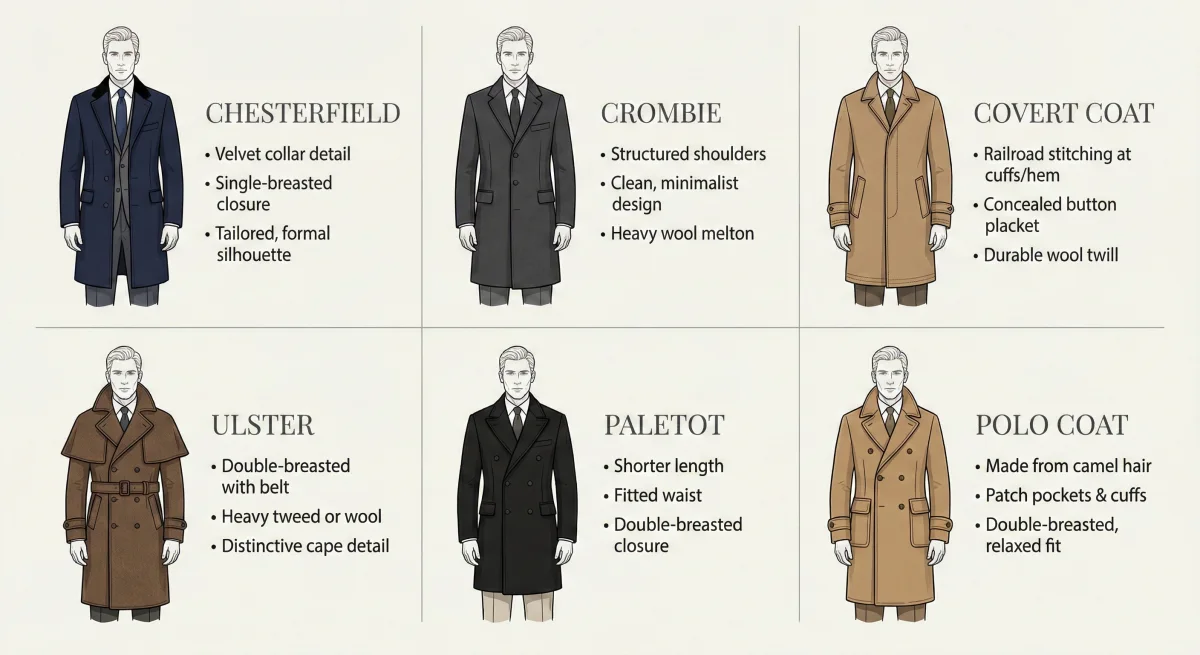
- Chesterfield: The Chesterfield represents the gold standard for business formal overcoats. Characterized by a single-breasted front, notch lapels, and a knee-length hem, this style projects clean, vertical lines that elongate the frame. The signature black velvet collar adds a touch of refined detail. Chesterfield coats work beautifully over custom suits for professional environments and formal events.
- Crombie: Originating from the British J. & J. Crombie textile company, this style emphasizes structured shoulders and a slightly fitted waist. Crombie coats typically feature a shorter length than traditional Chesterfields, terminating just at or slightly below the knee. The clean, minimalist design without a velvet collar makes it versatile for both business and smart casual occasions.
- Covert coat: With origins in English hunting traditions, the covert coat features distinctive "railroad stitching" along the sleeves and hem. Traditionally made in fawn or tan tones, this style projects rugged competence and heritage. It's particularly favored in professional British circles and pairs exceptionally well with country tweeds and business casual attire.
- Ulster: For maximum protection in severe cold, the Ulster coat delivers with its heavy-duty construction, double-breasted closure, and optional belt detail. This style often includes a cape or extended shoulder panel for additional coverage. While less common in contemporary business settings, the Ulster remains ideal for harsh winter climates.
- Paletot: A shorter, more fitted formal coat, the paletot typically reaches mid-thigh and features a tailored silhouette. This style works particularly well for evening wear and formal occasions where a full-length coat might feel excessive.
- Polo coat: Characterized by its camel hair fabric, double-breasted closure, and patch pockets, the polo coat originated from sideline wear at polo matches. Its relaxed, aristocratic aesthetic makes it perfect for weekend wear and smart casual occasions.
3.2. Length variations and their applications
- Full-length overcoats (below knee to mid-calf): These traditional lengths offer maximum formality and warmth, making them ideal for black-tie winter events, formal weddings, and executive business settings. The extended coverage provides superior protection but requires careful proportion management, particularly for shorter men.
- Three-quarter length (just below knee): This represents the most versatile option for contemporary professional men. The length provides substantial coverage while allowing easier movement and a more modern silhouette. This works across formal business, winter weddings, and upscale evening events.
- Car coat length (hip to mid-thigh): Shorter overcoats facilitate easier movement, particularly when driving or in more active urban environments. While less formal than longer options, quality car coats in fine fabrics can still complement business casual attire and elevated weekend wear.
3.3. Silhouette and fit types
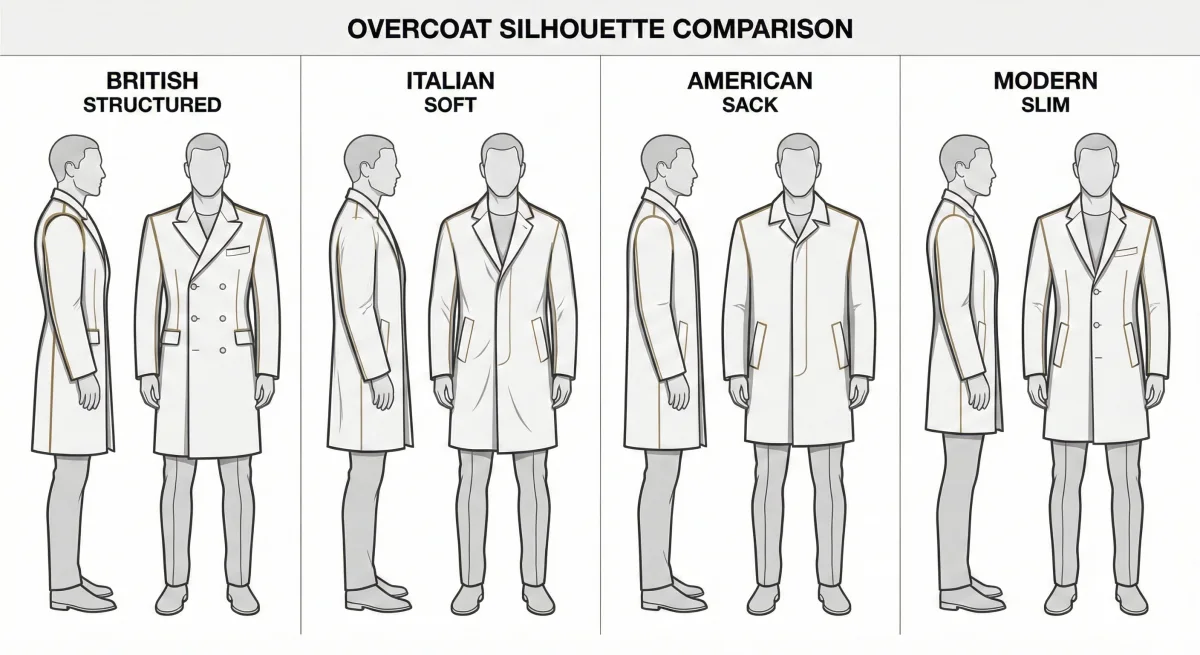
- British/Structured: This cut features defined shoulders with moderate padding, a slightly suppressed waist, and precise lines. The structured approach creates an authoritative appearance that works beautifully in professional environments. This silhouette particularly suits men with athletic or balanced builds.
- Italian/Soft: Italian tailoring emphasizes natural shoulders with minimal padding, creating a softer drape that follows the body's natural lines. The unstructured approach offers superior comfort and a contemporary aesthetic that works across business and smart casual contexts.
- American/Sack: The traditional American silhouette features a straighter hang with minimal shaping from shoulder to hem. Natural shoulders and a roomier cut provide maximum comfort, particularly appreciated by men with fuller builds or those who prefer a more relaxed fit.
- Modern slim: Contemporary slim-cut overcoats feature narrower shoulders, a defined waist taper, and a closer overall fit. This European-influenced silhouette appeals to younger professionals and creates a sleek, fashion-forward appearance. However, very slim cuts may limit layering options in severe cold.
Ready to complete your formal wardrobe? Explore our custom suit collection and custom jacket options designed to pair perfectly beneath your overcoat. For an interactive experience, try our 3D suit customizer to visualize your perfect combination.
4. Overcoat fabrics and materials: the complete guide
The fabric you choose fundamentally determines your overcoat's warmth, durability, appearance, and longevity. At Dunnio Tailor, we prioritize natural fibers for their superior performance and timeless quality.
4.1. Natural fiber excellence
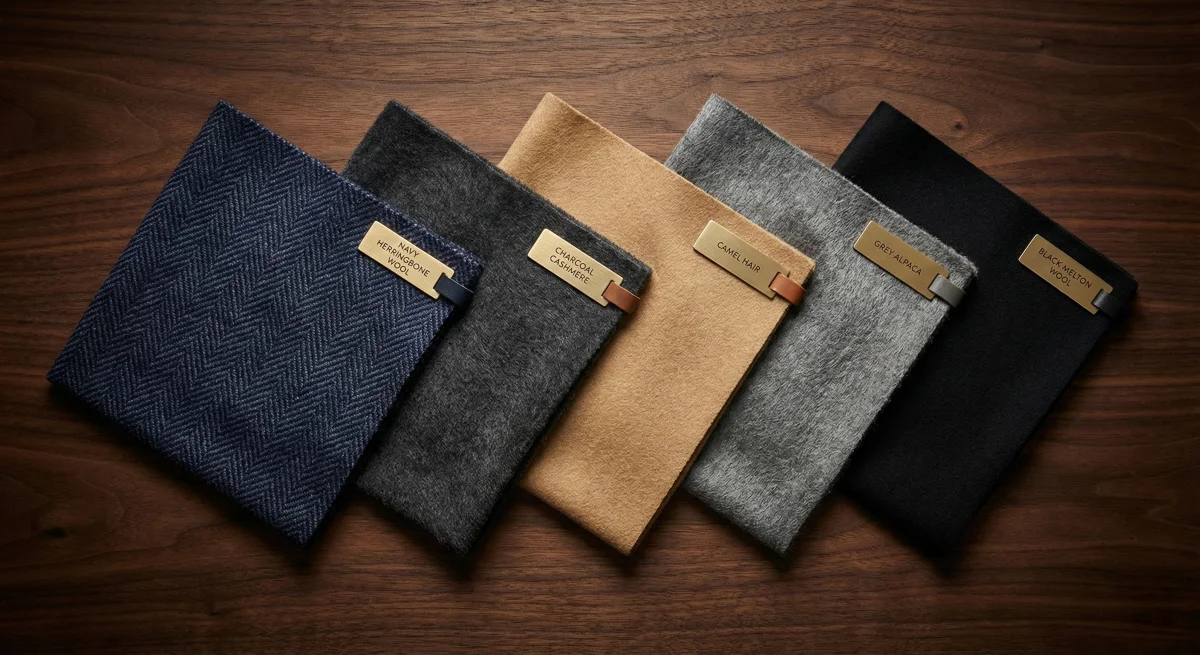
- 100% virgin wool: Wool remains the most versatile and reliable choice for mens overcoats. This remarkable natural fiber can absorb up to 20% of its weight in moisture while still feeling dry and maintaining its insulating properties. Wool is naturally water-resistant thanks to lanolin, breathes exceptionally well to prevent overheating, and holds its shape beautifully over time. For modern overcoats, fabrics between 18 and 22 ounces per yard provide the ideal balance. Merino wool from Australia and New Zealand represents the finest grade, offering superior softness and durability. The quality of wool varies significantly based on fiber length, crimp, and processing. Premium wool develops a subtle luster and becomes more comfortable with wear as the fibers relax.
- Cashmere: Obtained from the undercoats of Mongolian and Himalayan goats, cashmere offers an exceptional warmth-to-weight ratio and luxurious softness. A pure cashmere overcoat provides significant insulation while remaining surprisingly lightweight. The fiber's fine diameter creates a plush hand feel that distinguishes it immediately from standard wool. However, pure cashmere requires careful maintenance and is more susceptible to abrasion and pilling than wool. The premium price reflects both the fiber's rarity and its exceptional properties. For daily wear, many discerning gentlemen prefer a cashmere blend.
- Wool-cashmere blends: A 90% wool and 10% cashmere blend represents what many tailors consider the "sweet spot" for professional overcoats. This combination delivers wool's durability and shape retention with cashmere's softness and enhanced warmth. The blend offers excellent value, providing a luxury hand feel at a more accessible price point than pure cashmere. Blends with higher cashmere content (80/20 or 70/30) offer progressively softer textures but at increased cost and slightly reduced durability.
- Camel hair: Camel hair, particularly from Bactrian camels, provides exceptional warmth and a distinctive golden-tan color. This fiber carries strong associations with Ivy League style and American heritage fashion. Camel hair's natural color palette limits versatility compared to wool's dyeing options, but its warm tones complement earth-toned wardrobes beautifully. The fiber itself is extremely warm, making camel hair overcoats ideal for harsh winter climates. Pure camel hair can feel slightly fuzzy, so many premium coats blend it with wool for improved structure.
- Alpaca: Alpaca fiber, sourced from South American alpacas, offers a silky texture, excellent warmth, and natural hypoallergenic properties. The fiber's hollow core structure provides superior insulation, making alpaca overcoats particularly warm relative to their weight. Alpaca's fine fibers create a smooth, lustrous surface, though pure alpaca can sometimes appear overly fuzzy for formal business contexts. Alpaca-wool blends combine the best properties of both fibers.
4.2. Understanding fabric weight and performance
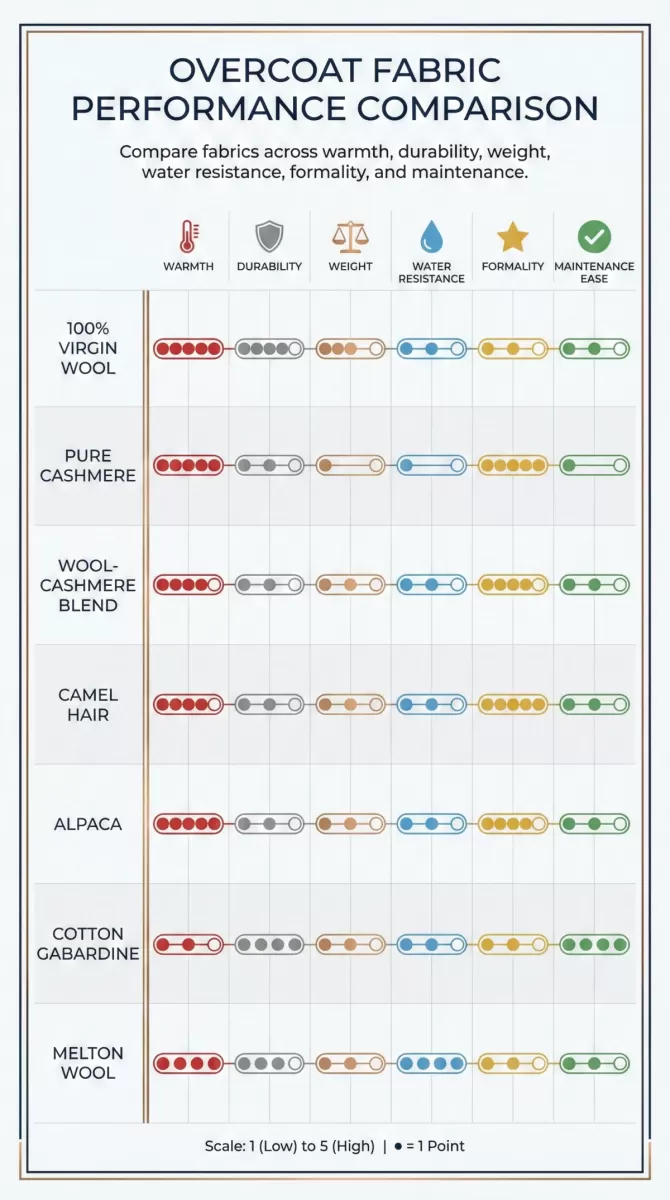
The relationship between fabric weight and performance is nuanced, going beyond simple "heavier equals warmer" assumptions:
Traditional standards called for 30-ounce fabrics, but modern materials achieve equivalent or superior warmth at lower weights through improved fiber density and yarn construction. For most professional men, an 18 to 22-ounce wool or wool-blend overcoat provides excellent performance across typical winter conditions.
4.3. Technical innovations (2025-2026)
Contemporary overcoat manufacturing has embraced technical innovation while maintaining traditional aesthetics:
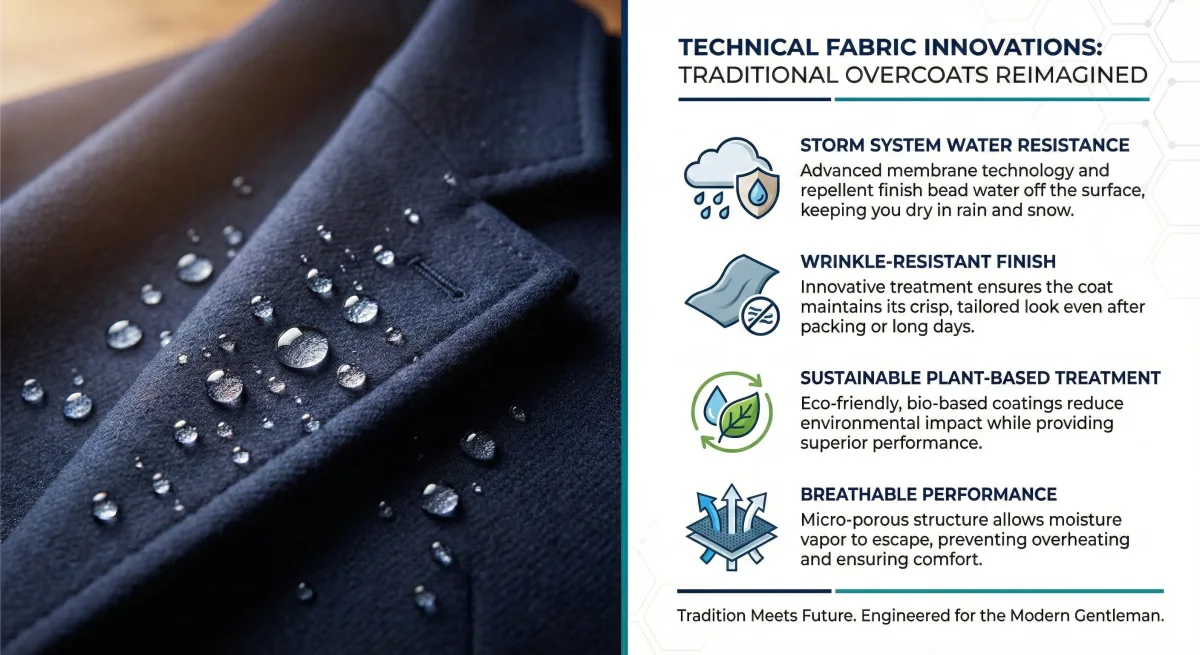
- Water-resistant treatments: Modern hydrophilic membranes, such as those in premium "Storm System" fabrics, provide wind and water resistance without compromising breathability. These plant-based, sustainable treatments allow natural fibers to perform like technical outerwear while retaining their classic appearance.
- Crease-resistant wool: Advanced finishing processes create wool fabrics that resist wrinkling during travel, maintaining a crisp appearance without constant pressing. This innovation proves particularly valuable for professionals who travel frequently.
- Sustainable innovations: The finest mills now prioritize traceable, sustainable wool from certified farms. Plant-based water- repellent treatments replace older chemical processes. Recycled fibers are increasingly incorporated without compromising quality, reflecting growing environmental consciousness.
4.4. Fabric selection by climate
Your local climate should significantly influence your fabric choice:
- Australian climate considerations: For temperate Australian cities like Brisbane and Sydney, lightweight wool overcoats (16-18 ounces) or even unlined options provide sufficient warmth without causing discomfort during milder winter days. Melbourne and Adelaide benefit from standard 18-20 ounce weights. Unstructured or half-lined coats offer comfort in climates where temperatures fluctuate significantly during the day. For transitional seasons, cotton gabardine or lightweight wool-blend topcoats serve better than heavy overcoats, preventing overheating during Australia's relatively mild winters.
- US Northeast and Midwest: Harsh continental winters demand substantial protection. Heavy wool overcoats (20-22 ounces) or cashmere blends provide necessary insulation. Water-resistant treatments prove valuable given snow and sleet exposure. Full linings and options for layering beneath the coat are essential.
- UK and Northern Europe: Moderate cold combined with frequent precipitation calls for medium-heavy wool (18-20 ounces) with water-resistant treatments. British clients often prefer slightly heavier fabrics than necessary purely for temperature, valuing the substantial drape and formal appearance.
5. Overcoat colors: classic and contemporary palettes
Color selection dramatically affects your overcoat's versatility and the impression you create. While personal preference matters, certain colors offer superior flexibility and timeless appeal.
5.1. Essential classic colors
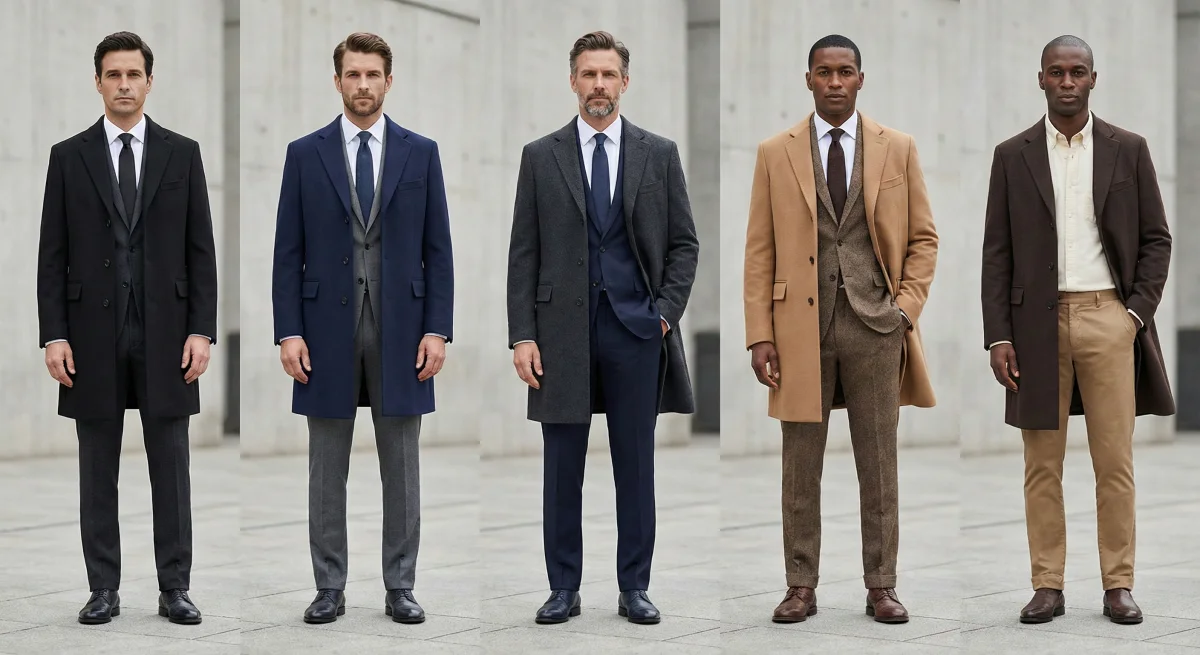
- Black overcoats: A black overcoat represents the ultimate in versatility and formal authority. This color coordinates effortlessly with virtually any suit or casual outfit, maintains its appearance longer than lighter colors, and projects sophisticated professionalism. Black proves essential for black-tie events and formal winter occasions. For maximum utility, choose black coats in smooth, tightly woven fabrics that emphasize sleekness.
- Navy overcoats:Navy provides vibrant depth that distinguishes itself from black while remaining equally professional. A quality navy overcoat pairs beautifully with grey suits, creating sophisticated color contrast. It also works with navy suits when the coat fabric includes subtle texture or pattern to prevent a flat, monotone appearance.
- Charcoal grey overcoats: Charcoal offers conservative elegance with slightly more versatility than black for daytime business wear. This color complements both warm and cool-toned suits and provides excellent continuity when worn with grey suits of similar tone.
- Camel and tan overcoats: Camel colored overcoats project relaxed confidence rooted in Ivy League and British heritage traditions. This warm, earthy tone pairs exceptionally well with navy, grey, and brown suits. The lighter color shows dirt more readily than darker options but offers incomparable style during crisp autumn and winter days.
- Dark brown overcoats: Deep brown, from chocolate to espresso tones, provides sophisticated warmth with excellent versatility. Brown pairs naturally with earth-toned wardrobes and complements both black and brown shoes, offering flexibility that pure black cannot match.
Notes:
- Textured blacks in herringbone or tweed patterns offer visual interest while maintaining the color's versatility.
- Navy's richness appears particularly distinguished in cashmere or cashmere-blend fabrics, where the fiber's luster enhances the color's depth.
- Medium grey overcoats work well for less formal professional contexts, offering approachability while maintaining sophistication.
- Camel works beautifully in both formal worsted wools and more casual textured fabrics like herringbone or tweed.
- Brown overcoats in rich, lustrous fabrics project understated wealth and discerning taste, particularly aligned with the current "quiet luxury" aesthetic.
5.2. Modern and statement colors
- Contemporary menswear has expanded acceptable color palettes beyond traditional options:
- Olive green offers military heritage with modern edge, working particularly well in casual and business casual contexts.
- Burgundy and wine tones provide rich, distinguished alternatives for men seeking subtle distinction without bold statements.
- Lighter greys, from pearl to slate, work beautifully in transitional seasons and less formal professional environments.
- Bold colors like mustard yellow or forest green suit more creative professional fields or weekend wear but require carefully considered coordination.
5.3. Color coordination guide
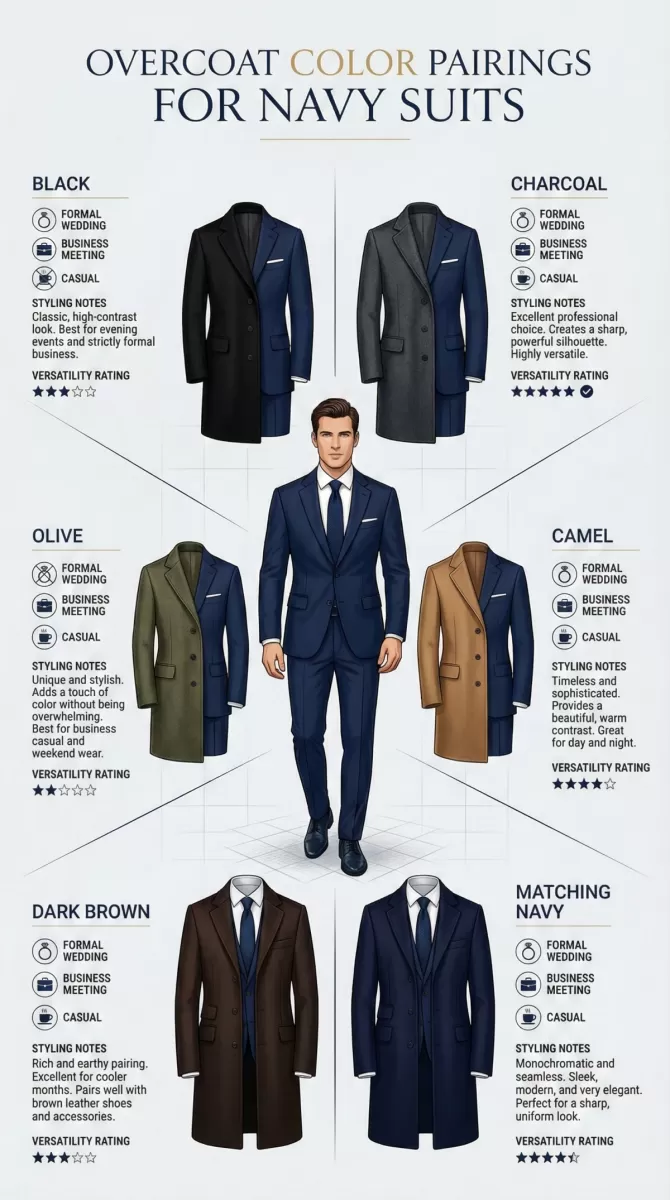
Selecting an overcoat color that harmonizes with your existing wardrobe maximizes versatility:
For maximum versatility in a first overcoat, we recommend navy or charcoal grey in a smooth, high-quality wool. These colors provide the broadest coordination options across professional and formal contexts.
6. How to choose the perfect overcoat for your body type
One of the most overlooked aspects of overcoat selection is how different styles and proportions flatter various body types. At Dunnio Tailor, we emphasize personalized fit recommendations to ensure your long coat for men enhances your natural proportions.
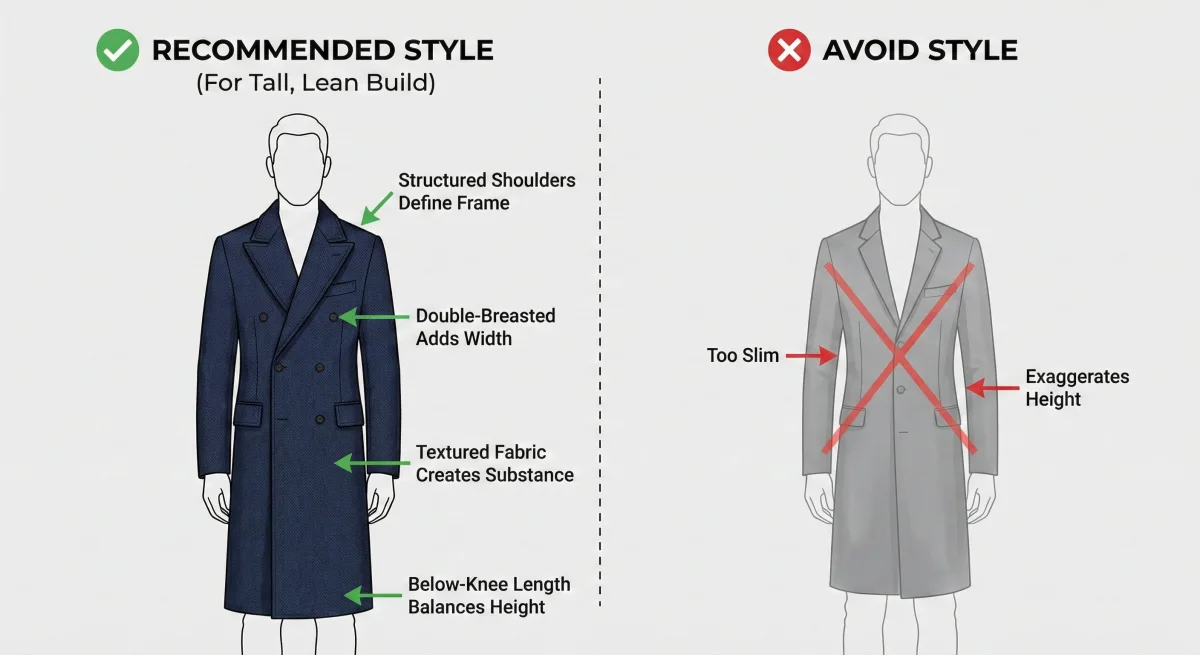
6.1. Overcoats for tall and slim/thin/lean men
Tall, lean gentlemen face the challenge of avoiding a coat that exaggerates height or makes the frame appear too slender.
Recommendations:
- Choose double-breasted styles or coats with broader lapels to add visual width across the chest.
- Opt for textured fabrics like herringbone, houndstooth, or tweed that create visual substance.
- Select full-length coats that reach below the knee rather than mid-calf lengths that can make you appear even taller.
- Consider Italian or British structured silhouettes that define the shoulders rather than unstructured American sack styles.
- Embrace horizontal design elements like patch pockets or belt details that break vertical lines.
Avoid:
- Ultra-slim modern cuts that emphasize narrowness.
- Mid-calf lengths that exaggerate height.
- Very dark, solid colors in smooth fabrics that create a stark vertical line.
- Coats that are too short, which can make legs appear disproportionately long.
6.2. Overcoats for big-bellied/heavier/fuller men
Gentlemen with fuller builds should focus on coats that provide comfortable coverage while creating clean, elongating lines.
Recommendations:
- Prioritize single-breasted styles with a straight or very subtle taper to avoid pulling across the midsection.
- Choose longer lengths (below knee) that balance proportions rather than ending at the widest point.
- Select structured shoulders that define the upper body and create a balanced V-shape silhouette.
- Opt for darker colors in smooth fabrics that create sleek, vertical lines.
- Ensure adequate room through the chest and midsection without excessive fabric that adds bulk.
- Consider coats with strategic drape rather than tight fits that emphasize the midsection.
Avoid:
- Double-breasted styles that add visual bulk and may pull when buttoned.
- Coats that end precisely at your widest point (typically hip level).
- Very slim modern cuts that strain across the body.
- Horizontal patterns or design elements that emphasize width.
- Insufficient fabric that creates pulling or stress lines.

6.3. Overcoats for shorter men
Height-conscious gentlemen should select coats that create vertical lines and proper proportions.
Recommendations:
- Choose three-quarter or slightly shorter lengths (just at or slightly below the knee) rather than mid-calf.
- Emphasize vertical lines through single-breasted styles, notch lapels, and minimal horizontal breaks.
- Opt for monochromatic combinations where your overcoat closely matches your trouser color.
- Select fitted silhouettes that follow your natural lines without excess fabric.
- Consider modern slim cuts that create sleek proportions.
Avoid:
- Full-length coats that overwhelm your frame.
- Very heavy fabrics that add visual weight.
- Oversized, boxy fits with excessive fabric.
- Strongly contrasting coat and trouser colors that visually shorten the leg line.
- Wide, exaggerated lapels that dominate your proportions.
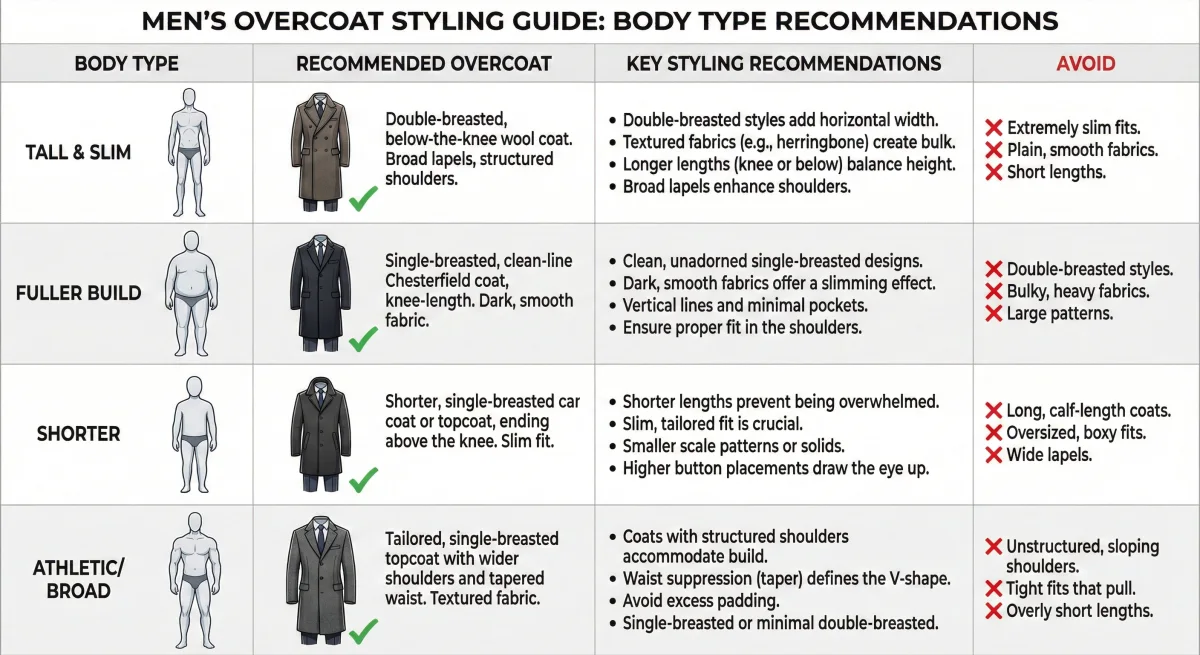
6.4. Overcoats for athletic/broad-shouldered men
Men with developed upper bodies need coats that accommodate shoulder width without adding unnecessary bulk elsewhere.
Recommendations:
- Choose Italian soft-shoulder construction that provides room without rigid padding.
- Select tapered silhouettes that follow from broad shoulders to a defined waist.
- Ensure adequate chest and shoulder measurements with professional fitting.
- Opt for flexible, draped fabrics rather than stiff, heavy materials.
- Consider raglan or set-in sleeves designed for movement.
Avoid:
- Overly structured British padding that exaggerates already broad shoulders.
- Straight, boxy American cuts that don't acknowledge your natural taper.
- Fabrics too stiff to drape properly over muscular builds.
- Coats sized up for shoulder room but consequently too large everywhere else.
Perfect fit for your unique build: Experience our 3D customization technology to design 3-piece suits and jackets tailored precisely to your measurements. See how different styles work with your proportions before you order.
7. Overcoat occasions and styling guide
Understanding when and how to wear different overcoat styles ensures you always present appropriately for the occasion.
7.1. Formal occasions
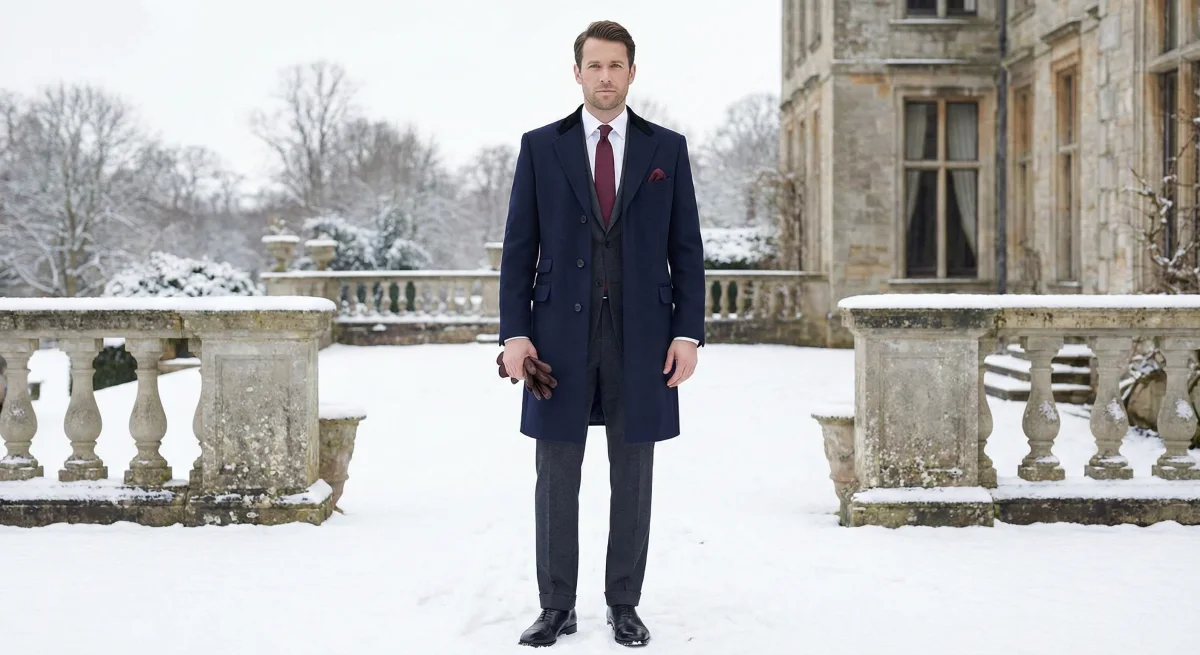
- Winter weddings - guest attire: As a winter wedding guest, your overcoat serves as the first impression you make upon arrival. Select a formal style in a conservative color that complements your custom suit without overwhelming it. For black-tie wedding events, choose a black or midnight blue cashmere or wool overcoat with clean, minimal lines. A Chesterfield style with a velvet collar provides traditional elegance. Pair it with a perfectly tailored custom tuxedo. Ensure your coat is immaculately maintained and fits perfectly, as wedding photography will capture your arrival. For formal daytime weddings, charcoal or navy overcoats pair beautifully with morning dress or dark lounge suits. The coat should be long enough to cover your suit jacket completely, maintaining a polished line.
- Winter weddings - groom and groomsmen: The groom should view his overcoat as an extension of his wedding ensemble, not a disparate element. Coordinate your overcoat color with your primary wedding attire: black with a custom tuxedo, charcoal or navy with a formal suit.
- Black-tie events: Traditional black-tie etiquette calls for a black or midnight blue overcoat in cashmere, superfine wool, or a wool-cashmere blend. The coat should feature minimal detailing, clean lines, and impeccable tailoring to complement your custom tuxedo.
- Formal daytime events: Morning dress for traditional daytime formal events pairs with a mid-length to full-length overcoat in Oxford grey, charcoal, or black. The coat must not interfere with the morning coat's distinctive tails, so ensure adequate length and a cut that accommodates this unique silhouette.
Notes:
- Always check your overcoat immediately upon entering the reception venue. Leaving it on or draping it over your chair detracts from your formal appearance and the event's aesthetic.
- For outdoor photography, a quality overcoat provides both warmth and sophisticated visual interest. Consider coordinating groomsmen in matching or complementary overcoats for cohesive group photographs.
- A Chesterfield remains the safest choice, though a well-tailored Crombie or even a refined paletot works for contemporary interpretations. Ensure your coat is completely removed before entering the main event space, as wearing outerwear over black-tie dress indoors constitutes a significant breach of etiquette.
Planning your wedding attire? Discover our complete wedding collection: custom wedding suits, linen wedding suits for warm-weather celebrations, custom tuxedos, and custom wedding vests. Design your perfect look with our 3D tuxedo customizer.
7.2. Business and professional settings
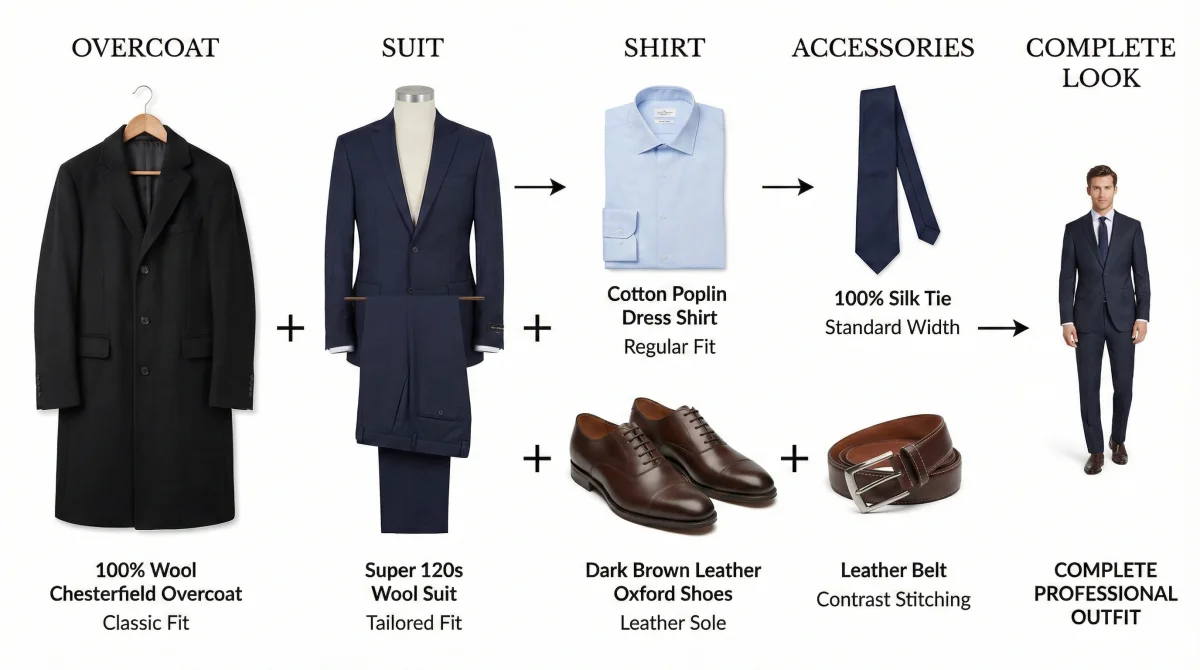
- Corporate formal environments: In conservative professional fields like law, finance, and corporate leadership, your overcoat signals attention to detail and professional standards. The Chesterfield and Crombie styles represent the gold standard when worn over your custom suits and custom jackets. Select navy, charcoal, or black in smooth, high-quality wool. Cashmere blends project success and discernment without ostentation. Ensure proper length (at or just below the knee) and structured shoulders that align with your suit jackets.
- Business casual settings: More relaxed professional environments allow for covert coats, car coats, and polo coats in broader color palettes. Camel, tan, olive, and lighter greys work beautifully.
- Creative and non-traditional professional fields: Creative industries, startups, and less traditional professional contexts allow for personal expression through your choice of overcoat. Consider bold colors, interesting textures, unconventional lengths, or heritage patterns that reflect your personal style while maintaining quality and good fit.
Notes:
- Your overcoat should be immaculately maintained, free from pills, stains, or wear, as it serves as your professional "package" arriving at and departing from important meetings and client interactions.
- Textured fabrics like herringbone or subtle patterns add visual interest while maintaining professionalism. These coats pair well with blazers, sport coats, or even elevated knitwear rather than requiring formal suits underneath.
7.3. Casual and weekend wear
- Smart casual occasions: For upscale restaurants, cultural events, or refined social gatherings, your mens overcoat elevates casual ensembles. A quality navy or grey overcoat transforms well-fitted jeans, a button-down shirt, and leather boots into a sophisticated casual outfit.
- Weekend and leisure: For weekend errands, casual dining, or relaxed social activities, shorter car coats or casual topcoats in earthy tones provide practical warmth without overdressing.
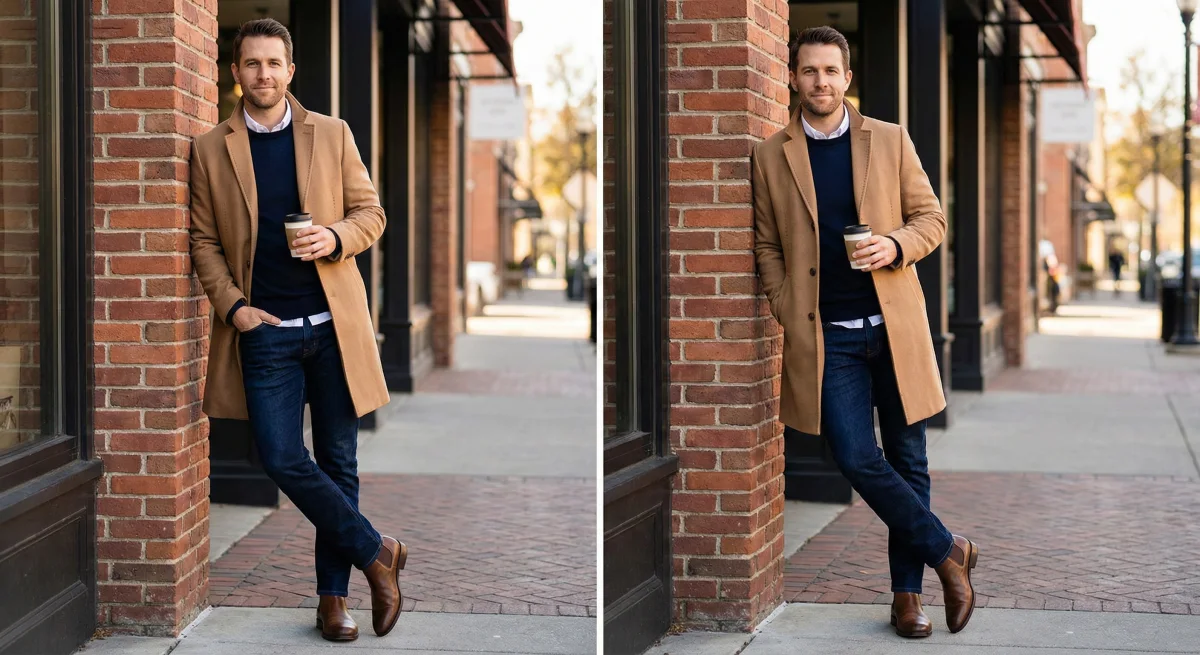
Notes:
- Polo coats, covert coats, and textured Crombies work particularly well in these contexts, projecting intentional style without formality.
- Tweed overcoats, duffle coats, and other heritage-inspired styles project relaxed sophistication. These pair naturally with knitwear, casual shirts, denim, and chinos.
7.4. Complete outfit formulas
Understanding full coordination helps you compose cohesive looks:
- Formal winter wedding guest: Navy Chesterfield overcoat + charcoal wool suit + white dress shirt + burgundy silk tie + black Oxford shoes + charcoal accessories.
- Black-tie event: Black cashmere overcoat + midnight blue tuxedo + white formal shirt + black bow tie + black patent leather shoes.
- Executive business meeting: Charcoal Crombie overcoat + navy suit + light blue shirt + navy tie + dark brown leather shoes + matching belt.
- Business casual office: Camel covert coat + grey wool trousers + burgundy merino sweater + white Oxford shirt + brown Chelsea boots.
- Smart casual evening: Navy overcoat + dark indigo jeans + navy crew neck sweater + white shirt (no tie) + brown leather boots + grey scarf.
- Weekend errands: Olive green car coat + khaki chinos + brown cable knit sweater + casual button-down + leather sneakers or desert boots.
8. How to wear and style an overcoat
Proper styling extends beyond simply putting on your mens long coat. Understanding layering, proportion, and complementary accessories ensures you maximize your overcoat's impact.
8.1. Layering principles
The fundamental purpose of an overcoat is to be worn over other garments, so proper layering prevents both discomfort and poor appearance.
- Over suits and tailored jackets: Your overcoat must accommodate your suit jacket without constraint or bunching. When being fitted, wear the coat over your typical business suit to ensure adequate room through the shoulders, chest, and sleeves. The coat's shoulders should extend slightly beyond your suit jacket's shoulders, typically a quarter to half inch. This provides room for the suit jacket's padding and prevents a cramped appearance.
- Over casual layers: When wearing your overcoat casually over sweaters, knitwear, or layered shirts, you have more flexibility. However, avoid excessive bulk from multiple heavy layers that distort the coat's silhouette or prevent proper closure.
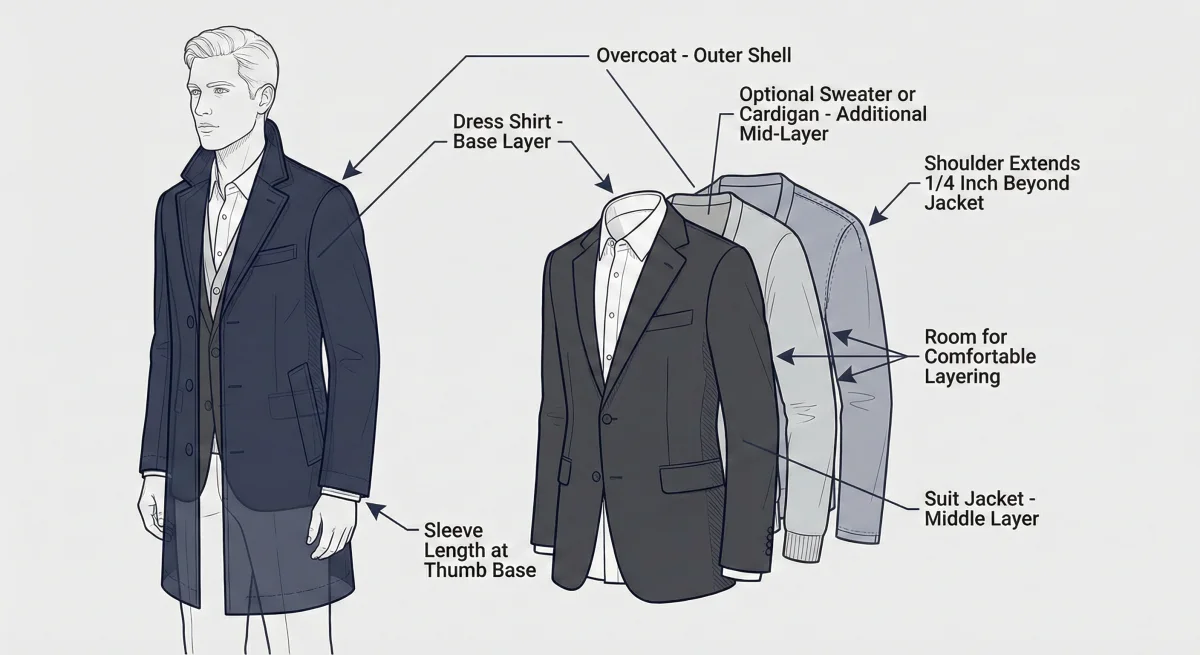
Notes:
- Sleeve length should terminate at the base of your thumb, completely covering your suit jacket sleeves. Unlike suit jackets, where a half-inch of shirt cuff shows, overcoats should fully enclose all inner layers to prevent cold air ingress.
- A typical casual layering combination might include a shirt, a lightweight merino or cashmere sweater, and the overcoat. This provides warmth without the structured bulk of a suit jacket.
8.2. Buttoning etiquette
Unlike suit jackets with strict buttoning rules, overcoat etiquette offers more flexibility based on temperature, formality, and personal preference.
- Single-breasted overcoats: You may button all buttons, only the top button, or leave the coat open depending on weather and aesthetics. For warmth, button all buttons. For a more relaxed appearance, particularly when the coat is longer and you're moving between venues, leave all buttons undone or fasten only the top button.
- Double-breasted overcoats: Double-breasted styles should always be buttoned when standing, as their design depends on the closure for proper drape and silhouette. Leave them unbuttoned only when seated for extended periods.
Notes: When sitting in a car or at a restaurant, unbutton your overcoat to prevent pulling and creasing.
8.3. Accessories and finishing touches
The right accessories elevate your overcoat from merely functional to genuinely stylish.
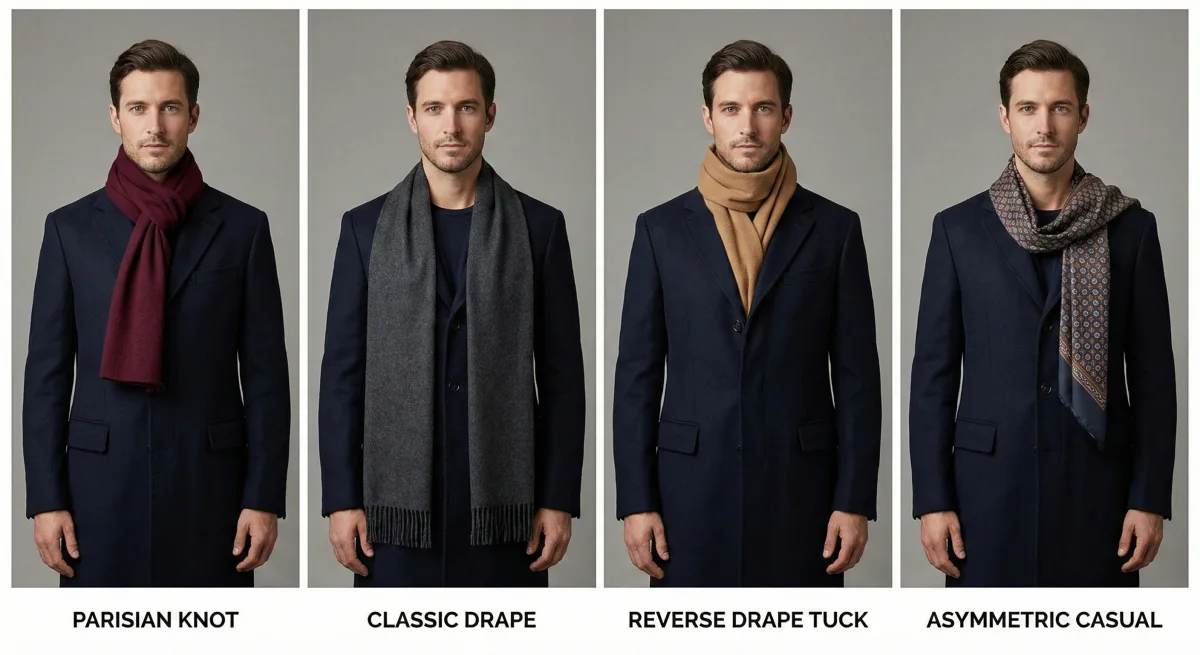
- Scarves: A quality scarf provides additional warmth while adding color, texture, and visual interest. For formal contexts, choose solid colors or subtle patterns in cashmere, merino wool, or silk-wool blends. Classic scarf colors that complement most overcoats include burgundy, navy, charcoal, cream, and camel. Ensure your scarf coordinates with your overall color palette without exactly matching any single element.
- Gloves: Leather gloves project refinement and formality, particularly in black or dark brown. Ensure they fit properly, neither too tight (restricting movement) nor too loose (appearing sloppy).
- Hats: While less common in contemporary dress, fedoras, trilbies, and flat caps can complement traditional overcoat styles, particularly heritage designs like polo coats or covert coats. Ensure your hat coordinates in both color and formality level with your coat.
Notes:
- Draping methods range from the simple European loop to more relaxed, casual wraps. For business contexts, keep scarves neat and contained rather than voluminous or overly casual.
- For less formal occasions, wool or wool-blend gloves in coordinating colors provide warmth with a relaxed aesthetic.
8.4. Footwear pairing
Your shoes must align with your overcoat's formality level and overall outfit.
- With formal overcoats: Black or dark brown Oxford shoes, Chelsea boots, or dress boots complement formal Chesterfields and Crombies worn over suits. Ensure shoes are immaculately maintained and appropriately polished.
- With casual overcoats: Desert boots, chukka boots, leather sneakers, or casual Chelsea boots work well with relaxed overcoat styles worn over casual layers. The key is visual cohesion between the refinement level of your coat and your footwear.
Build your complete coordinated wardrobe: Design custom suits, custom jackets, and custom pants that pair perfectly with your overcoat. Our 3D customization tool lets you visualize complete outfit combinations before ordering.
9. Overcoat care and maintenance
A quality overcoat for men represents a significant investment that, with proper care, will serve you for 10 to 20 years or longer. Implementing disciplined maintenance practices protects this investment.
9.1. Cleaning best practices
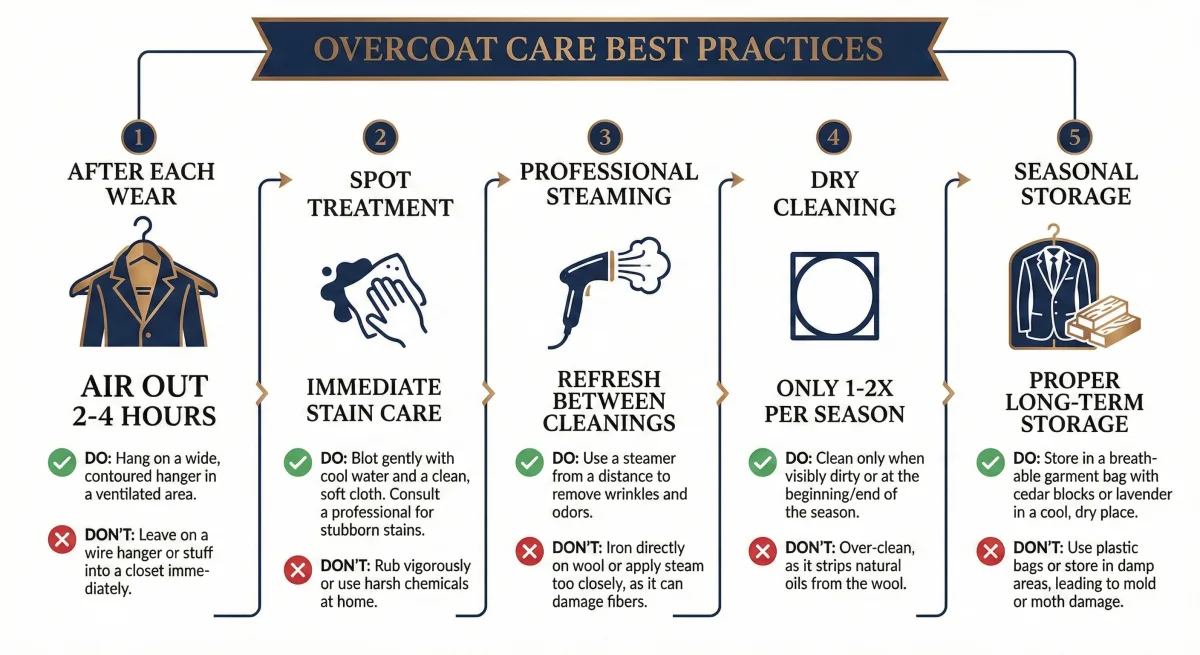
- Avoid over-dry cleaning: Many men over-clean their overcoats, assuming they require the same frequency as shirts or even suits. Excessive dry cleaning strips the natural lanolin from wool fibers, making them brittle, dull, and prone to damage.
- Professional steaming: Steam treatment offers an excellent alternative for refreshing your coat between cleanings. Professional steaming releases wrinkles, revitalizes fibers, and eliminates odors without the harsh chemical process of dry cleaning.
- Spot treatment: Address stains immediately before they set. For water-based marks, blot (never rub) with a clean, absorbent cloth. For oil-based stains, apply a small amount of talcum powder or cornstarch to absorb the oil before gently brushing away.
Notes:
- For most wearers, professional dry cleaning once or twice per season provides sufficient maintenance. Spot-clean minor marks immediately with a damp cloth and mild detergent appropriate for wool.
- Many high-end tailors and specialty cleaners offer steaming services, or you can invest in a quality home steamer for regular maintenance.
- For significant stains, consult a specialist cleaner rather than attempting aggressive home treatments that might damage the fabric.
9.2. Proper storage
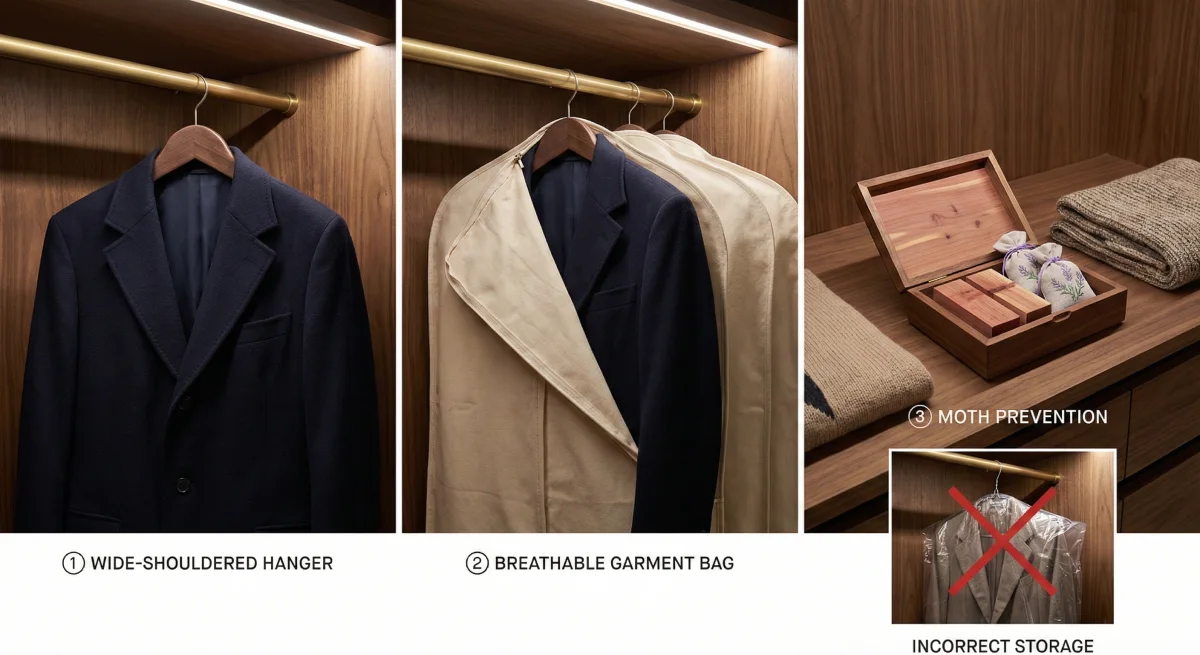
- Daily hanging: After each wear, hang your overcoat on a wide-shouldered wooden hanger that supports the coat's weight without distorting the shoulder padding or internal canvas. Wire hangers or narrow plastic hangers will eventually damage the shoulder structure.
- Seasonal storage: At season's end, have your overcoat professionally cleaned before storage, even if it appears clean. Body oils, environmental pollutants, and invisible stains can oxidize and become permanent during extended storage. Store your coat in a breathable fabric garment bag, never plastic dry-cleaning bags that trap moisture and promote mold growth. Cedar blocks or sachets deter moths without the harsh chemical scent of mothballs.
Notes:
- Allow the coat to air out for several hours before returning it to a closet, as this permits moisture from your body heat and environmental humidity to evaporate.
- Ensure storage areas maintain moderate temperature and humidity. Extreme conditions degrade natural fibers over time.
9.3. Seasonal rotation and rest periods
Like high-quality leather shoes, fine wool and cashmere coats benefit from rest periods between wears. The natural fibers need time to release absorbed moisture and return to their original shape.
If possible, rotate between two overcoats during peak winter season, allowing each at least a day of rest between wears. This practice significantly extends both coats' lifespans.
For single-coat owners, simply hanging your coat properly and allowing it to air thoroughly between wears provides adequate recovery.
10. Understanding overcoat construction quality
Recognizing quality indicators helps you make informed purchasing decisions and understand value differences across price points.
10.1. Canvassed vs. fused vs. unstructured construction
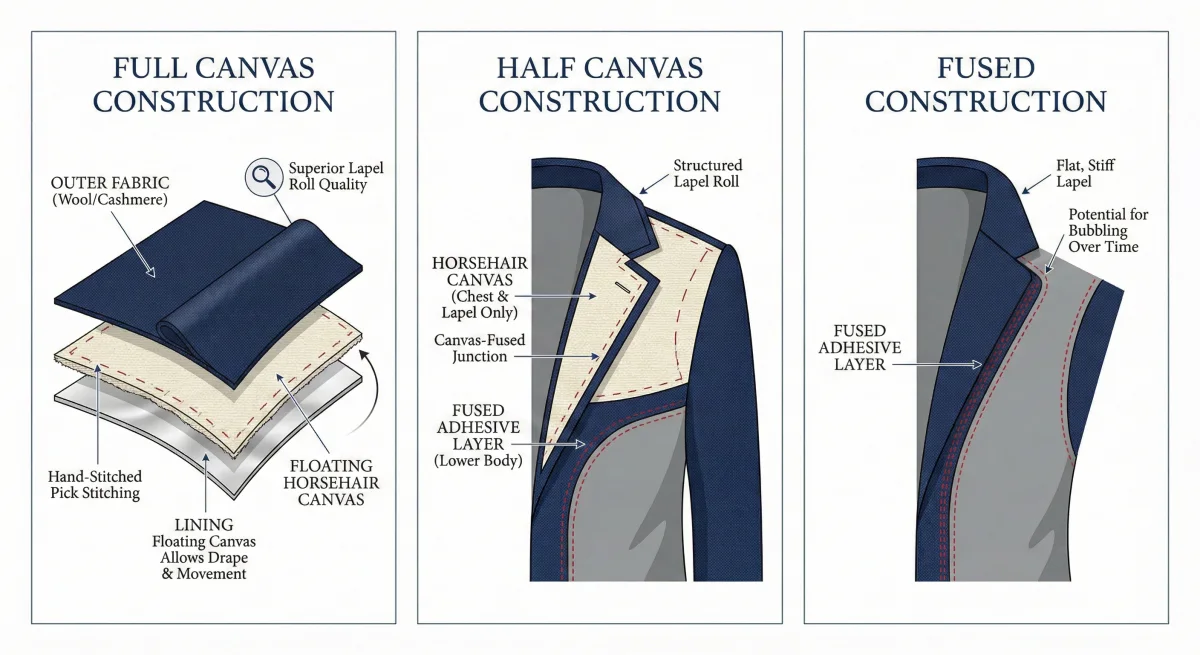
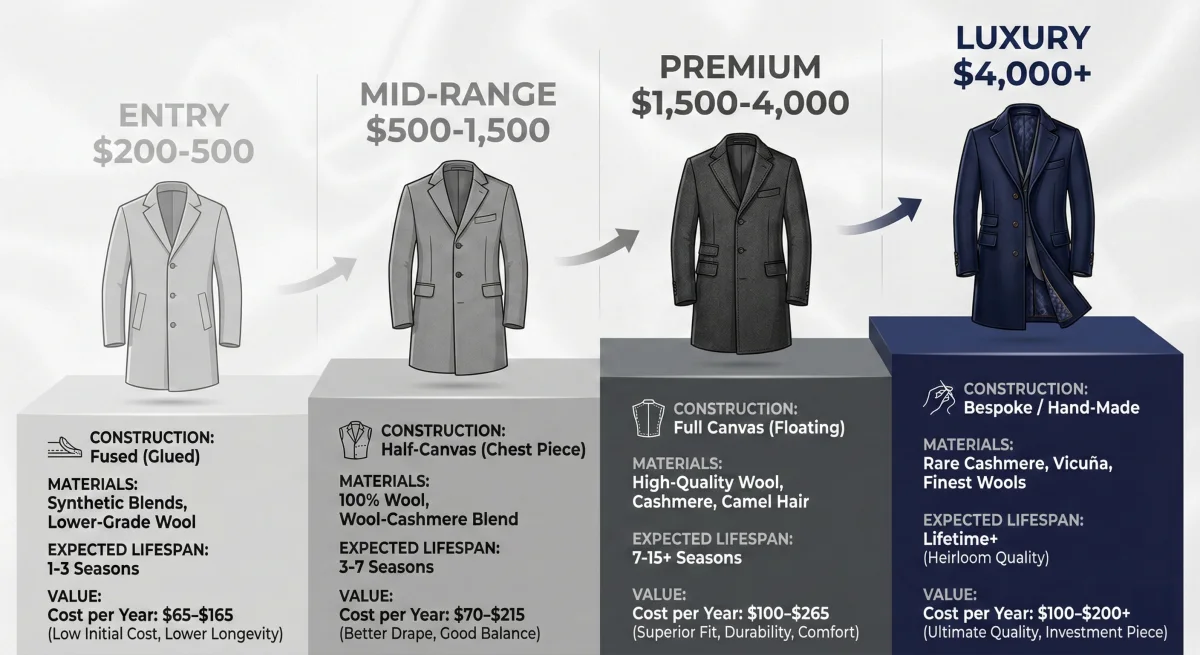
- Full canvas construction: The highest quality standard involves a layer of horsehair and wool canvas hand-stitched between the outer fabric and lining. This floating canvas remains unattached to the outer fabric in the chest area, allowing the coat to drape naturally and mold to your body over time.
- Half canvas construction: A balanced approach where canvas extends through the chest and lapels but not the entire coat. This provides many benefits of full canvas, particularly the critical lapel structure and chest drape, at reduced cost.
- Fused construction: Heat-activated adhesive bonds a synthetic interlining to the outer fabric. This manufacturing method reduces both cost and labor time significantly.
- Unstructured construction: Some casual overcoats, particularly in Italian styling, intentionally eliminate canvas entirely for a soft, relaxed drape. This isn't a cost-cutting measure but a deliberate aesthetic choice.
Notes:
- Full canvas construction provides superior shape retention, a graceful lapel roll, and longevity that justifies premium pricing. This traditional method requires significantly more labor, contributing to higher costs.
- For most professional men, half-canvas represents an excellent value proposition, delivering notably better performance than fused construction at a fraction of full-canvas pricing.
- While fused coats can perform adequately for infrequent wear or less formal contexts, they lack the refined drape of canvas construction. Over time and with cleaning, the glue can delaminate, causing bubbling or separation between layers.
- Unstructured coats offer maximum comfort and a contemporary casual appearance but sacrifice the crisp formality of structured options.
10.2. Quality indicators to examine
When evaluating an overcoat for men, examine these details:
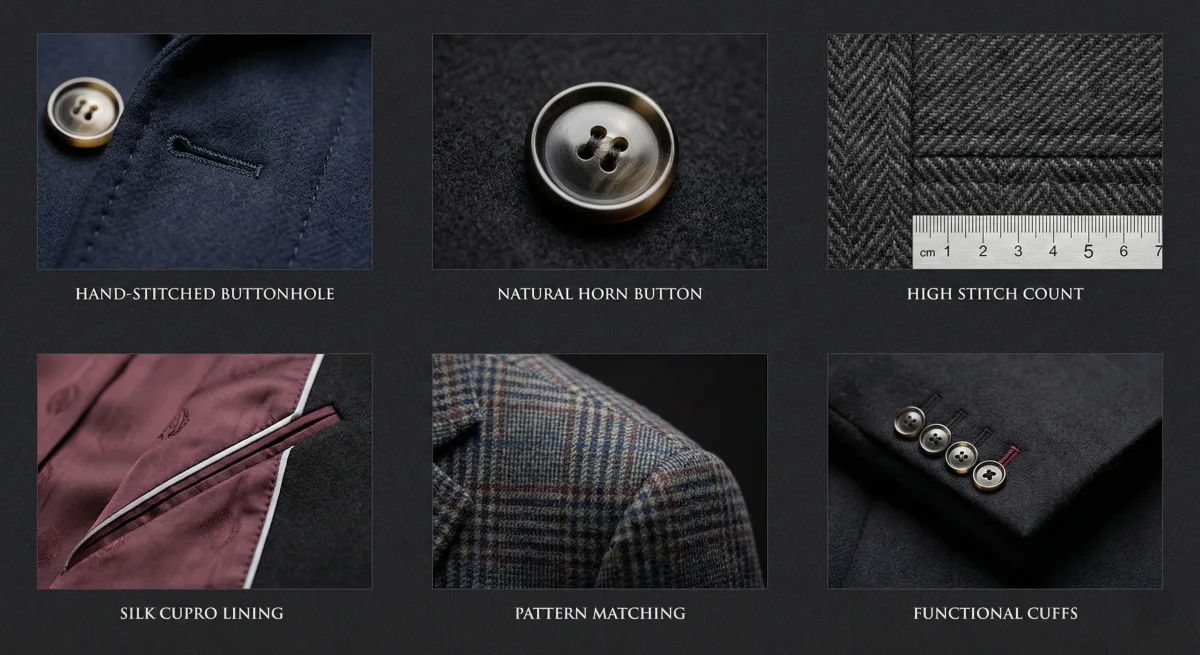
- Stitches per centimeter: Premium construction features at least 8 to 10 stitches per centimeter in seams and hems. Denser stitching provides superior strength and indicates careful manufacturing.
- Button quality: Horn, corozo (vegetable ivory), or mother-of-pearl buttons signal quality and attention to detail. These natural materials develop character over time and can be re-polished if scratched.
- Lining quality: Quality linings use cupro, rayon bemberg, or silk that drapes smoothly and resists static. Check that lining is cleanly installed without puckering or pulling.
- Functional buttonholes: Functional sleeve buttonholes (often called surgeon's cuffs) indicate either bespoke construction or premium ready-to-wear. While purely aesthetic since overcoat sleeves are rarely unbuttoned, they demonstrate commitment to detail.
- Pattern matching: Quality construction ensures fabric patterns align precisely at seams, particularly at the shoulders and across the back. Misaligned patterns indicate rushed manufacturing or inadequate fabric allocation.
Notes:
- Plastic buttons, while functional, indicate cost reduction and lack the subtle luster and substance of natural materials.
- Some premium coats feature partially unlined or skeleton-lined construction, reducing weight and improving breathability while highlighting the outer fabric's quality.
10.3. Brand tiers and expectations
Understanding typical quality standards across price ranges helps calibrate expectations:
- Entry level ($200-$500): Expect fused construction, wool-synthetic blend fabrics, and machine-made buttonholes. These coats serve adequately for occasional wear and limited budgets but won't develop character or last decades.
- Mid-range ($500-$1,500): This sweet spot typically offers half-canvas construction, quality 100% wool or wool-cashmere blends from reputable mills, proper lining, and good finishing details. Brands like Suitsupply and Reiss occupy this space effectively.
- Premium ($1,500-$4,000): Full or half-canvas construction in premium fabrics like pure cashmere or superfine wool, natural-material buttons, meticulous finishing, and often some degree of customization. Brands like Brunello Cucinelli and Corneliani represent this tier.
- Luxury and bespoke ($4,000+): Full canvas construction, exotic natural fibers like vicuña or baby camel hair, entirely handmade elements, bespoke fit, and often limited production or made-to-order manufacturing. Loro Piana and Savile Row tailors exemplify this category.
11. Buying guide: how to shop for your perfect overcoat
Purchasing your ideal mens long coat requires understanding fit essentials, shopping channels, and budget considerations.
11.1. Fit essentials
When trying on overcoats, evaluate these critical fit points:
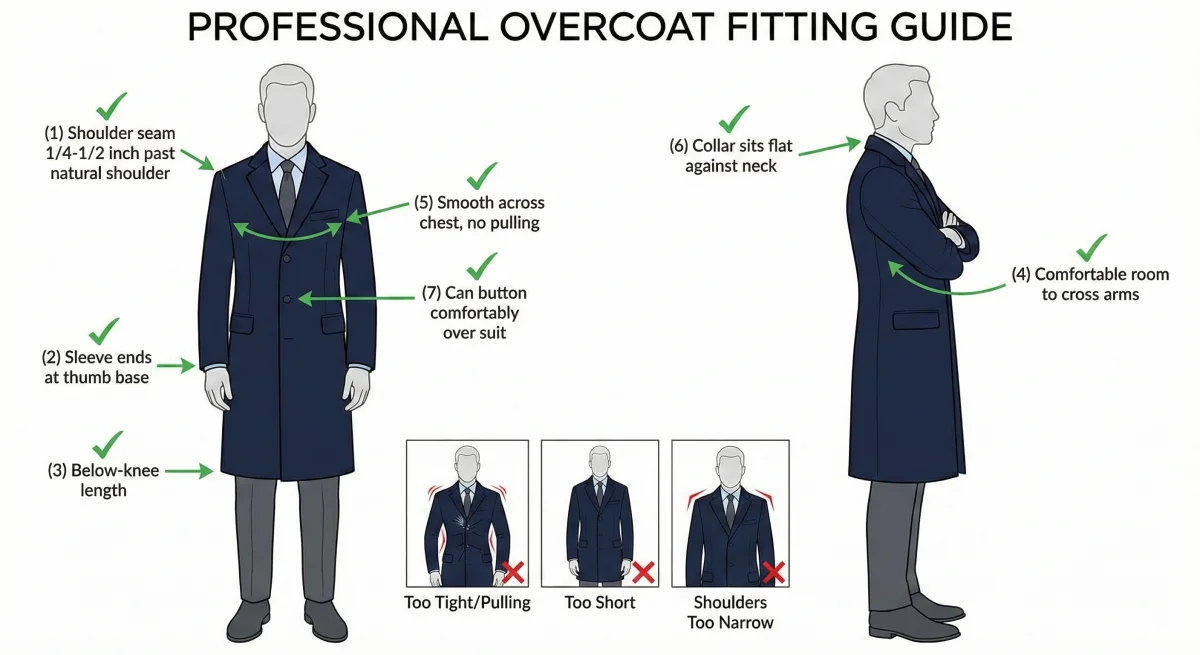
- Shoulder fit: The coat's shoulder seam should sit slightly beyond your natural shoulder bone, typically a quarter to half-inch past where your suit jacket's shoulder ends. This accommodation prevents the coat from feeling tight when worn over a jacket.
- Sleeve length: Overcoat sleeves should terminate at the base of your thumb when your arms hang naturally. This fully covers suit jacket sleeves and shirt cuffs, eliminating cold exposure.
- Overall length: Length selection depends on your height, intended formality, and personal preference. For professional and formal contexts, the coat should reach just below the knee. Taller men can accommodate longer lengths while shorter men should avoid mid-calf lengths that overwhelm proportions.
- Chest and waist: Button the coat and move naturally. You should be able to cross your arms comfortably and sit down without significant pulling. However, avoid excessive room that creates a sloppy appearance.
Notes:
- The shoulder should lie smooth without divots, pulling, or excess fabric bunching. If you see stress lines radiating from the shoulder or if fabric collapses inward, the coat is too small.
- Many quality overcoats offer unbuttoned sleeves, allowing for alterations. If you're between standard sizes, choose the longer sleeve length as shortening is easier than lengthening.
- The coat should follow your body's natural lines without clinging. For slim-fit styles, ensure tailoring is intentional rather than resulting from an undersized garment.
11.2. In-store vs. online shopping
- Professional fitting advantages: Purchasing from a knowledgeable tailor or specialty menswear retailer provides invaluable expertise. Professional fitters understand how an overcoat should sit, can recommend styles for your build, and often offer alteration services.
- Made-to-measure benefits: For men who struggle with standard sizing due to height, athletic builds, or proportional variations, made-to-measure overcoats provide customized fit without full bespoke pricing. Explore our custom 3-piece suits and custom jacket options with the same made-to-measure precision.
- Online shopping considerations: While online retailers offer convenience and sometimes better pricing, overcoat purchases present challenges. Without trying on the actual garment, fit becomes uncertain. If shopping online, thoroughly research the brand's sizing, read detailed customer reviews focusing on fit feedback, and confirm return policies before purchasing. Order from retailers offering free returns to allow risk-free home try-on.
Notes:
- At Dunnio Tailor, we emphasize comprehensive consultations that consider your wardrobe needs, climate, typical occasions, and personal preferences. This personalized approach ensures your investment serves you optimally.
- Made-to-measure allows fabric selection, style customization, and precise fitting, creating a unique garment that complements your specific requirements. Experience this level of customization with our interactive 3D design tools for suits, jackets, and vests.
- Take precise measurements following the retailer's instructions or, better, have a tailor measure you professionally.
11.3. Budget considerations
An overcoat represents a long-term wardrobe investment, so approach budgeting strategically.
- Investment piece philosophy: A quality mens overcoat for $1,000 that serves you impeccably for 15 years costs approximately $65 per year. An entry-level coat at $300 that looks worn after 3 years costs $100 annually.
- Cost-per-wear calculation: Consider how frequently you'll wear your overcoat. For men in cold climates who wear their coat daily for five months annually, even a $2,000 investment reaches cost-effectiveness quickly. Someone in a mild climate wearing a coat occasionally may find mid-range options more appropriate.
- When to splurge vs. save: Prioritize investment in your primary overcoat: the navy or charcoal coat you'll wear most frequently for professional and formal occasions. This deserves the best fabric and construction you can afford.
Notes:
- Beyond pure economics, the superior appearance, comfort, and confidence provided by a well-constructed coat in premium fabric delivers unquantifiable value throughout countless professional interactions and special occasions.
- Secondary coats for casual wear or specific purposes can occupy lower price points without compromising your overall wardrobe quality.
11.4. Australian market recommendations
For Australian gentlemen, climate considerations significantly influence overcoat selection.
- Climate-appropriate selections: Brisbane and coastal Queensland rarely require heavy overcoats. Lightweight wool topcoats (16 oz or less) or unlined options provide adequate warmth without causing discomfort. Sydney and Adelaide benefit from versatile 18-ounce wool coats that handle cool mornings and evenings while remaining comfortable during milder days.
- Local retailers vs. international brands: Australian retailers like M.J. Bale and Institchu offer locally tailored options accounting for our climate and aesthetic preferences. International brands through Suitsupply's Australian locations provide European styling and quality.
- Seasonal buying strategy: Australian winter stock arrives in May and June, offering full selection but premium prices. End-of-season sales in August and September provide significant discounts, though size and style selection diminishes.
Note:
- Melbourne, Canberra, and Tasmania justify traditional 20-ounce wool overcoats given colder, more variable winters.
- For premium and made-to-measure options, Australian tailoring houses like Dunnio Tailor offer personalized service accounting for Australian climate, lifestyle, and professional contexts.
- For best value, shop early-to-mid season when selection remains strong and minor markdown promotions begin.
Experience personalized Australian tailoring at Dunnio Tailor. Schedule a consultation to find your perfect made-to-measure overcoat and build a complete formalwear wardrobe with our custom suits, custom 3-piece suits, custom jackets, and custom pants collections.
12. Current trends: the overcoat in modern menswear (2025-2026)
Understanding contemporary trends helps you select an overcoat that feels current while maintaining timeless appeal.
12.1. Quiet luxury and stealth wealth
The dominant aesthetic of 2025-2026 emphasizes invisible quality over conspicuous branding. This "quiet luxury" movement prioritizes:
- Minimal or absent external branding: Logos and visible brand identifiers are deliberately eliminated in favor of subtle details only recognized by the knowledgeable. A coat's quality is communicated through hand-feel, drape, and finishing details rather than prominent labels.
- Superior natural materials: Investment in 100% cashmere, superfine merino wool, and other premium natural fibers takes precedence over synthetic technical fabrics or lower-grade blends. The tactile experience of wearing exceptional materials becomes paramount.
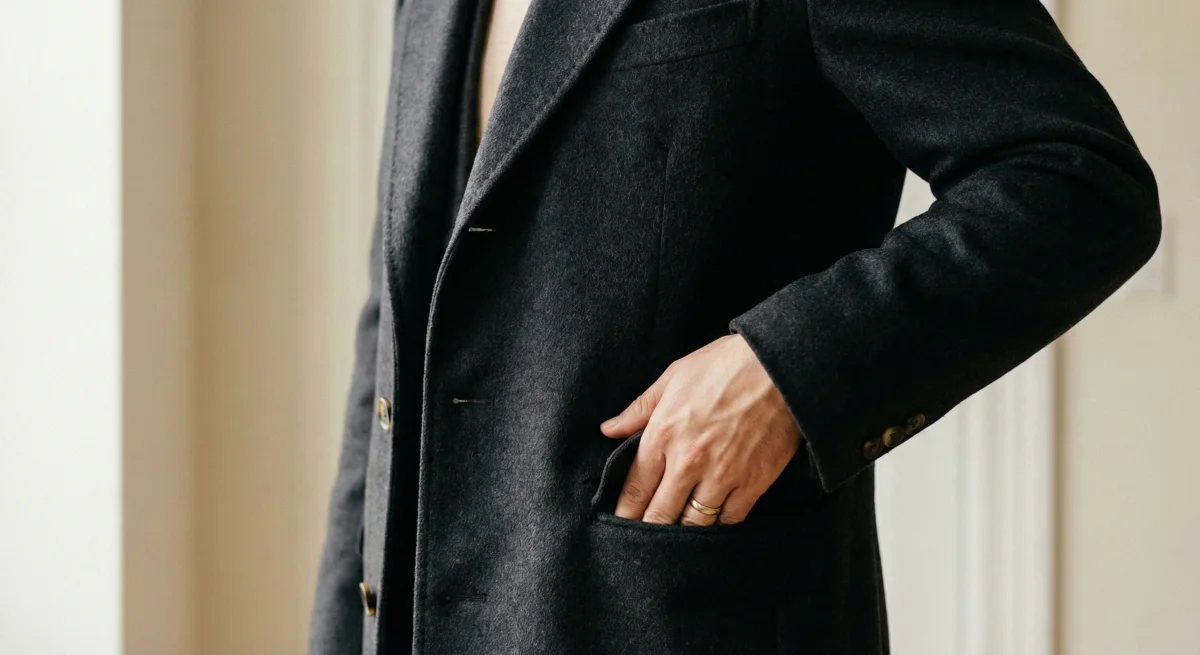
- Impeccable construction: Full or half-canvas construction, hand-stitched details, and natural horn buttons represent the kind of invisible quality that defines quiet luxury. These elements aren't immediately visible but fundamentally distinguish premium garments.
- Classic silhouettes: Rather than trend-driven designs, quiet luxury favors timeless styles like the Chesterfield and Crombie in conservative colors. The goal is an overcoat that appears equally appropriate today and in twenty years.
12.2. Old money aesthetic
Closely related to quiet luxury, the "old money" aesthetic uses traditional elements as cultural shorthand for generational sophistication.
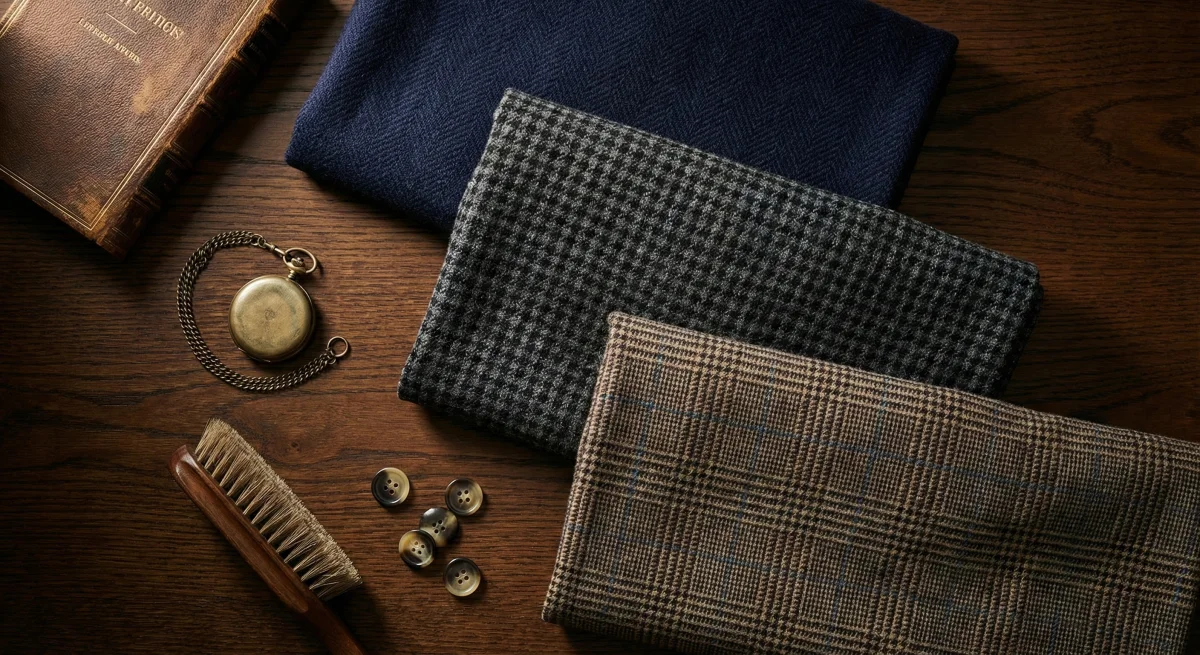
- Heritage patterns: Herringbone has experienced massive resurgence in 2025-2026. This chevron-like weave appears solid from distance but reveals intricate texture up close, providing visual interest without ostentation. Houndstooth in smaller scales (often called dogtooth) projects classic British elegance. Larger-scale houndstooth appeals to more adventurous dressers and creative professionals.
- Classic colors and natural tones: The old money palette emphasizes navy, charcoal, Oxford grey, camel, and rich browns. These colors reference decades of upper-class menswear tradition.
- Traditional construction and details: Velvet collars on Chesterfields, ticket pockets, surgeon's cuffs, and subtle design elements reference tailoring traditions spanning generations. These details signal understanding of sartorial heritage.
Notes:
- Glen plaid and Prince of Wales check patterns evoke aristocratic sporting heritage, particularly in lighter-weight coats for transitional seasons.
- Natural, undyed camel hair and oatmeal tones project understated confidence rooted in heritage rather than trend.
12.3. Technical innovation meets tradition
While aesthetic trends favor tradition, fabric technology continues advancing.
- Performance fabrics with classic appearance: Water-resistant wool treatments, wrinkle-resistant finishing, and technical membranes integrated into natural fibers allow overcoats to perform like modern outerwear while maintaining traditional aesthetics.
- Sustainable and ethical production: Increasingly, discerning consumers prioritize traceable, sustainable wool from certified farms practicing ethical animal husbandry. Plant-based water-repellent treatments replace chemical processes.
- Versatility and multi-functionality: Modern lifestyles demand coats that transition seamlessly from business meetings to casual dinners, from cold mornings to warmer afternoons, from domestic use to international travel.
Notes:
- These innovations particularly appeal to professionals who travel frequently or require versatility from a single coat.
- Brands like Loro Piana and Brunello Cucinelli have built premium positioning partly on transparent, ethical supply chains and environmental responsibility.
- Removable linings, convertible collars, and packable constructions address these needs while maintaining refined appearance.
Frequently asked questions
What is the difference between a coat and an overcoat?
- The terms are sometimes used interchangeably, but distinctions exist. An overcoat specifically refers to a long, substantial garment designed to be worn over indoor clothing like suits or blazers, primarily for cold weather protection. It emphasizes length (below knee), weight (typically 18-22 oz. fabric), and formality.
- "Coat" serves as a broader category encompassing all outer garments, including overcoats, topcoats, trench coats, parkas, and casual jackets. A coat may be purely functional, fashion-focused, or serve both purposes. An overcoat always prioritizes wearing over other garments and substantial weather protection.
What is the difference between a topcoat and an overcoat?
- The distinction centers on weight and intended season. An overcoat uses heavier fabrics (20-22 oz.) designed for deep winter and substantial cold. A topcoat utilizes lighter-weight materials (18 oz. or less) appropriate for fall, spring, and mild winter conditions.
- Topcoats often feature shorter lengths (at or above knee) and lighter construction. Examples include raincoats and trench coats. Overcoats extend below the knee and provide maximum warmth through thick wool, cashmere, or heavy wool blends.
- In practice, the terms sometimes overlap, particularly for 18-ounce wool coats that serve transitional purposes.
What temperature should you wear an overcoat?
- Overcoats perform optimally in temperatures below 10 degrees Celsius (50 degrees Fahrenheit). Traditional heavy overcoats in 22-ounce fabrics suit temperatures from minus 10 to plus 5 degrees Celsius.
- Lighter-weight overcoats around 18 ounces work comfortably from 0 to 10 degrees Celsius.
- For temperatures above 10-12 degrees Celsius, topcoats or lightweight jackets prevent overheating. Australian climates often require lighter-weight options than Northern hemisphere standards, with 16-18 ounce fabrics serving adequately for most winter conditions.
- Personal temperature tolerance varies, so some individuals wear overcoats in milder conditions while others prefer lighter layers.
Is an overcoat formal or casual?
- An overcoat occupies a broad spectrum depending on style, fabric, and color. Traditional Chesterfield and Crombie coats in smooth, dark fabrics qualify as formal, appropriate for business professional environments and black-tie events.
- Shorter car coats, textured fabrics like tweed or herringbone, and casual colors like olive or tan lean toward business casual and smart casual contexts.
- The key consideration is that an overcoat is outerwear designed to be removed indoors. Therefore, even formal overcoats don't carry the same strict etiquette as your underlying attire. You may wear a casual overcoat to a formal event, removing it upon entry, though coordinating formality levels creates visual harmony.
Should an overcoat be buttoned?
- Unlike suit jackets with specific buttoning rules, overcoat etiquette offers flexibility. The primary purpose is warmth, so buttoning your coat for protection is entirely appropriate.
- For single-breasted overcoats, you may button all buttons for maximum warmth, fasten only the top button for a more relaxed appearance, or leave the coat entirely unbuttoned in milder conditions or when moving between indoor spaces.
- Double-breasted overcoats should be buttoned when standing, as their design requires closure for proper drape. Leave them unbuttoned when seated for comfort.
- In all cases, unbutton when sitting in cars or at restaurants to prevent pulling and creasing.
What color overcoat with a navy suit?
- A navy suit offers exceptional versatility for overcoat pairing. The most classic and safe choices include black, charcoal grey, camel, or a matching navy.
- Black provides sleek, formal elegance while remaining appropriate across all professional and formal occasions. Charcoal grey offers slightly softer contrast while maintaining conservative sophistication.
- Camel creates beautiful contrast with navy, projecting refined, heritage-inspired style particularly suitable for daytime business and smart casual occasions.
- A matching navy overcoat works beautifully if your coat includes textural interest (herringbone, subtle pattern) that prevents a flat, monochromatic appearance.
- For more creative expression, dark brown, olive, or burgundy can complement navy suits, though these require more careful coordination.
How long should an overcoat be?
- Ideal length depends on your height, build, and intended formality. Traditional formal overcoats reach from just below the knee to mid-calf.
- For most men of average height (5'8" to 6'0"), the most versatile length terminates just below the knee, approximately at the lower third of the kneecap or slightly below. This provides substantial coverage while maintaining proportion and allowing easy movement.
- Taller men (over 6'2") can accommodate longer lengths extending to mid-calf without appearing overwhelmed. Shorter men (under 5'8") should consider lengths ending at or just below the knee to avoid overwhelming their frame.
- Casual car coats reaching mid-thigh suit business casual and relaxed occasions regardless of height.
Can you wear an overcoat with jeans?
- Absolutely. A quality overcoat elevates casual outfits, including well-fitted dark jeans. The key is selecting appropriate overcoat styles and ensuring overall coordination.
- For jeans and casual wear, choose less formal overcoat styles like polo coats, covert coats, or textured fabrics like herringbone and tweed. Colors like camel, navy, grey, olive, or brown work naturally with denim.
- Pair dark, well-fitted jeans with quality leather boots, a button-down shirt or refined knitwear, and your overcoat for sophisticated casual style. This combination works beautifully for upscale restaurants, cultural events, or refined social occasions.
- Avoid pairing extremely formal black Chesterfields with distressed or light-wash jeans, as the formality mismatch appears disjointed.
What's the best overcoat for fat men or men with a belly?
- Men carrying extra weight through the midsection should prioritize single-breasted overcoats with straight or very subtle tapers. These provide comfortable coverage without pulling across the stomach.
- Choose longer lengths extending below the knee to balance proportions rather than coats ending at your widest point. Structured shoulders create a defined upper body, establishing a V-shape silhouette that balances fuller midsections.
- Dark, solid colors in smooth fabrics create sleek vertical lines. Ensure adequate fabric through the chest and midsection without excessive material that adds visual bulk.
- Avoid double-breasted styles that add visual width and may strain when buttoned. Work with a knowledgeable tailor who can adjust the drape and proportions specifically for your build.
Do I need a different overcoat for the Australian climate?
- Australian winters, particularly in Brisbane, Sydney, and coastal regions, generally require lighter-weight overcoats than Northern hemisphere standards.
- For Brisbane and Queensland, lightweight wool (16-18 oz.) or unlined topcoats provide adequate warmth without overheating during relatively mild winters.
- Sydney and Adelaide suit versatile 18-20 ounce wool coats handling cool mornings while remaining comfortable during milder days.
- Melbourne, Hobart, and higher elevations justify traditional 20-ounce constructions given cooler, more variable conditions.
- Very heavy 22+ ounce overcoats or thick cashmere coats often prove excessive for Australian climates except in Tasmania or during rare cold snaps.
- At Dunnio Tailor, we customize recommendations based on your specific Australian location, lifestyle, and cold tolerance.
Conclusion
The mens overcoat remains an essential cornerstone of the refined gentleman's wardrobe in 2026. Far more than mere weather protection, your long coat for men communicates attention to detail, respect for occasion, and personal sophistication. Whether you select a structured Chesterfield for professional authority, a heritage polo coat for weekend elegance, or a technical innovation balancing tradition with modern performance, the right overcoat serves you faithfully across decades.
At Dunnio Tailor, we believe that investing in quality construction, premium natural fibers, and proper fit transforms your overcoat from a seasonal necessity into a treasured wardrobe companion. By understanding fabric properties, recognizing construction quality, selecting appropriate styles for your body type, and maintaining your coat with care, you ensure this investment delivers exceptional value and enduring style throughout countless winters ahead.
Complete your wardrobe transformation: Explore our full collection of custom-made suits, custom-made tuxedos, custom-made jackets, and custom pants. Experience the future of tailoring with our interactive 3D customization tools and start design your perfect outfit today.
When choosing groom's suits at Dunnio Tailor, you will receive:
- Tailoring is based on personal measurements.
- Customize according to preferences.
- Instructions from a professional technical team.
- Tailored by skilled craftsmen.
- Fitting and adjusting as required.
- Fabric pattern options with a collection of more than 500 different fabric patterns.
- Free 720-day warranty.
- Free hangers and specialized storage bags.
- Support and shipping policies for international customers.
Hotline - WhatsApp: +84 968996668
Email: support@dunniotailor.com